Iona Cameron
I would firstly like to take the opportunity of thanking the many research
scientists who have contributed to the research papers I refer to throughout
the text. Their efforts and knowledge have made this work possible, through
that accumulated knowledge and insights.
This book can be read as a series of stand-alone yet interconnected essays,
with recurring themes, referring to published and peer reviewed science paper,
that hopefully will make the case for the Transgender Brain.
I would especially like to thank Dr Scott Kerlin, a guide and mentor without
whom…..
TABLE OF CONTENTS
Chapter 1 Introduction. Page 3.
Chapter 2 The Theory of Gender Identity. Page 13.
Chapter 3. Biology Is Not Sex, Gender Is Not Orientation: I Am A Des Son And Daughter Page 27.
Chapter 4. Research Focusing on Disorders/Differences of Sexual Development (DSD) and Related Topics. Page 68.
Chapter 5. Intersex. Page 133.
Chapter 6. Transgender Trials. Page 147.
Chapter 7. What Is Gender Dysphoria? Page 174.
Chapter 8. The Transgender Brain. Page 183.
Chapter 9: What are the biochemical pathways that result in the Transgender Brain? Page 204.
Chapter 10. The association between autism and variations in gender identity. Page 239.
Chapter 11. Studies of personal narratives in the evolution of self-discovery about gender identity? Page 290.
Chapter 12. Transethics. Page 314.
Chapter 13. DES My Story. Page 359.
Chapter 14. Summary and Conclusion. Page.365.
Chapter 1
Introduction.
I knew that I was different,
Not like other boys.
I watched the girls in envy,
As I kicked around my toys.
I punched the wall in anger,
And cried at night in bed,
I prayed to the Almighty
That I would be the female in my head.
So I sneaked on female clothing,
At last I was a girl.
I was happy and contented,
My head was in a whirl.
Being caught was my nightmare,
It filled my soul with fears.
And on the day it happened,
It filled my soul with tears.
A childhood bullied from me, an adolescence lost.
My secret buried deep.
Society’s brand new man at large,
Society’s brand-new sheep.
I stood at the window for years,
Until the day I found my truth,
Now I stand on the other side,
And mourn the passing of my youth.
I am not a failure, strange or weird,
Every person is different, nothing to be feared.
We come in all shapes and sizes, a Trans is just another girl.
It is an identify nothing more and nothing less.
It is how I feel inside,
I want to be happy and be free.
the key to that happiness.
is finding the real me.
I am no threat,
I don’t feel any hate.
I want to be accepted as the real me,
And a quiet life before it is too late.
I do not seek attention,
Or am crazy, weird or sick,
Or trend, contagious, or recruiting others,
I didn’t choose who I am, I was born this way.
Before I was born, nestling in my mother’s womb,
They gave many mums a drug to stop babies arriving too soon.
The drug is DES, I am a DES son.
I assure you it’s no fun.
Defective immunity, anxiety, depression,
Asperger syndrome and changes gender too.
My brain was formed a female yet am trapped in another world.
I see and feel the world through female eyes.
But the woman is still within me,
I see and feel her every night.
And one day she will be free,
And you will see her in the light.
For years I was afraid…..
Afraid of being different.
Afraid of being ridiculed.
Afraid of being discovered.
Afraid of being laughed at.
Afraid of how I felt.
Afraid of who I was.
The bigotry and hate.
And living in fear is no way to live.
We are always told how to be,
You are either a he, or either a she.
And those of us who fall between,
Are told to be quiet and never seen.
They tell us that we are just a fad,
They hate us, beat us, and treat us as bad.
They think our heads are really sick,
But they are the ones who are really thick.
Despite the evidence they cannot see,
The heart inside that makes us free.
You can call us all the names you like,
But a sprit freed will take flight.
It is a treacherous path,
And one often walked alone.
Open minded people don’t judge or criticise,
They listen and the learn.
A female friend that understands, supports and helps
Is the dream we all seek.
So I made the decision to not be afraid anymore.
I look in the mirror and what do I see?
I see a reflection that is simply not me.
And withing me I found the confidence to live my life my way.
I am Transgender.
I am woman. I want fun.
It’s who I was aways meant to be.
Look into the mirror and who do I see?
I see a reflection that’s simply not me.
Intersex and transgender people have always been here. The earliest written mentions are in the Bhagavad Ghita, some 2,500 years ago. In the Indian sub continent there is the Hijra caste. The term hijra (often spelled hejira) refers to a legally recognized third gender in South Asia, not a traditional social caste. However, historical and social contexts often link them to caste-like marginalization. Hijras are typically assigned male at birth, but identify and present as female, transgender, or intersex. The community operates on a distinct clan and guru-disciple (gharana) system. Members often state that their internal kinship transcends traditional religious and birth-caste divides. The caste has been around for over 4,000 years, and currently numbers around 3 million.
“Two-spirit” is a contemporary, pan-Indigenous umbrella term adopted in 1990 to describe Indigenous North Americans who embody both masculine and feminine spirits. It bridges diverse, traditional tribal roles that existed across many Native nations before European colonization. Coined at the 1990 Indigenous gay and lesbian conference in Winnipeg, Canada, to replace outdated, offensive colonial terms. Translates from the Ojibwe phrase niizh manidoowag (two spirit). Exclusive to Indigenous people; it centers on tribal identity, culture, and spirituality rather than just Western concepts of sexuality. Served as healers, shamans, vision interpreters, and ceremonial leaders. Held high social standing, performed vital economic and artistic work, and acted as mediators or peacemakers. Varied widely by tribe; for example, the Zuni recognized lhamana roles, while other nations had distinct names and expectations for gender-fluid individuals.
The concept and traditions of gender-fluid and multi-gender roles in North America have existed for centuries, long before European colonization. Over 150 distinct Native American and First Nations tribes historically documented and respected traditional roles for individuals who embodied both masculine and feminine traits. As to how many, estimates are about 100,000 people.
In ancient Greece and Rome there were people recognised as hermaphrodites, having both male and female parts and characteristics. There is the Greek myth if Hermaphroditus, Greek mythology abounds in examples of such dual beings. Even the gods themselves were often hermaphrodites: Dyalos, the androgyne; Arse- nothelys, the man-woman; Gynnis, the effeminate; Adgistis, with two sexes; Tireasias who was successively a man and a woman.
Hermaphroditus is the ancient Greek mythological child of Hermes and Aphrodite. His name combines both parents’ names. In the famous myth told by Ovid, the water nymph Salmacis fell in love with him and prayed to be united with him forever, causing the gods to merge their bodies into a single, intersex form.
When it comes to the presence of intersex people in ancient societies, it appears that early Greek and Roman communities viewed intersex individuals as prodigious births, dangerous to the entire community, requiring expulsion and expiation. Culture informed ancient understandings of biology (sex and intersex).
Can you see a pattern here?
Yet being intersex and transgender is not a fad, a cult, a fashion statement, a ”phase we are going through” or an ideology. We exist in our own right and as of right, it is a state of being. I hope I can explain the science and psychology behind the transgender brain.
To clear something up, being intersex does not necessarily mean a person is transgender, but it seems likely that most people who have gender dysphoria, and hence being transgender, have an intersex condition.
There are many things in life I like, amongst these are motor bikes, rock music, science, the company of friends, wine, reading. Oh lounging about in stylish, feminine, exotic, elegant and classic female clothing.
What if you wish tomorrow to wake up and be the girl you want to be, the girl you are inside. If every night you wish the next day you will wake up as a beautiful woman… I do.
How can I explain it?
Does a little bit of crossdressing indicate the need to be a female? Not necessarily so, maybe just the need to be happy, and feel a release. Why should the female of the species have all the fun? I am transgender and just so very fond of stockings. Not just stockings, but the feel and sensuality of silks, satin and other nylon garments. It arouses a feeling of being special, looking good, and feeling confident.
Cross dressing, and bringing out me inner woman, my alter ego is sensual, thrilling, forbidden, magical, special, feeling free and exhilarating, uplifting and liberating, the fear of discovery, riske, and let’s be honest, the feel of fully fashioned black seamed nylon stockings on freshly shaved legs, pulled taught by suspenders is just shear bliss! There is also the hint of naughtiness, almost an act of rebellion. It is also about a feeling of inner calm and peace sense of tranquillity and euphoria. A feeling this is the real me, and how it is meant to be,
Because of the prejudice that exists around crossdressing, most people don’t have any first hand experience so assume that men cross dress for sexual pleasure, but in many cases it is just that cross-dressers feel comfortable rather than sexually aroused when they wear the clothing of the other sex.
There are of course those that dress up in women’s lingerie for sexual purposes although most are heterosexual, not gay or perverted. The inclination to cross-dress is not something most men have control over, it is a just a component of their full identity that has probably been with them from a very young age.
Keeping secrets like this from their partners can be difficult and in itself stressful as most of us want to be accepted for who we are, not judged by what we choose to wear.
What terms ?, I accepted my urges and totally gave in to my urges to crossdress and I feel a lot more happier and freer dressed in my feminine clothing, Crossdressing (as you put it) is something I like to do and enjoy every second of it, whether I’m indoors or out and about, I would rather wear female clothing over male clothing any day of the week, female clothing is a lot more softer, smoother to wear as well as the amazing choice to choose from, where as male clothing is a lot more rougher and more coarser than female clothing and have a far less of choice,
For myself, it wasn’t so much of a sudden coming to terms, but more like a journey of acceptance that took time to build up in me. The biggest obstacle was letting go of worrying about how I would be perceived as a CD.
It didn’t happen overnight and it took a lot of work changing my beliefs and thoughts. But once I did so, I came to the realization that there really wasn’t anything truly wrong with me being a crossdresser. Self-love and acceptance are hard things to achieve, especially since we are often our own worst enemies. But once you accept and embrace yourself, the rest falls into place.
There was something I realized from the times when I started wearing women clothes as I began discovering my feelings about my gender. Every time I tried some lingerie, skirts, dresses, shoes and makeup, I enjoyed it so much that I wanted more. After I tried red lipstick once, I wanted to try pink and then different tones. Same with skirts and dresses. Wanted to see myself in different outfits, different styles and I was amazed at how my attitude was changing and maybe adapting to the look I was trying to achieve.
As a child and teenager, I was borrowing sometimes my mum’s, but I was obviously restricted to her taste and size and many times I was left without new chances for new looks. I remember those days discovering myself looking at the fashion magazines my mother used to read and felt the strong desire of being able to try a look of some of the female models I found there. Of course that was really difficult then and even later when I was able to buy that same dress, to have a similar hairstyle and colour (with the help of a wig when needed), to try the makeup that goes with that outfit, etc. I don’t have all the female stuff I wish I could have but I enjoy what I have as much as I can.
Sometimes I felt discouraged at not being able to feel good with the results of my female look attempt but I kept on trying, learning, reading, practicing, watching video tutorials, and, more than anything, looking at women. Specially looking at women. Some time ago I watched the movie “The Danish Girl” and I remember how much I loved the scene when Lili, the main character, was looking at women and how they moved their hands and head and she was trying to do the same. It was funny I found myself following her mannerisms at that same time when watching the movie. I can wear the most wonderful dress, shoes, makeup and hairstyle but without the attitude, I can’t feel good with the look I want to achieve. The outfit helps, but doesn’t make the woman.
Cross-dressing is not try to ‘pass’ as women, and just dress up to enjoy feeling feminine, removing the pressures of having to be the strong, competitive, assertive male and is far more common than most of us think. The feelings of needing to cross-dress at certain times can be strong and compelling and many men do it without really knowing why.
Slightly later in life, I started being more adventurous along the road of cross dressing, wearing the full regalia of underwear, black stockings, knickers and full briefs, slips, petticoats, kimonos. It wasn’t until a bit later I developed the confidence to wear full outfits, make-up and wigs. Initially I did need assistance with make -up, but I found a good teacher.
It did occur to me that in crossdressing, I was exploring and discovering my feminine side, in a way that when I became Iona, it was like releasing my alter ego and she became alive, and essentially I became another person. It acted as an exhilarating release and felt magical, and not in any sexual way.
I learned to dress tastefully, and neither as a pantomime dame or a tart! I loved to dress up, wear themed costumes, often of my own making. I did have a slightly effeminate figure, which helped,
Neither women nor men can be seen solely as objects. To know someone, even slightly is to formulate an opinion of their mind. This can never fully override initial attraction. Attraction is about performance. How a person dresses, moves and generally conducts themselves before others. Whether we like it or not our basic instincts are procreation but accepted social convention ensures we resist the desire to act like animals. That said animals in all forms display their worth in an effort to secure a mate and humans are little different in their ‘display’ techniques but their desired outcome of such display may be a variety of reasons.
Many awake to a routine of cleansing and preparing for display. Many say it is for themselves. If no one else were to ever see the effort taken would there be any point? When pressed the answer becomes their desire to be seen as different to others. To be noticed in an acceptable way. To believe someone whose path they cross is left with a positive impression.
There are of course those that dress up in women’s lingerie for sexual purposes although most are heterosexual, not gay or perverted. The inclination to cross-dress is not something most men have control over, it is a just a component of their full identity that has probably been with them from a very young age.
Keeping secrets like this from their partners can be difficult and in itself stressful as most of us want to be accepted for who we are, not judged by what we choose to wear.
But over the years something deeper was stirring in me. It wasn’t just dressing up, it was a deeper feeling that something hidden with me needed to come to the fore, I identified more with what was seen as traditionally feminine, in my interests, feelings and where my place in the world could be.
I felt I was unique, the only one who felt the way I did, In the early eighties, I read about Caroline Cossey, ruthlessly outed by a Sunday newspaper, and I felt I wasn’t the only one, there were others out there.
But I got married, and Iona had to become hidden again, until such times. I thought that being married might “cure me”.
So where does all this come from, was I born this way? This has been a journey, and still is, and I must thank the authors and researchers whose work that have helped inform and direct the journey, in my attempt to discover the science of being transgender.
CHAPTER 2.
THE THEORY OF GENDER AND IDENTITY
There is a testable Theory of Gender and Identity. Psychologist would say that gender and identity is a construct of culture and conditioning, biologists would argue these are determined by genes, chromosomes, hormones and how the brain is wired. These all happen in the womb, so the individual has no choice, whether they are straight, gay, bi, lesbian, transgender, they are born this way. With our current knowledge of genetics and biochemistry, it can be tested, as well as improvements in techniques of psycho analysis. Nature and nurture.
When Wegener put forward the theory of continental drift, he was ridiculed as being fanciful. Yet we now accept this as fact, based on evidence from fitting the shapes of continents together, distribution of fossils and rock formations / geology. When the mid ocean ridges were discovered, the rocks got older the further away from the ridge they were located, this was symmetrical as well as the magnetic orientation of said rock samples. Strong evidence was found to support it.
When Darwin put forward the theory of natural selection, evolution, he was called blasphemous. yet through DNA and biochemistry, and analysing fossils, we accept this theory, well, maybe not in Alabama…..
We also accept that autism has a spectrum, defined by how severe the individual symptoms are. So why not with gender?
The theory could be expressed so:
- The human genome / genotype (the blueprint that describes how to make a human) is contained within 46 chromosomes arranged in 23 chromosome pairs.
- The pairs are identical in males and females, except in air 23, where females have an XX pair and males have an XY pair.
- All human foetuses start off as females, or undifferentiated, depending on the perspective.
- There is a specific gene sequence / protein complex on the Y chromosome, called SRY, that must be switched on to develop male characteristics.
- The SRY complex can get lost in translation and transcription, either due to copying errors or by endocrine disrupters.
- Endocrine disrupters can interfere with hormone production.
- This results in the Y chromosome having no SRY complex.
- The consequences are the foetus and subsequent human can be genetically male, chromosomally female, hormonally male / female.
- Endocrine disrupters can influence the development of areas of the brain that characterise gender, the hypothalamus, hippocampus and pituitary.
- The result is gender can be fluid and not binary.
- Gender is determined by genetics, chromosomes and hormones in the womb, and as such individuals are born the way they are, and not making lifestyle choices.
Are there essential differences between the male and female brain? The theory could be expanded so that the female brain is predominantly hard-wired for empathy, and that the male brain is predominantly hard-wired for understanding and building systems. According to Simon Baron-Cohen (Autism Research Centre, University of Cambridge 2003) this is the empathising-systemising (E-S) theory.
Empathy is the drive to identify another person’s emotions and thoughts, and to respond to these with an appropriate emotion. The empathiser intuitively figures out how people are feeling, and how to treat people with care and sensitivity. Systemising analyses and explores a system, to extract underlying rules that govern the behaviour of a system; and the drive to construct systems. The systemiser intuitively figures out how things work, or what the underlying rules are controlling a system. Systems can be as varied as a pond, a vehicle, a computer, a maths equation, or even an army unit. They all operate on inputs and deliver outputs, using rules.
According to this theory, a person (whether male or female) has a particular “brain type”. There are three common brain types: for some individuals, empathising is stronger than systemising. This is called the female brain, or a brain of type E. For other individuals, systemising is stronger than empathising. This is called the male brain, or a brain of type S. Yet other individuals are equally strong in their systemising and empathising. This is called the “balanced brain”, or a brain of type B.
A key feature of this theory is that your sex cannot tell you which type of brain you have. Not all men have the male brain, and not all women have the female brain. The central claim of this new theory is only that on average, more males than females have a brain of type S, and more females than males have a brain of type E.
So, are females better at empathising? True at an anecdotal level. For example, we’ve always known that people choose different things to read in the newsagent on the railway platform or in the airport departure lounge. Women are more likely to go to the magazine rack featuring fashion, romance, beauty, intimacy, emotional problems and agony-aunts, counselling, relationship advice, and parenting. Men are more likely to go to a magazine rack featuring computers, cars, boats, motorcycles, music, photography, sport, hi-fi, action, and the outdoors. But not exclusively.
And we all have anecdotal impressions about typical hobbies for men and women. Men are more likely to spend hours happily engaged in car or motorbike maintenance, sailing, bird- or trainspotting, mathematics, tweaking their sound systems, computer games and programming. Women are more likely to spend hours happily engaged in coffee mornings or pot-luck suppers, advising friends on relationship problems, or caring for friends, neighbours, or pets. Again, not exclusively.
But the E-S theory goes beyond such anecdotal evidence to pull together the scientific evidence, and investigate the origins of these differences.
The evidence for a female advantage in empathising comes from many different directions. For example, studies show that when children play together with a little movie player that has only one eye-piece, boys tend to get more of their fair share of looking down the eye piece. They just shoulder the girls out of the way. Less empathy, more self-centred. Or if you leave out a bunch of those big plastic cars that kids can ride on, what you see is that more little boys play the “ramming” game. They deliberately drive the vehicle into another child. The little girls ride around more carefully, avoiding the other children more often. This suggests the girls are being more sensitive to others.
Baby girls, as young as 12 months old, respond more empathically to the distress of other people, showing greater concern through more sad looks, sympathetic vocalisations and comforting. This echoes what you find in adulthood: more women report frequently sharing the emotional distress of their friends. Women also spend more time comforting people.
When asked to judge when someone might have said something potentially hurtful, girls score higher from at least seven years old. Women are also more sensitive to facial expressions. They are better at decoding non-verbal communication, picking up subtle nuances from tone of voice or facial expression, or judging a person’s character.
There is also a gender difference in aggression. Males tend to show far more “direct” aggression such as pushing, hitting and punching. Females tend to show more “indirect” (or “relational”, covert) aggression. This includes gossip, exclusion, and bitchy remarks. It could be said that to punch someone in the face or to wound them physically requires an even lower level of empathy than a verbal snipe.
Two other ways to reveal a person’s empathising skill are to see how they (as a newcomer) join a group of strangers, and to see how they (as a host) react to a new person joining their group. This has been investigated in children by introducing a new boy or girl to a group who are already playing together. If the newcomer is female, she is more likely to stand and watch for a while, to check out what’s going on, and then try to fit in with the ongoing activity. This usually leads to the newcomer being readily accepted into the group. If the newcomer is a boy, he is more likely to hijack the game by trying to change it, directing everyone’s attention on to him. And even by the age of six, girls are better at being a host. They are more attentive to the newcomer. Boys often just ignore the newcomer’s attempt to join in. They are more likely to carry on with what they were already doing.
How early are such sex differences in empathy evident? Certainly, by 12 months , girls make more eye contact than boys. But a new study carried at Cambridge University shows that at birth, girls look longer at a face, and boys look longer at a suspended mechanical mobile. Furthermore, the Cambridge team found that how much eye contact children make is in part determined by a biological factor: prenatal testosterone. This has been demonstrated by measuring this hormone in amniotic fluid. Hormones again.
All this adds up to a large amount of evidence for a female advantage in empathising, with at least some biological determinants. What about the claimed male advantage in systemising?
Boys, from toddlerhood onwards, are more interested in cars, trucks, planes, guns and swords, building blocks, constructional toys, and mechanical toys – systems. They seem to love putting things together, to build toy towers or towns or vehicles. Boys also enjoy playing with toys that have clear functions, buttons to press, things that will light up, or devices that will cause another object to move.
You see the same sort of pattern in the adult workplace. Some occupations are almost entirely male. Think of metal-working, weapon-making, crafting musical instruments, or the construction industries, such as boat-building. The focus of these occupations is on constructing systems. Professions such as maths, physics, and engineering, which require high systemising, are also largely male-chosen disciplines.
Some psychological tests also show the male advantage in systemising. For example, in the mental rotation test, you’re shown two shapes, and asked if one is a rotation or a mirror image of the other. Males are quicker and more accurate on this test. Reading maps has been used as another test of systemising. Men can learn a route in fewer trials, just from looking at a map, correctly recalling more details about direction and distance. If you ask boys to make a map of an area that they have only visited once, their maps have a more accurate layout of the features in the environment, eg, showing which landmark is south-east of another.
If you ask people to put together a 3D mechanical apparatus in an assembly task, on average, men score higher. Boys are also better at constructing block buildings from 2D blueprints. These are constructional systems. And in Nick Hornby’s novel, High Fidelity, the male protagonist is obsessed with his record collection, and works in a second-hand record shop catering for (almost all male) customers searching for that one missing item in their collections of music. Collections (of albums, or anything else) are often highly systematic in nature.
The male preference for focusing on systems again is evident very early. The Cambridge study found that at one year old, little boys showed a stronger preference to watch a film of cars (mechanical systems), than a film of a person’s face (with a lot of emotional expression). Little girls showed the opposite preference. And at one day old, little boys look for longer at a mechanical mobile.
We, of course, know that with time, culture and socialisation do play a role in determining a male brain (stronger interest in systems) or female brain (stronger interest in empathy). But these studies strongly suggest that biology also partly determines this.
Some of the most convincing evidence for biological causes comes from studies of the effects of hormones. There was a time when women were prescribed a synthetic female hormone (diethylstilbesterol), in an attempt to prevent repeated spontaneous miscarriages. Boys born to such women are likely to show more female-typical, empathising behaviours, such as caring for dolls. And if a female rat is injected at birth with testosterone, she shows faster, more accurate maze learning, compared with a female rat who has not been given such an injection.
Some important lessons have been learnt from studies of clinical conditions. Male babies born with IHH (idiopathic hypogonadotropic hypogonadism) have very small testes (and therefore low levels of testosterone) and they are worse at spatial aspects of systemising, relative to normal males. Other male babies born with androgen insensitivity (AI) syndrome (testosterone is an androgen) are also worse at systemising. Compare these with female babies born with CAH (congenital adrenal hyperplasia), who have high levels of androgens and who have enhanced spatial systemising. These strongly indicate Intersex conditions.
But even if you leave aside these clinical conditions, there is evidence for the effects of hormones on the mind in the typical child: toddlers who had lower foetal testosterone had higher levels of eye contact. Presumably eye contact may have something to do with sociability and empathising. And a group of Canadian researchers found that the higher your prenatal testosterone the better you do on the mental rotation (systemising) test.
Should a theory like this be a cause of concern? Some people may worry that this is suggesting one sex is better than the other, but a moment’s reflection should allay this fear. The theory is saying that, on average, males and females differ in what they are drawn to and what they find easy, but that both sexes have their strengths and their weaknesses. Neither gender is superior overall.
Others may worry that a theory like this stereotype the genders. But we need to distinguish stereotyping from the study of sex differences. The study simply looks at males and females as two groups, and asks why on average, differences are seen. There is no harm in that, and even some important scientific advances that can come out of it. Stereotyping, on the other hand, is when a characteristic of a group is assumed to apply to an individual, and this is potentially discriminating and harmful. The E-S theory does not stereotype. Rather, it seeks to explain why individuals are typical or atypical for their sex.
People with autism may have an extreme of the male brain – good at systemising, very bad at empathising – and that studying autism with E-S theory in mind, can help increase our understanding of the condition.
Two largest sub-groups of autism are classic autism, and Asperger syndrome. Both share certain features: a difficulty in developing social relationships; a difficulty in communication; the presence of unusually strong, narrow interests; and a strong adherence to routines.
They differ in that in classic autism, the person might have an IQ at any point on the scale (even in the learning-disabled range) and the person invariably had a language delay as a toddler. In Asperger syndrome, the person is always at least average in IQ (and may be well above average) and talked on time as a toddler. Autism spectrum conditions affect about one child in every 200, with males being far more likely than to be diagnosed.
What’s interesting is that the obsessional interests that people with autism spectrum conditions show often focus on a system. It may be an intense preoccupation with light switches in the house, or running water from the taps in different sinks in the house. For their long-suffering parents, these “obsessions” can be very hard to cope.
But according to the E-S theory the child may simply be focusing on the tiny details in the system – how fast the water flows when the tap is turned to different angles, or which lights go on when different switches are in the up or down position – using their intelligence to work out the underlying rules that govern the system. The characteristic approach they take is to home in on a topic or area of knowledge, and comb it for every detail, until they feel they’ve covered most if not all of the information available. The “obsession” might last weeks, months, or even years. And then typically, they move on to a new area to master.
Some parents and teachers will indulge the child so that the child can follow their obsessional interests all the way. And just sometimes, this can lead to great achievement or the development of expertise. Other parents or teachers – with good reason – feel a need to interrupt the child’s obsessional focus. But the E-S theory sees individuals with autism spectrum conditions as having a learning style that prefers depth over breadth, and accuracy or exactness over gist.
So much for their strong systemising. What about their impaired empathising? This is the area that is likely to lead them into trouble, or to leave them disabled. Difficulty empathising translates into a whole set of hurdles. You might be last person to get the point of a joke, which can leave you feeling like an outsider. You might end up saying something that another person finds hurtful or offensive, when that was the last thing you intended. You might misinterpret other people’s actions and motives. And you might just not pick up how others see you, and hence not know how you come across as odd or different. People’s insincerity or subtle emotions may just go straight over your head.
Such difficulties can lead to a child with autism or Asperger syndrome being neglected, or even ostracised by their peer group. Or worse, teased and bullied. Tragically, such bullying often goes undetected by teachers and even parents, so that the child suffers in silence at school for years and years. During the teens, this difficulty in fitting into a peer group can lead the person with Asperger syndrome to become depressed.
No wonder educators are now urgently waking up to the existence of Asperger syndrome, since if it can be better recognised, many of these secondary difficulties might be avoided. And the hope is that a better understanding of such conditions – the extreme male brain – may lead teachers to be more tolerant of the very different learning style such children possess. If nurtured, systemising is not only a valuable contribution, but can even result in a refreshingly original way of thinking and seeing the world.
We can take the definition of the brain as the coordinating centre for sensation, intellectual and nervous activity. However, the definition of mind is the element of a person that enables them to be aware of the world and their experiences, to think, and to feel; the faculty of consciousness and thought. All intellectual and psychological phenomena of an organism, encompassing motivational, affective, behavioural, perceptual, and cognitive systems; that is, the organized totality of an organism’s mental and psychic processes and the structural and functional cognitive components on which they depend. Can both brain and mind be male or female, or maybe make and female.
This reflects on the Jungian view of anima and animus, we all have female and male elements and it depends where an individual is in the spectrum. Or as DES does endow both Asperger Syndrome and Gender Dysphoria on individuals, perhaps these individuals have a unique world view.
There is growing support amongst the science community to suggest there is a link between Asperger Syndrome and Gender Dysphoria. The National Library of Medicine has published a paper ( Gender Dysphoria and Autism Spectrum Disorder: A Systematic Review of the Literature that supports There is a growing clinical recognition that a significant proportion of patients with gender dysphoria have concurrent autism spectrum disorder (ASD). The literature investigating ASD in children and adolescents with gender dysphoria showed a higher prevalence rate of ASD compared with the general population. There is a limited amount of research in adults. Only one study showed that adults attending services for gender dysphoria had increased ASD scores. Another study showed a larger proportion of adults with atypical gender identity and ASD.
Individuals on the Autism spectrum tend to be less influenced by or responsive to societal expectations or constraints. In many ways this individuality and “marching to a different drummer” leads to greater challenges fitting in socially and in the workplace; in other ways this out of the box thinking and behaviour leads those on the spectrum to become some of our greatest thinkers, innovators and creators. This natural inclination to be oneself and not follow the crowd or societal norms, seems to correlate with a higher than average incidence of individuals on the spectrum having greater variance and flexibility in the areas of sexual orientation and gender identity and expression.
Many on the Autism spectrum do not subscribe to the prevailing binary definitions. (To whom one is attracted) While many with Asperger/Autism firmly identify as heterosexual others firmly identify as gay, lesbian or bisexual. Still others may be more flexible regarding whom they are attracted to; being sexually attracted to an individual for who they are as a person regardless of the other person’s biological gender, gender identity or gender expression. Other Asperger/Autistics may identify as Asexual or Aromantic in higher numbers than in the general population.
In terms of sexual orientation, ow one thinks of oneself with regard to gender – man/woman/transgender/any number of non-binary descriptors, societal messages around gender run very deep from the pink and blue clothing and room decor bestowed on expectant parents who found out “what” they’re having to the It’s a Girl, It’s a Boy balloons waving outside newborn homes to gendered toys to public bathrooms.
This gender, assigned at birth, is determined by external genitalia and for the vast majority aligns with gender identity and expression. This is called being cisgender. Gender Identity: Those with Asperger/Autism may be less susceptible to buying into the prevailing binary gender identities and instead more readily identify or know that they are non-binary or transgender. [knowledge that one is the opposite of the gender assigned at birth – Male to Female (MtF), Female to Male, (FtM)] Less constrained by the strong societal messages and more inclined to be oneself, individuals with Asperger/Autism may more readily identify as Transgender than their non-autistic counterparts who may be more susceptible to strong societal messages about remaining their gender assigned at birth. (Gender expressed by an individual’s outward appearance and perceived by others) For many on the Asperger/Autism spectrum outward presentation of gender may have more to do with sensory issues than identification with accepted expressions of masculinity or femininity.
Dressing for comfort rather than style or fashion, having hygiene practices that don’t match the prevailing societal expectations may lead to erroneous assumptions about one’s gender and/or sexual orientation. Gender Expression: Still others may wish to present as cis-gender (gender expression matching sex assigned at birth) while others on the spectrum may choose and be most comfortable presenting outwardly as a gender not matching their biological sex. Because someone is diagnosed with an autism spectrum condition does not mean that person is less capable of determining their own sexual orientation or gender identity.
It is more likely that family members or professionals will question their identification with these non-mainstream identities because of the autism profile and out of concern that their loved one will be part of yet another marginalized, vulnerable group. Someone perceived as autistic may be questioned more by professionals or family members who wonder, is my client/family member choosing an alternative sexual orientation or gender identity because they want to find a reason for their difference that is not autism? Or because they are more accepted by these non-mainstream groups? But they’re Autistic.
How could they know if they’re Gay or Transgender? For some individuals, autistic and not, sexual orientation and gender identity and expression may fluctuate over the course of one’s lifetime. They may be more flexible or fluid. This fluidity, particularly in these areas, is often difficult for others to accept and may again be ascribed to the autism and may lead to an individual not being believed.
A Paper published by Science Direct (Autism and transgender identity: Implications for depression and anxiety; January 2020) concluded Autistic traits are over-represented in transgender populations, and gender variance is high in autistic individuals. Furthermore, some evidence suggests that the autism/transgender overlap is limited to individuals sex assigned female. Few studies, however, have investigated the impact of this overlap on mental health. This study therefore sought to investigate whether the autism/transgender overlap confers an increased risk of depression or anxiety. An online study of 727 individuals revealed a substantial overlap between transgender identity and autism, with increased autistic traits found in trans men compared to trans women. Depression and anxiety were highest in autistic-trans individuals, but no super additive effect was observed.
The present study examined the overlap between gender identity and autism and the impact of any observed overlap on mental health. Consistent with previous findings a significant overlap between an autism diagnosis and trans identity was observed. Higher rates of autistic traits were found in trans individuals, even when those reporting an autism diagnosis were excluded. Autistic traits were higher in trans men than cis women or trans women, whether or not those reporting an autism diagnosis were included. In contrast, trans women only scored marginally higher than cis men and cis women on certain subscales of the AQ. As predicted, depression and anxiety levels were significantly higher in trans than cis individuals and those with an autism diagnosis, compared to those without. Whilst the highest levels of depression and anxiety were observed in those who were both trans and autistic, no super additive effect was observed (i.e. as no interaction between gender identity and autism was observed, the combination of being trans and autistic had no more effect on levels of depression and anxiety than would be expected based on the additive effect of each factor alone)
Consistent with previous studies we found significant overlap between autism and trans identity. Compared to cisgender individuals, autistic traits were higher in those identifying as trans. These findings provide further support for this overlap not just being present in children and adolescents, but also extending into adulthood. Building on studies focusing on rates of autism in those referred to gender identity clinics, these data provide evidence that individuals who self-identify as transgender display more autistic traits than cisgender individuals. Importantly, the finding that autistic traits are higher in trans individuals who do not report a diagnosis of autism suggests that trans individuals without a diagnosis of autism, either because they have not been able to access one, or because they don’t fulfil the diagnostic criteria, also display more autistic traits than cis individuals. These findings are consistent with reports that trans individuals may find it more difficult to access services, which may include services which facilitate autism diagnosis (NHS England, 2015).
Conversely, the fact that a quarter of individuals identifying as trans did not report a formal diagnosis of gender dysphoria, also speaks to the possibility that an autism diagnosis may prevent trans individuals from accessing mental health support relating to their transition. Alternatively, this finding may suggest that some trans individuals don’t meet the criteria for gender dysphoria, which provides further support for studies utilising self identified trans identity rather than relying on a diagnosis, or measure, of gender dysphoria.
Findings concerning depression and anxiety in autistic-trans individuals showed that those who identified as trans and autistic had greater depression and anxiety symptoms than those who were trans but not autistic, or cis and autistic. These findings are consistent with previous evidence suggesting increased emotional problems in autistic adults and adolescents who endorsed gender variance. The use of a control group in the present study, however, revealed no super additive effect of being trans and autistic on depression and anxiety, consistent with previous evidence examining the impact of gender dysphoria and autism on mental health. This suggests that although trans identity and autism both contribute to increased depression and anxiety in autistic-trans individuals, the two do not interact to create an additional increase in depression and anxiety. Regardless, these data suggest an increased mental health burden for individuals who identify as transgender and autistic and highlight the importance of achieving better access to mental health services for autistic-trans individuals than the current system may allow.
In adults, it is possible that depression and anxiety levels may fluctuate depending on the stage of gender transition. As rates of depression and anxiety reduce towards the later stages of transition. it may be that the additive effect of autism and trans identity on mental health differs depending on the transition stage. Socially transitioning (where a person makes those around them aware of their trans identity) protected the mental health of trans children, raising the possibility that prolonged transition may confer a greater risk of depression and anxiety. Taking this evidence into account, it may be that trans identity and autism do have a super additive effect on depression and anxiety during the early or pre-transition stages.
So, it appears Asperger syndrome may endow the brain with male characteristics, but gender dysphoria may endow the brain with female characteristics. So where does that leave a person who has both Asperger Syndrome and Gender Dysphoria, such as DES sons?
Suppression doesn’t eliminate what you’re hiding. It just holds it back, at a cost. And that cost is paid every single day, by you.
Chronic, low-grade depression that doesn’t respond to treatment. Years of therapy. Different therapists. Medication. And still, a low ceiling you’ve lived under your whole life. A feeling that you can function but never quite stand up straight. Because the depression isn’t a chemical imbalance. It’s living inauthentically. Being estranged from yourself at the most fundamental level.
A pervasive sense of fraudulence. The person other people know isn’t real. You’re performing a version of yourself rather than being yourself. If anyone saw underneath, everything would fall apart.
“I’ve been acting in a play for decades and I’ve forgotten there’s a real person underneath.” That fraudulence isn’t distorted thinking. It’s accurate perception. Something is being hidden.
Emotional numbness and disconnection. Suppression requires internal dampening. You can’t selectively suppress one thing without suppressing everything adjacent to it. The result is distance from your own life. Watching your own moments from outside yourself. Glass between you and experience.
Anxiety that feels sourceless. A baseline anxiety that’s been present forever but can’t be traced to anything specific. A persistent hum of dread underneath everything. What you’re experiencing is the anxiety of carrying a secret. Even when the secret is from yourself. Your psyche knows something important is being avoided.
Loss of identity coherence. You’ve spent so long being what everyone needed that you don’t know what’s actually you. You don’t know what you like, what you want, how you feel. The public self feels like performance. The private self—kept hidden and shameful—doesn’t feel like a self either.And the result is hollowness. A centre of yourself that’s been emptied out.
Here’s what matters: These symptoms are often treated as separate problems when they’re actually expressions of the same underlying one. The treatment-resistant depression. The fraudulence. The numbness. The sourceless anxiety. The lost sense of self. They’re not character flaws or weakness. They’re the entirely predictable psychological cost of carrying something heavy and invisible for a very long time.
This is the theory then. However there is no one physiological test to determine if someone is transgender. It is more about the sense of self, how you identify, how do you see yourself, how would you like others to see you, and where is your place in the world. This does, however open some intriguing possibilities.
Further reading: The Riddle of Gender by Deborah Rudacille (Anchor Books)
http://www.helenwebberley.com/
Chapter 3.
Biology Is Not Sex, Gender Is Not Orientation: I Am A Des Son And Daughter
My mother used to tell me, on many occasions, I had operations on my “Little willie” to correct birth defects. She never told me what they were for, and when I asked I was invariably told, ” it is not important, it doesn’t matter” and “not to ask awkward questions” My father would turn quite nasty if I persisted.
She also told me on numerous occasions that when I was also very young I had to go and see a child psychiatrist. Again when I asked I was told this was because I couldn’t settle, and needed to be kept stimulated. This was on top of being told she took a drug when she was pregnant with me to prevent a miscarriage.
However, very recently I had an ultrasound scan on my testes, as it turned out I had cysts, hydroceles and a benign tumour, and a question was asked if I ever had an injury there. I mentioned the operations and the GP said the scarring was consistent with Hypospadias (urinary tract off centre) and Cryptorchidism (undescended testes). Considering this, my autoimmune conditions, the co-concurrence of Type 2 Diabetes and Psoriatic Arthritis, Asperger Traits, little if any body hair, microphallus, the conclusion the GP drew was I had Klinefelter Syndrome.
There were other physical markers: a curved inwards little finger, broader than the average male hips, and I recall as a pre teenager, I was very tall.
So was this the big secret that was hidden from me, and why couldn’t my parents be honest with me? Is the fact I was exposed to DES linked to having Klinefelter Syndrome? Let’s explore!
Jung, you all know him, put forward the idea of anima and animus, there is the male psyche and female psyche in all of us.
So are you sitting comfortably, and I will begin.
Biology is not sex, gender is not orientation. The short answer to the casualty question is if you have a vagina (and a great pair of tits) then you are a female, and if you have a penis then you are a male. But an awful lot of bollocks (?) is spoken on the LGBT topic. Sadly people choose or ignore the bits of science to support their own agendas, and that is embedded in the whole of the political class. The police are also very good at this scientific selectivity.
Consider these assertions:
Most of us are born male of female. This is not our “assigned gender”: it’s our biological sex. An individual’s sex is determined in animals (and plants) via the chromosomes one is born with.
Wrong.
For most of us, we are male, or we are female. Unfortunately, early scientific articles conflated “gender” and “sex”, and much of society conflate them this as well. Depending on context, someone might need to know your sex (karyotype).
It seems from what I know of the science, being LGBT is not a matter of choice, lifestyle choice or matter of following a fashion. It is in the genes, chromosome and hormones. Someone who has undergone full re alignment surgery male to female, female to male is of that realized gender.
I put together this essay from university lecture notes and kept it in my journal. Friendly neighbourhood biologist here. This is the subject I took my degree and masters in, and this is what I learned. A lot of people are talking about biological sexes and gender right now. Lots of folks make biological sex sound simple. Well, since it is so simple, let’s find out the biological roots shall we?
Biology is inherently messy and that seems to be problematic for a lot of people. For me that is what makes it fascinating, but it seems to upset a lot of people that seem to want or need everything to be neat, tidy and definitive answers. People, especially politicians don’t handle uncertainty that well.
The debate over how best to approach people who identify as transgender is many-layered and complex. Medical questions about the evidence for the safety and efficacy of specific interventions, and the ethics of treating minors, deserve thoughtful, open and informed discussion, as does incorporate transgender athletes into competition.
Unfortunately, discussion around transgender issues due to being co-opted as part of a politically motivated culture war, the opposite of thoughtful good-faith discussion, and a reality that may not conform to traditional notions of strictly binary sex and gender. Misconceptions about the basic science are rampant and are encouraged by the culture warriors.
Many of those who oppose trans healthcare and broader acceptance are asserting that biological sex is strictly binary. They portray themselves as taking the scientific high ground, and anyone who questions this obvious biological fact are the ones engaged in pseudoscience. The paranoid, reactionary and intolerant “right”
The essence of good science is challenging the orthodoxy of the day, and asking difficult questions. The philosopher Karl Popper derived the “Falsifiability criterion”. That is, you can never really call any theory “true”. All you can do is relentlessly question it, test it and observe whether or not its predictions align with reality. If they don’t, then the theory is wrong, if they do, you have merely increased the body of evidence the theory may be correct. Ultimately you could test the theory until you can no longer find any evidence that can disprove it. As Sherlock Holmes would have it: “eliminate the impossible and what you are left with, no matter how improbable must be the truth” And many “truths” in science are counter intuitive to the perceived orthodoxies and wisdom of the day.
Or should I say counter to common sense? This is after all the lifetimes accumulation of falsehoods and prejudice. Maybe we should trust intuition? That is the sense we have based on the lifetime accumulation of knowledge, truth and experience. So politicians clearly lack intuition and rely on common sense…..
We know real he man types, effeminate men, butch women and very effeminate women, and folks in between, a bit like a spectrum. Yet we know he man types who are gay (Rock Hudson) and effeminate gals who are also gay (Sam Fox and now Kelly Holmes) So clearly gender does not define sexuality. If you know a bit about biology you will probably say that biological sex is caused by chromosomes, XX and you are female, XY and you are male. This is “chromosomal sex”, but is it “biological sex”? Well….
It is a commonly held view that sex is strictly binary, it is entirely determined by karyotype, and it is completely distinct from gender. While this view is common, especially among those who are critical of the trans identity, it is also demonstrably scientifically wrong. Biological Sex Is Not Binary.
The notion that sex is not strictly binary is not even scientifically controversial. Among experts it is a conclusion derived from understanding the biology of sex. It is more accurate to describe biological sex in humans as bimodal, but not strictly binary. Bimodal means that there are essentially two dimensions to the continuum of biological sex. In order for sex to be binary there would need to be two non-overlapping and unambiguous ends to that continuum, but there isn’t. There is every conceivable type of overlap in the middle – hence bimodal, but not binary.
This matters, and in fact it is the overlapping middle that is the very point of the discussion. Denying a trans identity is denying that overlapping middle.
Humans display sexual dimorphism, with a typical male and typical female set of traits. There is no third sex, or pole, or sexual archetype. This can be distinguished, for example, from body type which is understood as trimodal – ectomorphic, endomorphic, and mesomorphic – forming a triangle with individuals falling somewhere between the three poles. Biological sex has only two poles, with one axis of variation between them.
Most people tend to cluster around one of the two poles of biological sex. At first glance, looking superficially at the human population, it may seem binary. This is because binary and bimodal can look very similar. However, we need to consider all the traits relevant to sex that vary along this bimodal distribution. The language and concepts for these traits have been evolving too, but here is a current generally accepted scheme for organizing these traits:
• Genetic sex
• Morphological sex, which includes reproductive organs
• Sexual orientation or sexual attraction
• Gender identity (how one understands and feels about their own gender)
• Gender expression (how one expresses their gender to the world)
Did you know you can have XXY, or even XXXY?
Let’s start with genetic sex, with females being XX and males XY, but on closer inspection this is not true. Most people fall into one of these two chromosomal patterns, but we also see other patterns, such as XXY, XYY, XXX, etc. Further, some people can be mosaics, with some cells having XX and others XY. These are known as Intersex conditions, more of which later.
Chromosomes alone do not fully tell the story of the genetics of sexual dimorphism. There are a number of genes involved in sexual characteristics (not all located on the sex chromosomes), and they can vary dramatically within chromosomal sex types, and even among the cells in an individual person, and throughout one’s life, and there is certainly an area of overlap where some people can’t easily define themselves within the binary structure. So there is much diversity in being male or female
To add to this diversity, genes are not the whole picture of biological sex. There are a host of epigenetic factors at play, including hormone levels at different stages of development, hormone receptor sensitivity, and metabolic factors. These influence the development of sexual characteristics, which can vary along a spectrum. For example, there are XY females who are chromosomal males but develop mostly or entirely female because of androgen insensitivity. There are, essentially, women walking around who have no idea they have XY chromosomes.
Considering the primary sexual characteristics, essentially the internal reproductive organs and external genitalia. For females that is ovaries, uterus, and vagina, for males it is testes, prostate and penis. When it comes to gametes, these are strictly binary – egg or sperm, but sex is about more than reproduction.
The argument often goes that sex is only about reproduction, and since gametes are binary, sex in total is binary. This is incredibly reductionist, expressed evolution in a simplistic way, and misses the fact that traits often simultaneously serve multiple evolutionary ends. Sex is also about bonding, social relationships, power, and dominance. Consider what percentage of the time that humans have sex is the express purpose reproduction? How many people have no desire to ever have children, but still have an active sex life? Can there be romance without sex? Why are there so many aspects of sex that are not strictly reproductive?
Sexual development is complex, resulting from not only chromosomes but a host of genetic and epigenetic factors, hormone levels, hormone receptor sensitivity, and metabolic factors. There is no one measure that by itself determines biological sex. Even within the subpopulation who have unambiguously male or female chromosomes, gametes, and genitals, there is considerable variation in their secondary sexual characteristics, which also vary in a bimodal and not strictly binary pattern.
Secondary sexual characteristics can be present from a young age while others emerge during puberty, and include bone structure, fat distribution, shape of the pelvis, muscular development, height, pitch of voice, and degree and pattern of hairiness. There are clusters of typically male or typically female characteristics but these are statistical only with great variation within groups. For example, if the only thing known about someone was how tall they were, or how hairy they were, it is not likely be able to determine their sex. Men are statistically taller and stronger than women, but many men are shorter than or weaker than many women. I have less body hair than many women I know.
All biological traits vary in a complex and messy way, and sexual characteristics are no exception. Most of the controversy surrounds sexual dimorphism and the brain. There are statistical differences only, with greater variation within the sexes than between them.
The concept of a human having a male and female side, psyches, is not new. The Hermaphrodites of Greek myth. Then there is the Anima and Animus concept of Carl Jung. The Anima is the feminine image in the male psyche, and the Animus is the male image in the female psyche. The Anima/Animus represents the true self rather than the image we present to others and serves as the primary source of communication with the collective unconscious. Often the Anima is repressed, and often appears in dreams. The anima represents soul, spirit, and vital force and the Animus represents rational soul, life, mind, mental powers, courage or desire.
Jung’s theory of anima and animus draws from his theory of individuation. In order for a person to reach the goal of individuation is to engage in a series of intrapersonal dialogues which help the person understand how he or she relates to the world. This process requires men and women to become aware of their anima or animus respectively, in so doing the individual will learn how not to be controlled by their anima or animus. As individuals are made aware of their anima or animus, it allows them to overcome thoughts of who they ought to be and accept themselves for who they really are. According to Jung, individuals can discover a bridge to the collective unconscious through the development of their anima or animus. The anima and the animus represent the unconscious. The anima and animus are not gender specific and men and women can have both, however, more empirical research is required to determine whether both men and women do possess both archetypes.
Anima rising!
In North America, being “two spirited” refers to a person who has both a masculine and feminine spirit, and is used by some to describe their sexual gender and / or spiritual identity. In India there are the Hijira’s, however they consider themselves neither male or female, but a third gender.
Equating biological sex with gender identity, which psychologist Carolyn M. Mazure wrote is “no longer true in science.” In a 2021 article published by the Yale School of Medicine, Mazure wrote that “While most people are born biologically female or male, rare biological syndromes can result in genital ambiguity. Or a resistance to a sex hormone can result in traits typical of the opposite biological sex.”
“Moreover, while an individual’s internal sense of gender can be female or male, some people identify as nonbinary — neither female nor male,” Mazure wrote. “Other individuals can identify as a gender that is the same as (cisgender) or different from (transgender) the one assigned at birth.”
The genotype is the “blueprint” and the phenotype is the physical manifestation as to how that blueprint is expressed. The human genome (the collection of genetic material that defines a human, a blueprint if you like) comprising of 46 chromosomes combines in 23 chromosome pairs. The “sex” information can be found in pair 23, on one chromosome only, either X or Y. The XX combination is female, and the XY combination is male. 45 out of 46 chromosomes are identical, that is all humans have most of their DNA in common. When the egg is fertilised in the womb and forms a gamete, there is no sex differentiation, all gametes by default are female. Whether the foetus receives an X or Y chromosome is down to random recombination, 50%
Whether you like it or not, you started life as a female! Turns out there is only one gene on the Y chromosome that really matters to sex, the SRY gene. During embryonic development the SRY protein turns on male associated genes. Having an SRY gene makes you “genetically male” but is this “biological sex”? Sometimes that SRY gene / protein pops off the Y chromosome and over to an X chromosome. Surprise! So you now have an X with an SRY and a Y without an SRY, so what does that mean?
A Y with no SRY means physically you are female, chromosomally you are male, XY, and genetically you are female, no SRY. An X with an SRY means physically you are male, chromosomally female, XX, and genetically male SRY, as you have acquired the SRY strand. But biological sex is simple! So there must be another answer….Sex related genes ultimately turn on hormones in specific areas of the body, and reception of these hormones by cells throughout the body. Is this the root of biological sex?
Thinking about hormones, all males produce oestrogen and all females produce testosterone, so that blow the “binary” argument clean out of the water. “Hormonal male” means you produce “normal” levels of male associated hormones. Except some percentage of females will have higher levels of “male” hormones than some percentage of males. Same with “female” hormones. And in the development phase as a foetus, your body may not produce enough hormones for your genetic sex. Leading you to be genetically male or female, chromosomally male or female, hormonally non-binary, and physically non-binary. Well, except cells have something to say about this.
While oestrogen is often thought of as a female hormone, healthy male testes produce a portion of the body’s oestrogen—specifically oestradiol—by converting testosterone using an enzyme called aromatase. The primary cells in the testes that make testosterone also synthesize oestrogen. The primary source of oestrogen (specifically oestradiol) production in males is the peripheral and gonadal conversion of testosterone and other androgens by the enzyme aromatase. Rather than a single central organ, about 80% to 85% of circulating oestrogen in men comes from this biochemical transformation
It’s common to hear the phrase “all babies start out female, and it’s only later that they become male,” and this is at least partially true. In fact, the influence of testosterone on a foetus has been described as a defeminization process, changing a foetus which was essentially predestined to be female into male. Testosterone production and the conversion of some testosterone to dihydrotestosterone between weeks 6 and 12 of pregnancy is critical for the initial development of male features, such as the penis, prostate gland, and scrotum. (Bao) In the absence of these male hormones, female genitalia develop instead. Brain development, however, does not occur in earnest until the second half of the pregnancy term, after the genitals have been developed, and the continued presence of male hormones results in a brain which has subtle, but critical physical differences from the female brain.
The fact that the brain and the genitals develop at different times in the womb mean that a misalignment between the genitals and brain may develop, leading to either an intersex condition, or a transgender individual.
Maybe cells are the answer to “biological sex”? Cells have receptors that “hear” the signal from sex hormones. But sometimes these receptors don’t work, like a mobile phone that is on “do not disturb” Call the cell, and it won’t answer. Or the signal can be misdirected, by an endocrine disrupter, what could go wrong?
Endocrine disrupters are synthetic chemicals that prevent hormones acting as they should. They come in many forms and have been around since the 1940’s. DDT, DES, plastics, Soya, “the pill” and HRT are all examples, and to cut a long story short, they are present in the ecosystem and entering humans. Specific to this explanation are these mimic or are artificial oestrogen, the female growth hormone. Soya is natural so that has been around since time immemorial.
Endocrine-disrupting chemicals (EDCs) are defined by the US Environmental Protection Agency as a group of substances that “interfere with biosynthesis, secretion, transport, elimination and function of naturally existing hormones in the human body”. Exposure to endocrine disruptors during crucial developmental time windows increases an individual’s risk of developing a variety of diseases, including inborn errors, infertility, obesity and cancer.
While in a hospital waiting room on behalf of my Mother I read an article pointing to the hardwired issue to GID ( gender identity disorder) and DES Sons. This connection is based in the brain. DES, Diethylstilbesterol, is a drug the FDA banned in 1973 after some 50 years of use because of its established mutant qualities. The synthetic hormone was used in preventing miscarriage and later with prostate cancer patients. The drugs primary action was as a anti LS Hormone (Luteinizing Hormone) produced in the Pituitary Gland that directs sex hormone production and development of antigens, namely Testosterone. recent studies conducted have confirmed natal DES Sons have shown marked under development in several areas as well as endocrine imbalance’s. These effects have been shown to alter the size and activity of the Hypothalamus and Pituitary Glands as well as the grey matter within the brain. These glands represent the largest impact on sexual development and behaviour of any gland . The result of natal exposure leaves the effected patient /child with the brain of a female even if it is in conflict to DNA markers. The time of ignoring the DES Son must end , the suffering has gone on to long.
The belief, is that these chemicals disrupt the influence of testosterone on the brain in the womb. In other cases, it’s believed that prenatal exposure to oestrogens, progestins, and antiandrogenic chemicals could suppress endogenous testosterone production by interfering with the hypothalamic-pituitary-testicular axis.
It’s a not widely appreciated fact, but male development isn’t driven directly by genes, but instead by hormones (primarily testosterone) produced in the testicles of a male foetus. Given the ability DES has to block testosterone production, it’s no surprise that many DES sons are physically and/or psychologically intersexed. The surprising thing is that there’s so little public awareness of it!
The science suggests there is more than sufficient evidence that transgender persons either have a serious hormonal-based birth defect, have been exposed to exogenous chemicals which have impacted their gender development in the womb, have a genetic karyotype which differs from the general population, or via some other process have a brain structure which is different than would be indicated by their chromosomes. While no single study presents proof beyond any shadow of a doubt or with metaphysical certainty, taken together they do present a preponderance of evidence such that one can say with confidence that transgender individuals have a congenital gene-based difference from cissexual individuals.
Biologists will know the genome, genotype, whatever, the blueprint that has all the information to make a human, is arranged in forty-six chromosomes, arranged in twenty-three chromosome pairs. Twenty-two of these pairs are identical between males and females, we are more alike than you think! It in the twenty third pair which provides the sex differences, female have an XX pair, and males an XY pair. The sequences that define male characteristics are on the Y chromosome, in a DNA protein complex called the S R Y
We all begin life in the womb as females, interesting huh? To become a male the S R Y complex has to switched on to do its job. But things can happen to disrupt that. It can become detached, get lost in translation, or inhibited by endocrine disrupters.
One such disruptor is Diethylstilbesterol DES for short. This is a synthetic form of oestrogen, given to pregnant mothers during the forties and seventies to prevent miscarriages. It had unfortunate side effects in both male and female offspring, elevated risk of certain cancers, autoimmune disease, deformed genitalia, and gender dysphoria, the hell of feeling you are trapped in the wrong body. My mother took DES when she was pregnant with me.
Hormones work on a lock and key process, to activate the regulatory proteins, and DES mimics and inhibits. It can also cross the blood brain barrier in the developing foetus and rewire the hypothalamus, hippocampus and pituitary.
Consider also Anti Mullerian hormone. When the male foetus does not produce enough anti-Müllerian hormone, the Müllerian ducts do not disappear and this leads to persistent Müllerian duct syndrome. Patients with this syndrome will have a male appearance but they usually have undescended testes (cryptorchidism) and low or absent sperm count due to abnormal development of the Wollfian duct. This can be associated with malformation of the vas deferens and epididymis. This condition is rare, but not uncommon with DES exposure.
DES is also known as the invisible thalidomide, and gender bending drug.
So, having an SRY gene makes you “genetically male” but is this “biological sex”? Sometimes that SRY gene / protein pops off the Y chromosome and over to an X chromosome. Surprise! So you now have an X with an SRY and a Y without an SRY, so what does that mean?
A Y with no SRY means physically you are female, chromosomally you are male, XY, and genetically you are female, no SRY. An X with an SRY means physically you are male, chromosomally female, XX, and genetically male SRY, as you have acquired the SRY strand.
But biological sex is simple! So there must be another answer….Sex related genes ultimately turn on hormones in specific areas of the body, and reception of these hormones by cells throughout the body. Is this the root of biological sex? Consider also that males produce oestrogen, and females produce testosterone, and this balance can be disrupted.
Endocrine disruptors are ubiquitous in the environment and affect energy balancing systems and energy balancing phenotypes are sexually dimorphic. Endocrine disruptors also significantly interfere with sexual differentiation and maternal.
Sexual dimorphisms are controlled by sex chromosomes, hormones that masculinize or feminize adult body weight during perinatal development, and hormones that act during later periods of development, such as puberty. Endocrine disruptors are natural and synthetic molecules that attenuate or block normal hormonal action during these same developmental periods. A growing body of research documents effects of endocrine disruptors on the differentiation of adipocytes and the central nervous system circuits that control food intake, energy expenditure, and adipose tissue storage.
In parallel, interest has grown in epigenetic influences, including maternal programming, the process by which the mother’s experience has permanent effects on energy-balancing traits in the offspring.
I mentioned “popping off” a few paragraphs back. SRY can get lost in transcription and translation. The hormone and protein complex regulate gene sequences on chromosomes. The hormone / protein complex operate on a “lock and key” model, where the hormone combines with the protein, it changes shape so it interacts with the gene sequence. If oestrogen combines instead of testosterone, a different hormone / protein shape emerges. In a developing foetus, think of the changes that can make in that foetus during its development. All humans have both testosterone and oestrogen, and the amount is regulated / converted in what are called serum cells. The endocrine disrupting chemical either combine with the serum cells or prevent the natural oestrogen combining, resulting in far more female growth hormone than male.
Ask yourself what happens to a developing male foetus if it is swamped with female growth hormone? Think of a hormone like a page of sheet music on the stand of classical musicians in an orchestra. As we know classically trained musicians need the sheet music as an instruction to know what to play. With the right music on the stand all sounds great. Change the sheet music, and disharmony results.
Can excess oestrogen “rewire” a brain? Short answer, yes. In foetal development, sex differentiation occurs very early on. However, the brain does not get organised, wired up, until much later, in the third trimester. To do this, it must cross the blood- brain barrier (BBB). Can it do so? Yes, These neuroprotective properties of oestrogen are typically facilitated by its most biologically active form, oestradiol, Oestradiol is found in circulation and is able to cross the blood-brain barrier through lipid-facilitated diffusion
Oestrogen can feminise parts of the brain that have responsibility for identity and cognition, the hypothalamus (releasing hormones and emotional responses) and hippocampus (memory), as well as the pituitary gland, which governs hormone production. So, it is possible to essentially have a female brain in a male body. The same applies with excess testosterone in a female body.
This means you may be genetically male or female, chromosomally male or female, hormonally male / female / non-binary / transgender, with cells that may or may not hear the male / female / non-binary / transgender call, leading to a body and mind that can be male / female / non-binary / transgender. Try some of these combinations for yourself. Note how confusing it gets. So, can we point to a single and absolute cause of biological sex, and therefore, is it fair to judge people by it? For the sake of argument, I could become a trans female but I would still have a preference for females, would that make me a lesbian?
The gene SRY (sex determining region of the Y), located at the distal region of the short arm of the Y chromosome, is necessary for male sex determination in mammals. SRY initiates the cascade of steps necessary to form a testis from an undifferentiated gonad.
Changes affecting the SRY gene have been found to cause 46,XX testicular difference of sex development. Individuals with this condition have a female-typical chromosome pattern (46,XX karyotype) but develop male sex characteristics, including testes, though they may be small and undescended.
The SRY gene (sex determining region of Y) is responsible to elicit testis determination and male development. Loss or microdeletion of SRY gene results in XY male exhibiting feminine characteristics (known as Swyer syndrome or XY gonadal dysgenesis)
What Is the Biological Role of the Y Chromosome? One gene, SRY (for sex-determining region of the Y chromosome), determines sex in humans; although many genes are involved, SRY is the key switch and individuals with SRY develop into males, while those without it develop into females.
The incidence rate of being intersex, transgender is 1 in 2,000 to and may even be 1 in 500, allowing the condition is underdiagnosed, or those who are wish to remain anonyamous. This karyotype may present clinically with normal genitalia, ambiguous genitalia or with the presence of both testicular and ovarian tissues simultaneously [3]. The Y chromosome in males usually contains a gene known as the sex-determining region Y gene (SRY)
Females typically have two X chromosomes. XX males that are SRY-positive have two X chromosomes, with one of them containing genetic material (the SRY gene) from the Y chromosome; this gene causes them to develop a male phenotype despite having chromosomes more typical of females.
The SRY gene tells a foetus to develop male body parts. It is a dominant gene. There are rare cases where someone with two X chromosomes also has an SRY gene. Without functional sex-determining region Y gene, a foetus will not develop testes but will develop a uterus and fallopian tubes, despite having an X and a Y chromosome. Females typically have two X chromosomes. XX males that are SRY-positive have two X chromosomes, with one of them containing genetic material (the SRY gene) from the Y chromosome; this gene causes them to develop a male phenotype despite having chromosomes more typical of females.
Girls with Swyer syndrome have an XY chromosomal makeup (as boys normally do) instead of an XX chromosomal makeup (as girls normally do). Despite having the XY chromosomal makeup, girls with Swyer syndrome look female and have functional female genitalia and structures including a vagina, uterus and fallopian tubes. Genetically male, but chromosmally female. And there are boys and men who have XX chromosomes. This can happen, for example, when a gene on the Y chromosome ends up on an X chromosome, causing that X chromosome to function more like a Y. There are genes on chromosomes other than the X or Y that also contribute to sex development.
The 46,XY female is characterised by a male karyotype and female phenotype arising due to any interruption in the sexual development pathways in utero. The cause is usually genetic and various genes are implicated. People who are male have XY chromosomes. People who are females have XX chromosomes. People who are intersex may have a mix of chromosomes, such as XXY. Or they may have some cells that are XY and some cells that are XX.
Can you be intersex with XY chromosomes?
The person must have both ovarian and testicular tissue. This may be in the same gonad (an ovotestis), or the person might have 1 ovary and 1 testis. The person may have XX chromosomes, XY chromosomes, or both. The external genitals may be ambiguous or may appear to be female or male.
“Girls born with XY chromosomes are genetically boys but for a variety of reasons – mutations in genes that determine sexual development – the male characteristics are never expressed. They live their lives as girls and then women, and a few can even give birth.
What of having an XXY configuration? This is known as Klinefelter Syndrome.
After about age four, XXY males tend to be taller and may have less muscle control and coordination than other boys their age. As XXY males enter puberty, they often don’t make as much testosterone as other boys. This can lead to a taller, less muscular body, less facial and body hair, and broader hips than other boys.
Babies with Klinefelter syndrome typically have weak muscles, reduced strength, and quiet personalities. They also can take longer to do things like sit up, crawl, walk, and speak. Compared with other kids their age, boys with Klinefelter syndrome might have some or all of these symptoms: a taller, less muscular body.
Individuals with Klinefelter syndrome typically have small testes that produce a reduced amount of testosterone (primary testicular insufficiency). Testosterone is the hormone that directs male sexual development before birth and during puberty. In males with KS, basal serum concentrations of LH and FSH are moderately elevated. Serum testosterone concentration is usually decreased (<300 ng/dL in adults), whereas the normal range in adult males is 350 to 1,030 ng/dL. This duplicate chromosome can lead to small testicles and low to no testosterone production, which can affect physical development and fertility.
Klinefelter Syndrome is the most common sex chromosome aneuploidy in men and is characterized by the presence of an additional X chromosome (XXY). In some Klinefelter males, certain traits may be feminized or shifted from the male-typical pattern towards a more female-typical one.
In terms of physiological conditions, a person with KS can develop type 2 diabetes, hypertension, autoimmune conditions such as psoriasis, psoriatic or rheumatoid arthritis, high cholesterol. Physical examination revealed hypospadias penis and bilateral cryptorchidism. Chromosomal analysis of peripheral blood showed the karyotype of 47, XXY, and the diagnosis of Klinefelter’s syndrome associated with hypospadias and cryptorchidism was made
In terms of behavioural conditions, Anxiety and depression. Social, emotional and behavioural problems, such as low self-esteem, emotional immaturity and impulsiveness. Infertility and problems with sexual function. About 70% of patients have minor developmental and learning disabilities. These may include academic difficulties, delayed speech and language acquisition, diminished short-term memory, decreased data-retrieval skills, reading difficulties, dyslexia, and attention deficit disorder. Population-based studies of autism have found that Klinefelter’s syndrome (KS), a common chromosome abnormality, is sometimes associated with autism, especially Asperger Syndrome.
However, the range of IQ values in boys with Klinefelter Syndrome was 70 to 130, so it is clearly possible to have above average intelligence with this condition. Boys with Klinefelter Syndrome tend to do less well at school than their brothers and sisters and may feel discouraged by this.
There are some famous people who have KS, People with Klinefelter’s syndrome are born with an extra sexual gene, so while boys are usually XY and girls are XX, KS genes are XXY. Although most boys with Klinefelter’s syndrome grow up to live as men, some do develop female gender identities.Tom Cruise is reported to have KS. The actress and model Caroline Cossey also has KS, she was born a male and transitioned to a female. So it does not fit a gender pattern.
KS is a spectrum condition, some will have mild symptoms, others moderate, and others still considerable. Given the range of symptoms, not all of the symptoms will be displayed, making it difficult to initially diagnose. It can’t be certain as to how many have the condition, but estimates vary from between 1 in 2,000 to 1 in 200. Many won’t know they have the condition, so won’t necessarily be diagnosed. Others, given the prejudice evident these days, may wish to remain silent.
Intersex people are born with variations in physical and sex characteristics including those of the chromosomes, gonads, sex hormones, or genitals that, according to the UN Office of the High Commissioner for Human Rights, “do not fit the typical definitions for male or female bodies”.
Intersex mosaicism happens when a person has two or more different cell lines with distinct chromosome makeups (such as 45,X/46,XY) originating from a single fertilized egg. This genetic variation can lead to diverse physical or gonadal traits. It starts from one single cell that divides after fertilization. A mutation or chromosome loss happens during early cell growth. Some body cells end up with one set of chromosomes (e.g., 46,XY), while other cells have a different set (e.g., 45,X).
An ovotestis is a gonad that contains both ovarian (egg-producing) and testicular (sperm-producing) tissue. Formerly called true hermaphroditism, this rare intersex trait is now medically termed ovotesticular disorder of sex development (OT-DSD) and occurs in roughly 1 in 20,000 births. A single gonad features both cell types, or an individual has one testis/ovary and one ovotestis. Most people with this variation have 46,XX chromosomes, though some have mosaic or 46,XX/46,XY patterns. External genitals at birth can look typically male, typically female, or in-between (ambiguous). Development often includes mixed hormonal signs, such as breast growth in individuals raised as males or unexpected virilization
Then there is Anti-Mullerian hormone, what is this? About eight weeks after conception the human foetus has two sets of ducts, one of which can develop into the male reproductive tract and the other into the female reproductive tract. If the foetus is genetically male (XY chromosomes) then the embryonic testes will produce anti-Müllerian hormone. This causes the Müllerian (female) ducts to disappear – hence the term anti-Müllerian hormone, whilst testosterone produced by the testes causes the male (Wollfian) ducts to survive. The Wollfian ducts go on to develop into the different parts of the male reproductive system: the epididymis, the vas deferens, the seminal vesicles and the prostate gland. In a female foetus (XX chromosomes) the Wollfian ducts disappear (because of the lack of testosterone) and the Müllerian ducts develop into the fallopian tubes, uterus (womb), cervix and the upper part of the vagina.
Anti-Müllerian hormone may also have a role in regulating sex steroid production in puberty and in the adult ovaries and testes. In the ovaries, anti-Müllerian hormone appears to be important in the early stages of development of the follicles, which contain and support the eggs prior to fertilisation. The more ovarian follicles a woman has, the more anti-Müllerian hormone her ovaries can produce, and so AMH can be measured in the bloodstream to assess how many follicles a woman has left in her ovaries: her ‘ovarian reserve’. It is not currently known how the production of anti-Müllerian hormone is controlled.
When the male foetus does not produce enough anti-Müllerian hormone, the Müllerian ducts do not disappear and this leads to persistent Müllerian duct syndrome. Patients with this syndrome will have a male appearance but they usually have undescended testes (cryptorchidism) and low or absent sperm count due to abnormal development of the Wollfian duct. This can be associated with malformation of the vas deferens and epididymis. This condition is rare, but not uncommon with DES exposure.
In medical science, there isn’t a specific biological framework named the “luteinizing inhibiting system”. However, it is a fundamental mechanism in differences in sex development (DSD) / intersex variations: the failure of the Luteinizing Hormone (LH) signalling pathway. When the body cannot appropriately respond to or process Luteinizing Hormone during foetal development, it prevents the normal production of androgens (like testosterone). In genetic males (46,XY), this directly results in intersex presentations where individuals are born with feminine or ambiguous external genitalia.
Luteinizing hormone, secreted by the pituitary gland, normally signals the Leydig cells in the testes to produce testosterone. In certain intersex variations, this pathway is disrupted by an “inactivating mutation”—essentially a genetic typo that disables the receptor. Because the receptor is broken or missing, the body acts as if LH has been completely “inhibited” or blocked. The testes cannot receive the signal to create testosterone.
Can we define gender and orientation by activity? It gets even trickier. We have been conditioned from an early age to accept that certain activities are “manly” and others are “girlie” But we know of lady motor bike riders who can down a pint, female pilots; the best cooks in the world are men, we have male nurses and fashion designers. Take football, deemed to be as manly a pursuit as any, yet we have chaps running around showing off their legs, hugging, kissing, showing emotions and crying, all a bit ” girlie”.
The only activities that do distinguish is the mating game, females give birth and males impregnate. But what of artificial insemination. A male is not needed for the full act. Technology is supplanting nature.
So, a female has a hysterectomy, becomes sterile, and needs HRT for the rest of her life. A transitioned male, “trans female” is also sterile and needs HRT for the rest of her natural. A male can undergo surgery to transform into a trans female, have a vagina and clitoris constructed that function, and have all the cosmetic surgery available to women who wish to rejuvenate. Are they any different in reality? The same surgery techniques are used. A female wishing to transition to a male has a harder time, as mastectomy is straight forward, but constructing a penis is harder. Testosterone increase both the size and sensitivity of the clitoris, so there are “compensations” It would seem easier to transition to a female than a male it would seem, worth reflecting on.
Biological sex is complicated. Before you discriminate against someone on the basis of biological sex and identity, ask yourself “have you seen your chromosomes, do you know the genes of people you love, or the people you work with, and the state of their cells”? Since the answer will obviously be no, please be kind, respect people’s right to tell you who they are, and remember none of us have all (or even any) answers. Sex does not define gender or orientation, that is in DNA, and pre-determined before birth, and not a matter of life style choices.
We can accept that individuals have the right to do to their bodies as they wish, and there is medical technology to facilitate that. Who pays for it? An alcoholic can abuse his / her body all their life to the extent they require a liver transplant, funded by the NHS. A lifelong smoker gets cancer, and has to have a lung replaced, and so on. No-one told them they must do these acts, they did so voluntarily Yet someone who has gender dysphoria and the torture of a brain in the body of the opposite sex, and didn’t ask for this, usually has to pay for access to that technology. We now merge into the tricky topic of who receives what treatment for “free”
One brain feature that gets a lot of attention is sexual orientation. The current consensus of scientific evidence and opinion that sexual orientation is essentially determined by brain development. People are generally born with their sexual orientation, even if it is not fully realized until they go through puberty.
Especially before the science dealing with this issue was more mature, this was controversial. Those who opposed gay rights claimed (and some still claim) that homosexuality is a choice, or a product of social influences, perhaps even a mental disorder or pathology. Years of research has lead to the conclusion that sexual orientation among humans is simply more fluid than old-school strictly binary concepts. People are heterosexual, homosexual, bisexual, pansexual (romantic feelings are blind to sex or gender), asexual, and everything in between. I don’t think that anyone can reasonable defend today the position that sexual orientation is strictly binary, and any deviation is pathological.
So, if sexual orientation is a brain function largely determined by genes, hormones, receptor sensitivity, and other epigenetic factors all affecting brain development and physiology, then it’s reasonable to consider sexual orientation an aspect of biological sex. Current evidence indicates that sexual differentiation of the human brain occurs during fetal and neonatal development and programs our gender identity—our feeling of being male or female and our sexual orientation as hetero-, homo-, or bisexual. In terms of binary vs bimodal sex question, it makes it pretty clear that biological sex is not strictly binary, because any combination of morphological sexual characteristics and sexual orientation is possible, and someone’s sexual orientation can’t be determined by looking at their genitals.
This is where communicating these ideas gets tricky, because some experts might express this reality by saying that there are more than two sexes. The “bimodal but not binary” approach may be preferable. But understand the real point – a strictly binary definition of biological sex cannot possibly capture all of the actual variation, which includes many possible states of sexual orientation. However, claiming there are only two sexes because “gametes” is hopelessly reductionist and poorly informed.
The situation gets more complex when gender identity is considered. All the old arguments that were marshalled against homosexuality (that it is deviant, pathological, a choice, a social contagion) are now being applied to those with a non-traditional gender identity, and with just as little scientific basis. The scientific research is not as well developed as it is for sexual orientation, but what is established so far strongly suggests (just as it did in previous decades for orientation) that people are essentially born with their gender identity. Many people who identify as trans knew their gender identity from a very young age, similar to sexual orientation. The principle of parsimony would suggest gender identity is also a brain phenomenon, and therefore just another aspect of biological sex.
Yes Biology is messy, with plenty of variation.
What researchers find when they simply describe gender in the population are people who display pretty much every combination of morphological sex, gender identity, expression, and sexual orientation. Gender identity does not appear to be binary at all and does not fall into categories as easily as sexual orientation.
What is known is that a small percentage of the population does not identify with the sex that they were assigned at birth, which is controversial. What is the alternative? “Biological sex” doesn’t work, because it probably includes gender identity, so that becomes self-contradictory. Sex is assigned at birth based entirely (in most cases – unless for some reason there was a genetic test) on examination of the external genitalia. Because humans are a bimodal species, this is a reasonable marker for biological sex for many people. But it does not capture all of the biological aspects of sex (such as genetics and hormone levels), does not capture sexual characteristics that do not emerge until puberty, and does not capture anything to do with brain development and function.
To take the position that the gender assigned at birth is completely objective and unambiguous, the beginning and ending of biological sex, is to also believe that external genitalia as manifested at birth are 100% determinative of every other aspect of biological sex. This is just not true. It is not true for secondary sexual characteristics, which can vary significantly, not true for sexual orientation, and it is not true for gender identity.
Someone who is trans does not have a gender identity that traditionally aligns with their external genitalia (as it is apparent shortly after birth). This is no different than people who have a sexual orientation that does not traditionally align with their external genitalia. This is not at all surprising once the complex messiness of sexual development is understood
It could be asked why should sexuality in any way be defined by the 2% (to use a representative round figure) rather than the 98%? But this misses the actual issue, which is how the 2% are considered – are they part of biological diversity or can they be defined out of existence?
The point of promoting the fiction of strictly binary sex is that it eliminates the middle ground. There are two sexes and nothing in between. Anyone who does, in some way, fall in between is clearly an “aberration”. The claim is that any conflict between genitals and sexuality must be a mental disorder. Given all the biological evidence, however, it seems unavoidable to conclude that human sexuality is bimodal, with lots of variation in the middle. From this perspective trans individuals are just one more manifestation of the full and demonstrably biological diversity that is human sexuality.
In all area areas of the human genome / genotype, we find there is a fair it of variation in some areas, none in other areas. You can be tall, medium, short; have black, blonde, brown, auburn or red hair; brown , blue , grey, green, or hazel eyes; you can have dark skin, light skin, and all shades in between. The brain can be wired up in a myriad of different ways, each human in this respect is unique, so can we define what is normal? Other than social conditioning? So why when we consider gender and sex there is only a binary choice? That is the key phrase just back there: “all shades between” it is a spectrum, so ask yourself, where do you sit in that spectrum?
Plants can hybridise and many are both male and female.
What we do know the simplest answer is that gender identity is a brain function as much as sexual orientation is. Gender identity awareness is usually established by age 2-3, which itself is strong evidence it is biological. Further, the position that “gender identity is all psychocultural” should not be treated as the default answer, and it is not reasonable to place the burden of proof entirely on the biological side of the question. The question could be approached scientifically by looking at the brains of cis vs trans individuals to see if there is a difference. This research is preliminary, with mixed findings, but is trending in the direction of showing some differences between cis and trans brains. Overall studies do find differences in some measured features, with trans brains looking more like the identified gender than the apparent biological sex (even prior to any medical interventions).
These results on brain structure are partially in line with a sex-atypical differentiation of the brain during early development in individuals with GD (gender dysphoria), but might also suggest that other mechanisms are involved. Indeed, using resting state MRI, we observed GD-specific functional connectivity in the visual network in adolescent girls with GD. The latter is in support of a more recent hypothesis on alterations in brain networks important for own body perception and self-referential processing in individuals with GD.
Overall it’s too early to form a confident conclusion, but the data is trending in the exact same direction as similar research into sexual orientation – the brains of trans individuals appear to be different than their cis counterparts.
It seems that in the development phase to become a male, that SRY gene sequence on the Y chromosome needs to be switched on. So, is the female the natural human state and condition? Did the Judeo / Christian / Islamic creation myth get it right? Could have been Eve’s rib instead of Adam’s? So, let’s get this straight. God took a male body part, from Adam and made a female body part, to make Eve. So if transitioning from male to female was god’s idea, part of his plan, why are so many people hostile to it?
Given that humans can procreate using technology, where does that leave the male? Some may say this is technology gone too far, and maybe even blasphemous. However, humans are a product of nature, so anything and everything they do could be deemed natural.
An objective look at the science of biological sex indicates that humans are sexually dimorphic and bimodal, but that biological sex is much more complicated than it may at first appear and is not strictly binary. Although more research is required to fully understand the trans / gender non-binary phenomenon, it seems that variations in gender identity are just one more manifestation of biological sexual variability. There is also no one system to categorize all of biological sex (do we use chromosomes, genes, hormone levels, genitalia, gametes?), and certainly humanity cannot be placed entirely into two categories. The binary system breaks down in the middle.
In essence if you have a vagina, you are female, a penis then you are male. One thing that all humans have in common, irrespective as to whether you are male, female, straight, gay, bi and or trans, is we all have bottoms.
Biology is complicated and complex. Kindness and respect don’t have to be. De politicising this issue would be helpful. All we can do is live and let live, keep an open mind, as Frank Zappa said; “the mind is like a parachute, works best when it is open”
So there you are.
There was a time when I felt I had been hard, even cruel, towards my “female self” She deserved to be seen and heard, and live her life, yet I had suppressed her, due to the pressure to conform. Then I started to feel she was more me than me.
I am a “DES (Diethylstilbesterol) Son”, and as such it explains a few things. Why am I telling you? Well, I like to think you are a trusted confidante. In the grand scheme of things it could be far worse, but there has been a range of issues that have troubled me all my life. I find writing a catharsis, researching, collects and organises my thoughts.
This was a drug, a synthetic form of oestrogen, that was given to women during the forties through to the seventies, to prevent miscarriages, it didn’t. My mum had said on a few occasions that she was given a drug to stop miscarriages during the pregnancy with me, but didn’t really know what it was, except it wasn’t the one that you can see. It could only have been Diethylstilbesterol, as it was the only one in use at that time. It didn’t prevent miscarriages, but it did result in a number of side effects in offspring.
Have to say my parents were far from sympathetic, but that is another story. Also at school I had a bit of a torrid time due to my “girlie” features as a teenager, earning the nicknames “twinkle toes”, “wee willie winkie” and “girlie”.
I rebelled, and interestingly my poor bottom became regularly acquainted with the cane, but at least I become “one of the lads” This is the way traditional boys grammar schools were back then. It took the discovery of beer and cheeseburgers to attain a less “girlie” figure.
Although I had been aware for some time I was exposed to DES, it has taken a long time, and a lot of researching to build a fuller picture. In offspring, it is not unusual to find the full array of auto immune diseases, anxiety, depression, and prone to Asperger’s syndrome, this is all in my medical record. And an increased risk of cancers. I have also had cryptorchidism (undescended testes, too a long time for mine to appear), epidydimal cysts, embarrassingly microphallus. My mum also told me that when I was born I had to have an operation on my “willie” as it was “deformed”, a hypospadias, where the urethral opening is in the wrong place, ok, so I could pee anywhere.
In females it gave rise to cancers and miscarriages. In males it is often called the gender bending drug. More often than not, feminised features will be found, such as female proportioned hands and feet, a not prominent Adam’s apple, and I am not joking when I say “still got the legs”. There is a strong trend to be somewhere on the transgender spectrum.
It was all there, I just could not make the connection.
A common thread is that mothers can’t remember what they were given, but during that period only DES and Thalidomide were prescribed, and the effects of the latter are plain to see, which gives rise to the moniker that DES is the “invisible thalidomide” It is almost impossible to find records, and there is no blood test.
DES exposure is deemed only likely through statistical correlations, by questioning those that have come forward, the DES traits are far, far higher in DES sons and daughters than in the general population. So there is uncertainty. But one of the consultants I saw did say that all these conditions I have are linked and associated with a faulty set of gene sequences.
There is no “smoking gun” but it needs to be asked what happens if a developing foetus is pumped full regularly of a female growth hormone? In the development phase, oestrogen does not cross over into the brain, but in animal trials, DES clearly did. I didn’t ask for this, I have never felt as if I fitted in anywhere, and I have always felt that something is not right, and struggled.
Research is on-going, a recent study shows that DES can alter how the Thymus works, this is an organ that regulates the immune system. In 1938, biochemists at the University of Oxford first synthesized Diethylstilbesterol, a nonsteroidal oestrogen that became commonly referred to as DES. And while its path to approval in the United States was not long, it was far from straightforward.
In “The Retreat From Precaution,” Nancy Langston writes of how DES came to enter the market. In the 1920s, scientists had discovered that both sexes produce varied levels of both “female” oestrogen and “male” testosterone, fracturing the socially and politically-ingrained notion of male-female duality. Exposure is also a possible and plausible explanation for gender dysphoria.
Concurrently, endocrinologists were in the midst of discovering how women’s hormone levels fluctuate around menstruation and menopause, which helped to institute the belief that women’s hormones were the ones to be regulated. In the 1930s, doctors began the quest for a long-acting, cheap synthetic oestrogen.
“Doctors soon realized…they could give hormones to smooth out and rationalize the variations in a woman’s body,” Langston writes. “To make women’s bodies controllable and predictable—to make them fit a particular model of orderly changes—doctors and scientists joined forces.” In 1941, FDA Commissioner Walter Campbell approved DES as a treatment for menopausal symptoms, postpartum lactation suppression, gonorrheal vaginitis, and atrophic vaginitis.
Much of DES’s prevalence in the US can be attributed to husband-and-wife biochemists Olive Watkins Smith and George V. Smith. The couple found that women’s levels of estrogen dropped right before they miscarried, so they conducted non-randomized, non-blind clinical trials of giving DES to pregnant women “who started their prenatal care in the first half of their pregnancy,” according to the CDC; they figured that pumping women’s bodies with synthetic estrogen was the easy solution, and according to the findings of their (poorly conducted) study, it was.
In 1949, the team published their pro-DES results in prestigious journals like the New England Journal of Medicine and the American Journal of Obstetrics and Gynecology. Soon, physicians started flooding the bodies of their pregnant patients with the wonder drug. All the while, farmers were simultaneously giving DES to lambs, cattle, and other livestock to promote rapid weight gain.
According to Langston, reviews of research published in 1953 and 1958 found that DES did not decrease the risk of miscarriages in women; instead, it increased it.
Interesting that doctors can’t recall what drugs were administered, if indeed any, and how many records have either been “lost” or “destroyed in fires”
While some male children, known as “DES Sons,” were at risk of developing smaller-than-average sexual organs and epididymal cysts, it is the drug’s effect on the daughters that is especially tragic. According to a CDC fact sheet, DES Daughters are 40 times more likely of developing CCA, a rare vaginal and cervical cancer; women over 40 are twice as likely to be diagnosed with breast cancer; infertility, ectopic pregnancies, and preterm births are more common; and more than a third today are living with identifiable genital abnormalities. Doctors today are still studying the granddaughters and grandsons of the women who took DES to see how they may be affected, though this generation is still relatively young.
“The science that informs medicine—including the prevention, diagnosis, and treatment of disease—routinely fails to consider the crucial impact of sex and gender,” reads a 2014 report from the Brigham and Women’s Hospital in Boston. “This happens in the earliest stages of research, when females are excluded from animal and human studies or the sex of the animals isn’t stated in the published results. Once clinical trials begin, researchers frequently do not enroll adequate numbers of women or, when they do, fail to analyze or report data separately by sex.”
DES and BPA (Bisphenol A) are now considered just two of a large class of substances termed endocrine disrupting chemicals (EDCs). Many industrially produced synthetic chemicals, it turns out, have estrogenic effects in the body. These chemicals are designed to remain stable throughout industrial manufacturing processes, and as a result they remain “persistent” once they have escaped the confines of their initial product and have gone feral in the big wide world. As the output of the global chemical industry grew from near zero at the dawn of the twentieth century to a relentless deluge at century’s end, EDCs accumulated in sewage, farm run-off, industrial waste, human and animal waste, and so on.
Today these chemicals can be found everywhere on the face of the earth, and there are no humans left who do not have some of these chemicals in their blood, even if they live in the remotest areas far from industrial production. Essentially, the whole earth is now “on oestrogen.” In fact, we can say that at the most general level, the chemical consequences of industrialization are that the atmosphere is more heat absorptive, sea water more acidic, and living tissue more estrogenic.
If research on oestrogens deliberately consumed for medical purposes faces daunting hurdles, research on oestrogens inadvertently consumed from environmental exposure confronts even more. Medical research must deal with issues like how to infer causality from correlation, how to precisely track difference in outcome between exposures at different times in an organism’s life, how to track subjects over the long delay between exposure and result (spanning second and even third generations), and how to measure behavioural outcomes. EDC research must deal with all of that plus how to measure doses received from environmental sources, and how to pinpoint when exposure occurred, how to construct control groups in a world where no living being outside the lab is unexposed, among many other things.
As if that were not enough, EDC research is perceived as a threat not just to one company making one drug like Premarin, but to the entire chemical industry and indeed the industrial way of life. As a result, the chemical industry has mobilized a network of researchers, think tanks, and media consultants to “debunk” the whole notion of endocrine disrupting chemicals. This network consists of many of the same individuals and institutions mobilized by the tobacco industry to “debunk” the link between cigarette smoking and cancer, and by climate change denialists to “debunk” the idea that the earth is warming due to industrially produced greenhouse gases. EDCs have been linked to cancer, birth defects, cognitive and brain development disorders, deformations of the body including limbs and reproductive organs, declining fertility rates, and more. Each and every one of these effects is highly contested. Depending on who you listen to, EDCs constitute a global crisis as profound as global warming, a minor problem with less than dire consequences, or a figment of a paranoid environmentalist imagination.
One possible cause of transgender identity, Diethylstilbesterol (DES), was first synthesized in 1938. It was a medication that was first used in treatment of breast cancers. Starting about 1940, physicians started prescribing DES in the belief that it would reduce miscarriages and other complications during pregnancy. It also had many other uses.
In 1971, it was found that DES sometimes created a rare vaginal tumour called “clear cell carcinoma” — not in the women who took the medication, but in girls and women who had been exposed to Diethylstilbesterol years earlier while they were in their mothers’ wombs, when they were embryos and foetuses. DES was also found to increase the rate of breast cancers in women who took the drug. The U.S. Food and Drug Administration quickly removed its approval for use in pregnant women that year.
Children of women who took Diethylstilbesterol during their pregnancy are often called “DES daughters” and “DES sons.” DES daughters have a higher rate of abnormalities of their reproductive tract, some forms of cancer, and are at a higher risk of pregnancy complications. DES sons have a higher rate of testicular cancer, infertility and urogenital abnormalities. There is also a strong suspicion by many researchers that exposure to DES before birth might cause transgender identity.
Dr. Scott Kerlin, a major Diethylstilbesterol research scientist and founder of the DES Sons International Research Network in 1996, has documented for the past 20 years a high prevalence of individuals with confirmed prenatal DES exposure who self-identify as male-to-female transsexual, transgender, or have intersex conditions, and many individuals who report a history of experiencing difficulties with gender dysphoria.
Gender dysphoria refers to feelings of intense distress caused by a conflict between a person’s current gender identity and the biological sex with which they were identified at birth. Questions have been routinely raised in the DES community regarding the possibility that prenatal DES exposure may be linked to increased rates for homosexuality, transgender and transsexual conditions. Animal studies point in that direction yet, so far, no evidenced-based research in human populations has been able to confirm it.
The precise cause of gender transition is unknown. However current research into gender identity and sexual orientation point towards processes before birth as being responsible. A persons biological sex is determined during the conception process when an ovum is fertilized by one very lucky spermatozoon, and a zygote is produced normally with either an XY sex chromosome pair for a male, or XX pair for a female. The bodies of all embryos start off as female. However, embryos that are biological males generally produce hormones that change their appearance to male. Thus, an ultrasound test on a ten-week-old embryo can often tell whether she or he is a biologically female or male.
In contrast, major neuron development in the brain of the foetus starts much later in pregnancy, in the middle of the second trimester. Thus, during pregnancy, there are some processes early on that determine a person’s biological sex and their anatomical design. However, the processes that develop the brain occur much later, in the second and third trimester. This introduces the possibility that some processes at different times during pregnancy can result in the birth of a new-born with a male body and a female brain or vice versa. Much research will be needed to identify the processes involved.
In his surveys and personal interviews, Kerlin concluded that the three most important issues to DES Sons in his study were the following: (a) hormonal/endocrine health issues; (b) gender identity and sexual health issues; and (c) psychological/mental health issues, including anxiety and depression. Again, however, these were DES Sons who had chosen to join his group—they were “self-selected” in research terms—so these three primary concerns represented only those of the Sons in his group, not necessarily all DES Sons.
Kerlin reported that in his non-random group of DES sons, “Somewhere between one-quarter and one third of members of the DES Sons’ network since 1999 have indicated that gender dysphoria, transgender outcomes, and/or sexual health issues were among their top concerns.”
Doctors and the pharmaceutical industry quickly realised that hormones had tremendous potential as medicines, and they were rushed to market with comparatively little safety testing, and even in spite of clear evidence of harm during what animal experiments were performed. The earliest of these substances was an artificial oestrogen called diethylstilbestrol (or DES). DES was developed by a team of chemists in the UK in 1938. It is a completely man-made substance that has a chemical structure unrelated to naturally occurring oestrogens. Nonetheless, the DES molecule has a similar shape to natural oestrogen molecules, binds really well to oestrogen receptors and acts as an extremely potent oestrogen (one of the most powerful ever developed).
Furthermore, it is active when taken by mouth, and it is comparatively easy to synthesize, so can be manufactured in bulk very cheaply. DES had all the right characteristics to become a blockbuster drug. Because it was developed using public funds, DES was never patented. The people who developed it hoped that, by making the secret of its manufacture freely available, it would make a low cost source of oestrogen available to women who needed it. However, US pharmaceutical giant Eli Lilly spotted a moneymaking opportunity, and quickly made DES their own, becoming the main manufacturer and distributor of the drug worldwide throughout the time it was used as a medicine.
With this new drug in their armoury, Lilly needed to find uses for it. One of the first uses they came up with was in pregnancy, as a treatment for preventing miscarriages and premature births. Their theory was that one main cause of miscarriage was inadequate hormone production, and that by supplementing a woman’s own hormones with DES, she would be less likely to miscarry. Never mind that the animal research showed no reduction in miscarriages.
More importantly, there was a whole series of experiments carried out between 1938 and 1941 at Chicago’s Northwestern University (here, here, here) showing that DES causes female development in male rat foetuses! Consequences of Maternal DES 3/5 Undeterred, Eli Lilly pressed ahead, and through an aggressive marketing campaign and with a bit of arm twisting at the FDA, soon had DES licensed as a wonder drug for preventing miscarriages. Between 1940 and about 1980 (by which time it had largely been withdrawn from use as a miscarriage preventative), DES was used in somewhere in the region of 10 million pregnancies worldwide.
In the US, it is estimated that 4.8 million children were exposed prior to 1971 when the FDA withdrew its approval, although doctors continued to use it off-label for several years. It is estimated that DES was prescribed to between 2 and 10 million pregnant women world-wide as pills, injections, suppositories, and creams to prevent miscarriage between 1947–1971 … The exact number of women/foetuses prenatally-exposed to DES world-wide is unknown . The majority of reports of DES use are from the U.S. where it is believed that between the 1940s and 1970s, 5 to 10 million people either consumed DES during pregnancy or experienced in utero exposures (IARC 2012).
DES use was also popular in Europe and Australia, and like the U.S., many women did not know that they were taking DES. Therefore, estimated numbers of people reporting exposure during pregnancy or in utero are around 300,000 in the United Kingdom and 200,000 in France. DES Daughters The “DES daughters” from those pregnancies have since been acknowledged to have suffered all kinds of problems as a result of their exposure, including: very high rates of several kinds of cancer; infertility; abnormalities of their internal reproductive organs; several times greater risk of miscarriage and ectopic pregnancies; and various other health problems, including autoimmune disorders, osteopenia, degenerative disc disease, endometriosis, premature menopause, the list goes on and on. Everyone I have talked to who was prenatally exposed to DES seems to have health problems of one kind or another attributable to their exposure.
DES Sons In contrast with the daughters, the official line has always been that the “DES sons” suffered virtually no ill effects as a result of their exposure. Based on observations since first finding out about DES in 2011, that is not true at all, and in fact what it has done to us is exactly the same thing it did to the rats at Chicago’s Northwestern University: it caused males to develop as female instead of male during the time it was being administered. Under the standard dosing schedule, increasing doses of DES was given to women with doses of across pregnancy reaching a 125mg in the last month of pregnancy. As a result of this graduated hormone exposure, we might expect relatively normal male development during the first trimester, but predominantly female development during the second and third trimesters.
DES is a Teratogen, which can be defined as a chemical that increases the occurrence of structural or functional abnormalities in offspring if administered to either parent before conception, to the female during pregnancy, or directly to the developing organism. (Science Direct). It is cited by NHS Patient info as a contributing factor to Asperger’s Syndrome.
DES is also known to induce Aneuploidy. This is a condition that is caused when there are an abnormal number of chromosomes in an organism, due to loss of a chromosome (monosomy) or the presence of an extra copy of a chromosome. For example XXY, Klinefelter Syndrome. This is an intersex condition.
The first trimester is when genital development takes place and physical sexual attributes develop. During the second and third trimesters, the main things still ongoing as far as development is concerned, is brain development. With this graduated dose of synthetic oestrogens, we would expect relatively 4/5 normal genital development although there is emerging evidence of alterations here too, but feminized brain development. In other words, with DES sons, we see a person who looks male but whose brain has predominantly or overwhelmingly, in a fair number of cases it seems, developed as female.
The development of the brain’s sex is influenced by several factors, including oestrogen activation, DNA methylation, adrenal gland hormone production, hormone levels, and sex hormone binding globulin. When there is a mismatch between the sex of an individual’s brain and the development of their body, it may result in gender dysphoria. The purpose of steroidogenesis in the body is the conversion of cholesterol molecules to progestogens. Progestogens convert to mineralocorticoids and androgens. Then androgens convert to oestrogens.
DES is an Aromatase inhibitor. It has been proposed by Meyer and Powers (2023) that low levels of Testosterone combined with less effective Aromatase produce very little Oestrogen and the brain neural architecture ends up somewhere between a female brain and an androgynous brain as seen most prominently in transfeminine people.
It is well-known that in utero exposure to DES, a compound with estrogenic and anti-androgenic activity, induces genital malformations the human male foetus through a profound disturbance in the androgen/oestrogen balance.
The way this tends to manifest itself later in life is as a person who everyone regards as male, but who has a strong inner sense of being a woman. Other common effects associated with DES exposure in males include subfertility or infertility, and hypogonadism (chronic below normal male testosterone production). This may also be a big risk factor for testicular cancer, however, this is unproven. All the genuine research into DES effects on males appears to have been discontinued by about 1980, and the total number of people studied is too small to assess cancer risk. In Utero Synthetic Progestins DES isn’t the only man-made hormone with gender bending properties to have seen widespread use during pregnancy.
There is the suggestion that children exposed to DES have a higher level of intelligence, as measured by IQ. Did the pharmaceutical companies get away with regulators by claiming this drug could bread a generation if suer intelligent children? Well, my IQ as measured I my Royal Navy induction was 160…..
There is a class of hormones called progestins (which are all man-made versions of the hormone progesterone), that have also seen extensive use for miscarriage prevention. The first progestins were actually derivatives of testosterone. Although they act more like progesterone in adult women, in female foetuses they turned out to act more like testosterone. Female babies who had partially developed as male were being born throughout the 1950s as a result of progestin exposure. There are a number of papers all published around 1960 reporting on cases of “progestin induced virilization”, so that appears to be when the medical community first realized there was a problem with these drugs.
How long these androgenic progestins continued beyond this point is not known, nor how many pregnancies they were used in in total. However, in her book “DES: The Complete Story”, the author, Cynthia Laitman, describes how she was given an androgenizing progestin alongside DES during her pregnancy in 1969, so it appears these gender bending drugs were being used throughout the 1960s too. Unlike DES, progestins were never withdrawn. They are the main ingredient in birth control pills and other forms of hormonal contraception and taken by several hundred million women every day for contraception. In fact, some progestin formulations are still used for miscarriage prevention (allegedly these are non-androgenizing types of progestin, however, there isa big risk they could be inducing female brain development in male babies).
There is also a group of people whose babies were harmed by another hormone-based medicine, a drug called Primodos (marketed as Duogynon in Germany). A similar drug, called Gestest, was marketed in the United States. Here, the exposure occurred very early in the pregnancy, during the time organogenesis and limb development is taking place in the foetus, and before the process of sexual development is underway. As a result, the main effects have been severe, thalidomide like disabilities rather than abnormalities of sexual development. As with DES and the androgenizing progestins debacles, the pharmaceutical industry has been given a free pass by the governments of the countries involved, and the whole thing swept under the rug.
An important fact about Primodos is that it contains exactly the same hormones as are used in birth control pills, the only difference being that the dose is higher. A third group of people I’ve come across whose lives have been blighted by prenatal exposure to synthetic hormones, are in Hhorages France . The main issue this group is trying to highlight is that many of their hormone exposed children later committed suicide or developed serious psychiatric illnesses (although reading some of their published research, it appears that many of the children have intersex related abnormalities too). The hope is that by alerting people to the harm so many have suffered as a result of being exposed in the womb to medically prescribed hormones, such exposures can be prevented from taking place in the future. Maybe this will help gain greater public acceptance for the transgender community; a much maligned group of people who, through no fault of their own, were born with brains that do not properly match their biological sex.
It’s not just DES either. A whole bunch of artificial female hormones have been given to pregnant women over the years as treatments for preventing miscarriages and premature births. At least 3 (allylestrenol, dydrogesterone and hydroxyprogesterone caproate) are still in use. The total number of people exposed to these substances must be well into the tens of millions.
What they all have in common is that they don’t have much effect on women (who already have high levels of female hormones), but in men they act as chemical castration agents. They shut down testicular hormone production. Once you understand how the process of sexual development takes place in a human foetus, it’s obvious why a lot of the people with XY chromosomes exposed to these substances end up identifying as women.
By default a human (or other mammalian) foetus develops as female. It’s the presence of hormones produced in the testicles that causes male development to occur. During the first trimester, the presence of testicular hormones causes male genital development to occur. During the second and third trimester, the window for genital development has already closed, but the brain continues undergoing its development throughout the pregnancy, and most of the differences between male and female brains are thought to arise during the second and third trimesters.
DES was started at a low dose during the first trimester, the dosage progressively increased week by week until week 35 of the pregnancy. The result was a comparatively small exposure during the first trimester, but a much heavier exposure during the second and third trimesters. The prescribing guidelines for the main drug that replaced DES in pregnancy, hydroxyprogesterone caproate, call for the treatment to not be commenced until week 16 of the pregnancy, so with that one there’s no first trimester exposure at all.
Basically, the way these drugs are prescribed creates ideal circumstances for producing people with XY chromosomes and not much physical sign of being intersex, but who have female brains.
What Is Gender Dysphoria?
The diagnosis of gender dysphoria (which not all trans people experience) is not a mental illness – it is a term used to describe the clinically significant distress some people feel at the difference between their gender and the sex they were assigned at birth. That said, many trans people do have mental health issues.
Something you’ll see asked a lot is what exactly gender dysphoria is (and isn’t), and, for good reason – it’s something not a lot of people explain well. Please understand this is in no way a 100% comprehensive guide, and I am not a psychologist, but from my research and personal experience, this is the more common forms of manifestation, as well as the things commonly mistaken to be dysphoria but aren’t actually.
Before I can ever begin, I need to define two seemingly self-explanatory words that is often the ideological splitting point of confusion for people: Sex and Gender.
Sex: Two members of one species that are needed together to reproduce. One is dominated by Estrogen (Female) and the other Testosterone (Male.) Both sexes have both these hormones, but one more than the other. Hormones tell the body to put priority in certain features and growth in the body in order to prepare that body for reproduction. This is called sexual dimorphism. Sexual dimorphism isn’t artificial, there are very real biological difference between the male and female sexes of a species. This can be measured scientifically.
Gender: Originally interchangeable with “sex”, gender in relatively recent human history has come to largely refer to the social and cultural expectations put on each sex, known as Gender Roles. Gender Roles is the artificial, cultural tropes that have adhered itself to either sex, such as blue is for boys, girls like to wear dresses, etc. We know these are artificial tropes because those two examples used to be swapped (boys wore dresses in some time periods, blue was a feminine color). Because of the ever-changing definitions of the male and female gender roles, they cannot be measured scientifically – they are entirely artificial.
So, there are two groups of people: One that believe sex and gender are the same thing and gender should never be used to refer to these sorts of tropes, and the other believes that sex and gender should be separate as sex is biology and gender refers entirely to gender role tropes. And this reluctance to collectively decide on a definition has brought about a lot of confusion about gender dysphoria.
Sources:
Rebecca R Helm; University of North Carolina – Professor of Biology
Steven Novella: Yale University of Medicine.
Scott Kerlin DES. Gradmentor.
Diethylstilbesterol DES.
Science direct.
Research focusing on Disorders/Differences of Sexual Development (DSD) and related topics.
Introduction
This topic has turned out to be extensive, and as such the studies have been split into different sections. Section A will contain the physiological aspects, section B will contain the psychological aspects, and section C will contain descriptions of Intersex/DSD conditions that are associated with Gender Dysphoria.
This chapter will demonstrate the evidence for and scientific basis of Intersex/DSD conditions.
It must be emphasized the evidence suggest that by no means all people who are intersex/DSD have Gender Dysphoria, but it is likely that many who do have GD also have an intersex condition. This begs the question is Gender Dysphoria an intersex condition in its own right?
SECTION A PHYSILOGICAL.
Androgen Insensitivity Syndrome is a comparatively rare intersex/DSD condition, about every 1 in 10,000, is well researched but merits a section of itself.
From: Androgen Insensitivity Syndrome Synonym: Testicular Feminization. Gottlieb B and Trifiro M [2017] National Library of Medicine
Clinical characteristics. Androgen insensitivity syndrome (AIS) is typically characterized by evidence of feminization (i.e., undermasculinization) of the external genitalia at birth, abnormal secondary sexual development in puberty, and infertility in individuals with a 46,XY karyotype. AIS represents a spectrum of defects in androgen action and can be subdivided into three broad phenotypes:
- Complete androgen insensitivity syndrome (CAIS), with typical female external genitalia
- Partial androgen insensitivity syndrome (PAIS) with predominantly female, predominantly male, or ambiguous external genitalia
- Mild androgen insensitivity syndrome (MAIS) with typical male external genitalia
Diagnosis/testing. The diagnosis of AIS is established in an individual with a 46,XY karyotype who has: undermasculinization of the external genitalia, impaired spermatogenesis with otherwise normal testes, absent or rudimentary müllerian structures, evidence of normal or increased synthesis of testosterone and its normal conversion to dihydrotestosterone, and normal or increased luteinizing hormone (LH) production by the pituitary gland; AND/OR hemizygous a pathogenic variant in AR identified by molecular genetic testing.
Management. hemizygous Treatment of manifestations. To prevent testicular malignancy, treatment of CAIS may include either removal of the testes after puberty when feminization is complete or prepubertal gonadectomy accompanied by estrogen replacement therapy.
Androgen insensitivity syndrome (AIS) should be suspected in an individual with the following clinical, family history, radiologic, and supportive laboratory findings.
Clinical features:
- Absence of extragenital abnormalities
- Two nondysplastic testes
- Absent or rudimentary müllerian structures (i.e., fallopian tubes, uterus, and cervix) and the presence of a short vagina
- Undermasculinization of the external genitalia at birth
- Impaired spermatogenesis and/or somatic virilization (some degree of impaired virilization at puberty)
Complete androgen insensitivity syndrome (CAIS). Individuals with CAIS have normal female external genitalia with absence of female internal genitalia. They typically present either before puberty with masses in the inguinal canal that are subsequently identified as testes or at puberty with primary amenorrhea and sparse to absent pubic or axillary hair. Breasts and female adiposity develop normally. Sexual identity and orientation are typically female and heterosexual. In the case of ambiguous individuals, could also present microphallus, undescended testes and hypospadias.
Partial AIS with ambiguous genitalia or predominantly male genitalia (PAIS, Reifenstein syndrome). Determining the sex of rearing may be an issue for children with frank genital ambiguity. Individuals with PAIS and predominantly male genitalia are raised as males. Gynecomastia at puberty and impaired spermatogenesis occur in all individuals with PAIS. Pubic hair is usually moderate; facial, body, and axillary hair are often reduced.
Mild AIS (MAIS, undervirilized male syndrome). The external genitalia of affected individuals are unambiguously male. They usually present with gynecomastia at puberty. They may have undermasculinization that includes sparse facial and body hair and small penis. Impotence may be a complaint. Spermatogenesis may or may not be impaired.
Differential Diagnosis
Mayer-Rokitansky-Kuster-Hauser (MRKH) syndrome (OMIM 277000) is diagnosed in phenotypic females who exhibit amenorrhea and have a partial or complete absence of the cervix, uterus, and vagina. Individuals with MRKH can be distinguished from those with CAIS by confirmation of a 46,XX karyotype.
Hypospadias resulting from an AR pathogenic variant (and thus a part of the spectrum of PAIS) cannot be distinguished from hypospadias resulting from other (largely undefined) causes by the examination of the genitalia alone. AR variants associated with hypospadias are likely rare.
MAIS caused by single-nucleotide variants of AR may be clinically indistinguishable from MAIS caused by expansion of the polymorphic CAG repeat in AR. Pathogenic expansion of this triplet repeat is the cause of spinal and bulbar muscular atrophy (SBMA), also known as Kennedy disease).
Undermasculinization of the external genitalia and pubertal undervirilization are components of many different syndromes that have no etiologic relation to AR. They may or may not have a pathogenic relation to the androgen receptor protein. The one exception is a contiguous gene deletion syndrome that includes the AR locus and results in intellectual disability and genital abnormalities
46,XY infants born small for gestational age may have clinical features of PAIS with no identifiable AR pathogenic variant. It has been suggested that this association be termed “XY DSD with fetal growth restriction, as yet unexplained” [ Lek et al 2014]. A survey of the Androgen Receptor Gene Mutations Database suggests that AIS may be attributable to factors other than the presence of AR variants.
Assignment of sex of rearing.
The issue of sex assignment in infancy when the child is being evaluated for ambiguous genitalia is paramount. It requires informed decision making by parents and health care personnel and should be resolved as early as possible, after a multidisciplinary evaluation has been completed.
Even in CAIS this may not always be easy. Psychological counselling and use of support groups can be of benefit. Gender identity has become a topic of increasing importance due to the possibility of changes in sex assignment over time. Issues of sexual orientation regardless of gender phenotype have also become increasingly important to explore and discuss.
A common practice is to remove the testes after puberty when feminization of the affected individual is complete, since feminization occurs partly by testicular oestrogen and partly by peripheral conversion of androgen to oestrogen.
The rationale for postpubertal gonadectomy is that testicular malignancy, which develops at the usual rate for cryptorchid testes, seldom occurs before puberty. Prepubertal gonadectomy is now only considered if inguinal testes are physically or aesthetically uncomfortable, and if inguinal herniorrhaphy is necessary. In this event, oestrogen replacement therapy is necessary to initiate puberty, maintain feminization, and avoid osteoporosis.
The assignment of sex in an infant with ambiguous genitalia is a complex process that requires timely assessment by a multidisciplinary team in consultation with the family and should be resolved as early as possible. Aside from purely anatomic and surgical considerations, the choice of a male sex-of-rearing demands a therapeutic trial with pharmacologic doses of androgen to try to predict potential androgen responsiveness at puberty. Furthermore, appreciable phallic growth in response to administered androgen facilitates reconstructive surgery.
Gender identity. In a long-term outcome study of DSDs that included CAIS, it was noted that while many affected individuals fare well, dissatisfaction with original sex assignment has been underestimated and gender and sexual counseling should be part of the multidisciplinary service available to individuals with DSDs.
From: Androgen insensitivity syndrome. Hughes I et al [2012] The Lancet.
Androgen insensitivity syndrome in its complete form is a disorder of hormone resistance characterised by a female phenotype in an individual with an XY karyotype and testes producing age-appropriate normal concentrations of androgens. Pathogenesis is the result of mutations in the X-linked androgen receptor gene, which encodes for the ligand-activated androgen receptor—a transcription factor and member of the nuclear receptor superfamily.
Several clinical disorders arise because of complete or partial resistance to the action of hormones. Examples include diabetes due to insulin resistance and reproductive disorders caused by resistance to gonadotropin and steroid hormones. Male development during foetal life occurs only when an XY zygote directs the bipotential gonad to become a testis (sex determination), which in turn secretes sufficient amounts of active androgen to produce the male phenotype (sex differentiation)
Diagnosis of complete androgen insensitivity syndrome can happen by chance. The sex of a foetus is now increasingly known before birth through analysis of karyotypes, chorionic villi, amniotic fluid samples, or maternal circulating free foetal DNA,11 and use of three dimensional ultrasonography. Complete androgen insensitivity syndrome can therefore some times be diagnosed as a result of mismatch between the prenatal sex prediction and the phenotype at birth In infancy, complete androgen insensitivity syndrome presents as an inguinal hernia or labial swelling containing a testis in an apparently female infant. Bilateral inguinal herniae are rare in female infants—the incidence of complete androgen insensitivity syndrome in such patients is 1–2% during infancy.
Low testosterone concentrations in infants with complete androgen insensitivity syndrome are not fully understood but might suggest that androgens need to act prenatally on the hypothalamic–pituitary axis to prime the LH surge after birth.
The clinical presentation of partial androgen insensitivity syndrome depends on the degree of responsiveness of the external genitalia to androgens. The typical pheno type is micropenis, severe hypospadias (perineo scrotal), and a bifi d scrotum that might contain gonads. Occasionally, the appearance of the genitalia is more consistent with complete androgen insensitivity syndrome, apart from the degree of clitoromegaly. This presentation is referred to as severe partial androgen insensitivity syndrome, and sex assignment is generally female.
A PAIS-like (partial androgen insensitivity syndrome) phenotype involves undermasculinized or atypical external genitalia in a 46,XY individual. It is caused by conditions that disrupt how the body makes or responds to male hormones (androgens) during foetal development. Individuals with androgen insensitivity have a 46,XY karyotype and testes that produce age-appropriate androgen levels but have undermasculinized external genitalia due to defects in androgen action. The phenotype in PAIS varies depending on residual androgen receptor function, ranging from severe undermasculinization presenting as female-like external genitalia to male-appearing genitalia. The typical presentation comprises micropenis, severe hypospadias, and bifid scrotum with or without cryptorchidism.
Defects in androgen production
Defects in androgen production occur when the body cannot make enough testosterone or related hormones. These errors disrupt normal sex development, puberty, and reproductive health. They often stem from genetic mutations that block specific enzymes or damage hormone-producing cells.
Causes:
- Missing enzymes like 17-alpha-hydroxylase or 3-beta-HSD stop the chemical steps that turn cholesterol into androgens.
- 5-Alpha-Reductase Deficiency: The body makes testosterone, but a defect stops it from changing into dihydrotestosterone (DHT), which is needed to form external male sex organs.
- Leydig Cell Hypoplasia: The cells in the testes that make testosterone fail to develop or function correctly.
- Congenital Adrenal Hyperplasia (CAH): Certain rare forms, such as lipoid CAH, block steroid production in both the adrenal glands and the gonads.
- Partial gonadal dysgenesis
- Mutations in SRY, NR5A1, WT1
- Mutations of the luteinising hormone receptor
- Biosynthetic enzyme deficiencies
- 17,20-lyase deficiency
- P450 oxidoreductase deficiency
- 17β-hydroxysteroid dehydrogenase deficiency type 3
- 5α-reductase deficiency type 2
Genetic
- Klinefelter’s syndrome
- Smith-Lemli-Opitz syndrome
- Denys-Drash syndrome
- Frasier’s syndrome
PAIS
• Mutations of the androgen receptor gene
• Normal androgen receptor gene with foetal growth restriction
Management of androgen insensitivity syndrome should address functional, sexual, and psychological issues such as disclosure, gonadectomy and subsequent hormone replacement, creation of a functional vagina, and provision of genetic advice. Care needs to be individualised, flexible, and holistic. Management is dependent wholly on a multidisciplinary team.
Classification of causes of disorders of sex development
Sex chromosome anomalies
• 45X/46,XY (mixed gonadal dysgenesis)
• 46,XX/46,XY (chimerism) • 47,XXY (Klinefelter’s syndrome) 46,XX
• Disorder of gonad development—eg, gonadal dysgenesis, ovotesticular disorders of sex development
• Foetal androgen excess—eg, congenital adrenal hyperplasia, aromatase deficiency, P450 oxidoreductase deficiency
• Maternal androgen excess—eg, luteoma of pregnancy 46,XY
• Disorder of gonad development—eg, gonadal dysgenesis, ovotesticular disorders of sex development
• Disorder of androgen production—eg, mutation of the luteinising hormone receptor, 17β-hydroxysteroid dehydrogenase deficiency type 3, 5α-reductase defi ciency type 2
• Disorder of androgen action—eg, complete, partial, and mild androgen insensitivity syndromes.
Psychosocial support is central to the multidisciplinary approach to management of complete androgen insensitivity syndrome.89 Presenting adolescents and parents of children with the disorder will have to make important decisions at diagnosis about treatments and the timing and extent of any surgical interventions. Concerns should focus on assimilation of the disconnect between chromosomal, gonadal, and phenotypic sex and its implications. Most centres caring for patients with disorders of sex development provide specialist psycho logical support.
Disclosure must be done carefully, especially for children with complete androgen insensitivity syndrome as they approach pubertal age. Issues to address include implications of an XY karyotype, the presence of testes, absence of a uterus, infertility, and sexual function. Such information should be shared with parents initially, with age-appropriate disclosure as the child grows up. Long-term psychosexual outcome in complete androgen insensitivity syndrome suggests a trajectory of female-typical development, with the assimilation of a female identity and female-typical behaviour, and psychological wellbeing similar to that of other women. Altered gender-related self-concept can be problematic but might respond to psychological intervention.
From: The epidemiology of disorders of sex development. Berglund et al. [2025]. Best Practice and Research Clinical Endocrinology and metabolism in Science Direct.
During recent years the epidemiology of disorders of sex development (DSD) has been more clearly delineated. Disorders of sex development (DSD) encompass a broad and heterogeneous group of congenital conditions where sex, from a biomedical perspective, is atypical at either the chromosomal, gonadal, genital, and/or hormonal levels. DSD is therefore an umbrella term for a range of very different conditions. Atypical genitalia are part of the phenotypic spectrum of most DSD conditions, and a few epidemiological studies have addressed atypical genitalia as a broader category. The complexity of DSD, as encompassing many different conditions with highly variable phenotypes that may present at different stages of life, poses significant challenges in obtaining reliable estimates in most cases.
Turner Syndrome
TS is associated with a significant comorbidity burden, in particular a high risk of cardiovascular malformations, high cardiovascular disease risk and a proneness to pro-inflammatory conditions with an increased risk of most autoimmune diseases, contributing to the reduced life-span in TS. The increased comorbidity is believed in part to be related to hypogonadism, but certainly specific genetic mechanisms related to the karyotype are contributing directly to the clinical phenotype.
Klinefelter Syndrome
A typical presentation of KS is due to prolonged exposure to male hypogonadism. Similar to TS, specific genetic modifications brought on by the presence of an extra X chromosome seem to also play a significant direct role beyond the effects of hypogonadism.
One of the more intriguing findings from recent epidemiological studies on KS revolves around the undiagnosed phenotype. Based on genetic data from the UK Biobank it has recently been demonstrated that men with KS, who at the time of assessment were not clinically diagnosed with KS, present with a pattern of increased comorbidities and poor overall health.
However, today, most men with Klinefelter are never diagnosed, with also substantial diagnostic delay in those obtaining diagnosis. KS is associated with increased risk of several autoimmune diseases, including Addison’s disease, type 1 diabetes mellitus, multiple sclerosis, acquired hypothyroidism, rheumatoid arthritis, Sjogren’s syndrome and systemic lupus erythematosus. Interestingly prostrate cancer is lower than the background population. Significantly increased occurrence of schizophrenia, bipolar disorder, depression, ADHD, and neurodevelopmental disorders, herein autism spectrum disorder, increased risk of anxiety and panic disorders and depression
47,XYY
Similar to 47,XXX syndrome, the first reports of 47,XYY date back more than 60 years. It is associated with an increased occurrence of developmental delay, learning difficulties, and social- and behavioural disorders. Little is, however, known about associated comorbidities. There is a significantly increased occurrence of schizophrenia, bipolar disorder, anxiety, depression, ADHD, and neurodevelopmental disorders, herein autism spectrum disorder.
45,X/46,XY DSD
45,X/46,XY DSD is associated with a broad spectrum of genital phenotypes, ranging from typical female genitalia to varying degrees of genital ambiguity and, in some cases, slightly under virilized or typical male genitalia. While individuals with female genitalia fall under the TS diagnosis, those with ambiguous or male genitalia do not.
46,XX DSD. XX Males
The classic XX male present with complete male genitalia and the majority are diagnosed as part of diagnostic work-up for infertility [105]. Some degree of genital variability however exists, especially in those without presence of the SRY gene, and include under virilized traits like maldescended testis but also more ambiguous traits like hypospadias and micropenis.
46,XY DSDXY Females
Women with 46,XY are a mixed group with different genetic background and since they are all rare it is difficult to get sound epidemiological data.
Epidemiological studies have greatly improved our understanding of DSD through recent years, have led to reasonably sound estimates of prevalence for the most frequent diagnoses, have detailed morbidity and mortality patterns and have for some conditions also clarified the impact on socio-economic achievements. Emerging data suggest that hormone replacement therapy improves aspects of morbidity and mortality in Turner and Klinefelter syndrome, however, there is a need for more data on this issue, detailing advantages and possible drawbacks to such treatment. There is a need for more information concerning the socio-economic impact of DSD, with current data showing a rather profound effect of sex chromosome DSD, while more discrete effects are present among 46,XY and 46,XX DSD. Not much is known concerning the socio-economic impact on CAH. DSD’s appear to have many comorbidities in common.
From: Hypogonadism and Cryptorchidism. Rodprasert et al. [2020]. Frontiers In Endocrinology.
An endocrine-disrupting chemical (EDC) is an exogenous substance or mixture that modifies function(s) of the endocrine system and consequently causes adverse health effects in an intact organism, or its progeny, or (sub) populations. Some EDCs show anti-androgenic or estrogenic effect, or affect androgen or INSL3 levels or action during foetal development in animal studies. Animal studies have demonstrated that exposure to anti-androgen or oestrogen during a critical period of male reproductive organ development during embryonic days 13.5–17.5 in rats (equivalent to GW 7–15 in humans) is related to the occurrence of cryptorchidism. In humans, boys with a history of in utero exposure to diethylstilbesterol, a synthetic non-steroidal oestrogen, have been shown to have a two-fold increased risk of cryptorchidism. Association between EDCs, such as dioxins, polybrominated flame retardants and pesticides, and cryptorchidism, has also been identified.
The cause of isolated cryptorchidism is still not fully understood, and therefore more studies investigating the mechanisms of cryptorchidism are still needed. The studies on hormonal treatment during mini-puberty in CHH boys showed promising results on testicular descent, however, the treatment outcomes were observed without randomization of the subjects.
Additionally, long-term outcomes are still largely unknown. Therefore, randomized, multi-centre studies that explore the role of gonadotropin or GnRH treatment in mini-puberty and peri-puberty in CHH patients with cryptorchidism are necessary to gain more knowledge on the effects of this treatment.
From: Disorders of Sex Development: Classification, Review, and Impact on Fertility. Acien M and Acien P. [2020] Journal Of Clinical Medicine.
The phenotypic sex of a person depends on the type of gonad that deve
lops in the embryo, a process that in itself is determined by the constitution or genetic inheritance of the individual, although the development of the gonads is different from that of any other organ, since they have the potential to differentiate into two functionally distinct organs, i.e., testes or ovaries. However, there are many more elements that determine the sex of an individual; additionally, a person’s sexual identity includes any behaviours with sexual overtones, such as characteristic gestures and habits, ways of speaking, preferences about leisure, and the content of dreams.
Indeed, hormonal influences not only affect internal and external genital development and differentiation; the embryo’s brain has also been shown to differentiate sexually, perhaps through control mechanisms similar to those developed by the external genitalia. On the other hand, it is also possible that the induction of the central nervous system(CNS)by hormones affects the patterns of hormonal secretion and consequently, sexual behaviour in adults. Thus, the sex of an individual and their sexual expression, i.e., homo or heterosexual, must be considered the result of all influences that the individual receives, both before and after birth.
From: Ambiguous Genitalia and Disorders of Sexual Differentiation. Mehmood K and Rentea R [2023] National Institute of Health.
The birth of an infant with ambiguous genitalia generates difficult multiple medical, surgical, ethical, psychosocial, and physical issues for patients and their parents. Phenotypic sex results from the differentiation of internal ducts and external genitalia under the influence of hormones and other additional factors. When discordance occurs among three processes (chromosomal, gonadal, phenotypic sex determination), a DSD is the result.
Normal sexual development in utero is dependent upon a precise and coordinated spatiotemporal sequence of various activating and repressing factors. Any deviations from the usual pattern of differentiation can present as DSDs. Two distinct processes occur in normal sexual development. The first of which is sex determination, in which the bi-potential gonads are induced to form either the male testes or the female ovaries.
Secondarily, the newly formed gonads secrete hormones to modulate the formation of internal and external genitalia. The phenotypic manifestation of DSDs are diverse and can include; bilateral undescended testes, severe hypospadias (scrotal or perineal), clitoromegaly, a fusion of posterior labial folds, female external genitalia with palpable gonad, discordant genitalia, and sex chromosomes. Regardless of presentation or severity, individuals require an interprofessional approach that is warranted to improve the quality of life and achieve the best possible outcomes.
A multitude of genes plays an important role in orchestrating this complex sequence of events. An overview of the most important genetic factors is provided below:
1. SRY gene: the sex-determining region of the Y chromosome is the chief regulator of male sex differentiation; expression causes translation of SRY protein, which mediated testicular development.
2.SOX9 gene: expression of this gene follows the SRY gene and is responsible for the differentiation of Sertoli cells.
3. NR5A1/SF-1: The steroidogenic factor gene codes an important transcription factor involved in male development and steroid biosynthesis. [
4. DHH gene: The desert hedgehog gene plays a role in testicular differentiation.
5. DAX/NROB1: Considered as an antitestis factor up-regulated in the ovary.
6.WT1: Codes a transcription factor involved in renal and gonadal development, mutation results in various congenital syndromes of abnormal genitourinary development.
7. Wnt4 and Wnt 7a: Wnt 4 suppresses male sexual differentiation and ovarian androgen production.
A mutation in any of these above genes may lead to the development of DSD. A loss of genes involved in male sexual development can lead to an undervirilized male or 46 XY with a female phenotype.
The male external genitalia requires the presence of dihydrotestosterone for normal phenotypic development. The deficiency of this hormone or resistance may lead to undervirilized genitalia.
The incidence of a child with a disorder of sexual development (DSD) is approximately 1 in 1000 to 4500 live births. The most frequently occurring etiology was congenital adrenal hyperplasia (CAH), followed by androgen insensitivity and mixed gonadal dysgenesis. Psychosexual development is dependent on factors such as societal and cultural norms, in utero exposure to androgen, genetic differences, and familial dynamics. A need to move away from physician-directed early gender assignment surgeries is warranted because of poor long-term outcomes. The management should be focused on three main domains; initial stabilization, accurate diagnosis, and decisions on the gender of rearing and planning of surgical intervention and hormonal treatment.
The decision for gender assignment should be made upon the best available evidence and considerations of such as type of DSD, prenatal androgen exposure, the possibility of fertility and sexual functionality, and psychosocial factors. There are strongly differing viewpoints regarding the timing of gender assignment. The first is to assign complete genital reconstruction after birth to avoid internal conflicts with the patient or external societal conflicts as the child develops. The opposing viewpoint is that gender assignment is a shared decision that the affected individual participates in during puberty- essentially, physicians and family cannot predict future gender identity or sexual orientation.
Three considerations in the discussion of gender assignment include the functional and anatomic ability of the genitalia (size of the phallus or vagina, fertility potential), the cause of the DSD, and the values and desires of the family. The basic principles of surgery are to ensure the best cosmetic results, preserve sexual functioning, preserve fertility if possible, and decrease the risk of malignancy in the dysgenetic gonad. Deferring surgery is often advocated until the child is old enough to confirm their gender identity.
From: Ambiguous Genitalia in the Newborn. Fluck C and Guran T [2023]. NCBI Bookshelf. A service of the National Library of Medicine, National Institutes of Health.
Ambiguous genitalia in a newborn are the clinical sign of atypical sexual development of the external genitalia in utero. This condition is rare and can result from various underlying factors, including certain disorders with potentially severe consequences, such as cortisol deficiency due to congenital adrenal hyperplasia. Therefore, it is crucial to promptly determine etiology when ambiguity is observed. The formation of typical male or female external genitalia is a complex process involving a cascade of genetic and physiological events that begin with sex determination and progress through the differentiation of internal and external reproductive structures. When this process is disrupted and does not occur in the typical manner, it is referred to as a difference or disorder of sex development (DSD). Not all DSD cases present with ambiguous genitalia at birth; for example, complete androgen insensitivity syndrome does not, but all cases of ambiguous genitalia are the result of a DSD.
Typical male and female development commences with the presence of the typical 46,XY or 46,XX chromosomes, which play a pivotal role in determining the indifferent gonads. Around the 6th week of gestation, these gonads follow pathways to develop into male-typical or female typical gonads. This gonadal determination is intricately regulated by a complex interplay of multiple genes, which guide the male gonads to become testes and the female gonads to become ovaries. The development of external genitalia begins with a neutral anlage, including a genital tubercule, genital folds, and a urogenital sinus. These structures are subsequently differentiated into typical male external genitalia under the influence of androgens, particularly dihydrotestosterone (DHT). Conversely, for the development of typical female external genitalia, the absence of androgens is crucial to prevent virilization.
Therefore, ambiguous genitalia at birth can arise from either an excessive or insufficient androgen effect on the neutral external genital anlage in males or females.
The reported incidence of ambiguous genitalia in newborns is approximately one in 4,500, although due to under reporting that figure could be more common. It is essential that a newborn with ambiguous genitalia and their parents are promptly referred to a specialized centre for evaluation. This evaluation should be carried out by a multi-disciplinary team specializing in DSD in accordance with international recommendations on diagnostic and therapeutic strategies. This team should provide holistic care and treatment guidance, collaborating closely with relevant subspecialists and peer support groups.
The discordance between genetic, gonadal, or anatomic sex is commonly referred to as DSD. In addition to candidate gene testing, the new era of molecular diagnostic tools, including whole exome/genome sequencing has uncovered numerous novel molecular etiologies in recent years. Accurate molecular diagnosis aids in managing affected individuals and provides families with information concerning prognosis and the risk of recurrence.
The etiology of genital ambiguity in newborns is diverse and can have significant implications for management. Obtaining an accurate diagnosis through a medical workup is crucial. Some investigations are urgent, such as ruling out or confirming and treating potentially life-threatening adrenal insufficiency with mineralocorticoid and glucocorticoid replacement therapy in children with underlying CAH.
Assigning or registering the sex of a newborn with atypical external genitalia is a complex and important decision that requires careful consideration, consultation, and a patient-centred approach. The parents and DSD network team should not rush but take the time needed to come to a consensus in the best interest of the child in its environment. Not knowing whether the newborn is a girl or boy causes mostly a lot of distress and one is tempted to call it an emergency, but if there are no medical reasons to make it an emergency (like e.g., suspected adrenal insufficiency or additional organ anomalies), it is important to declare it accordingly and inform that the newborn is not at risk and actually does not care whether it is a male or female or intersex person at this moment. Thus, the stress of ambiguity of the newborn is actually at this moment “only” an issue of the parents and the care team who mostly wish to know ASAP whether the child can be assigned/registered a “correct” sex that might also fit later in life. A god reason why Intersex/DSD should be recognised.
Generally, people believe that the sex chromosomes indicate a person’s “true sex” and laws exist supporting this idea, to the detriment of some individuals affected by DSD. Scientifically speaking, it is clear that the majority of genes on the X chromosome do not influence sex development and differentiation, although the AR gene is necessary for phenotypic masculinization. Concerning the Y chromosome, only the SRY gene contributes to testicular formation. In fact, most of the genes required for sex development and differentiation are found on the autosomes.
Chromosomes do not dictate the sex of rearing in newborns affected by a DSD and are only one piece of a big puzzle.
Only recently has the understanding of, and reaction to, having a child with ambiguous genitalia received systematic study. For some parents and caregivers, feelings of isolation and concern over what the future may hold for their affected child in terms of stigmatization and sexual dysfunction are paramount. The importance of a multidisciplinary and compassionate approach to the care of newborns with ambiguous genitalia, acknowledging the complex medical, psychological, and emotional aspects involved in such cases, is essential. The critical role of specialized teams and support in ensuring the well-being of both the child and his/her family, is similarly essential.
SECTION B PSYCHOLOGICAL
From: Differences/Disorders of Sex Development: Medical Conditions at the Intersection of Sex and Gender. Sandberg and Gardner. [2022] Annual Review of Clinical Psychology
Defined as congenital conditions in which development of chromosomal, gonadal, or anatomic sex is atypical, differences or disorders of sex development (DSDs) comprise many discrete diagnoses ranging from those associated with few phenotypic differences between affected and unaffected individuals to those where questions arise regarding gender of rearing, gonadal tumour risk, genital surgery, and fertility. Controversies exist in numerous areas including how DSDs are conceptualized, how to refer to the set of conditions and those affected by them, and aspects of clinical management that extend from social media to legislative bodies, courts of law, medicine, clinical practice, and scholarly research in psychology and sociology.
Variations in genetic or hormonal determinants of somatic sex development can result in a newborn with characteristics that do not fit neatly into either the male or female category.
Some people with DSDs adopt intersex as an identity rather than as a term for a medical condition. Others prefer not to be defined by their biology or want to distance themselves (or their children) from words that may imply atypical gender or sexuality. Although those born with DSDs may identify with lesbian, gay, bisexual, and transgender (LGBT) or other gender-nonconforming communities, many view themselves as cisgender (i.e., accepting the boy/man or girl/woman category in which they were reared).
Parents are often unaware DSDs exist until they receive their child’s diagnosis. Conflicting clinical management strategies contribute to and complicate information-collecting and promote parental distress.
Having a child born with atypical genitalia is often perceived as problematic and brings about changes in parental roles, responsibilities, goals, and social status. Parents worry sharing information about their child’s condition will lead to rumours, gossip, and teasing, resulting in isolation and withdrawal from usual support systems. A major issue in the clinical management of DSDs involves elective genital or gonadal surgery. In 2018, the American Academy of Paediatrics reaffirmed its endorsement of “patient- and family-cantered care”—core principles include shared decision making (SDM) involving the family and child.
Many studies have reported sexual discomfort and dysfunction accompanying DSDs, Insofar as early genital surgery has been a feature of standards of care in DSDs, participants in long-term follow-up studies have generally received surgery.
Unlike atypical gender-role behaviour or a non heterosexual orientation, which are not targets of clinical care, there are good reasons for wanting to avoid rearing in a gender that increases the likelihood that the person will experience gender dysphoria. In DSDs, the most common finding is that gender identity follows the gender of rearing regardless of sex chromosome complement or prenatal androgen exposure.
Given these principles, patient- and family-cantered care is recommended in the management of DSDs. As applied to DSDs, patient-centred care includes the following:
1. Provide medical and surgical care when real and present threats exist to patient physical well-being
2. Recognize that what is typical/acceptable for one individual may not be for another; providers should not force patients into a social norm.
3. Minimize potential for patients and families to feel ashamed, stigmatized, or overly fixated on genital appearance; and promote openness.
4. Ask oneself, when elective surgical or hormonal treatments are considered, whether they are needed for the child’s benefit versus to allay parental distress.
5. Respect parents by addressing their concerns and distress empathetically, honestly, and directly and helping them obtain behavioural health care
6. Directly address children’s psychosocial distress through psychosocial interventions and peer support
7. Speak the truth to the family and the child, answering questions promptly and honestly—including the patient’s medical history.
Issues commonly affecting the DSD community include information about specific conditions and/or aspects of care that are lacking, conflicted, or anxiety-provoking; parental stress; stigma, shame, and secrecy; legal and ethical questions in paediatric care surrounding consent, assent, child rights, and parental responsibilities, largely in regard to surgical procedures; influence of religion and culture; and nosocomial trauma.
From: Management of 46,XY Differences/Disorders of Sex Development (DSD) Throughout Life. Wisniewski A et al. [2019] Endocrine Reviews Oxford Academic.
Decisions regarding sex of rearing in newborns with DSD are complex and can be especially challenging for those with a 46,XY karyotype and severe undervirilization of the genitalia. Such decisions are based on the understanding that gender identity, or the gender a person identifies with, does not always align with a person’s genetic, gonadal, or anatomic sex. Sexual attraction toward males, females, or both is likewise difficult to predict according to a person’s biological sex.
Psychological support is a keystone for interdisciplinary management, and every parent caring for an affected child should be offered counselling by an experienced mental health specialist. Distress about the general health of their child, coupled with the fear of stigma surrounding their child’s diagnosis, is often reported by parents.
Stigma, compromised self-esteem, negative body image, social anxieties, and traumatic sexual experiences contribute to dissatisfaction when it exists as do suboptimal mental health, endocrine, and surgical interventions. Historically, both patients and parents were either totally uninformed or inadequately informed about DSD and related treatment options. More recently, patients and parents report increased knowledge in these areas; however, there remains room for improvement. A key principle of family-centred care is the ongoing provision of complete and unbiased information to patients and families.
From: Psychosocial and psychosexual aspects of disorders of sex development. Cohen-Kettenis [2010]. Best Practice and Research Clinical Endocrinology and Metabolism in Science Direct.
The treatment of individuals with disorders of sex development (DSDs) requires the input of many disciplines. Although the psychological outcome of DSD is often satisfactory, medical and psychosocial factors may put the development of children with DSD in many ways at risk. Even in adulthood, certain aspects of life may remain challenging.
Gender assignment or physician-imposed gender reassignment may result in the wish to change gender by the person involved; genital ambiguity may cause parental rejection; or genital surgery may create sexual dysfunctions, to name a few.
it’s possible to have multiple DSD conditions. This can occur when concurrent mutations in different genes, or when a person has a combination of genetic and hormonal influences, leading to a complex interplay of effects on sex development. For example, individuals with 46,XY DSD may have undervirilization due to mutations in genes like AKR1C4 and AKR1C2, which are involved in testosterone synthesis. Additionally, DSD conditions can involve abnormalities in multiple stages of development, such as gonad formation, development of reproductive organs, or hormone production.
From: Psychological Aspects of the Treatment of Patients with Disorders of Sex Development. Sandberg D, Gardner M and Cohen-Kettenis P [2012] National Institute of Health.
Research on the psychological development of persons with Disorders of Sex Development (DSD) has focused on understanding the influence of atypical sex hormone exposure during steroid sensitive periods of prenatal brain development on the process of psychosexual differentiation (i.e., gender identity, gender role, and sexual orientation). In contrast, analysis of clinical management strategies has focused on gender assignment and the desirability and timing of genital surgery. This review focuses on the psychological issues that confront clinicians managing the care of persons born with DSD and their families. Particular attention is paid to processes and factors that potentially mediate or moderate psychosocial and psychosexual outcomes within and across developmental stages.
In cases in which gender assignment is in question, or gender reassignment is under consideration, decision making needs to be informed by both developmental and clinical psychology. The necessity of psychological counselling also emerges in the context of decisions about the timing of interventions, education of the patient and others about medical history (i.e., disclosure), management of potential psychosocial or educational problems that emerge for the child, or when parents need support in understanding the etiology of the child’s condition and its implications. The importance of these aspects of care is reflected by the increasing participation of mental health professionals in multidisciplinary DSD teams.
An ethical question arises in that should an unborn infant is known to have a DSD should it be terminated, despite the fact the child can grow into an adult and led a productive life. Is it also ethical to surgically or pharmaceutically alter an infant that is different and does not conform to societal norms? Especially in the cases of some DSD’s where the adult gender identity cannot be predicted.
DSD that are a consequence of errors of androgen biosynthesis have historically been particularly challenging from the standpoint of gender assignment. In contrast to the common pattern of gender change from female to male in persons with 46, XY DSD secondary to errors in androgen biosynthesis, a recent report suggests a markedly different outcome.
Biology, however, also plays a role in the shaping of gender-role behaviour. There is substantial evidence from animal and human research that sex hormones, androgens in particular, play an important role in the differentiation of gender-role behaviour, gender-typed preferences, and even aspects of personality. Studies of sex-steroid levels in the blood or amniotic fluid of pregnant women and gender-related behaviours of their children have demonstrated positive associations between androgen exposure and male-typical behaviour in healthy girls. Timing, dose and type of androgen exposure seem to be important. Similarly, studies of gender-role behaviour in persons with DSD also suggest that sex hormone exposure during sensitive development periods play a role in the formation of behaviours exhibiting sex-related variability. The influence of early sex hormone exposure on the formation of gender identity is less clear.
Information management refers to two processes: first, the sharing of information about the DSD between clinicians, the parents and the child and second, the sharing of information about the condition by the child or family with the wider social environment.
Major psychosocial and social-environmental aspects of DSD and its management, identified in earlier developmental stages, can re-emerge during childhood. Gender assignment and possible early reassignment will have taken place previously; however, parental questions and uncertainties may emerge if they observe their child engaging in gender-atypical play (e.g., boys playing with baby dolls or girls rough-housing).
The age that healthcare provider/parent-imposed gender reassignment can take place without harming the child’s gender and general psychological development remains an open question. Although it is clear from developmental psychology studies in normative samples that the person’s ability to cognitively identify one’s gender occurs around 30 months of age, it is not precisely known when affective aspects of gender identity develop and until what age do they remain flexible. The process of gender development in children with DSD may follow a different pathway than in children without a DSD.
Children will require explanations for multiple aspects of the DSD and associated clinical management. For instance, they may wonder why they need medication in childhood or hormone replacement at the beginning of puberty; why they have scars in their genital area; or why they have to visit the clinic and receive physical examinations more frequently than peers. If the child has not been adequately and timely informed, atypical gender-role behaviour or sexual feelings (e.g., sexual attraction to same-gender peers) may create anxieties.
In transgender (i.e., physically typical at birth) adolescents and adults experiencing gender dysphoria, the gender reassignment decision is taken in phases. In the first, diagnostic phase, it has to be established that the person fulfills DSM or ICD criteria for the diagnoses “gender identity disorder” or “transsexualism” and that the person is physically and psychologically ready to undergo gender reassignment. The next phase usually consists of receiving hormones of the desired gender and social transitioning. Undergoing surgery to change the genitals and sometimes other somatic sex characteristics is typically the last phase of the treatment.
A very useful part of the gender reassignment procedure is what was previously called the “real-life experience” phase. In this phase, one lives full-time in the desired gender role to tryout, on a daily basis, what it is like to live in the desired gender before one makes irreversible change.[64] In this phase the person’s feelings about the social transition, including coping with the responses of others, is a major focus of the discussions and counselling. In gender dysphoric adolescents without DSD, one option is to suppress puberty by using gonadotropin-releasing hormone analogues. This reversible treatment is meant to provide the adolescent time to consider gender reassignment without experiencing development of secondary sex characteristics. Feminizing/masculinizing hormone therapy (oestrogens/anti-androgens/progestins for male to-females, androgens for female-to-males) is considered only partially reversible, as some of the changes persist even if hormone therapy is discontinued.
The developmental pathway is a remarkably productive metaphor. … At its simplest, the idea of a pathway suggests a route that is travelled over time, in which there are constraints over the directions the traveller can take, and there is an ordered sequence of events or experiences… a traveller (walker) can take one of a number of possible pathways over a changing terrain, for example, encompassing relatively easy walking before climbing up steep mountain paths… If developmental pathways resemble such physical paths, we can make predictions, such as that there will be phases of the journey where the path taken by an individual is highly predictable but punctuated by points at which choices are made among different paths…. The pathway metaphor also provokes ideas regarding mechanisms in development. For example, there are multiple ways in which decisions regarding which path to take can be made. They can be based on an overview of the ultimate aim or destination of the journey…or they may be determined by immediate factors, such as whether the visible path looks easy or difficult. A path may be chosen because it is desirable, or because it is the only one remaining after others have been rejected.
The “pathway” metaphor can be as productive for studying the psychological development of persons with DSD as it has been in the much broader field of child development and developmental psychopathology. It is easy to imagine how decisions made by parents for or against early surgery, for example, might alter the path the person with a DSD takes on their personal journey. By studying a large number of people with DSD for whom different decisions were made, or who themselves made varying choices when older, it may be possible to create a “taxonomy of travellers.”
From: Psychosocial and psychosexual aspects of disorders of sex development. Cohen-Kettenis P. [2010] Best Practice and Research Clinical Endocrinology and Metabolism.
Psychosocial aspects of the treatment of gender assignment, disorders of sex development (DSDs) concern information management and communication, timing of medical interventions, consequences of surgery, and sexuality.
Although outcome is often satisfactory, a variety of medical and psychosocial factors may jeopardise the psychological development of children with DSDs. This sometimes results in the desire to change gender later in life. The clinical management of gender dysphoria in individuals with DSD may profit from methods and insights that have been developed for gender dysphoric individuals without DSD. In DSD care, clinical decisions are often made with long-lasting effects on quality of life and should be based on empirical evidence. Yet, such evidence (e.g., regarding gender assignment, information management and timing of surgery) is largely non-existent.
In the field of DSD, it is important to make a distinction between the terms ‘gender identity’ and ‘gender role’. The concept of gender identity encompasses cognitive and affective components. Gender role refers to behaviours, attitudes and personality traits that a society, in a given culture and historical period, designates as masculine or feminine, that is, more typical of the male or female social role. In young children, gender role behaviour includes phenomena such as preference for same-sex versus other-sex peers, roles in fantasy play, toy interests, dress-up play and interest in rough-and-tumble play. In older children or adults, gender role is measured using personality attributes with stereotypic masculine or feminine connotations or with regard to recreational and occupational interests and aspirations.
The term transsexualism refers to a desire for complete gender reassignment originating from an experienced discrepancy between one’s gender of assignment, on the one hand, and one’s basic sense of self as a male or female, or indeterminate (gender identity), on the other.
In 1973, Fisk proposed the term gender dysphoria syndrome. This term allows for the possibility that an atypical gender identity development does not always result in a complete cross-gender identity and wish for gender reassignment. Gender dysphoria is now often used to indicate the distress associated with conflicting gender identity and gender of assignment. A discrepancy between assigned gender and gender identity and/or role, however, does not always seem to be associated with distress. For this reason, more neutral terms such as gender (identity) variance, gender dissonance, gender incongruence or transgenderism are often used for the spectrum of atypical manifestations of gender identity and gender role phenomena.
From: Public understanding of intersex: an update on recent findings. Hegarty P and Smith A. [2023] International Journal of Impotence Research.
Surgical interventions on infants with intersex characteristics are considered justified by some on the grounds that they carry a high risk of intolerable stigma. However, public understanding of intersex and its medicalization are under-researched. Recent qualitative and quantitative studies of the understandings of intersex and its medicalization among people who have no particular professional or public experience of intersex have been reviewed. First, such laypeople reason about clinical dilemmas by drawing on values in similar ways as expert healthcare professionals do. Second, laypeople can over-estimate the utility of current ‘umbrella terms,’ including intersex, for people with direct familial experience of intersex. Third, beliefs about good and bad effects of medical intervention are affected by framing intersex as either a medical condition or the natural basis for a social identity. Fourth, sexual identity is the best evidenced predictor of opinions about early surgical intervention and its legal limitation on human rights grounds.
Possible stigmatizing reactions from the public may not be a solid basis on which to justify early surgical intervention on intersex characteristics.
Stigma was framed as a central matter by intersex activists in the 1990s and disagreement as to whether surgical interventions deliver people with intersex variations any relief from stigma is longstanding. In 19th century medicine, a search for such patients’ “true sex” characterized clinical investigation, and determining “true sex” of an apparent “hermaphrodite” through medical interpretation carried moral implications for the person’s sexual relationships and marriage. This moralization intensified with the medicalization of sexuality at the end of the 19th century.
Even as some 19th century medical professionals developed surgical interventions to “correct” intersex variations, others critiqued their colleagues’ claims that surgery delivered this benefit. In 19th century Europe, some adults with natural intersex variations were accepted by their families and communities, and their medical case histories imply fear about possible negative consequences of medical attention.
The boundary between beneficent and harmful medical intervention remains contested and morally drawn today. Whilst human rights statements assume a moral boundary between problematic interventions performed only for “cosmetic” or “normalizing” reasons, and those that are “medically essential” or “medically necessary,” contemporary healthcare professionals disagree amongst themselves about where to draw this such a moral line.
Clinicians can provide different answers to this question due to opposing psychosocial assumptions about the materiality of stigma in the lives of school-age boys, see also. Both of their answers stand on shaky ground, and either clinician could, in good faith, pass on their beliefs to parents who might reasonably interpret those beliefs as medical expertise. Whilst such parents bear the risks of stigma to their children in mind when making such decisions, neither clinician has the expertise in children’s social development to research what happens in situ at the urinal; training in paediatric urology does not provide this.
Since stigma was framed as a central matter by intersex activists in the 1990s, a number of researchers have investigated its effects in the lives of adults with intersex variations, finding that cultural norms of sexed embodiment and medically prescribed silence commonly impacted personal identity development by perpetuating shame.
Participants gave free associations to three umbrella terms, “hermaphrodite,” “intersex,” and “disorders of sex development (DSD),” and reported familiarity with those terms.
What general lessons can be drawn now?
First, lay people’s understandings of intersex and its medicalization can be researched using ordinary social science methods; focus groups, interviews, experiments, and surveys. In the course of this work, we heard experts express doubt that this work could be done ethically and with validity.
Second, is there a clear bioethical line between (good) medically necessary and (bad) cosmetic interventions on intersex variations? Laypeople, like health care professionals, can and do ground their bioethical reasoning about what is best to do when intersex variations are presented in clinical contexts in psychosocial concerns that are matters of debate and disagreement. A single essential clear line may be assumed to exist, but many such lines may be drawn in response to dilemmas.
Third, to whom—among the public–should a young person or their anxious parent turn for support? There are diverse views among the general public about whether surgical intervention on intersex characteristics and other social forms of support are good and viable things.
Fourth, can people with intersex variations hope to reduce stigmatization by sharing their personal narratives with others? Laypeople’s opinions about the medicalization of intersex, and surgical interventions on infants in particular, are not completely crystallized. Those opinions can be affected by framing intersex as either primarily a medical or psychosocial issue, with consequences for beliefs about whether genital surgery in infancy is benevolent or not. Sharing experiences may be a form of ‘contact’ that reduces prejudice toward intersex people as it reduces prejudice in many other areas.
Fifth, several intersex rights organizations who call for rights to self determination and so oppose early surgical interventions have described it as problematic that intersex and transgender groups are confused in the public mind. Whilst many laypeople do consider intersex and transgender to be analogous (or wrongly consider them identical), those laypeople who are most likely to support intersex human rights are also those who endorse the gender binary the least.
Members of the public may similarly be torn between two paradigms; traditional medical authority vs. openness to rethinking what is necessary given changing societal norms around sex characteristics and their relationship to gender norms. This vision of the public stands at odds to the traditional one in which naturally occurring intersex variations are assumed to inevitably invite unbearable stigma such that surgical intervention on those traits must be the most benevolent response to them.
SECTION C INTERSEX/DSD CONDITIONS ASSOCIATED WITH GENDER DYSPHORIA
From: Gender identity, gender assignment and reassignment in individuals with disorders of sex development: a major of dilemma. Fisher A et al. [2016] Italian Society of Endocrinology.
In many respects this research and paper acts as a baseline for the understanding of differences of Sexual Development and Gender dysphoria.
Disorders of Sex Development (DSD) are a wide range of congenital conditions characterized by an incongruence of components involved in sexual differentiation, including gender psychosexual development. The management of such disorders is complex, and one of the most crucial decision is represented by gender assignment. The primary goal in DSD is to have a gender assignment consistent with the underlying gender identity in order to prevent the distress related to a forthcoming Gender Dysphoria. Historically, gender assignment was based essentially on surgical outcomes, assuming the neutrality of gender identity at birth. This policy has been challenged in the past decade refocusing on the importance of prenatal and postnatal hormonal and genetic influences on psychosexual development.
The normal pattern of human sexual development occurs in a highly regulated and dynamic process, dictated by intricate genetic activity, and executed by endocrine mediators in the form of steroid and peptide hormones. According to the pioneering Jost’s paradigm, the first sexual development step is constituted by the establishment of the chromosomal sex (i.e., the presence of a Y or X chromosome), at the time of fertilization. Then, the chromosomal sex influences the determination of the gonadal sex, in differentiating the bipotential gonadal ridge into either a testes or an ovary. The presence and expression of the testes-determining gene SRY, located on the distal part of the short arm of the Y chromosome (Yp), determines the gonadal sex of an embryo by directing the development of the bipotential embryonic gonad into testes, with formation of Sertoli and Leydig cells. The differentiation of male testes leads to the secretion of specific hormones responsible for translating gonadal sex into male internal and external genitalia (sex phenotype).
In particular, the anti-mullerian hormone (AMH), produced by Sertoli cells, causes the regression of the Mullerian ducts and prevents the development of the uterus, fallopian tubes, and the distal portion of the vagina [5, 6]. Meanwhile, testosterone secretion from Leydig cells promotes the Wollfian duct differentiation into vasa deferentia, epididymis, and seminal vesicles.
The process of sexual differentia ion is not completed with the formation of genitalia, but also the brain, as the substrate of sexual and non-sexual behaviour, undergoes sexual differentiation consistent with the other characteristics of sex. The two crucial periods in human development when testosterone levels are known to be higher in male than in female individuals are mid-pregnancy and the first 3 months after birth. These two peaks of testosterone, together with functional changes in steroid receptors, are thought to fix (and “organize”) the structures and circuits in the brain for the rest of a person’s life. The rising testosterone levels during puberty activate and reorganize circuits that were built during development.
Psychosexual development is a complex and long-lasting process influenced by multiple factors, including brain structure, prenatal and postnatal hormonal and genetic influences, postnatal environmental and psychosocial experiences, and social and familiar circumstances, and is traditionally broken down into three domains: gender identity, gender role behaviour, and sexual orientation.
The assumption that GD could be considered a DSD is based on the demonstration in male to-female (MtF) and female-to-male (FtM) transsexuals of a sex reversal in terms of volume and cell number of sex dimorphic brain nuclei, such as the central portion of the bed nucleus of the striaterminalis (BNSTc) [38–40], the gray matter in the right putamen, and the interstitial nuclei 3 and 4 of the anterior hypothalamus (INHAH3 and INAH4). It has also been postulated that there may be genetically based systemic sex hormone abnormalities that do no cause abnormalities of the reproductive anatomy, but nevertheless influence brain and behaviour.
Sexual orientation as well as gender-atypical behaviour do not affect the decision-making process in DSD gender assignment. This may explain the fact that studies addressing systematically the relationship between gender atypical behaviour and sexual orientation in DSD are missing, at the time of writing.
Interestingly, recent studies suggest that Gender Dysphoria (GD) could hypothetically be considered as a DSD limited to the central nervous system, without the involvement of the reproductive tract. GD, according to DSM-5 criteria, is a condition characterized by a marked incongruence between one’s experienced/expressed gender and the assigned one, associated with clinically significant distress or impairment in social, occupational, or other important areas of functioning. The assumption that GD could be considered a DSD is based on the demonstration in male to-female (MtF) and female-to-male (FtM) transsexuals of a sex reversal in terms of volume and cell number of sex dimorphic brain nuclei, such as the central portion of the bed nucleus of the striaterminalis (BNSTc)
In a wider and more current perspective, DSD could be defined as all the conditions in which the chromosomal, gonadal, phenotypical or psychological (or rather gender identity) sex are incongruent [50]. Moreover, the overlap existing between DSD and GD is linked to the possibility in both conditions of discomfort or distress caused by a discrepancy between gender identity and gender assigned at birth [51, 52]. Furthermore, in both groups, such distress could lead to a possible gender reassignment request. In fact, in non-intersex persons, gender identity issues develop, even though all biological sex indicators are differentiated uniformly in the direction of one sex or of the other. These indicators include sex chromosomes, sex-determining genes, the gonads, the systemic sex hormone milieu during foetal development, puberty, and adulthood, and the secondary sex characteristics.
For many years, according to the “optimal gender policy” developed by Money, it was believed that gender identity should have been concordant with assigned sex, assuring that the child is raised unambiguously and that appropriate surgical “corrections” and hormone therapies are instituted in line with the gender chosen. This assumption was based on the belief of the neutrality of gender identity at birth, which develops its characterization on the basis of postnatal social and environment influences. This theory, assuming psychosexual neutrality at birth, has been challenged in the past decade by refocusing on the potential importance of prenatal (e.g., endocrine) and genetic influences on psychosexual development.
Theoretically, assignment should be made as quickly as a thorough diagnostic evaluation permits. Because DSD is an uncommon phenomenon, there has been limited data concerning the eventual outcomes regarding gender identity, gender role identification, or sexual orientation, and in many of these conditions, information about long-term gender development is unfortunately not syndrome-specific.
The issues that surround DSDs are multidimensional and require both an individualized and multidisciplinary approach to provide effective diagnosis, treatment, and support. The ultimate aim of treatment and care for patients with DSD are the physical, psychological, and sexual well-being within a “patient-centred” view and a continuous teamwork [93]. Considering the difference in physical appearance and the variation in developmental history, the basic processes of successful social and emotional development, as well as self-concept, may be more challenging for children and adolescents with DSD than for their peers.
Several factors related to hypospadias could expose the subject to an increased risk of psychosexual maladjustment: the stress related to a praecox genital surgery, the possible poor aesthetic and functional results of surgery procedures, and finally the abnormal prenatal androgen exposure and/or androgen receptor defects to which they have been possibly subject. It has been observed that a more pronounced masculine gender role behaviour was predicted by a younger age at final surgery. Vice versa, the number of surgeries has been found to be positively correlated with increased gender-atypical behaviour.
47,XXY Klinefelter syndrome and variants: Men with Klinefelter syndrome, which is one of the most common forms of sex chromosome aneuploidy, usually report a male gender identity. However, a recent Belgian study described a significantly higher prevalence of Klinefelter syndrome among male-to-female than expected, based on the population data. In addition, a recent study showed the presence of higher dysphoric symptoms in Klinefelter persons compared to a group of healthy controls.
Levels of GD observed were not at critical threshold to suggest a GD diagnosis and should be better considered in light of the dimensional construct of GD. Moreover, moderator analyses showed that gender dysphoric symptoms observed in Klinefelter population might be an epiphenomenon of the autistic traits. However, it should be recognized that GD in Klinefelter syndrome has not been systematically studied in large samples, and it is possible that not all karyotype variations have been reported by other gender teams, specifically in relation to the finding of Klinefelter syndrome.
The suggested strategy for gender assignment of a newborn with genital ambiguity should not be based only on the appearance of the genitalia at birth, as the degree of genitalia virilization does not necessary correlate with the degree of brain masculinization. In fact, there are temporal trends in gender assignment that are independent of this external appearance.
In conclusion, it should be taken into account that every DSD subject is unique and has to be treated with individualized care. Research for further understanding of specific outcomes are needed. In this perspective, international registries (e.g., I-DSD Registry, DSD-Life, DSD-net, and DSD-TRN) are crucial to improve the understanding of these challenging conditions and clinical practice, in providing a better prediction of gender identity and common clinical procedures.
From: Differences/Disorders of Sex Development: Medical Conditions at the Intersection of Sex and Gender. Sandberg D and Gardner M [2022] Annual Review of Clinical Psychology.
Defined as congenital conditions in which development of chromosomal, gonadal, or anatomic sex is atypical, differences or disorders of sex development (DSDs) comprise many discrete diagnoses ranging from those associated with few phenotypic differences between affect ed and unaffected individuals to those where questions arise regarding gender of rearing, gonadal tumour risk, genital surgery, and fertility.
Controversies exist in numerous areas including how DSDs are conceptualized, how to refer to the set of conditions and those affected by t hem, and aspects of clinical management that extend from social media to legislative bodies, courts of law, medicine, clinical practice, an d scholarly research in psychology and sociology. In addition to these aspects, this review covers biological and social influences on psychosocial development and adjustment, the psychosocial and psychosexual adaptation of people born with DSDs, and roles for clinical psychologists in the clinical management of DSDs.
Medical conditions—or categories of them, as in the case of differences or disorders of sex development (DSDs) —are rarely the focus of topic reviews in the Annual Review of Clinical Psychology. Yet print, broadcast, and social media have raised public awareness of people identifying as intersex. What is the relationship between intersex and the medical conditions falling under the umbrella term DSD? What are the biological origins of DSDs? And how are DSDs specifically relevant to clinical psychology? Nonspecialist health care providers and the public are more likely to see and hear the terms intersex or LGBTI than DSD. Similarly, it is likely that people have heard of women Olympians with an XY karyotype who have been disqualified from competition because of “naturally elevated” testosterone.
There are also reports by international governmental and nongovernmental organizations challenging medical standards of care for people born with medical conditions that fall under the DSD umbrella; some of these standards have been equated to a form of torture according to the UN Human Rights Council. Finally, disputes regarding medical care received by individuals born with atypical sex anatomies have played out in courts of law Western societies demonstrate increasing acceptance of men and women who cross conventional gender and sexual expression boundaries. Yet, when it comes to biological sex, societies lack frameworks—legal or otherwise—to accommodate anatomies that challenge the male–female binary.
Variations in genetic or hormonal determinants of somatic sex development can result in a newborn with characteristics that do not fit neatly into either the male or female category. It is frequently, but mistakenly, assumed that the term DSD necessarily implies ambiguity in external genital appearance. This is not a definitional requirement. DSDs can present with a wide range of genital phenotypes depending on the specific condition and its expression. Most children born with DSDs are identified soon after birth because of visible genital differences, health concerns [e.g., a positive newborn screening test for congenital adrenal hyperplasia (CAH)], or discordance between prenatal genetic testing, diagnostic ultrasound, and the newborn’s apparent sex. However, some DSDs may not be detected until later when an inguinal hernia is identified, a girl fails to ever menstruate (i.e., primary amenorrhea), or an adult experiences infertility. A commonly cited estimate of DSD incidence is 1:4,500 live births, but estimates as high as 1% are used when conditions considered borderline for inclusion are counted.
Sex determination begins at 6 weeks: Sex chromosomes (XX or XY) guide bipotential gonads to develop into testes or ovaries. The SRY (sex-determining region Y) gene on the Y chromosome triggers a cascade of genetic signalling events resulting in development of the testes. Development of ovaries was once believed to be the default process [i.e., an ovary develops in the absence of a Y chromosome (and SRY) which does happen]; current understanding shows ovarian development is also an active process requiring activation of genes that promote ovarian, and interfere with testicular, development. A major consequence of deviation in typical sex determination includes development of atypical sex anatomy.
Important distinctions between transsexualism/transgenderism and DSDs can become blurred in both popular and scientific literature. People who identify as transsexual or transgender are characteristically born with typical male or female sex chromosomes, gonads, and anatomy but experience a mismatch between their somatic sex and their experienced gender identity. In contrast, a DSD is a consequence of atypical development of sex chromosomes, gonads, or sex anatomy. Although individuals born with DSDs may share experiences with transgender individuals (e.g., gender dysphoria incidence is higher in individuals with DSDs than in the general population), DSD’s expose affected persons to saliently different life events. In other words, these are distinct populations; one should not simply apply lessons learned from research and clinical experience with the transgender population to the DSD population (or vice versa).
Sex hormones (e.g., androgens and oestrogens) influence behaviour via two routes: organizational and activational effects. Organizational effects occurring early in development cause permanent changes to brain structure and physiology that produce long-lasting changes to behaviour. Activational effects produce temporary changes to the brain, affecting behaviour only when sex hormones are present (Berenbaum & Meyer-Bahlburg 2015). A substantial experimental research literature in nonhuman animals demonstrates that sex hormones present during early development produce long-lasting effects on behaviours that exhibit sex differences—for instance, learning and memory, aggression, play, and sexual behaviour (Berenbaum & Beltz 2011). Early programming influences of sex hormones occur during species-specific sensitive periods of prenatal or neonatal life; sex hormones do not have the same effect if exposure occurs before or after this period. There is strong evidence human behaviour is also influenced by hormones present during prenatal development, particularly androgens. Sex hormones continue to organize the brain well beyond the prenatal and early neonatal periods, with later periods of brain organization building upon and refining neural circuits established during earlier development.
Challenges germane (though not exclusive) to DSDs include accessing balanced and authoritative information, stress associated with the birth of a child for whom gender of rearing is not obvious, anticipated stigma, and evaluating what constitute the best interests of the child in the process of clinical decision making. Parents are often unaware DSDs exist until they receive their child’s diagnosis. Unfamiliarity with DSDs, lack of clear information, and cognitive confusion contribute to stress and feelings of isolation.
Prior to these legislative efforts, activists who equated genital surgery to torture worked with the United Nations (UN) High Commissioner for Human Rights and the UN Special Rapporteur on Torture and Other Cruel, Inhuman or Degrading Treatment or Punishment to “repeal any law allowing intrusive and irreversible treatments, including forced genital-normalizing surgery”
When asked to “affirm that medically unnecessary surgeries in individuals born with differences of sex development are unethical and should be avoided until the patient can actively participate in decision-making” and to “oppose the assignment of gender binary sex to infants with differences in sex development through surgical intervention outside of the necessity of physical functioning for an infant and [recognize that] children should have meaningful input into any gender assignment surgery,” in 2019, the Council on Ethical and Judicial Affairs of the American Medical Association (AMA) declined to do either.
DSDs share several aspects with other conditions, including congenital conditions (generally) and chronic illnesses, as well as issues pertaining to LGBT communities; however, the issues are not one and the same and require careful thought regarding the application of lessons learned in these areas to DSDs. Issues commonly affecting the DSD community include information about specific conditions and/or aspects of care that are lacking, conflicted, or anxiety-provoking; parental stress; stigma, shame, and secrecy; legal and ethical questions in paediatric care surrounding consent, assent, child rights, and parental responsibilities, largely in regard to surgical procedures; influence of religion and culture; and nosocomial trauma.
Psychosocial and psychosexual adaptation in DSDs can differ from that in unaffected persons regarding experienced stigma and shame, psychological and social problems, experiences and preferences regarding genital surgery, psychosexual milestones and sexual function, sexual orientation, and gender dysphoria.
Roles and considerations for clinical psychologists within multispecialty team care include the following: integrate with other specialists caring for the patient/family; in clinical assessment and intervention, balance a noncategorical approach, which assumes that patients and families are influenced by a similar set of factors that affect adaptation in general, with condition-specific knowledge (e.g., needs for medication or regular screening for tumour risk) gleaned from the full range of specialty team providers; educate patients, families, and health care provider colleagues about the implications of medical conditions for quality of life and strategies to address quality of life concerns; within SDM, promote patient self-efficacy (in paediatrics, based on developmentally qualified understanding of one’s condition)—for instance, choosing how the person wants the genital exam to be performed; and promote psychologically informed research—both in its conduct and uptake to inform practice.
From: A Life Course Perspective on the Sexual Development of Young Intersex People. Marinus M A and Cense M. 2024 Healthcare.
Previous research has indicated that intersex people face specific challenges in their sexual development, including uncertainties or confusion about their gender, a negative genital self-image, and hesitance to engage in romantic and sexual relationships. However, in-depth knowledge regarding a central period in this development, adolescence, is missing. In this qualitative study, factors which influence the relational and sexual development of intersex youth and what elements contribute to positive development were investigated. Eighteen intersex persons aged 18–38 were interviewed. Three main areas were identified: (1) intersex experiences, (2) the described sexual and relational life course, and (3) factors influencing a positive development. The findings show that intersex youth face many obstacles in their relational and sexual development, many of which are related to healthcare. However, their life stories also illuminate how healthcare professionals, as well as parents, friends, partners, teachers, and others, can make a substantial difference in intersex lives by breaking normative, binary thinking on sex and gender.
Between 0.05% and 1.7% of humankind is intersex, depending on the definition used (e.g., including only people with either ambiguous genitalia, a genetically confirmed diagnoses, any related diagnosis, or taking a broader approach, and the type of study conducted. In this article, the term intersex rather than medical notions such as Differences/Disorders in Sex Development (DSD) is used, as the focus is on the lived experience of the socio-cultural consequences of being born with a body that does not fit the normative social construct of male and female/ Although different forms of sex diversity (including but not limited to Klinefelter syndrome, Turner syndrome, (Complete) Androgen Insensitivity Syndrome, Mayer–Rokitansky–Küster–Hauser syndrome, and Congenital Adrenal Hyperplasia) have various impacts on people’s health and physical well-being, this research focuses on common threads that run through these experiences from a psychosocial perspective.
These common threads relate to the social awkwardness, shame, stigma, and secrecy that can accompany any bodily difference coded as “sexual”. Even though challenges for intersex youth are identified in existing research, more specific knowledge about factors that influence their sexual and relational development is minimal. A brief review of literature discussing general life challenges for intersex youth and the sexual and relational development of intersex people is provided below, followed by an introduction to the current study.
Young intersex individuals may face several challenges throughout their youth and adolescence, including insecurities or confusion about their gender, a negative genital self image, and reluctance to engage in romantic and sexual relationships. These challenges are closely related to intersex peoples’ medical experiences. Medical intervention on infants’ intersex traits is long-standing. Nowadays, non-medically necessary genital surgery is contested for breaching human rights to bodily integrity and self-determination.
Narratives of intersex people depict how experiences of systematic pathologization of intersex bodies were negatively internalized and affected the sense of self, family function, and social agency. In the meantime, the claimed positive effect of surgery on sexual functioning, psychological consequences, and sexual well-being, when compared with no surgery in people with a DSD condition, is very uncertain.
Advised secrecy and stigma impact how intersex people perceive themselves and are perceived by others. Although the stigma, in principle, refers to the intersex or DSD characteristics, it is primarily the undesired effect of ‘being different’ according to others, which harms the self-image and confidence of intersex people.
As being intersex is often not recognizable from one’s appearance, it requires active disclosure. Even though being able to talk openly about being intersex is beneficial to one’s mental health, it does take a lot of courage and constant assessment of whom to trust, as being intersex makes one vulnerable to misunderstanding, stigma, and exclusion.
Most of the challenges mentioned above are especially prevalent during adolescence when relational, sexual, and identity development is vital. For example, many young intersex individuals are reluctant to enter into a romantic or sexual relationship because they are uncertain about a new partner’s reaction to being intersex. Reasons for this are that certain forms of sexual behaviour are not physically possible, or the social environment problematizes their sexual development.
The research questions:
- How do young intersex persons experience their relational and sexual development?
- What factors, actors, and life events of young intersex persons contribute to positive relational and sexual development, and what factors are barriers to achieving this?
- What support needs do young intersex persons have?
Based on the research questions, three main themes were identified during the analysis. These are intersex experiences, the sexual and relational life course, and factors influencing positive development. In the stories participants shared concerning their sexual life course, six recurring tendencies stood out:
(1) later sexual onset;
(2) negative and/or medicalized body image and low self-confidence;
(3) challenges within dating and experimentation, and the importance of intimacy;
(4) a compromised ability to be aware of, and the setting of, one’s own boundaries;
(5) negotiating norms concerning sex, gender, and sexuality; and (
6) strongly related to the latter: the search related to identity in terms of gender, sex, and sexuality. Even though not all participants experienced all six tendencies, their re-occurring presence in the stories of the participants was significant.
It is important to note that both the identified main- and subthemes are inextricably linked; the experiences related to being intersex, often related to medicalization and normativity, have a direct impact on the sexual and relational life course of the participants. The positive factors, then, contain ways of coping with intersex experiences and their impact or are elements the participants identified as missing.
To understand the participant’s sexual and relational development, it is necessary to first provide an outline of the intersex experiences. These partly overlap with factors discussed in existing literature, as described above, and provide a complete overview of the relevant intersex-related background as described by the participants. After this, specific aspects and consequences of these experiences, providing further insight into how they impact sexual and relational development, resulting in the above-mentioned tendencies. Lastly, identified factors influencing positive relational and sexual development will be discussed.
Participants were diagnosed at different times, ranging from the first year of life to high school years. Most participants were told their diagnosis by their parents or doctors during their teenage years. A few participants did not have a medical diagnosis because their parents did not feel it was necessary to have it examined. Apart from receiving a diagnosis, the discovery of one’s own body as “different” also played an important role in the development of body image, in which shame played a central role. Often, this was experienced as a shock.
The diagnosis, then, worked as a confirmation of the idea of being “different”.
The degree to which parents and other family members reacted with shock to the diagnosis greatly impacted the participants; the more shocked or saddened the family responded, the stronger the feeling grew that something was wrong with them. Other participants mentioned that their parents handled it well by not putting their own emotions first but instead focusing on their child’s response and being supportive or caring. Some parents took a protective stance regarding unnecessary medicalization, which contributed to the child’s later control over optional treatments and a sense of security. Some participants faced secrecy as parents or doctors withheld information from them. However, the largest group received confidentiality advice, advising them not to tell their social circle. In this, parents mostly followed advice from the hospital.
Finally, the silence and stigma in society around intersex impacted the effect of the diagnosis. Many participants experienced discrimination and stigma, ranging from hurtful comments to prejudice and discrimination. In part, this stems from a lack of knowledge about intersex, which leads to embarrassing situations both in the immediate environment and with professionals. These include hurtful questions, wrong assumptions, negative comments, and unabashed curiosity.
The medical journey participants went through forcefully impacted their relationship with their bodies and directly affected their sexual development. The medical treatments and examinations often created a distance between participants and their bodies, where the body was objectified and medicalized, and feelings of alienation or dispassion occurred. An experienced lack of self-determination in treatments contributes to distance from one’s body and contributes to dispossession. In particular, the genital treatments and examinations were often described as intense and painful. Various participants who experienced them also highlighted the lack of choice (do I want this) and guidance, particularly for looking beyond the unquestioned heteronormative premise of having to be able to have penetrative sex. These experiences, the dispossession and distance between the participants and their bodies, had significant implications for sexual experiences, as it resulted in experiencing sex like a medical act and, in some cases, in physical (sometimes traumatic) memories of genital treatments surfacing while having sex.
One of the described tendencies, the difficulty in experiencing and indicating one’s boundaries, is strongly related to this dispossession. The distance from one’s body resulted in difficulty in experiencing one’s own limits, and because in medical trajectories, control over one’s own body was not always present, for some participants, this also led to difficulty in indicating boundaries in sexual settings.
The gendered normativity on what it means to be female or male is an element several participants encountered on their medical journey, where it was constantly emphasized that they were “otherwise a normal woman or man” and that intersex should not be confused with being transgender. To communicate that someone is not “deviant”, this strategy reinforced binary gender ideas and gender bias. For a limited number of participants, parents and medics chose which gender they were assigned. Both the gendered norms and the gender assignments are practices participants perceived as (very) harmful. Although many participants felt comfortable in the assigned gender, they still experienced an inner struggle around being a “sufficient” or “real” woman or man.
For participants who did not feel comfortable in the assigned gender, the battle was obviously even harder. Interestingly, many participants dealt with the perceived normativity around sexuality and gender by questioning these norms. Not fitting into societal pigeonholes regarding gender led many participants to question their sexuality and gender, as reflected by the high number of participants with an orientation other than exclusively homosexual or heterosexual. Also, concerning gender expression, participants started to dress extra feminine so that people would not think they might be “different”. In addition to the high number of participants (n = 13) who did not want to pigeonhole themselves in terms of sexual identity or who identified as pan, bi, or questioning, a relatively large group described themselves as non-binary or questioned the binarity of their sex and gender (n = 6). A non-binary identity can help with acceptance of being intersex, and feelings of gender euphoria can be part of this. Sometimes gender and sex are combined in self-identification, such as identities as intersex female or cis intersex non-binary.
One of the steps that improved their self-confidence intersex people took was to claim and tell their own stories. For some, this started early on by doing a paper or a talk about intersex at school. That way, they were able to express themselves and teach those around them how to deal with intersex. Some participants shared their stories through (social) media, art, education, or theatre with a broader audience than their immediate social circle. The motivation behind this was to lift the secrecy and work on social acceptance and change.
Another way of gaining more self-confidence and discovering who you are and what you want is to allow oneself to experiment with sexuality. It must be noted, however, that it also comes with risks, depending on motivation (a participant told about her experimentation, which was, as she put it, possibly a result of a self-destructive side) and the outcome, as it can also lead to negative experiences. However, when listening to their own boundaries and needs, having positive experiences helped them gain self-confidence.
Being connected and feeling loved emerged as an important factor con tributing to positive sexual and relational development. At first, parents are significant to children’s sense of belonging.
As mentioned above, the social support of parents and the feeling of being loved just for who you are, are essential buffers against the impact of the diagnosis and medical treatments. Participants reflected on the importance of openness around being intersex at home. The few participants who experienced parents concealing the diagnosis from them later felt very disrespected. In addition, parents must think about the child’s right to self-determination and ensure that no unnecessary examinations, medicalization, or interventions are done to prevent the child from developing the feeling of having no control over their own body (dispossession).
When getting older, other people are becoming more important when it comes to being connected and feeling loved, like friends and partners. In the participants’ stories, many described their difficulties in trusting a partner, allowing intimacy, and trusting that the other person truly valued them and respected their boundaries. When somebody’s self esteem is low, it is challenging to allow another person to be close. Participants described how they distanced themselves from a relationship or broke up out of fear of rejection and the conviction that they were ‘not enough’.
Another factor visible in the life stories is the importance of gaining knowledge about the existing diversity in bodily characteristics, sexual experience, sexual orientation, and relationship forms. The insecurity many participants experienced in multiple areas due to internalized normativity may diminish through this knowledge. Insecurities that intersex individuals can initially feel about their bodies may decrease as they become more knowledgeable about the vast diversity that exists in human bodies, including sex diversity and diversity in sex characteristics. The same is true for fear of failure around sex, which can decrease if people know more about the breadth of sexuality and sexual pleasure.
This study shows that the medical environment especially poses the risk of creating barriers to positive relational and sexual development, confirming previous findings on the effects of systemic pathologization of intersex bodies and the place of traditional gender roles. Several kinds of experiences in this environment impact receiving a diagnosis (and the related strong response of close relatives to this diagnosis), undergoing treatments and examinations, and being advised of secrecy. These experiences risk implanting and reinforcing a sense of being “different” and deep-rooted shame and can lead to the dispossession of the body. As noted, norms are formative here as well, as is evident, for example, in “normalizing” medical treatments where the body is adapted to fit within binary and oppositional sex norms. When medically unnecessary and executed without the person’s consent, treatments are deemed human rights violations and are banned in several other countries around the world.
Not only medicalization itself but also interaction between healthcare professionals and intersex people can be an impeding factor, for example, when heteronormativity is present as an unquestioned framework, when information is withheld, self-determination is not discussed, or when age-appropriate information is lacking. These factors contribute to a sense of feeling “different”, traumatizing events, and dispossession of the body, creating vulnerability to new transgressive experiences.
This study has provided information about a very diverse group. It would be beneficial to conduct follow-up research on the various experiences that are diagnosis- or experience specific (such as “syndrome” discrimination, physical limitations resulting from specific diagnoses such as Turner and Klinefelter, and the impact of various medical treatments). Furthermore, research on culturally and religiously specific types of support and experienced discrimination would enable providing tools for spiritual and social care workers as well. In addition, our study’s target population was people aged 18 to 38. Because older participants appeared to be well capable of extensive reflections on their earlier relational and sexual development, older participants could be included in a subsequent study.
The findings show that the current life course of many young intersex individuals is paved with painful obstacles and social challenges that demand great strength to overcome. If a healthier and easier relational and sexual development for intersex youth is to be achieved, changes in society, including in the medical sector, are necessary. More space for gender and sex diversity benefits the social acceptance of intersex persons. Parents, healthcare professionals, teachers, and other professionals can all support this tendency by breaking the normative, binary thinking on sex and gender. In the words of one of the participants:
“Above all, I wish intersex children and young people an easier life, with parents who understand them and not a society that says, “Yes, but there are only boys and girls, and soccer is for boys and ballet is for girls. And I wish that for every child as well.”
From: Beyond the deficit: From damage to desire in intersex studies. Griffiths D and Prandelli M. 2025. On Intersex J, Feminist Theory in Sage.
Intersex studies, although often framed as an ‘emerging’ field, has been rooted in activism and scholarly inquiry since at least the early 1990s. Much of this work has centred on documenting harm towards individuals with variations of sex characteristics, in what could be considered a damage-based approach. Recently, scholars and activists have begun to advocate for a shift towards intersex joy as an alternative framework.
This article explores the suggested ‘turn’, arguing for a critical and cautious engagement with joy. While important, there is a risk that this might downplay or erase intersex accounts that com plicate easy distinctions between harm and joy. We analyse historical and contemporary dis courses on intersex happiness, often framed as reliant upon medical intervention. Happiness is always culturally and politically contingent, and is mobilised differently by par ents, intersex adults, policymakers and clinicians, sometimes to justify interventions, other times to resist them. Recognising this complexity is not simply descriptive, it opens space for rethinking what counts as harm, care and flourishing, and for developing research, policies and activism attuned to both structural injustice and resistant forms of joy. A flexible, desire-based approach to intersex studies that does more than document trauma or celebrate joy is proposed. It examines how both are shaped by power, how they risk being dichotomised and how scholars and stakeholders generate meaning, belonging and critique. This approach acknowledges intersex experiences as complex and contradictory, while remaining attentive to broader systems of power that structure their lives.
Intersex studies have been rooted in activism and scholarly inquiry since at least the early 1990s. It is, however, often still regarded as an ‘emerging’ field. One of its central tenets is that intersex lived experiences are powerful narratives which should be essential to aca demic and clinical discourse. Scholars like Davis have emphasised the trans formative potential of these narratives in empowering intersex individuals and communities, challenging entrenched medical practices and societal attitudes.
More recently, the concept of ‘intersex joy’ has gained attention, sometimes proposed as an alternative to approaches that privilege the documentation of harm. This aligns with broader trends within the LGBTQIA+ community, where movements like The Queer Joy Project (www.thequeerjoyproject.com) emphasise the importance of celebrating positive experiences. By countering narratives of oppression, discrimination and stigma, these projects reframe marginalised lives through the lenses of empowerment, connection and resilience. Intersex scholarship and storytelling has increasingly drawn from these frameworks, with studies highlighting how positive experiences can illuminate aspects of support and empowerment that are often overshadowed by stories of interphobia and marginalisation.
While this shift provides an important counterpoint to approaches that might frame intersex lives solely through trauma, it also raises critical questions. Whose joy is being represented, and under what conditions? Can intersex joy, like mainstream ideals of happiness, become co-opted into dominant frameworks that obscure structural inequalities? Just as damage-centred frameworks might reduce intersex people to their suffering, a joy-centred perspective, if uncritically applied, could overlook the structural and systemic inequities that continue to shape intersex experiences.
As projects like The Queer Joy Project act as a reminder, joy is not merely an emotional state but a deeply political act. While sharing intersex joy might disrupt narratives of marginalisation, it must also resist co-option into normative frameworks that demand compliance with traditional social hierarchies. Feminist and queer scholarship offer critical insights into the cultural politics of emotions, particularly happiness as a mechanism of power, rewarding individuals who conform to patriarchal, cis normative and racialised hierarchies, while marginalising those who do not. Individuals are often framed as ‘killjoys’ when they disrupt these scripts or challenge societal norms. This dynamic underscores the risk that intersex joy, if not critically examined, could be assimilated into these hierarchies, promoting a reductive narrative of positivity that obscures structural inequalities.
At the same time, intersex joy must be understood in the broader context of the persistent lack of public knowledge about intersex experiences. This gap in public understanding is not merely a matter of insufficient information but is actively maintained by dominant social and political forces. Contemporary debates around sex and gender, including the rise of anti-‘gender ideology’ campaigns, have contributed to an increasingly polarised discourse. Initially rooted in religious contexts, these movements have played a key role in reinforcing binary conceptions of sex and limiting public recognition of intersex narratives.
The persistent lack of public understanding of intersex can be read through deficit models in the public understanding of science, which suggest that scepticism or hostility towards certain knowledge stems from a lack or deficit of information. These models suggest that increasing awareness should resolve misinformation. However, critiques of this model indicate that in complex, socially and politically charged issues, more information does not necessarily translate to deeper understanding or acceptance. Decades of intersex advocacy have provided robust storytelling and knowledge sharing, yet public awareness and knowledge remain limited, and medical practices continue to resist meaningful change. Intersex voices are frequently overshadowed by those of medical professionals, parents, researchers and other stakeholders who often claim authority over their narratives. This reflects broader patterns of epistemic injustice, where the knowledge and lived experiences of marginalised groups are systematically devalued.
Intersex research has often focused on documenting harm. Recent human rights research, for example, has documented the harms and damage caused to individuals by surgeries and other medical interventions, to resist medical narratives that justify these surgeries through the perceived negative experiences of growing up with a body with variations of sex characteristics. This has been essential in the reframing of intersex as a human rights issue, rather than an issue of bodily pathology. Iain Morland has also explored the potential in sharing experiences of loss, pain and damage. Social science research on intersex has also often followed this approach, focusing on documenting harm to achieve political or material change.
Just as in the 1930s, medical intervention is presented as justifiable precisely because it is imagined to if not guarantee happiness, at least ameliorate unhappiness. In the 1930s, Broster was seeing mainly adult individuals. By the 1960s, intersex was increasingly seen as an issue of the newborn child. Importantly, this means that the happiness (or lack of happiness) is imagined by the medical profession in the future of the child for whom surgical intervention is recommended. Dewhurst includes no individual voices or opinions other than that of the medical profession; if anything, medical power over intersex happiness has increased. The fact that this unhappiness is imagined by medical professionals begs the question as to whether this is based in reality, and if medical intervention is the best tool to solve it.
This idea that there is a ‘silent majority’ of intersex people who are happy with their treatment has been critiqued elsewhere.
Peter Hegarty and Annette Smith have argued that cosmetic interventions on infants are still structured by medical professionals’ imaginations of certain social stigma, but that this logic rests on shaky ground, for example around the idea that boys must be able to pee standing up next to their friends at school. Not only do they question whether this source of potential social unhappiness exists in quite the way that medical professionals imagine, but they also question whether, if it does exist, medical interventions are the right recourse to ameliorate this unhappiness.
Intersex joy has been gaining attention in activist and academic discourse as a counter point to damage-centred narratives. Dani Coyle’s 2022 podcast Interview exemplifies this shift: Coyle centred the show on ‘intersex connection, visibility, diversity, and most importantly, JOY’. Over the course of the podcast, Coyle interviewed intersex individuals about their lives, work and other topics, but always centring discussions about joy and the possibility of joy. Coyle describes this ‘possibility of joy’ as what they hope listeners will take away from the podcast. By centring the possibility of joy, Coyle challenges the historical framing of intersex as the cause of unhappiness (unless medically ‘fixed’).
Creating this space for the possibility of intersex joy is a radical act, and the format of the discussions allows for the exploration of complex personhood and the individual and structural nuances of what joy and happiness are and can be. Recent academic scholarship has also begun to explore the concept of ‘intersex joy’, a move seen in related fields.
Jennifer Yusin offers a psychoanalytic perspective on intersex and trans joy as deeply intertwined with justice and the subjective experience of the body, rather than as a simple emotion (Yusin, 2022). Yusin’s focus is on trans and intersex experiences, linking these together to suggest a ‘knowledge of body’ that goes beyond objective, scientific under standing. The joy in this understanding arises from a confrontation with the limitations of law and societal norms. Yusin’s focus is mainly on trans experiences; however, in her focus on a certain possibility of joy, and the importance of yoking together joy and justice in the space of this possibility, her work aligns with Coyle’s intersex-specific approach in her podcast and broader calls for desire-based approaches in scholarship and activism in, with and for marginalised communities.
Intersex joy in these formulations is not simply the absence of pain but a positive experience of thriving, self-acceptance and community, which includes embracing one’s body, connecting with others who share similar experiences and self-expression. Intersex people’s euphoric experiences are influenced by institutional and community factors, like supportive policies, celebrating diversity and community connections.
The intersex community encompasses a wide spectrum of experiences, bodies and perspectives, defying any attempt to reduce experiences to a singular narrative. This diversity is mirrored in the contested terminologies within intersex discourse, such as ‘disorders/differences of sex development (DSDs)’, ‘intersex’ and ‘variations of sex characteristics (VSCs)’. Each term carries distinct implications and priorities, reflecting broader struggles over framing and power. Happiness is not a universal or fixed state but is culturally, historically and socially contingent. This variability matters profoundly for intersex studies: joy and resistance are not experienced or expressed uniformly but are shaped by intersecting structures of power such as race, class, gender, sexual orientation and disability.
For example, an intersex person of colour from a working-class background may face unique barriers and develop different forms of resilience compared to a white, middle-class intersex person. Whether focusing on damage or desire (or a complex mix of both), these layers of complexity are essential for guarding against reproducing normative and individualised notions of happiness and inadvertently erasing those whose experiences challenge dominant narratives.
In sports, intersex athletes are framed as unfair competitors simply by existing outside of rigid sex-based categories. Regulatory bodies, such as World Athletics and the International Olympic Committee, have imposed testosterone limits on female athletes with variations of sex characteristics, effectively barring them from competing unless they undergo medical interventions. These exclusions are justified under the guise of fairness and competitive integrity, yet it disproportionately affects gender non-conforming athletes and women of colour, revealing how normative ideals of fairness and joy in sport are structured by binary logics. Intersex people have also resisted exclusion within the LGBTQ+ community. While intersex activism has significantly influenced queer and feminist thought, the inclusion of the ‘I’ in LGBTQI+ is not always seamless, with little attention paid to the specific needs of intersex people.
Ultimately, this article calls for an intersex studies that embraces contradiction, nuance and complexity. Moving beyond damage-centred frameworks does not mean replacing them with a singular narrative of joy. Indeed, Tuck states that desire-based approaches set out to document ‘not only the painful elements of social realities but also the wisdom and hope’ (Tuck, 2009: 416, emphasis ours). Desire-based approaches in inter sex studies require remaining open to the full range of intersex experiences, from struggle to celebration, from resistance to acceptance, from silence to vocal advocacy.
Researchers and activists alike must resist the temptation to totalise, instead prioritising an approach that is flexible, responsive and accountable to the lived realities of intersex people. This means listening to intersex individuals not only when they recount harm but also when they express joy, not only when they resist but also when they express hope and not only when they challenge dominant norms but also when they redefine what intersex existence can be.
As intersex studies continues to develop, it must remain critically engaged with the tensions we have explored in this article. These tensions are further exacerbated by the increasing prominence of binary discourses that frame sex as a biologically determined and immutable category. As essentialist and nationalist movements seek to reinforce rigid sex and gender norms the complexity of intersex experiences risks being erased in favour of narratives that uphold binary classifications as natural and universal. If intersex joy is to be a meaningful site of theoretical and political inquiry, it must remain an open-ended concept, one that does not impose a new normativity but instead creates space for intersex people to articulate their own complex, contradictory and evolving relationships to happiness.
It is through this commitment to complexity, through the refusal to simplify, categorise or predefine intersex experience, that intersex studies can continue to be a site of meaningful feminist and queer inquiry.
From: Embracing Difference in Intersex Variations. Kamoun C and Dalke K. 2024. Clinical Paediatrics in Sage.
US medical providers have historically tried to prevent the harms of stigma by “normalizing” the sex of children with intersex variations/differences of sex development (I/DSD),also called variations of sex characteristics (VSC) Meanwhile, adults with I/DSD have reported suffering resulting from even well-meaning paediatric protocols. Revised care models, intended to be informed by bioethics, were designed with the intention to avoid this suffering.
However, if clinical ethics cannot imagine a future in which sex diversity is accepted and affirmed, clinical care risks enacting the future it aims to avert: an adult struggling with trauma, shame, and internalized stigma. US inter sex adults have reported poor general and mental health6 and sexual well-being. In a community survey of US adults with I/DSD, 61.7% screened positive for depressive symptoms, and 31.8% reported a lifetime suicide attempt,6 markedly higher than the US lifetime prevalence of 4.6%. In service of the Paediatric Endocrine Society’s goal to “support efforts to raise resilient individuals who have genital differences,” a paradigm that radically destigmatizes I/DSD is overdue.
Fortunately, there is increasing recognition of the need to accept sex diversity. Nonetheless, significant challenges hinder this shift. An international consensus statement defines I/DSD as “congenital conditions in which development of chromosomal, gonadal, or anatomic sex is atypical. This includes infants and children born with genital difference (“ambiguity”), gonads discordant with assigned gender and/or dysgenetic gonads. Intervention refers to treatments, including surgeries, that can be safely deferred until the patient is older, not interventions that are urgently necessary to prevent imminent physical harm.
The early 21st-century treatment approach is built on an assumption that “accurate” sex assignment and surgery eradicate stigma and prevent suffering. Affirmation of sex diversity has been missing from the application of the principlist paradigm. Yet, major shifts in I/VSC care in the early 2000s,and in creasing general acceptance of sex and gender diversity, suggest that sex diversity need not be forever de facto stigmatized by clinicians.
Affirmation of sex diversity demands a radical reimagination of I/VSC medical care. Providers must examine and reduce the influences of heteronormativity, cisnormativity, and medicalization on their upbringing recommendations and surgical counselling. This aligns with the 2020 position statement of the Paediatric Endocrine Society, which “advocates for advances in acceptance by the broader society of individuals with physical differences and/or non-binary gender expression.
In creating an Open Future, to illustrate this alternative, a hypothetical infant with 46,XY PAIS and apply an affirming model. The clinicians characterize genital difference as one aspect of the spectrum of human variations, explaining that all genitals vary and that genitals do not single-handedly define well-being or gender identity. Absent urgent physical health need, the clinicians observe that there is little advantage to altering the child’s genitals in early childhood.
The clinicians may encourage a non-binary—or at least flexible—social gender of upbringing in support of an open future. They emphasize the inability to predict the child’s eventual gender identity or sexuality. The parents are encouraged to avoid assumptions that may turn out to be false, allowing the child to be free to explore gender, and eventually sexuality, on their own terms.
As the child grows, their clinicians’ orient interventions toward affirming bodily diversity and promoting autonomy in a way that is conscious of—but not driven by—societal stigma. They educate the child about their anatomy on the spectrum of genital diversity seen among all people. Psychosocial interventions expose the child to language, relationships, and role models that affirm difference and empower the child to navigate social stigma. Adolescent anxiety about sexual experiences is buffered by having grown up in an environment of positivity around body, sexual, and gender diversity, and is explicitly normalized by teaching that all people have apprehensions about sex.
Anxieties about infertility could also be addressed in adolescence to build future resilience.46 Perhaps, our adolescent even feels prepared to decide about interventions that are in the service of their own gender, sexual, and fertility goals, rather than in response to what they think is “normal.”
Perhaps, the greatest challenge to this approach is stigma-related clinical knowledge and skills deficits. Most clinicians were taught to think of sex as binary, lack practice in communicating positively about bodily, sex, and gender differences, and learn little—if at all—about sex variation.
Medical education trains clinicians to prioritize patient deficits relative to an ideal of healthy and “normal.” In I/VSC care, this manifests as training in sex disorders, rather than sex variation, in which a perspective of pathological differences is reinforced by heteronormative and cisnormative biases. However, unlearning societal norms and stigma can be done. Recent work in I/VSC care has explored surgical delay and non-binary gender/sex recommendations, aligning with medical trends toward affirmation of LGBTQ+ (lesbian, gay, bisexual, transgender, queer) experiences, as well as rejection of race-based medicine.
To achieve the goals of promoting well-being and reducing the impact of stigma on health in I/VSC care, clinicians must embrace the complexity of sex diversity, even despite ones’ stigmatizing cultural and medical training. A model of care that affirms sex diversity and dismantles stigma is slowly emerging but faces barriers. This model necessitates actively rejecting dominant narratives that restrict the human body to sex binaries and cisgender and heterosexual views of human identities and desires. In the clinic, this can be achieved by normalizing bodily, sexual, and gender diversity and avoiding assumptions. This approach respects the future autonomy of paediatric individuals with I/VSC and resists reproduction of internalized stigma and shame.
Perspectives on conducting “sex-normalising” intersex surgeries conducted in infancy: A systematic review. Muschialli L et al. 2024. PLOS Global Public Health.
Children with intersex variations continue to be subject to elective, irreversible, “sex-normalising” surgical interventions, despite multiple human rights and legislative bodies calling for their prohibition. Our systematic review aims to understand how medical literature reports rationales for “sex-normalising” surgical interventions conducted in childhood, and how they are contextualised within the medical and social controversy surrounding such interventions. PubMed, EMBASE and CINAHL were searched for English language, peer-reviewed articles reporting primary data on elective, genital, “sex-normalising” surgical interventions conducted on individuals informed consent of the person concerned, to promote and protect the highest attainable standard of health for people with intersex variations.
Intersex is an umbrella term used to refer to individuals born with physical or biological sex characteristics (including sexual anatomy, reproductive organs and/or chromosomal patterns) that do not fit normative definitions of male or female bodies. These congenital variations in sex characteristics, also known as differences/disorders of sex development (DSDs), are a large, heterogeneous group of reproductive, urogenital, chromosomal and/or hormonal con genital conditions, with the set of diagnoses lying within these umbrella terms varying across different settings and disciplines. Some of these variations may be visible and identifiable at birth, while others may not be recognized until later in childhood, puberty and/or adulthood.
Many congenital variations in sex characteristics pose no threat to physical health, while others may necessitate medical or surgical intervention (i.e., to facilitate excretion or urination). However, standard surgical practice for decades has involved using a variety of elective (i.e., non-urgent) surgical procedures to attempt to ‘normalize’ ‘atypical’ traits in people with congenital variations in sex characteristics, striving for cosmetic, functional and anatomical outcomes that align more with those associated with ‘typical’ male or female bodies, referred to in this manuscript as “sex-normalising” interventions. These procedures frequently take place in infancy or early childhood, due in part to pervasive beliefs that early intervention will facilitate better psychological and/or physiological development and alleviate anticipated personal and parental stress associated with the congenital variation in sex characteristics.
The continued conduct of “sex-normalising” surgical interventions in infancy or early childhood is supported by clinical guidance such as the 2006 Consensus Statement on Management of Intersex Disorders, a statement that attempted to create recommendations for the long-term management, evaluation of, and future research into, congenital variations in sex characteristics. This is despite a noted lack of evidence regarding the physical, mental, and social outcomes of infants with congenital variations in sex characteristics who have undergone such interventions. Evidence on patient preference for infant surgical intervention, despite still being used as a rationale for procedures, is also inconsistent.
Human rights experts have recently raised serious concerns about the conduct of elective, irreversible, “sex-normalising” surgical interventions carried out in infancy and childhood. In October 2016, multiple UN human rights monitoring and accountability mechanisms (The international human rights treaty bodies and special procedures behind this joint statement were the UN Committee on the Rights of the Child, UN Committee against Torture, UN Committee on the Rights of People with Disabilities, UN Sub-Committee on Prevention of Torture and other Cruel, Inhuman or Degrading Treatment or Punishment, UN Special Rapporteur on torture and other cruel, inhuman or degrading treatment or punishment, UN Special Rapporteur on the right of everyone to the highest attainable standard of health, UN Special Rapporteur on violence against women, its causes and consequences, Special Representative of the UN Secretary-General on Violence against Children, African Commission on Human and Peoples’ Rights, Council of Europe Commissioner for Human Rights and the Inter-American Commission on Human Rights.) issued a joint statement highlighting the human rights violations associated with ‘medically unnecessary surgeries in an attempt to forcibly change [intersex infants’, children’s and adolescents’] appearance to be in line with societal expectations about female and male bodies’ and called on governments to ’prohibit harmful medical practices on intersex children, including unnecessary surgery and treatment without their informed consent’
Following this, several UN human rights treaty bodies, including the UN Committee on the Rights of the Child, as well as the World Health Organization (WHO), have provided further advice, speaking out against medically unnecessary surgical interventions for infants with congenital variations in sex characteristics on the grounds of compromised bodily integrity and rights of the child. Recently, and for the first time, the UN Human Rights Council adopted a resolution calling on countries to enhance efforts to combat discrimination, violence and harmful practices against people with congenital variations in sex characteristics.
Simultaneously, intersex community groups have extensively campaigned against “sex-normalising” interventions on the same grounds, with some suggesting that the existence of such interventions also represent an elimination of intersex communities and an enforcement of strongly normative conceptualizations of gender and sex. The collective impact of advocacy groups and human rights monitoring bodies has been reflected in a growing wave of national and sub-national legislative change restricting the practice of elective genital surgery conducted on children, focusing on the protection of children’s physical integrity and the prohibition of surgical intervention for infants and children with congenital variations in sex characteristics too young to participate in decision-making.
Anatomical/functional/cosmetic.
Studies providing anatomical/functional/cosmetic rea sons as a rationale for the timing or conduct of procedures investigated CAH (n = 17), diphallia, MGD (n =3, respectively), PMDS, MRKH syndrome, Herlyn-Werner-Wunderlich syndrome, unspecified DSDs, PAIS (n = 2, respectively), genital ambiguity with high vaginal confluence, true hermaphroditism, genital ambiguity, 5-alpha reductase deficiency, ovotesticular syndrome, ovotesticular DSD, perineal hypospadias in DSD, persistent cloaca and 46, XX DSD(n=1,respectively).
Cosmetic rationalisations for intervention were primarily based around the goal of achieving a ‘normal’ external genital appearance, corresponding with the sex proposed for children by the surgical team or parents.
This was sometimes done through critically presenting ambiguous genitalia, labelling them as ‘ugly’ or something to ‘correct’ Cosmetic goals were generally unspecific, with authors striving for cosmetic results that were ‘satisfactory’, ‘aesthetically pleasing’, ‘normal’, ‘good’, ‘natural-looking’, ‘favourable’ or ‘typical’]. Improved cosmesis, determined primarily by parents or surgeons, was perceived by surgical teams to be linked to improved psychosocial outcomes such as anticipated improved parent child attachment, reduced stigma or psychological distress, or perceived improvements in developments of gender identity.
Anatomically, surgical interventions were proposed as a way to prevent perceived incorrect virilisation of children and to align genitalia with the perceived ‘typical’ anatomy of the sex proposed by parents or surgeons. Cosmetic rationalisations for early intervention were often identical to those justifying the conduct of procedures, with no clear distinction articu lated on the relative benefits of conducting these interventions in infancy. Some studies argued that the long-term psychological impact of the appearance of ambiguous genitalia is greater if interventions are not conducted early, without citing any recommendations or wider literature.
Rationale for conducting procedure. Rationalising procedures through pursuing a binary assigned sex for infants manifested in several ways. Anatomically, articles cited an intention to use interventions to create ‘normal’ external genitalia corresponding with the assigned sex of the infant by parents or surgeons or to remove genitals unconcordant with the sex assigned to infants. Some articles went further than this and identified interventions as a way to manifest the assigned sex (and subsequently, gender identity) chosen for the infant, suggesting interventions could ‘create anatomical female gender [emphasis added]’ or ‘convert to the male sex [emphasis added.
Facilitating psychosocial adjustment through conforming to a binary sex was also cited as an ethical motivation for conducting interventions, based on the assumption that genital appearance influences the development of the sexual psyche. Teams also suggested that intervention could achieve certain sexual orientations and sexual development associated with the assigned sex.
Rationale for timing of procedure. The key rationalisation of early intervention timing when enacting the perceived goal of aligning with an assigned sex was the assumption that earlier intervention will more effectively facilitate gender identity development in line with sex assigned to a child by parents or surgeons, and limit psychological distress associated with an ambiguous sex. Parental desire as a rationale for the timing or conduct of procedures investigated that external genital appearance that did not match conventional conceptions of male or female bodies would increase parental anxiety, distress and embarrassment, and used mitigating this as a justification for intervention.
Studies that addressed controversies surrounding the cultural, gender and social considerations of interventions introduced this debate through discussing the age of gender identity and sexual development, largely suggesting that by 2–3 years of age, children may be able to correctly label themselves of a certain gender, thus justifying intervention before this age.
Some studies recognised that controversies surrounding sex determination were increasing, particularly with concerns around higher prevalence of gender dysphoria among individuals with congenital variations in sex characteristics due to assignment of sex not matching future gender identity.
A range of ethical controversies were acknowledged by included studies, primarily concerning the ability to provide informed consent for an irreversible intervention in infancy, and the interventions’ implied impact on cosmesis and gender identity. Some studies further extend this debate to discuss the relative rights of the individual and the perceived rights of parents/guardians to request such intervention. There is a recognition in some articles about a changing trend in the ethical approach to “sex-normalising” interventions, suggesting a global trend towards prioritising rights of the individual and postponing interventions. These ethical controversies were navigated in different ways. Often ethical concerns were considered but not explored or integrated into decision making.
The aforementioned surgical, functional, and anatomical rationales are also used by authors as considerations that overwhelm the ethical concerns of interventions, despite many concurrently noting that evidence on the relative efficacies of early and late surgery are lacking. Notably, one team changed their recommendations to pro mote later intervention after their study, citing ethical concerns arising when considering high complication rates and low patient satisfaction with early intervention. Placement of the global ethical debate within the context teams were working was also used to rationalise why teams found it appropriate to continue to conduct interventions, primarily suggesting that perceived rights of parents overwhelm the rights of the child in certain settings.
Other studies introduced ethical controversies surrounding interventions but rationalised their conduct through providing individualised care to patients from a multidisciplinary team and providing psychological counselling to those involved. Some studies adapted their interventions based off of ethical concerns about irreversibility, with authors of one diphallia study promoting early surgery using a technique that did not remove penile tissue as a way to (in their view) address ethical concerns surrounding irreversibility. One study adapted their study to focus on vaginoplasty rather than clitoroplasty in their report on a child with CAH to incorporate ethical concerns, due to vaginoplasty being ‘less debated’ in their setting. International human rights monitoring and accountability mechanisms call for the deferral of decision-making around elective, irreversible, “sex-normalising” genital surgeries for infants and children with congenital variations in sex characteristics until individuals can participate in decision-making and provide free, full and informed consent to any desired interventions.
This review has identified a heterogenous literature reporting the surgical outcomes, rationales, and controversies of surgical interventions, with notably inconsistent study designs, methods, and outcome reporting. Assessment of surgical rationale and outcomes has revealed that medical teams continue to conduct these interventions in the face of controversy due to desires to mitigate parental distress surrounding the perceived difficulties of raising a child with a congenital variation in sex characteristics, as well as a variety of under-researched or outdated beliefs that doing so mitigates suboptimal anatomical, cosmetic, physiological, and psychological outcomes for a child, or that surgical intervention is best practice.
Irreversible, elective, “sex-normalising” genital interventions on infants or children with congenital variations of sex characteristics are unethical without the full, free, and informed consent and active participation in decision-making of the individual concerned. Rationales of achieving a cosmetic outcome perceived as satisfactory. individuals to whom the genitalia do not belong, matching parental desire or alleviating parental distress, or promoting a specific gender identity do not justify continuation of these procedures.
National legislating and medical regulatory bodies, in collaboration with relevant international and regional organisations, should enhance efforts to end the conduct of irreversible, elective, “sex-normalising” interventions conducted without the full, free, and informed con sent of the person concerned, in an effort to promote and protect the right to the highest attainable standard of physical and mental health for people with congenital variations in sex characteristics.
Additional sources:
Ambiguous Genitalia in the Newborn – Endotext – NCBI Bookshelf
Psychological aspects of the treatment of patients with disorders of sex development – PubMed
Androgen Insensitivity Syndrome – GeneReviews® – NCBI Bookshelf
Androgen insensitivity syndrome – The Lancet
Ambiguous Genitalia and Disorders of Sexual Differentiation – StatPearls – NCBI Bookshelf
Psychosocial and psychosexual aspects of disorders of sex development – ScienceDirect
Chapter 5
Intersex
Approximately 1.7% of the global population is intersex, and up to 1.1 million people in the UK alone. Being intersex is as common as being a twin. Medical practitioners refer to intersex variations as ‘disorders of sex development’.
Babies who are intersex may have noticeable differences in their genitalia — but they also may not. Sometimes, intersex traits can involve internal organs or hormone production and are not apparent until puberty or at all.
It can be scary for new parents to hear anything unexpected from a doctor once their baby is born. But intersex traits occur naturally, and it’s not a disease or condition that affects a baby’s physical health. When a baby is born, they’re assigned a biological sex — either male or female — based on their genitals. You may have even learned your baby’s sex before birth in a similar way.
But it can actually be a bit more complicated than that. Sometimes, a baby can have genitalia with some male characteristics and some female characteristics. And even deeper than external appearance, some people are born with a mix of male and female biological features (such as a uterus and testicles) that can’t be seen on the outside.
When someone doesn’t fall exactly into the “male” or “female” sex designation, the term “intersex” may be used. Intersex isn’t new, and it isn’t political in and of itself. It’s just a more widely recognizable term now — though a lot of people still don’t understand it. This is a popular question to Google, but it may not be the right one to ask.
Keep in mind that people who are intersex are our co-workers, friends, neighbours, and classmates — in other words, you’ve likely interacted with someone who is intersex and had no idea. That’s because they look like anyone else you meet. Yes, sometimes the genitalia of a baby who has intersex traits is noticeably different. Here are some possibilities:
- a clitoris that’s larger than expected
- a penis that’s smaller than expected
- no vaginal opening.
- a penis without a urethra opening at the tip (the opening might instead be on the underside)
- labia that are closed or otherwise resemble a scrotum
- a scrotum that is empty and resembles labia
But the baby’s genitalia may also look completely male or completely female. In other words, they may have male anatomy on the outside but female anatomy on the inside or vice versa. It could be that a child’s status as intersex doesn’t become obvious until puberty when their body produces more of a hormone that doesn’t match their assigned sex. Or perhaps certain expected puberty milestones — like a deepening voice or growing breasts — don’t happen. Or maybe the ones that happen are characteristic of what you thought was the “opposite” sex. In these cases, a person who had more biological male features as a child might look more feminine after puberty, according to a society slow to reject the traditional binary system. Or a person who looked female as a child might start to look more stereotypically male as a teenager. And sometimes, a person might not learn they have intersex traits until even later, such as if they have difficulty having children and see specialists to learn why. (Note: Not all people with intersex traits have issues with fertility.) It’s even possible to have intersex traits and never know. Regardless, a person doesn’t “become” intersex. It’s what they’re born with, whether it’s clear at birth or not until later.
A note about terminology
Opinions differ about the term “intersex” and whether it’s a medical or social designation. Some people with intersex traits identify as either male or female
The term “intersex” doesn’t describe one particular thing. There are many different varieties — it’s a spectrum. They typically occur naturally. If you’re a new parent trying to figure all this out, know that there’s nothing that you did or didn’t do to “make” your baby intersex. For example, you may have learned in sex ed that we’re born with sex chromosomes. Generally, females have a pair of X chromosomes and males have one X and one Y chromosome.
But did you know that there are other variations? For example: XXY, or Klinefelter syndrome XYY syndrome mosaicism, when chromosomes differ by cell (e.g., some cells are XXY and some are XY) These variations can happen randomly and spontaneously during conception. Sometimes it’s due to egg cells, and sometimes it’s due to sperm cells. The variations can also happen due to other causes. These chromosomal variations sometimes result in what might be labelled as intersex. More commonly, though, a baby born with intersex traits does fit into either the XX or XY category. But we now know that biological sex is more complex than our chromosomes. For example: If a baby is born with female anatomy on the outside and male anatomy on the inside, this is something that happened randomly around the time of conception. They may have XX or XY chromosomes, but that alone doesn’t mean they’re a “girl” or a “boy.”
Intersex isn’t a disease, and it can’t be “cured.” So in that sense, there’s no treatment. It’s possible to have health conditions that need to be addressed that relate to intersex anatomy. For example, if you have a uterus but no uterine opening, you may have painful menstrual cycles in which the blood doesn’t exit your body. In this case, you may want to have surgery to create an opening. But this isn’t “treating intersex.” This is treating a closed uterus. So what about your baby, who may not have typical genitalia?
The short answer: Unless there’s also a health condition (like urine not flowing out of the body properly), you don’t need to do anything in terms of medical intervention. But your doctor may recommend surgery to make the genitalia appear more typically male or typically female. American doctors have been doing this since at least the 1930s — especially performing clitoral surgery when parents intend to raise a baby with a large clitoris as a girl. There may be social reasons for this recommendation, and your doctor can go over these with you. But it’s essential to also consult non-medical professionals, like counsellors. Currently, in the vast majority of U.S. states, every baby is assigned a binary sex — your baby’s birth certificate will say either male or female.
However, this practice is changing. A growing number of states are allowing an “X” in place of “M” or “F” on things like ID cards. However, this is still generally something that is changed later, when your child is older — or even an adult — and decides for themselves. And in most places, changing the sex on your birth certificate means changing it from male to female or vice versa. When it comes to raising your child, there’s good news for babies born with intersex traits — it’s more acceptable to raise kids in a “genderneutral” way than ever before.
But social stigma and barriers are still very real. Again, this is why many doctors still recommend surgery to make your baby’s genitals match the sex they’re assigned. This can lead to all sorts of questions, though: What if my child later identifies as the opposite sex instead of the one we chose for them? What if we have a micropenis removed, only to learn during our child’s puberty that they produce a dominant amount of male hormones? What if our child resents our decision and wishes we had left everything as it was when they were born? What if we opt not to do surgery, and our child later wishes we had done the “obvious” surgery when it was less complicated/memorable? All of these questions are more commonly stated as, “What if we chose wrong?” This worry can weigh heavily. This is why it’s crucial to talk with counsellors familiar with intersex, social workers, a variety of medical professionals, trusted friends and family, and people with intersex traits themselves.
Get to know your child as they grow and continue an open dialogue with your doctor and others.
For many parents who are told that their baby is intersex, fears about their child’s future acceptance, relationships, and self-esteem are front and centre. You may have questions like, “Will my child be able to go to sleepovers?” and “What if they’re made fun of in high school gym class locker rooms?” These are natural worries that show your love and concern for your little one. But you don’t have to go it alone.
There are resources available that can help. In addition to a number of firsthand accounts from people who identify as intersex, helpful resources include: InterAct, which advocates for intersex youth the Dutch government’s guide for supporting your intersex child Intersex Initiative online support groups on social media platforms like Facebook in-person support groups Ask your doctor to put you in touch with a counsellor or social worker who can recommend support groups in your area.
Remember: There is no shame in having a child with intersex traits or in being intersex yourself. Until society is completely aligned with this view, there will be some challenges ahead. But with a strong support system that includes you, your baby can thrive into adolescence and beyond.
Klinefelter syndrome
Klinefelter syndrome is a genetic disease that causes biological males to be born with an extra copy of the X chromosome in their cells. Males with this condition may not have any symptoms, or may have a variety of symptoms, including smaller-than-normal testicles that produce less testosterone.
Testosterone is the male hormone that stimulates sexual traits like body hair and muscle growth.
A lack of testosterone can cause symptoms, such as:
- breast growth
- a smaller penis
- less facial and body hair than typical
It’s possible that males with this condition may have issues with fertility. Klinefelter syndrome can also delay speech and language development in male children.
Klinefelter syndrome symptoms
The symptoms of Klinefelter syndrome can vary. While some people will have no discernible symptoms and have no idea they’re living with the syndrome, others may deal with a variety of symptoms.
Symptoms in babies
When present, many of the symptoms of Klinefelter syndrome in young children and babies may go overlooked because they aren’t always obvious — especially because child development can be very individualized. However, you may want to talk with your child’s paediatrician if these symptoms are present and concern you:
- a delayed start in learning to crawl or walk
- a delayed start in talking
- a seemingly quieter, or more passive attitude
Symptoms in young males and teens
The symptoms of Klinefelter syndrome are often most obvious in tween and teen males due to the onset of puberty. It’s important to follow your instincts if you, or they, are worried something is amiss. Some of the symptoms of the Klinefelter syndrome in tween and teens are:
- mild dyslexia
- issues with paying attention
- lowered energy levels
- difficulty socializing
- delayed puberty, which can include:
- a lack of facial or body hair
- a higher pitched voice
- more fat deposits around the hips and buttocks, creating a rounder lower half of the body
- enlarged breasts (gynecomastia)
- taller stature than the rest of the family (including long arms and legs)
- difficulty increasing or producing muscle tone
- smaller testicles
- smaller penis
- It consists of: long, slender arms and legs, feminine looking facial features, legs that are noticeably longer than the upper body, an arm span that’s greater than total body height, sparse or absent body hair, a female pubic hair pattern (like an upside down triangle), and in my case (I’m not sure if it applies more generally), clear, acne free skin, long, luxuriant eyelashes, a female digit ratio, and small, high arched feet.
Symptoms in adults
The main symptom in adults is often fertility difficulties — although there are many treatments available for this symptom.
Adult males who only have an extra X chromosome in some of their cells will have milder symptoms. A smaller number of males have more than one extra X chromosome in their cells. The more X chromosomes they have, the more severe their symptoms may be.
Symptoms of more severe Klinefelter types include:
- major problems with learning and speech
- poor coordination
- unique facial features
- bone problems
How common is it?
Klinefelter syndrome is one of the most common Trusted Source chromosome conditions in newborns. It affects between 1 in 500 and 1 in 1,000 Trusted Source newborn males. Variants of the disease with three, four, or more extra X chromosomes are less common. These variants affect 1 in 50,000 or fewer newborns.
It’s possible that Klinefelter syndrome affects even more male children and adults than statistics suggest. Sometimes symptoms are so mild that they go unnoticed. Or symptoms can be misdiagnosed as being caused by other similar conditions.
What causes Klinefelter syndrome?
Everyone is born with 23 pairs of chromosomes, or 46 chromosomes in total, inside each of their cells. These include two sex chromosomes, X and Y.
- People who are born female have two X chromosomes, XX. These chromosomes give them sexual traits like breasts and a uterus.
- People who are born male have one X and one Y chromosome, XY. These chromosomes give them traits such as a penis and testicles.
People with Klinefelter syndrome are born with an extra X, causing their cells to have XXY chromosomes. This happens randomly during conception. About half the time the extra chromosome starts in the mother’s egg. The other half of the time it comes from the father’s sperm.
Some people with the syndrome have more than one extra X chromosome. For example, their chromosome might look like this: XXXXY. Others have different chromosome abnormalities in each cell. For example, some cells might be XY, while others are XXY. This is called mosaicism.
Risk factors
Klinefelter syndrome is usually random and not caused by anything either parent did. Females who have pregnancies after age 35 are slightly more likely to give birth to a baby with Klinefelter syndrome.
What are the possible complications?
Many people with Klinefelter syndrome won’t have to worry about complications. But in rare cases, people with this syndrome have an increased risk of:
- weaker bones (osteoporosis)
- heart and blood vessel disease
- diabetes
- underactive thyroid gland (hypothyroidism)
- autoimmune diseases like rheumatoid arthritis, lupus, and Sjögren syndrome
- a rare tumor called an extragonadal germ cell tumor
- male breast cancer (although this is quite rare)
- Neurodevelopmental concerns in males with sex chromosome aneuploidy (SCA) (XXY/Klinefelter syndrome, XYY, and XXYY) include many symptoms seen in autism spectrum disorder (ASD), such as speech-language impairment, verbal cognitive deficits, and social difficulties.
How is it diagnosed?
A small number of males with Klinefelter syndrome receive a diagnosis before birth when their mother has one of these tests:
- Amniocentesis. During an amniocentesis, a technician removes a small amount of amniotic fluid from the sac surrounding the baby. The fluid is then examined in a lab for chromosome problems.
- Chorionic villus sampling. Cells from tiny finger-like projections called chorionic villi in the placenta are removed during a chorionic villus sampling. These cells are then tested for chromosome problems.
Because these tests can increase the risk for a miscarriage, they usually aren’t done unless the baby is at risk for a chromosome problem. Often, Klinefelter syndrome isn’t discovered until a child reaches puberty or later.
If your child seems like they’re developing slowly and it feels concerning, talk with your child’s paediatrician. They may refer you to an endocrinologist. This doctor specializes in diagnosing and treating hormonal conditions.
During the exam, your doctor will ask about any symptoms or development issues you or your child has. The main test used to diagnose Klinefelter syndrome is:
- Chromosome analysis. Also called karyotyping, this blood test checks for abnormal chromosomes, such as an extra X chromosome.
What treatments are available?
Mild symptoms often don’t need to be treated. Males with more obvious symptoms are often encouraged to start treatment as early as possible, preferably during puberty. Starting treatment early can prevent some of the symptoms.
One of the main treatments is testosterone replacement therapy. Taking testosterone around the time of puberty will trigger the development of characteristics that normally happen at puberty for people who are born biologically male, such as:
- a deeper voice
- hair growth on the face and body
- increased muscle strength
- penis growth
- bone strengthening
You can take testosterone as a pill, patch, or cream. Or you can get it by injection every 2 to 3 weeks.
Other treatments for Klinefelter syndrome include:
- speech and language therapy
- physical therapy to improve muscle strength
- occupational therapy to help you function day to day at school, work, and in your social life
- behavioural therapy to help gain social skills
- educational assistance
- counselling to deal with emotional issues like depression and low self-esteem that could stem from the condition
- surgery (mastectomy) to remove extra breast tissue
- fertility treatments
Can you have a child if you have Klinefelter syndrome?
Most people with Klinefelter syndrome don’t produce much or any sperm. A lack of sperm can make it harder to biologically have a child, but it’s not impossible.
While having a biological child is not the only way to become a parent, fertility treatments can help some people who are interested in that method.
If you have a low sperm count, a procedure called intracytoplasmic sperm extraction with intracytoplasmic sperm injection (TESE-ICSI) removes sperm directly from your testicle and injects it into an egg to increase the chances of pregnancy.
How can this condition be managed?
Many people living with Klinefelter syndrome either don’t know they have it or aren’t adversely affected by it. However, in some cases, living with this syndrome can create stress. Children may feel embarrassed about the lack of changes in their bodies during puberty. Adults may be upset to know their chances of having biological children are low.
A therapist or counsellor can help you manage any depression, low self-esteem, or other emotional issues that stem from this condition.
You may also look for a support group, where you can talk with others who have this condition. You can find support groups through your doctor or online.
Children with Klinefelter syndrome often need extra help in school. Contact your local school district to find out about special programs for kids with disabilities. You might be able to get an Individualized Education Program, which helps tailor a learning program to suit your child’s needs.
Many children with Klinefelter syndrome have more trouble interacting socially than their peers. An occupational or behavioural therapist can help them learn social skills.
How might Klinefelter syndrome affect your life?
Most people with Klinefelter syndrome live long, healthy lives. If you or your child requires treatment, the earlier it’s received, the better. This is because treating Klinefelter syndrome during puberty can lessen some of the symptoms. Like many health conditions, some of the difficulties that arise with a Klinefelter syndrome diagnosis can be mental or emotional. Support from family members, therapists, and loved ones can be just as important as finding the right medical team.
Another way of looking at this, is that we now know far more about genetics and DNA. When DNA replicates (transcription and translation) there are occasions when it does not make exact replicas of itself, and creates variations. These can occur naturally or via external pathways from the environment. It is these variations that evolution acts on so that species can adapt to changes in the environment. It is called natural selection, not creation, some people understand this, maybe the rest of “society” needs to catch up.
Rebecca Helm, a biologist and an assistant professor at the University of North Carolina, Asheville US writes:
“Friendly neighbourhood biologist here. I see a lot of people are talking about biological sexes and gender right now. Lots of folks make biological sex sex seem really simple. Well, since it’s so simple, let’s find the biological roots, shall we? Let’s talk about sex…[a thread]
If you know a bit about biology you will probably say that biological sex is caused by chromosomes, XX and you’re female, XY and you’re male. This is “chromosomal sex” but is it “biological sex”? Well…
Turns out there is only ONE GENE on the Y chromosome that really matters to sex. It’s called the SRY gene. During human embryonic development the SRY protein turns on male-associated genes. Having an SRY gene makes you “genetically male”. But is this “biological sex”?
Sometimes that SRY gene pops off the Y chromosome and over to an X chromosome. Surprise! So now you’ve got an X with an SRY and a Y without an SRY. What does this mean?
A Y with no SRY means physically you’re female, chromosomally you’re male (XY) and genetically you’re female (no SRY). An X with an SRY means you’re physically male, chromsomally female (XX) and genetically male (SRY). But biological sex is simple! There must be another answer…
Sex-related genes ultimately turn on hormones in specifics areas on the body, and reception of those hormones by cells throughout the body. Is this the root of “biological sex”??
“Hormonal male” means you produce ‘normal’ levels of male-associated hormones. Except some percentage of females will have higher levels of ‘male’ hormones than some percentage of males. Ditto ditto ‘female’ hormones. And…
…if you’re developing, your body may not produce enough hormones for your genetic sex. Leading you to be genetically male or female, chromosomally male or female, hormonally non-binary, and physically non-binary. Well, except cells have something to say about this…
Maybe cells are the answer to “biological sex”?? Right?? Cells have receptors that “hear” the signal from sex hormones. But sometimes those receptors don’t work. Like a mobile phone that’s on “do not disturb’. Call and cell, they will not answer.
What does this all mean?
It means you may be genetically male or female, chromosomally male or female, hormonally male/female/non-binary, with cells that may or may not hear the male/female/non-binary call, and all this leading to a body that can be male/non-binary/female.
Try out some combinations for yourself. Notice how confusing it gets? Can you point to what the absolute cause of biological sex is? Is it fair to judge people by it?
Of course you could try appealing to the numbers. “Most people are either male or female” you say. Except that as a biologist professor I will tell you…
The reason I don’t have my students look at their own chromosome in class is because people could learn that their chromosomal sex doesn’t match their physical sex, and learning that in the middle of a 10-point assignment is JUST NOT THE TIME.
Biological sex is complicated. Before you discriminate against someone on the basis of “biological sex” & identity, ask yourself: have you seen YOUR chromosomes? Do you know the genes of the people you love? The hormones of the people you work with? The state of their cells?
Since the answer will obviously be no, please be kind, respect people’s right to tell you who they are, and remember that you don’t have all the answers. Again: biology is complicated. Kindness and respect don’t have to be.’
Note: Biological classifications exist. XX, XY, XXY XXYY and all manner of variation which is why sex isn’t classified as binary. You can’t have a binary classification system with more than two configurations even if two of those configurations are more common than others.
Biology is a shitshow. Be kind to people.
Chapter 6
Transgender Trials.
I always felt something was not right, I don’t fit in, and I feel different to everyone else, not better or worse, just different. It is like being in a bubble I can’t burst, tying to break down a wall around me that others send their lives erecting. It is like being in a parallel universe. I can see and experience this one, but I can’t cross over from my own. Yet I look in a mirror and what do I see, I see a reflection that is simply not me. All I see is a mask. Who is the real me?
Part of the feeling of not being right is that I wanted to be a girl, I wanted to be with them, dress like a girl, play games with them. It was, and is, uncomfortable being a male, and there are plenty of things about my body I don’t like. I would, and still do, imagine I am a woman, being a woman. I feel I am trapped in the wrong body. I was born a boy, but I want to be a girl. It is horrid, and depressing, it seems I can never be the real me. Gender dysphoria?
When I dream I am a young woman, but I am lost, either in a spectacular landscape, a huge rambling country mansion with hidden rooms, or in a vast cityscape. I feel so alone.
It has been, and still is a puzzle, and taken a very long time to piece it together. Being a graduate biologist has been helpful in understanding the biochemical pathways. So there are what I call clues and cues as to who and what I am;
My mother told me on any occasions she had taken a drug when pregnant with me that would prevent miscarriages. The only drug in use for that during the 1950’s was Diethylstilbesterol. (DES) a powerful endocrine disrupter amongst other things, but that is another story.
She also told me on many occasions that when very young I had operations on my “little willy” to correct deformities. She also said on many occasions I should have been a little girl. She never elaborated.
She also told me that when I was very young (pre school) I was taken to a child psychiatrist as I couldn’t settle down. The only information Iwas told was that I needed to be stimulated.
Much later In life, when being assessed by a consultant for orthopaedic issues, I asked as to why I seemed to have so many autoimmune conditions. The response was that I had a set of genes that were defective, I had a genetic disorder, which was the subject of research. When pressed all he would say is that the research is on-going. I have asked to see my childhood medical record, but was told it had been lost and never transferred.
Shortly before he died my father told me that I had been done a terrible wrong, a grave misjustice and been treated very badly, and was very sorry. He was in a very poor condition so I didn’t want to press further, but he added “everything”
So all I can conclude is that when I was very young, something did go badly wrong, and yet no-one has ever bothered to explain exactly what. I can only piece the puzzle together, maybe I should have pressed harder.
And pressed harder I did. I recently underwent investigation for testicular cancer. Thankfully turned out negative, but at the examination, for what was thought to be Hydroceles and cysts, the consultant observed I had received operations there. The GP had confirmed what I had already managed to work out. These were for Hypospadias and Cryptorchidism. The consultant confirmed that. He also remarked my testes were small, Hypogonadism, not fully descended, and this meant my testosterone and fertility is low, and if testosterone is low, oestrogen levels are higher.
I did question what could cause this. He did say that the causes were due to a chromosome disorder and hormone imbalance. This either occurs naturally, or could be induce be chemical exposure, a drug my mother took, as a foetus in the womb. The view taken by both that these genitalia conditions along with microphallus indicate Klinefelter Syndrome, XXY.
It would have been common for the operation on an infant to be carried out, with the aim of aligning with male of female gender. Some people are assigned male or female at birth but are born with traits including sexual anatomy, reproductive organs, and/or chromosome patterns that may not fit the typical definition of male or female. These traits may be known as variations or differences of sex development (DSD) or intersex. With KS, the birth incidence is about 1 in 600.
It would have been normal then not to have told the child, and to normalise behaviour to the assigned birth gender. It didn’t work, we worked out something wasn’t right and got curious. We were denied a choice as to how we could develop our lives, through no fault of our own. Others who felt they knew better made that choice for us.
My late father believed in conversion therapy, called the cane, and practiced frequently whenever I did not conform to the male stereotype.
But I can take heart there is a hard science basis for people being transgender, it is not an ideology, a life style choice, fashion statement or fad. We are born this way, it is in our genetic make-up, we have no choice.
Biology is not sex, gender is not orientation. The short answer to the casually question is if you have a vagina then you are a female, and if you have a penis then you are a male. But an awful lot of rubbish is spoken on the LGBT topic. Sadly people choose or ignore the bits of science to support their own agendas, and that is embedded in the whole of the political class.
Consider these assertions:
Most of us are born male or female. This is not our “assigned gender”: it’s our biological sex. An individual’s sex is determined in animals (and plants) via the chromosomes one is born with.
Wrong.
For most of us, we are male, or we are female. Unfortunately, early scientific articles conflated “gender” and “sex”, and much of society conflate them this as well. Depending on context, someone might need to know your sex (karyotype).
It seems from what I know of the science, being LGBT is not a matter of choice, lifestyle choice or matter of following a fashion. It is in the genes, chromosome and hormones. Someone who has undergone full re alignment surgery male to female, female to male is of that realized gender.
Friendly neighbourhood biologist here. This is the subject I took my degree and masters in, and this is what I learned. A lot of people are talking about biological sexes and gender right now. Lots of folks make biological sex sound simple. Well, since it is so simple, let’s find out the biological roots shall we?
Biology is inherently messy and that seems to be problematic for a lot of people. For me that is what makes it fascinating, but it seems to upset a lot of people that seem to want or need everything to be neat, tidy and definitive answers. People, especially politicians don’t handle uncertainty that well.
The debate over how best to approach people who identify as transgender is many-layered and complex. Medical questions about the evidence for the safety and efficacy of specific interventions, and the ethics of treating minors, deserve thoughtful, open and informed discussion, as does incorporate transgender athletes into competition.
Unfortunately, discussion around transgender issues due to being co-opted as part of a politically motivated culture war, the opposite of thoughtful good-faith discussion, and a reality that may not conform to traditional notions of strictly binary sex and gender. Misconceptions about the basic science are rampant and are encouraged by the culture warriors.
Many of those who oppose trans healthcare and broader acceptance are asserting that biological sex is strictly binary. They portray themselves as taking the scientific high ground, and anyone who questions this obvious biological fact are the ones engaged in pseudoscience. The paranoid, reactionary and intolerant “right”
The essence of good science is challenging the orthodoxy of the day, and asking difficult questions. The philosopher Karl Popper derived the “Falsifiability criterion”. That is, you can never really call any theory “true”. All you can do is relentlessly question it, test it and observe whether or not its predictions align with reality. If they don’t, then the theory is wrong, if they do, you have merely increased the body of evidence the theory may be correct. Ultimately you could test the theory until you can no longer find any evidence that can disprove it. As Sherlock Holmes would have it: “eliminate the impossible and what you are left with, no matter how improbable must be the truth” And many “truths” in science are counter intuitive to the perceived orthodoxies and wisdom of the day.
Or should I say counter to common sense? This is after all the lifetimes accumulation of falsehoods and prejudice. Maybe we should trust intuition? That is the sense we have based on the lifetime accumulation of knowledge, truth and experience. So politicians clearly lack intuition and rely on common sense…..
We know real he man types, effeminate men, butch women and very effeminate women, and folks in between, a bit like a spectrum. Yet we know he man types who are gay and effeminate gals who are also gay. So clearly gender does not define sexuality. If you know a bit about biology you will probably say that biological sex is caused by chromosomes, XX and you are female, XY and you are male. This is “chromosomal sex”, but is it “biological sex”? Well….
It is a commonly held view that sex is strictly binary, it is entirely determined by karyotype, and it is completely distinct from gender. While this view is common, especially among those who are critical of the trans identity, it is also demonstrably scientifically wrong. Biological Sex Is Not Binary.
The notion that sex is not strictly binary is not even scientifically controversial. Among experts it is a conclusion derived from understanding the biology of sex. It is more accurate to describe biological sex in humans as bimodal, but not strictly binary. Bimodal means that there are essentially two dimensions to the continuum of biological sex. In order for sex to be binary there would need to be two non-overlapping and unambiguous ends to that continuum, but there isn’t. There is every conceivable type of overlap in the middle – hence bimodal, but not binary.
This matters, and in fact it is the overlapping middle that is the very point of the discussion. Denying a trans identity is denying that overlapping middle.
Humans display sexual dimorphism, with a typical male and typical female set of traits. There is no third sex, or pole, or sexual archetype. This can be distinguished, for example, from body type which is understood as trimodal – ectomorphic, endomorphic, and mesomorphic – forming a triangle with individuals falling somewhere between the three poles. Biological sex has only two poles, with one axis of variation between them.
Most people tend to cluster around one of the two poles of biological sex. At first glance, looking superficially at the human population, it may seem binary. This is because binary and bimodal can look very similar. However, we need to consider all the traits relevant to sex that vary along this bimodal distribution. The language and concepts for these traits have been evolving too, but here is a current generally accepted scheme for organizing these traits:
• Genetic sex
• Morphological sex, which includes reproductive organs
• Sexual orientation or sexual attraction
• Gender identity (how one understands and feels about their own gender)
• Gender expression (how one expresses their gender to the world)
Did you know you can have XXY, or even XXXY?
Let’s start with genetic sex, with females being XX and males XY, but on closer inspection this is not true. Most people fall into one of these two chromosomal patterns, but we also see other patterns, such as XXY, XYY, XXX, etc. Further, some people can be mosaics, with some cells having XX and others XY.
Chromosomes alone do not fully tell the story of the genetics of sexual dimorphism. There are a number of genes involved in sexual characteristics (not all located on the sex chromosomes), and they can vary dramatically within chromosomal sex types, and even among the cells in an individual person, and throughout one’s life, and there is certainly an area of overlap where some people can’t easily define themselves within the binary structure. So there is much diversity in being male or female
To add to this diversity, genes are not the whole picture of biological sex. There are a host of epigenetic factors at play, including hormone levels at different stages of development, hormone receptor sensitivity, and metabolic factors. These influence the development of sexual characteristics, which can vary along a spectrum. For example, there are XY females who are chromosomal males but develop mostly or entirely female because of androgen insensitivity. There are, essentially, women walking around who have no idea they have XY chromosomes.
Considering the primary sexual characteristics, essentially the internal reproductive organs and external genitalia. For females that is ovaries, uterus, and vagina, for males it is testes, prostate and penis. When it comes to gametes, these are strictly binary – egg or sperm, but sex is about more than reproduction.
The argument often goes that sex is only about reproduction, and since gametes are binary, sex in total is binary. This is incredibly reductionist, expressed evolution in a simplistic way, and misses the fact that traits often simultaneously serve multiple evolutionary ends. Sex is also about bonding, social relationships, power, and dominance. Consider what percentage of the time that humans have sex is the express purpose reproduction? How many people have no desire to ever have children, but still have an active sex life? Can there be romance without sex? Why are there so many aspects of sex that are not strictly reproductive?
Sexual development is complex, resulting from not only chromosomes but a host of genetic and epigenetic factors, hormone levels, hormone receptor sensitivity, and metabolic factors. There is no one measure that by itself determines biological sex. Even within the subpopulation who have unambiguously male or female chromosomes, gametes, and genitals, there is considerable variation in their secondary sexual characteristics, which also vary in a bimodal and not strictly binary pattern.
Secondary sexual characteristics can be present from a young age while others emerge during puberty, and include bone structure, fat distribution, shape of the pelvis, muscular development, height, pitch of voice, and degree and pattern of hairiness. There are clusters of typically male or typically female characteristics but these are statistical only with great variation within groups. For example, if the only thing known about someone was how tall they were, or how hairy they were, it is not likely be able to determine their sex. Men are statistically taller and stronger than women, but many men are shorter than or weaker than many women. I have less body hair than many women I know.
All biological traits vary in a complex and messy way, and sexual characteristics are no exception. Most of the controversy surrounds sexual dimorphism and the brain. There are statistical differences only, with greater variation within the sexes than between them.
The concept of a human having a male and female side, psyches, is not new. The Hermaphrodites of Greek myth. Then there is the Anima and Animus concept of Carl Jung. The Anima is the feminine image in the male psyche, and the Animus is the male image in the female psyche. The Anima/Animus represents the true self rather than the image we present to others and serves as the primary source of communication with the collective unconscious. Often the Anima is repressed, and often appears in dreams. The anima represents soul, spirit, and vital force and the Animus represents rational soul, life, mind, mental powers, courage or desire.
Jung’s theory of anima and animus draws from his theory of individuation. In order for a person to reach the goal of individuation is to engage in a series of intrapersonal dialogues which help the person understand how he or she relates to the world. This process requires men and women to become aware of their anima or animus respectively, in so doing the individual will learn how not to be controlled by their anima or animus. As individuals are made aware of their anima or animus, it allows them to overcome thoughts of who they ought to be and accept themselves for who they really are. According to Jung, individuals can discover a bridge to the collective unconscious through the development of their anima or animus. The anima and the animus represent the unconscious. The anima and animus are not gender specific and men and women can have both, however, more empirical research is required to determine whether both men and women do possess both archetypes.
Anima rising!
In North America, being “two spirited” refers to a person who has both a masculine and feminine spirit, and is used by some to describe their sexual gender and / or spiritual identity. In India there are the Hijira’s, however they consider themselves neither male or female, but a third gender.
Equating biological sex with gender identity, which psychologist Carolyn M. Mazure wrote is “no longer true in science.” In a 2021 article published by the Yale School of Medicine, Mazure wrote that “While most people are born biologically female or male, rare biological syndromes can result in genital ambiguity. Or a resistance to a sex hormone can result in traits typical of the opposite biological sex.”
“Moreover, while an individual’s internal sense of gender can be female or male, some people identify as nonbinary — neither female nor male,” Mazure wrote. “Other individuals can identify as a gender that is the same as (cisgender) or different from (transgender) the one assigned at birth.”
The genotype is the “blueprint” and the phenotype is the physical manifestation as to how that blueprint is expressed. The human genome (the collection of genetic material that defines a human, a blueprint if you like) comprising of 46 chromosomes combines in 23 chromosome pairs. The “sex” information can be found in pair 23, on one chromosome only, either X or Y. The XX combination is female, and the XY combination is male. 45 out of 46 chromosomes are identical, that is all humans have most of their DNA in common. When the egg is fertilised in the womb and forms a gamete, there is no sex differentiation, all gametes by default are female. Whether the foetus receives an X or Y chromosome is down to random recombination, 50%
Whether you like it or not, you started life as a female! Turns out there is only one gene on the Y chromosome that really matters to sex, the SRY gene. One gene out of 100,000. During embryonic development the SRY gene / protein turns on male associated genes. Having an SRY gene makes you “genetically male” but is this “biological sex”? Sometimes that SRY gene / protein pops off the Y chromosome and over to an X chromosome. Surprise! So you now have an X with an SRY and a Y without an SRY, so what does that mean?
A Y with no SRY means physically you are female, chromosomally you are male, XY, and genetically you are female, no SRY. An X with an SRY means physically you are male, chromosomally female, XX, and genetically male SRY, as you have acquired the SRY strand. But biological sex is simple! So there must be another answer….Sex related genes ultimately turn on hormones in specific areas of the body, and reception of these hormones by cells throughout the body. Is this the root of biological sex?
Thinking about hormones, all males produce oestrogen and all females produce testosterone, so that blows the “binary” argument clean out of the water. “Hormonal male” means you produce “normal” levels of male associated hormones. Except some percentage of females will have higher levels of “male” hormones than some percentage of males. Same with “female” hormones. And in the development phase as a foetus, your body may not produce enough hormones for your genetic sex. Leading you to be genetically male or female, chromosomally male or female, hormonally non-binary, and physically non-binary. Well, except cells have something to say about this.
Maybe cells are the answer to “biological sex”? Cells have receptors that “hear” the signal from sex hormones. But sometimes these receptors don’t work, like a mobile phone that is on “do not disturb” Call the cell, and it won’t answer. Or the signal can be misdirected, by an endocrine disrupter, what could go wrong?
Endocrine disrupters are synthetic chemicals that prevent hormones acting as they should. They come in many forms and have been around since the 1940’s. DDT, DES, plastics, Soya, “the pill” and HRT are all examples, and to cut a long story short, they are present in the ecosystem and entering humans. Specific to this explanation are that these mimic or are artificial oestrogen, the female growth hormone. Soya is natural so that has been around since time immemorial.
It’s common to hear the phrase “all babies start out female, and it’s only later that they become male,” and this is at least partially true. In fact, the influence of testosterone on a foetus has been described as a defeminization process, changing a foetus which was essentially predestined to be female into male. Testosterone production and the conversion of some testosterone to dihydrotestosterone between weeks 6 and 12 of pregnancy is critical for the initial development of male features, such as the penis, prostate gland, and scrotum. In the absence of these male hormones, female genitalia develop instead. Brain development, however, does not occur in earnest until the second half of the pregnancy term, after the genitals have been developed, and the continued presence of male hormones results in a brain which has subtle, but critical physical differences from the female brain.
The fact that the brain and the genitals develop at different times in the womb mean that a misalignment between the genitals and brain may develop, leading to either an intersex condition, or a transgender individual.
Endocrine-disrupting chemicals (EDCs) are defined by the US Environmental Protection Agency as a group of substances that “interfere with biosynthesis, secretion, transport, elimination and function of naturally existing hormones in the human body”. Exposure to endocrine disruptors during crucial developmental time windows increases an individual’s risk of developing a variety of diseases, including inborn errors, infertility, obesity and cancer.
The belief, is that these chemicals disrupt the influence of testosterone on the brain in the womb. In other cases, it’s believed that prenatal exposure to oestrogens, progestins, and antiandrogenic chemicals could suppress endogenous testosterone production by interfering with the hypothalamic-pituitary-testicular axis.
It’s a not widely appreciated fact, but male development isn’t driven directly by genes, but instead by hormones (primarily testosterone) produced in the testicles of a male foetus. Given the ability of endocrine disrupters to block testosterone production, it’s no surprise that many exposed are physically and/or psychologically intersexed. The surprising thing is that there’s so little public awareness of it!
The science suggests there is more than sufficient evidence that transgender persons either have a serious hormonal-based birth variation, have been exposed to exogenous chemicals which have impacted their gender development in the womb, have a genetic karyotype which differs from the general population, or via some other process have a brain structure which is different than would be indicated by their chromosomes. While no single study presents proof beyond any shadow of a doubt or with metaphysical certainty, taken together they do present a preponderance of evidence such that one can say with confidence that transgender individuals have a congenital gene-based difference from cissexual individuals.
Biologists will know the genome, genotype, whatever, the blueprint that has all the information to make a human, is arranged in forty-six chromosomes, arranged in twenty-three chromosome pairs. Twenty-two of these pairs are identical between males and females, we are more alike than you think! It in the twenty third pair which provides the sex differences, female have an XX pair, and males an XY pair. The sequences that define male characteristics are on the Y chromosome, in a DNA protein complex called the S R Y
We all begin life in the womb as females, interesting huh? To become a male the S R Y complex has to switched on to do its job. But things can happen to disrupt that. It can become detached, get lost in translation, or inhibited by endocrine disrupters.
One such disruptor is Diethylstilbesterol DES for short. This is a synthetic form of oestrogen, given to pregnant mothers during the forties and seventies to prevent miscarriages. It had unfortunate side effects in both male and female offspring, elevated risk of certain cancers, autoimmune disease, deformed genitalia, and gender dysphoria, the hell of feeling you are trapped in the wrong body. My mother took DES when she was pregnant with me.
Hormones work on a lock and key process, to activate the regulatory proteins, and DES mimics and inhibits. It can also cross the blood brain barrier in the developing foetus and rewire the hypothalamus, hippocampus and pituitary.
Consider also Anti Mullerian hormone. When the male foetus does not produce enough anti-Müllerian hormone, the Müllerian ducts do not disappear and this leads to persistent Müllerian duct syndrome. Patients with this syndrome will have a male appearance but they usually have undescended testes (cryptorchidism) and low or absent sperm count due to abnormal development of the Wollfian duct. This can be associated with malformation of the vas deferens and epididymis. This condition is rare, but not uncommon with DES exposure.
Anti-Müllerian hormone may also have a role in regulating sex steroid production in puberty and in the adult ovaries and testes. In the ovaries, anti-Müllerian hormone appears to be important in the early stages of development of the follicles, which contain and support the eggs prior to fertilisation. The more ovarian follicles a woman has, the more anti-Müllerian hormone her ovaries can produce, and so AMH can be measured in the bloodstream to assess how many follicles a woman has left in her ovaries: her ‘ovarian reserve’. It is not currently known how the production of anti-Müllerian hormone is controlled.
When the male foetus does not produce enough anti-Müllerian hormone, the Müllerian ducts do not disappear and this leads to persistent Müllerian duct syndrome. Patients with this syndrome will have a male appearance but they usually have undescended testes (cryptorchidism) and low or absent sperm count due to abnormal development of the Wollfian duct. This can be associated with malformation of the vas deferens and epididymis. This condition is rare, but not uncommon with DES exposure.
DES is also known as the invisible thalidomide, and gender bending drug.
So, having an SRY gene makes you “genetically male” but is this “biological sex”? Sometimes that SRY gene / protein pops off the Y chromosome and over to an X chromosome. Surprise! So you now have an X with an SRY and a Y without an SRY, so what does that mean?
A Y with no SRY means physically you are female, chromosomally you are male, XY, and genetically you are female, no SRY. An X with an SRY means physically you are male, chromosomally female, XX, and genetically male SRY, as you have acquired the SRY strand.
But biological sex is simple! So there must be another answer….Sex related genes ultimately turn on hormones in specific areas of the body, and reception of these hormones by cells throughout the body. Is this the root of biological sex? Consider also that males produce oestrogen, and females produce testosterone, and this balance can be disrupted.
Endocrine disruptors are ubiquitous in the environment and affect energy balancing systems and energy balancing phenotypes are sexually dimorphic. Endocrine disruptors also significantly interfere with sexual differentiation and maternal.
Sexual dimorphisms are controlled by sex chromosomes, hormones that masculinize or feminize adult body weight during perinatal development, and hormones that act during later periods of development, such as puberty. Endocrine disruptors are natural and synthetic molecules that attenuate or block normal hormonal action during these same developmental periods. A growing body of research documents effects of endocrine disruptors on the differentiation of adipocytes and the central nervous system circuits that control food intake, energy expenditure, and adipose tissue storage.
In parallel, interest has grown in epigenetic influences, including maternal programming, the process by which the mother’s experience has permanent effects on energy-balancing traits in the offspring.
I mentioned “popping off” a few paragraphs back. SRY can get lost in transcription and translation. The hormone and protein complex regulate gene sequences on chromosomes. The hormone / protein complex operate on a “lock and key” model, where the hormone combines with the protein, it changes shape so it interacts with the gene sequence. If oestrogen combines instead of testosterone, a different hormone / protein shape emerges. In a developing foetus, think of the changes that can make in that foetus during its development. All humans have both testosterone and oestrogen, and the amount is regulated / converted in what are called serum cells. The endocrine disrupting chemical either combine with the serum cells or prevent the natural oestrogen combining, resulting in far more female growth hormone than male.
Ask yourself what happens to a developing male foetus if it is swamped with female growth hormone? Think of a hormone like a page of sheet music on the stand of classical musicians in an orchestra. As we know classically trained musicians need the sheet music as an instruction to know what to play. With the right music on the stand all sounds great. Change the sheet music, and disharmony results.
Can excess oestrogen “rewire” a brain? Short answer, yes. In foetal development, sex differentiation occurs very early on. However, the brain does not get organised, wired up, until much later, in the third trimester. To do this, it must cross the blood- brain barrier (BBB). Can it do so? Yes, These neuroprotective properties of oestrogen are typically facilitated by its most biologically active form, oestradiol, Oestradiol is found in circulation and is able to cross the blood-brain barrier through lipid-facilitated diffusion
Oestrogen can feminise parts of the brain that have responsibility for identity and cognition, the hypothalamus (releasing hormones and emotional responses) and hippocampus (memory), as well as the pituitary gland, which governs hormone production. So, it is possible to essentially have a female brain in a male body. The same applies with excess testosterone in a female body.
This means you may be genetically male or female, chromosomally male or female, hormonally male / female / non-binary / transgender, with cells that may or may not hear the male / female / non-binary / transgender call, leading to a body and mind that can be male / female / non-binary / transgender. Try some of these combinations for yourself. Note how confusing it gets. So, can we point to a single and absolute cause of biological sex, and therefore, is it fair to judge people by it? For the sake of argument, I could become a trans female but I would still have a preference for females, would that make me a lesbian?
The gene SRY (sex determining region of the Y), located at the distal region of the short arm of the Y chromosome, is necessary for male sex determination in mammals. SRY initiates the cascade of steps necessary to form a testis from an undifferentiated gonad.
Changes affecting the SRY gene have been found to cause 46,XX testicular difference of sex development. Individuals with this condition have a female-typical chromosome pattern (46,XX karyotype) but develop male sex characteristics, including testes, though they may be small and undescended.
The SRY gene (sex determining region of Y) is responsible to elicit testis determination and male development. Loss or microdeletion of SRY gene results in XY male exhibiting feminine characteristics (known as Swyer syndrome or XY gonadal dysgenesis)
What Is the Biological Role of the Y Chromosome? One gene, SRY (for sex-determining region of the Y chromosome), determines sex in humans; although many genes are involved, SRY is the key switch and individuals with SRY develop into males, while those without it develop into females.
The incidence rate of being intersex, transgender is 1 in 2,000 to and may even be 1 in 500, allowing the condition is underdiagnosed, or those who are wish to remain anonymous. This karyotype may present clinically with normal genitalia, ambiguous genitalia or with the presence of both testicular and ovarian tissues simultaneously [3]. The Y chromosome in males usually contains a gene known as the sex-determining region Y gene (SRY)
Females typically have two X chromosomes. XX males that are SRY-positive have two X chromosomes, with one of them containing genetic material (the SRY gene) from the Y chromosome; this gene causes them to develop a male phenotype despite having chromosomes more typical of females.
The SRY gene tells a foetus to develop male body parts. It is a dominant gene. There are rare cases where someone with two X chromosomes also has an SRY gene. Without functional sex-determining region Y gene, a foetus will not develop testes but will develop a uterus and fallopian tubes, despite having an X and a Y chromosome. Females typically have two X chromosomes. XX males that are SRY-positive have two X chromosomes, with one of them containing genetic material (the SRY gene) from the Y chromosome; this gene causes them to develop a male phenotype despite having chromosomes more typical of females.
Girls with Swyer syndrome have an XY chromosomal makeup (as boys normally do) instead of an XX chromosomal makeup (as girls normally do). Despite having the XY chromosomal makeup, girls with Swyer syndrome look female and have functional female genitalia and structures including a vagina, uterus and fallopian tubes. Genetically male, but chromosomally female. And there are boys and men who have XX chromosomes. This can happen, for example, when a gene on the Y chromosome ends up on an X chromosome, causing that X chromosome to function more like a Y. There are genes on chromosomes other than the X or Y that also contribute to sex development.
The 46,XY female is characterised by a male karyotype and female phenotype arising due to any interruption in the sexual development pathways in utero. The cause is usually genetic and various genes are implicated. People who are male have XY chromosomes. People who are females have XX chromosomes. People who are intersex may have a mix of chromosomes, such as XXY. Or they may have some cells that are XY and some cells that are XX.
Can you be intersex with XY chromosomes?
The person must have both ovarian and testicular tissue. This may be in the same gonad (an ovotestis), or the person might have 1 ovary and 1 testis. The person may have XX chromosomes, XY chromosomes, or both. The external genitals may be ambiguous or may appear to be female or male.
“Girls born with XY chromosomes are genetically boys but for a variety of reasons – mutations in genes that determine sexual development – the male characteristics are never expressed. They live their lives as girls and then women, and a few can even give birth.
What of having an XXY configuration? This is known as Klinefelter Syndrome.
After about age four, XXY males tend to be taller and may have less muscle control and coordination than other boys their age. As XXY males enter puberty, they often don’t make as much testosterone as other boys. This can lead to a taller, less muscular body, less facial and body hair, and broader hips than other boys.
Babies with Klinefelter syndrome typically have weak muscles, reduced strength, and quiet personalities. They also can take longer to do things like sit up, crawl, walk, and speak. Compared with other kids their age, boys with Klinefelter syndrome might have some or all of these symptoms: a taller, less muscular body.
Individuals with Klinefelter syndrome typically have small testes that produce a reduced amount of testosterone (primary testicular insufficiency). Testosterone is the hormone that directs male sexual development before birth and during puberty. In males with KS, basal serum concentrations of LH and FSH are moderately elevated. Serum testosterone concentration is usually decreased (<300 ng/dL in adults), whereas the normal range in adult males is 350 to 1,030 ng/dL. This duplicate chromosome can lead to small testicles and low to no testosterone production, which can affect physical development and fertility.
Klinefelter Syndrome is the most common sex chromosome aneuploidy in men and is characterized by the presence of an additional X chromosome (XXY). In some Klinefelter males, certain traits may be feminized or shifted from the male-typical pattern towards a more female-typical one.
In terms of physiological conditions, a person with KS can develop type 2 diabetes, hypertension, autoimmune conditions such as psoriasis, psoriatic or rheumatoid arthritis, high cholesterol. Physical examination revealed hypospadias penis and bilateral cryptorchidism. Chromosomal analysis of peripheral blood showed the karyotype of 47, XXY, and the diagnosis of Klinefelter’s syndrome associated with hypospadias and cryptorchidism was made
In terms of behavioural conditions, Anxiety and depression. Social, emotional and behavioural problems, such as low self-esteem, emotional immaturity and impulsiveness. Infertility and problems with sexual function. About 70% of patients have minor developmental and learning disabilities. These may include academic difficulties, delayed speech and language acquisition, diminished short-term memory, decreased data-retrieval skills, reading difficulties, dyslexia, and attention deficit disorder. Population-based studies of autism have found that Klinefelter’s syndrome (KS), a common chromosome abnormality, is sometimes associated with autism, especially Asperger Syndrome.
However, the range of IQ values in boys with Klinefelter Syndrome was 70 to 130, so it is clearly possible to have above average intelligence with this condition. Boys with Klinefelter Syndrome tend to do less well at school than their brothers and sisters and may feel discouraged by this.
There are some famous people who have KS, People with Klinefelter’s syndrome are born with an extra sexual gene, so while boys are usually XY and girls are XX, KS genes are XXY. Although most boys with Klinefelter’s syndrome grow up to live as men, some do develop female gender identities.
KS is a spectrum condition, some will have mild symptoms, others moderate, and others still considerable. Given the range of symptoms, not all of the symptoms will be displayed, making it difficult to initially diagnose. It can’t be certain as to how many have the condition, but estimates vary from between 1 in 2,000 to 1 in 200. Many won’t know they have the condition, so won’t necessarily be diagnosed. Others, given the prejudice evident these days, may wish to remain silent.
There are 40 recognised medial conditions that are deemed intersex, or Disorders/Differences of Sexual Development, as they are more widely known today. Intersex people are born with variations in physical and sex characteristics including those of the chromosomes, gonads, sex hormones, or genitals that, according to the UN Office of the High Commissioner for Human Rights, “do not fit the typical definitions for male or female bodies”.
Can we define gender and orientation by activity? It gets even trickier. We have been conditioned from an early age to accept that certain activities are “manly” and others are “girlie” But we know of lady motor bike riders who can down a pint, female pilots; the best cooks in the world are men, we have male nurses and fashion designers. Take football, deemed to be as manly a pursuit as any, yet we have chaps running around showing off their legs, hugging, kissing, showing emotions and crying, all a bit ” girlie”.
The only activities that do distinguish is the mating game, females give birth and males impregnate. But what of artificial insemination. A male is not needed for the full act. Technology is supplanting nature.
So, a female has a hysterectomy, becomes sterile, and needs HRT for the rest of her life. A transitioned male, “trans female” is also sterile and needs HRT for the rest of her natural. A male can undergo surgery to transform into a trans female, have a vagina and clitoris constructed that function, and have all the cosmetic surgery available to women who wish to rejuvenate. Are they any different in reality? The same surgery techniques are used. A female wishing to transition to a male has a harder time, as mastectomy is straight forward, but constructing a penis is harder. Testosterone increase both the size and sensitivity of the clitoris, so there are “compensations” It would seem easier to transition to a female than a male it would seem, worth reflecting on.
Biological sex is complicated. Before you discriminate against someone on the basis of biological sex and identity, ask yourself “have you seen your chromosomes, do you know the genes of people you love, or the people you work with, and the state of their cells”? Since the answer will obviously be no, please be kind, respect people’s right to tell you who they are, and remember none of us have all (or even any) answers. Sex does not define gender or orientation, that is in DNA, and pre-determined before birth, and not a matter of life style choices.
We can accept that individuals have the right to do to their bodies as they wish, and there is medical technology to facilitate that. Who pays for it? An alcoholic can abuse his / her body all their life to the extent they require a liver transplant, funded by the NHS. A lifelong smoker gets cancer, and has to have a lung replaced, and so on. No-one told them they must do these acts, they did so voluntarily Yet someone who has gender dysphoria and the torture of a brain in the body of the opposite sex, and didn’t ask for this, usually has to pay for access to that technology. We now merge into the tricky topic of who receives what treatment for “free”
One brain feature that gets a lot of attention is sexual orientation. The current consensus of scientific evidence and opinion that sexual orientation is essentially determined by brain development. People are generally born with their sexual orientation, even if it is not fully realized until they go through puberty.
Especially before the science dealing with this issue was more mature, this was controversial. Those who opposed gay rights claimed (and some still claim) that homosexuality is a choice, or a product of social influences, perhaps even a mental disorder or pathology. Years of research has lead to the conclusion that sexual orientation among humans is simply more fluid than old-school strictly binary concepts. People are heterosexual, homosexual, bisexual, pansexual (romantic feelings are blind to sex or gender), asexual, and everything in between. I don’t think that anyone can reasonable defend today the position that sexual orientation is strictly binary, and any deviation is pathological.
So, if sexual orientation is a brain function largely determined by genes, hormones, receptor sensitivity, and other epigenetic factors all affecting brain development and physiology, then it’s reasonable to consider sexual orientation an aspect of biological sex. Current evidence indicates that sexual differentiation of the human brain occurs during fetal and neonatal development and programs our gender identity—our feeling of being male or female and our sexual orientation as hetero-, homo-, or bisexual. In terms of binary vs bimodal sex question, it makes it pretty clear that biological sex is not strictly binary, because any combination of morphological sexual characteristics and sexual orientation is possible, and someone’s sexual orientation can’t be determined by looking at their genitals.
This is where communicating these ideas gets tricky, because some experts might express this reality by saying that there are more than two sexes. The “bimodal but not binary” approach may be preferable. But understand the real point – a strictly binary definition of biological sex cannot possibly capture all of the actual variation, which includes many possible states of sexual orientation. However, claiming there are only two sexes because “gametes” is hopelessly reductionist and poorly informed.
The situation gets more complex when gender identity is considered. All the old arguments that were marshalled against homosexuality (that it is deviant, pathological, a choice, a social contagion) are now being applied to those with a non-traditional gender identity, and with just as little scientific basis. The scientific research is not as well developed as it is for sexual orientation, but what is established so far strongly suggests (just as it did in previous decades for orientation) that people are essentially born with their gender identity. Many people who identify as trans knew their gender identity from a very young age, similar to sexual orientation. The principle of parsimony would suggest gender identity is also a brain phenomenon, and therefore just another aspect of biological sex.
Yes Biology is messy, with plenty of variation.
What researchers find when they simply describe gender in the population are people who display pretty much every combination of morphological sex, gender identity, expression, and sexual orientation. Gender identity does not appear to be binary at all and does not fall into categories as easily as sexual orientation.
What is known is that a small percentage of the population does not identify with the sex that they were assigned at birth, which is controversial. What is the alternative? “Biological sex” doesn’t work, because it probably includes gender identity, so that becomes self-contradictory. Sex is assigned at birth based entirely (in most cases – unless for some reason there was a genetic test) on examination of the external genitalia. Because humans are a bimodal species, this is a reasonable marker for biological sex for many people. But it does not capture all of the biological aspects of sex (such as genetics and hormone levels), does not capture sexual characteristics that do not emerge until puberty, and does not capture anything to do with brain development and function.
To take the position that the gender assigned at birth is completely objective and unambiguous, the beginning and ending of biological sex, is to also believe that external genitalia as manifested at birth are 100% determinative of every other aspect of biological sex. This is just not true. It is not true for secondary sexual characteristics, which can vary significantly, not true for sexual orientation, and it is not true for gender identity.
Someone who is trans does not have a gender identity that traditionally aligns with their external genitalia (as it is apparent shortly after birth). This is no different than people who have a sexual orientation that does not traditionally align with their external genitalia. This is not at all surprising once the complex messiness of sexual development is understood
It could be asked why should sexuality in any way be defined by the 2% (to use a representative round figure) rather than the 98%? But this misses the actual issue, which is how the 2% are considered – are they part of biological diversity or can they be defined out of existence?
The point of promoting the fiction of strictly binary sex is that it eliminates the middle ground. There are two sexes and nothing in between. Anyone who does, in some way, fall in between is clearly an “aberration”. The claim is that any conflict between genitals and sexuality must be a mental disorder. Given all the biological evidence, however, it seems unavoidable to conclude that human sexuality is bimodal, with lots of variation in the middle. From this perspective trans individuals are just one more manifestation of the full and demonstrably biological diversity that is human sexuality.
In all area areas of the human genome / genotype, we find there is a fair it of variation in some areas, none in other areas. You can be tall, medium, short; have black, blonde, brown, auburn or red hair; brown , blue , grey, green, or hazel eyes; you can have dark skin, light skin, and all shades in between. The brain can be wired up in a myriad of different ways, each human in this respect is unique, so can we define what is normal? Other than social conditioning? So why when we consider gender and sex there is only a binary choice? That is the key phrase just back there: “all shades between” it is a spectrum, so ask yourself, where do you sit in that spectrum?
Plants can hybridise and many are both male and female.
What we do know the simplest answer is that gender identity is a brain function as much as sexual orientation is. Gender identity awareness is usually established by age 2-3, which itself is strong evidence it is biological. Further, the position that “gender identity is all psychocultural” should not be treated as the default answer, and it is not reasonable to place the burden of proof entirely on the biological side of the question. The question could be approached scientifically by looking at the brains of cis vs trans individuals to see if there is a difference. This research is preliminary, with mixed findings, but is trending in the direction of showing some differences between cis and trans brains. Overall studies do find differences in some measured features, with trans brains looking more like the identified gender than the apparent biological sex (even prior to any medical interventions).
These results on brain structure are partially in line with a sex-atypical differentiation of the brain during early development in individuals with GD (gender dysphoria), but might also suggest that other mechanisms are involved. Indeed, using resting state MRI, GD-specific functional connectivity in the visual network was observed in adolescent girls with GD. The latter is in support of a more recent hypothesis on alterations in brain networks important for own body perception and self-referential processing in individuals with GD.
Overall the data is trending in the exact same direction as similar research into sexual orientation – the brains of trans individuals appear to be different than their cis counterparts.
It seems that in the development phase to become a male, that SRY gene sequence on the Y chromosome needs to be switched on. So, is the female the natural human state and condition? Did the Judeo / Christian / Islamic creation myth get it right? Could have been Eve’s rib instead of Adam’s? So, let’s get this straight. God took a male body part, from Adam and made a female body part, to make Eve. So if transitioning from male to female was god’s idea, part of his plan, why are so many people hostile to it?
Given that humans can procreate using technology, where does that leave the male? Some may say this is technology gone too far, and maybe even blasphemous. However, humans are a product of nature, so anything and everything they do could be deemed natural.
An objective look at the science of biological sex indicates that humans are sexually dimorphic and bimodal, but that biological sex is much more complicated than it may at first appear and is not strictly binary. Although more research is required to fully understand the trans / gender non-binary phenomenon, it seems that variations in gender identity are just one more manifestation of biological sexual variability. There is also no one system to categorize all of biological sex (do we use chromosomes, genes, hormone levels, genitalia, gametes?), and certainly humanity cannot be placed entirely into two categories. The binary system breaks down in the middle.
Biology is complicated and complex. Kindness and respect don’t have to be. De politicising this issue would be helpful. All we can do is live and let live, keep an open mind, as Frank Zappa said; “the mind is like a parachute, works best when it is open”
Approximately 1.7% of the global population is intersex, and up to 1.1 million people in the UK alone. Being intersex is as common as being a twin. Medical practitioners refer to intersex variations as ‘disorders of sex development’.
Babies who are intersex may have noticeable differences in their genitalia — but they also may not. Sometimes, intersex traits can involve internal organs or hormone production and are not apparent until puberty or at all.
It can be scary for new parents to hear anything unexpected from a doctor once their baby is born. But intersex traits occur naturally, and it’s not a disease or condition that affects a baby’s physical health. When a baby is born, they’re assigned a biological sex — either male or female — based on their genitals. You may have even learned your baby’s sex before birth in a similar way.
But it can actually be a bit more complicated than that. Sometimes, a baby can have genitalia with some male characteristics and some female characteristics. And even deeper than external appearance, some people are born with a mix of male and female biological features (such as a uterus and testicles) that can’t be seen on the outside.
When someone doesn’t fall exactly into the “male” or “female” sex designation, the term “intersex” may be used. Intersex isn’t new, and it isn’t political in and of itself. It’s just a more widely recognizable term now — though a lot of people still don’t understand it. This is a popular question to Google, but it may not be the right one to ask.
Keep in mind that people who are intersex are our co-workers, friends, neighbours, and classmates — in other words, you’ve likely interacted with someone who is intersex and had no idea. That’s because they look like anyone else you meet. Yes, sometimes the genitalia of a baby who has intersex traits is noticeably different. Here are some possibilities:
So there you are.
There was a time when I felt I had been hard, even cruel, towards my “female self” She deserved to be seen and heard, and live her life, yet I had suppressed her, due to the pressure to conform. Then I started to feel she was more me than me.
Sex is an act, orientation is how an individual does that act with and gender is concerned with how you feel about yourself, and how you fit into this world.
Due to the paranoid, reactionary, ignorant, intolerant bigots I have not transitioned. I fear the rejection ridicule, prejudice, hostility and downright violence the trans community seems to face. I have nothing but respect for the courage shown by those that have transitioned.
We might have been kept in ignorance, but the problem is compounded by telling other family members, so it then becomes a matter of who to trust. The thing is I am in my late 60’s now, I doubt as to whether I will achieve my dream, and to be honest I wouldn’t want any young transgender person to go through this, let them have the help and understanding they need, without the ill-informed bigotry that some so called celebrities and politicians are espousing.
Chapter 7
What Is Gender Dysphoria?
The life of transgender person is not easy to put it mildly. The statistics of our group are shocking. But it is the truth of what we face every day to varying degrees for a very long time.
So those who might say it is just a trend don’t know what they are talking about. Even well meaning cisgender persons say stuff that make me cry inside at times. We have come so far but have a long way to go.
So guarded in secret much of our lives as we try to understand ourselves, our impulses and actions. These brave persons do what they need to do to live their lives with a glimmer of hope and happiness.
The quest for UN-biased and up to date information is something a transgender person has needed to do to survive, to explain to ourselves and to well meaning skeptics. The uncounted hours, days, years, decades to read about others like ourselves gives us solace that we are not alone with these feelings.
So please be respectful of that brave soul who is just trying to be themselves, perhaps taking that first brave step outside the closet. They’re trying to smile and live their truth in a skeptical world.
I have always felt that something was not right with me, I felt I didn’t fit in and I was different. Yet I could never pin that down. It was like being able to experience the world, realise it is there, but feel part of it, like being in a parallel universe looking in to this one, but not being able to cross over.
I would look in a mirror, and what would I see, I would a reflection that is simply not me. Is this a mask? Who is the real me?
I not only wanted to do things girls do, I wanted to be with them, be friends, dress like a girl, and I felt I wanted to be a girl. There is a she in me that wants to exist. I felt disgust with parts of my body, especially genitalia and body hair. I felt anger at not being the gender I felt I ought to be. Why do I need a diagnosis, I know who I want to be, and know what I an be. Can I not be trusted to say who I am?
There have been occasions when I did fully dress up as a female or glam up as I called it. It felt natural, I felt content, at peace, and fully happy.
I was faced with a dilemma. Should have transformed or stay hidden? If I transformed I have no doubt I would have faced prejudice, rejection, ridicule, hostility and maybe even threats of verbal abuse and physical violence from family and friends. So for all these years I have suppressed my feelings, and perhaps my true self, and the she in me remains hidden, in what has proved to be a lonely life filled with frustration and melancholia.
I have nothing but admiration for the brave souls who have transformed and become the people they need to be.
Something you’ll see asked a lot is what exactly gender dysphoria is (and isn’t), and, for good reason – it’s something not a lot of people explain well. Please understand this is in no way a 100% comprehensive guide, and I am not a psychologist, but from my research and personal experience, this is the more common forms of manifestation, as well as the things commonly mistaken to be dysphoria but aren’t actually.
Before I can ever begin, I need to define two seemingly self-explanatory words that is often the ideological splitting point of confusion for people: Sex and Gender.
Sex: Two members of one species that are needed together to reproduce. One is dominated by Oestrogen (Female) and the other Testosterone (Male.) Both sexes have both these hormones, but one more than the other. Hormones tell the body to put priority in certain features and growth in the body in order to prepare that body for reproduction. This is called sexual dimorphism. Sexual dimorphism isn’t artificial, there are very real biological difference between the male and female sexes of a species. This can be measured scientifically.
Gender: Originally interchangeable with “sex”, gender in relatively recent human history has come to largely refer to the social and cultural expectations put on each sex, known as Gender Roles. Gender Roles is the artificial, cultural tropes that have adhered itself to either sex, such as blue is for boys, girls like to wear dresses, etc. We know these are artificial tropes because those two examples used to be swapped (boys wore dresses in some time periods, blue was a feminine color). Because of the ever-changing definitions of the male and female gender roles, they cannot be measured scientifically – they are entirely artificial.
So, there are two groups of people: One that believe sex and gender are the same thing and gender should never be used to refer to these sorts of tropes, and the other believes that sex and gender should be separate as sex is biology and gender refers entirely to gender role tropes. And this reluctance to collectively decide on a definition has brought about a lot of confusion about gender dysphoria.
It is how you see yourself and how you interact wit society and the world
People who are politically trans (”tucutes”) believe gender dysphoria is entirely about gender roles, even to a point they are denouncing the medical research as unproductive and harmful. Which would make sense if Gender Dysphoria was a political issue – but it’s not, and shouldn’t be, because Gender Dysphoria has had decades of research and support from the psychiatric community.
Gender Dysphoria Isn’t necessarily:
- Liking clothing usually attributed to the opposite sex
- Enjoying hobbies that are dominated by the opposite sex
- Disliking sexism directed at your birth sex
- Feeling as though people will take you more seriously as the opposite sex
- Wanting to be allowed to do something that is seen only for the opposite sex, but will have you mocked if you try to do it as your birth sex (makeup, not shaving your legs, etc)
- Feeling disconnected from your birth sex because none of the examples of your birth sex in your family, school, or work act like you, and you feel as though they are alien-like
- Feeling like the opposite sex is better because all the examples of your same sex in your life are toxic, abusive, or unpleasant people
- Feeling guilty for being or identifying as your birth sex because your peers told you your birth sex or you identifying as your birth sex is objectively harmful or undesirable
- Hating the way you look.
- Wanting to be able to play with toys that are associated with the opposite sex, but doing so gets you called a tomboy/sissy/etc.
As you may have noticed, many of these examples of what gender dysphoria isn’t have to do with political and cultural baggage revolving around gender roles for either biological sex, and the very real psychological discomfort they can cause. But all these things are about how you relate to the outside world.
When in reality, gender dysphoria is entirely about how you relate to yourself.
What gender Dysphoria Is:
Gender Dysphoria, like any other medically defined condition, will vary in how the person experiencing the condition will display the symptoms. Some people are naturally more sensitive to some symptoms, and less others. Some people are not able to cope well at all and are a total wreck about them, and some manage to ignore and numb the symptoms to a point they don’t realize anything is wrong because they are so used to drowning the symptoms out.
You see this a lot with chronic pain – some are very obviously in agony, while others have become so used to ignoring the pain that it only displays in ways that aren’t directly obvious: stress, anger, depression, etc.
The best analogy of how dysphoria often feels like is the trope of the trans person looking in the mirror, except in reverse. This trope often depicts the trans person standing in front of a mirror, the reflection showing who they REALLY are, while the viewer can see the trans person for what they really are in front of the mirror – their birth sex. But to a trans person, this feels like the opposite. Subconsciously, we’ll feel like the sex we know we are, but when the world outside of us brings to attention that we’re not what we expect ourselves to be, it can result in varying levels of distress.
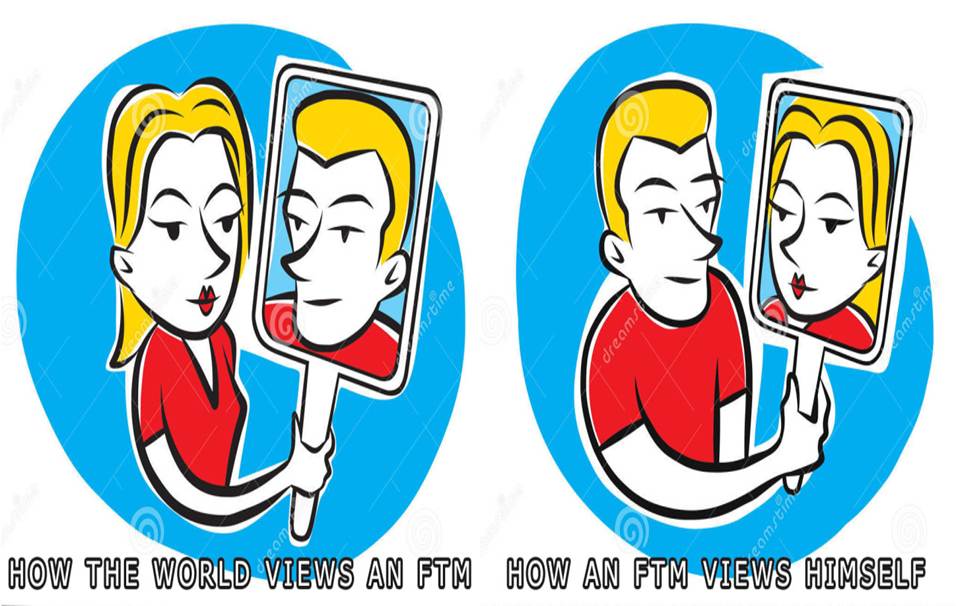
Gender dysphoria will not be experienced by everyone the same, but with all medical conditions, there are still certain things that will remain consistent, even if its expression can vary in intensity. Because of this, I will offer three levels of intensity for each dysphoria symptom to try and cover all degrees of intensity. And remember, these are just examples and should not be considered a play-by-play book for situations that you need to exactly adhere with.
Subconsciously feeling your body is “off.”
- Low Intensity: You know, logically, this body is yours, but it doesn’t really feel yours. You’re not sure how other people are so confident in Knowing their body is theirs. You just don’t feel this innately.
- Medium Intensity: You don’t recognize yourself in the mirror. You logically know this person is you, but it doesn’t *feel* like you. Unless you have an active reminder of your body, such as pain or a reflection, you forget you’re in it. You forget certain parts of your body exist. Maybe you have attributed it to sex by now, maybe you haven’t.
- High Intensity: You look in the mirror, and it makes you angry. You know something is wrong, and when you finally realize what it is (your breasts, for example) you develop an intense hatred of them, a fear of them. You hate everyone can see them, see that they exist on you. They feel foreign, like an alien. They don’t register as yours. Worse yet, you know people are assuming things about your body from the fact they exist at all.
Feelings of distress at noticeable contrasts
- Low Intensity: You notice the arm of someone of the opposite sex, and how different its features are from yours. It makes you uncomfortable, but you can’t really pin why. Or maybe you can. You try to ignore it.
- Medium Intensity: You’re talking to someone, and you’re really put off by the difference between your voice and theirs. You find yourself wanting to sound like them. You may begin to avoid situations online where you need to use your voice, because you don’t feel like you sound correct.
- High Intensity: You’ve become so sensitive to the contrasting differences between you and the opposite sex that you begin to entirely avoid the opposite sex all together. Surrounding yourself with the same sex feels counter intuitive, but it allows you to ignore the things off with your body much more successfully.
Noticing different expectations of gender roles, and having them amplified by already feeling your disconnected from your birth sex.
- Low Intensity: When in school, your class is split up into male and female groups for the gym or for a class project. You feel alienated by this, even if you can’t pin why.
- Medium Intensity: The clothing your sex is expected to wear at your age leaves you feeling exposed – it accents the features you try best to ignore. And worse yet, it draws the attention of others to those features.
- High Intensity: The idea of anything adhered to your birth sex revolts you – you cannot stand being associated with it due to what it *says* about you… what others assume. Which sucks… because you like some of it. But it’s not worth the assumptions of others.
Feeling sexually awkward or inadequate due to subconscious expectations of your sexual workings
- Low Intensity: You like the opposite sex, maybe bisexual or straight. But when you watch porn or fantasize about it… you find yourself placing yourself in the point of view of the opposite sex… Or you only like same sex porn of the opposite sex, yet still find yourself placing yourself in one of their point of view despite not being that sex. it just feels more natural.
- Medium Intensity: You can’t masturbate the way your birth sex is “meant” to masturbate – something about it just doesn’t feel natural. You find another way to get off, maybe you mime the action of the opposite sex’s genitalia, or get off by thrusting/humping a pillow like the opposite sex would during sex.
- High Intensity: You know you’re not asexual, but you functionally might as well be. The fact your genitals don’t work remotely the way you feel they should work has defeated any libidio you would have otherwise had. Your sex life is awkward – you find yourself focusing on pleasuring your partner, and politely declining when they offer to get you off. Using toys has prosthetics doesn’t really help either, sometimes it’s nice but more often than not it just results in you noticing your lack of the proper genitalia even more starkly.
If you’re wondering if what you feel is clinical dysphoria and not just feeling hurt by the harmful tropes inflicted by gender roles, ask yourself this question:
You’re the last person on earth. There’s a button that, when pressed, will turn you into the opposite sex perfectly. You won’t get to choose how you end up looking, that’s decided by your genetics, and you won’t be skinnier or heavier either. There is no one around to judge you or treat you differently for either decision you make. There is no reverting the change.
Would you press it?
Why or why not?
This guide is very important. What is gender dysphoria? It’s a feeling of distress that affects transgender people into seeing or being an image that isn’t themselves. For instance, you can be a woman well into transition, but if the circle around you makes you feel like an impostor (not an Amogus reference), there is this amount of stress that invades you to where it may even resemble a panic attack.
In the mirror example, you can dress as a woman and feel so euphoric because, well, you are a woman. But if you suddenly see a few features that are part of the gender you don’t identify with (i.e. male), your mirror image starts to distort itself into a “man in drag” looking back at you and your stress levels get high. In other words, you feel your identity as a trans woman becomes invalidated.
It’s a very awful feeling and I really don’t wish it upon anyone. Read the guide carefully and you will find out whether you have gender dysphoria or not. Although you don’t need gender dysphoria to identify as transgender, non-binary, etc., it’s something many of us go through and sometimes, it helps us get hormone therapy much easier.
But ask yourself this; I’ll paraphrase the conclusion from the OP. Say the button on the guide is real. Only instant gender change exists. If you press it, you will instantly turn into a girl, down to the chromosomes and anatomy. Your appearance is based on genetics, age, and other factors. Nobody around you will judge how you look because everyone knew you as a girl at birth. Yes, you are a cisgender girl. You can even give birth. However, there is also the possibility of a drawback: everything you have done and experienced as a guy is forever gone. Your friends, career, achievements, role models, finances, reputation, loved ones if you’re married or together, everything. Even some memories are rewritten. You would be given the overall quality of life if you were born a girl and the results may vary. Don’t worry, you can change that later on in life. The biggest drawback, however, is that you can never return to your old life again. Forever. It is permanent.
Now that you thought about it wisely, and read both the pros and cons of each choice, you have two choices at this once-in-a-lifetime opportunity. You can either back down and lose this chance forever or finally become the person you are inside forever. Both choices are permanent.
So what will it be? Will you press it, or will you skip it?
Think before you act…
People who are politically trans (”tucutes”) believe gender dysphoria is entirely about gender roles, even to a point they are denouncing the medical research as unproductive and harmful. Which would make sense if Gender Dysphoria was a political issue – but it’s not, and shouldn’t be, because Gender Dysphoria has had decades of research and support from the psychiatric community. If you’re wondering if what you feel is clinical dysphoria and not just feeling hurt by the harmful tropes inflicted by gender role.
But I now take some comfort in understanding what may well be the root cause. I wish that some people would have been a lot more honest with me when I was much younger, as it would have helped me come to terms with this, and I could have made different choices.
I find humour gets me through.
Funny girl.
Sources:
Rebecca R Helm; University of North Carolina – Professor of Biology
Steven Novella: Yale University of Medicine.
Scott Kerlin DES. Gradmentor.
Diethylstilbesterol DES.
Science direct.
Chapter 8
The Transgender Brain
Or “It’s all in your head – no, really!”
It’s clear that a significant segment of human society has difficulty accepting that transsexuality is a real medical condition which is part of our inherited genetics. The common tactic of the blatant transphobe is to dismiss us as freaks, psychopaths, or even monsters deserving of involuntary institutionalism. The casual transphobe, or crafty one, will instead often use phrasing, like this copied from an online debate I participated in.
“Hey, I don’t care if someone thinks they’re Napoleon. What. Ever. But don’t expect me to salute them or call them Emperer[sic]. That would make me as crazy as they are. This is just common sense, people.”
Sadly, as seen in any political debate, “common sense” is a meaningless phrase loaded with contrived meaning, almost always uncommon and insensible. “We want common sense measures to keep dangerous weapons off our streets!” versus “Giving people the ability to defend themselves against criminals is just common sense!” With so much “common sense” out there, it’s amazing that anything ever goes wrong!
So let’s try to dispense with “common sense,” and my editorializing upon such, and look at the facts. I’m going to address the following points in order:
- How the genitals and brain develop their respective gendering, and significant cases of brain and genital misalignment resulting from endogenous or exogenous chemicals.
- Clues given to us from hereditary studies.
- Karyotype aberrations from the normal XX and XY chromosomes.
- Several significant differences from the average population which have been found in the brains of transsexuals.
- Contrary research which indicates there may be either a limited or no difference between the brains of transsexuals and the general population.
Note: “Transsexual” is used somewhat synonymously with “transgender” in this article. The word “transsexual” will be the default term, as it typically is used in scientific literature, unless there is a specific need for the broader umbrella term “transgender.” Also note, “transwomen” refers to male-to-female transsexuals, and “transmen” refers to female-to-male transsexuals.
Brain Development
Gender identity was once thought of as being entirely a social construct, with most of our gender formation occurring between the ages of 1-4. (Bao, Gooren 2006) In the 21st century, the general thought is that gender identity is programmed at birth, although social factors can potentially overwhelm this programming. One tragic example is the “John-Joan-John” case, where a boy who lost his penis at 8 months was surgically turned into a girl, including the administration of estrogens and receiving psychological counseling. Although raised a girl all her life, she had the unshakeable feeling that she was in fact a boy. She transitioned back to male at age 14, and attempted to live as a male, but eventually, due to financial instability and a failing marriage, committed suicide. (Bao)
It’s common to hear the phrase “all babies start out female, and it’s only later that they become male,” and this is at least partially true. In fact, the influence of testosterone on a foetus has been described as a defeminization process, changing a foetus which was essentially predestined to be female into male. (Gooren, 2006) Testosterone production and the conversion of some testosterone to dihydrotestosterone between weeks 6 and 12 of pregnancy is critical for the initial development of male features, such as the penis, prostate gland, and scrotum. (Bao) In the absence of these male hormones, female genitalia develop instead. Brain development, however, does not occur in earnest until the second half of the pregnancy term, after the genitals have been developed, and the continued presence of male hormones results in a brain which has subtle, but critical physical differences from the female brain. (Bao)
The fact that the brain and the genitals develop at different times in the womb mean that a misalignment between the genitals and brain may develop, leading to either an intersex condition, or a transgender individual.
Example 1: Women with complete androgen insensitivity syndrome (CAIS) develop bodies which are almost entirely female, and they tend to be sexually oriented towards men – despite having an XY karyotype. (Bao, Gooren 2006) Often, there is no indication the child is anything but female until surgery or an x-ray reveals the presence of undescended testes. (Gooren, 2006)
Example 2: Either a 5α-reductase-2 or a 17β-hydroxy-steroid dehydrogenase-3 deficiency will prevent the formation of testosterone into dihydrotestosterone, which will result in an XY karyotype baby girl with a large clitoris. However, when puberty arrives the girl will discover to her alarm that her clitoris grows significantly, her testes descend, and she will begin to take on masculine features. (Bao, Gooren 2006) Even though children with these birth defects are raised as girls, about 60% will become heterosexual males. (Bao) A Brazilian study found that of 25 5α-reductase-2 affected babies who were raised as girls, 13 changed their gender identity to male after puberty. (Gooren, 2006) Another study found that about 50% of 17β-hydroxy-steroid dehydrogenase-3 affected babies changed their gender identity back to male at puberty. (Gooren, 2006) What these results indicate to us is that testosterone likely more directly impacts the organization of the fetal brain than dihydrotestosterone. (Bao)
Example 3: Boys with an XY karyotype who are born with a cloacal exstrophy (where they are either partly or completely missing a penis) are typically changed surgically into “girls” just after birth, and are given female hormone therapy and counseling. However, about half of these new girls later determine that they are really boys, and change their social gender when they become teenagers or adults. (Bao, Gooren 2006)
Example 4: Girls with an XX karyotype born with congenital adrenal hyperplasia (CAH) (meaning they were exposed to high levels of testosterone in the womb) tend to develop male social tendencies and male personality features. (Hines, Zucker) They tend to be described by their parents as “tomboys”, with a high energy level. (Gooren, 2006) CAH girls are 100-300 times as likely to be transsexual, compared to the general female population, and 1 in 20 have serious gender identity problems. (Bao) One study found that 37% of CAH girls classified themselves as either lesbian or bisexual, a number far greater than the general population. (Gooren, 2006)
Example 5: Phenobarbital or diphantoin administered to pregnant women as anticonvulsants can increase the chance of giving birth to a transsexual child.(Bao, Dessens) The belief, not proven conclusively at this juncture, is that these chemicals disrupt the influence of testosterone on the brain in the womb. (Bao, Swaab) In other cases, it’s believed that prenatal exposure to estrogens, progestins, and antiandrogenic chemicals could suppress endogenous testosterone production by interfering with the hypothalamic-pituitary-testicular axis. However, studies have focused largely on sexual preference as a result of this exposure, rather than gender identity, and in general these drugs were primarily only given to pregnant women between 1940-1970. (Gooren, 2006) There is some evidence that exposure to DDT could be responsible for increased polycystic ovary syndrome (PCOS) in women, increased idiopathic oligospermia (IO) in men, and increased transsexualism. Notably, transmen are found to often have PCOS, while transwomen often have IO. (Balen, Dorner) One study found transmen were 32.5% more likely to have endocrine dysfunction than XX karyotype women. (Futterweit)
Example 6: Kallmann’s Syndrome, a condition which occurs due to deficiency of gonadotropin-releasing hormone. The result can be an adult who has a loss of secondary sex characteristics. It is found much more frequently in genetic males than in genetic females, and male sufferers typically have what the medical literature describes as “eunuchoid growth,” with delayed or absent puberty, undeveloped infantile genitals, sparse body hair growth, a high-pitched voice, and other feminine features. Some of those with Kallmann’s Syndrome will become transsexual, although this is rare. (Meyenburg, 2001)
Even in these factual cases, questions remain about the connection between genetic and physical factors and gender identity. For example, why wouldn’t a preponderance of those with cloacal exstrophy feel they were boys? This likely attests either to the complexity of the physical processes involved, randomness in our development process, or the intense pressures social upbringing can exert upon both our gender and sexual attraction.
Other recent studies cast some question on what is more important in creating a feminized brain – the presence of two X chromosomes, or the presence of a Y chromosome and a sufficient level of testosterone. It’s a subtle argument, which essentially is trying to determine if hormones are the only differentiator between male and female brains, or whether there are other factors. One study which compared XX, XXY, and XY individuals came to the conclusion that having two X chromosomes is responsible for differences in the formation of the amount of gray matter in the cerebrum and precentral areas of the brain. However, the presence of testosterone appeared to be responsible for differences in the amygdala, parahippocampus, and occipital cortex. Thus, any condition which would reduce or interfere with the testosterone that the foetus was exposed to could result in an intersex or transgender brain. However, it is also possible that XXY individuals may have other compounding factors which can skew the data. (Lentini)
Heredity Studies
Transwomen who are sexually attracted to men have been found to be more likely to be the younger or youngest children in families with more brothers than sisters. (Bao) A study of 417 transwomen and 96 transmen found that transwomen had significantly more maternal aunts than uncles, while transmen showed no clear trends. Interestingly, this trend was strongest in lesbian transwomen, while an even stronger trend was seen for asexual transsexuals of both birth sexes, where they had more maternal uncles than aunts. (Green & Keverne) There is some speculation that this could be a result of a defect in the X chromosome from the mother, similar to fragile-X syndrome. Twin studies have shown a hereditary component for gender identity disorder (GID). (Swaab) One study of gender identity disorder in 314 twins found a heritable trait – and thus, implying strong genetic trait – as being 62% likely. (Coolidge) In some rare cases, two or more transsexuals have been born into a single family generation, (Green, Sabalis, Sadeghi) and in some cases transsexualism has been inherited from a transsexual parent. (Green)
Karyotype Aberrations
None of the cases above address profound karyotype aberrations, such as Klinefelter’s syndrome (47,XXY karyotype males, or 47,XXY/46,XY mosaics, or even the exceedingly rare 47,XXY/46,XX mosaicism), which can occur in 1 out of 1,000 male births. (Khandelwal) Other karyotype aberrations of note include 47,XYY males and 47,XXX females. In all of these cases the individual can develop gender identity disorder and become a transsexual (Khandelwal); indeed, this author personally knows individuals in this category who have become transsexuals.
Evidence for Physical Differences in the Transgender Brain
Despite the many profound genetic aberrations which can occur to create a transgender individual, most of us do not fall under any of the examples listed above. Here we must look to much more subtle evidence, and the majority of studies searching for a physical cause for transgender individuals have found physiological and genetic differences which can be tested and measured. And most of these differences are found in our brains.
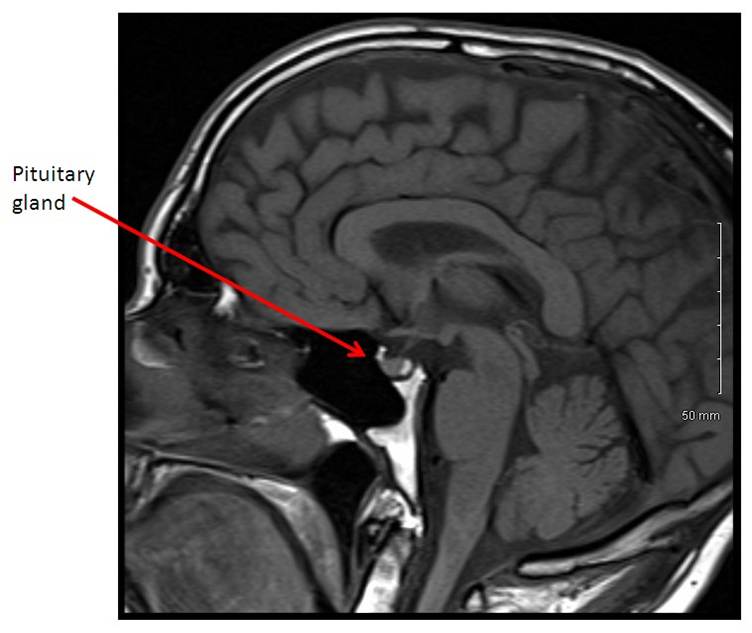
This is a single MRI slice through the centre of a brain which was done when the doctors were trying to diagnose an intersex hormone condition. It was suspected that the subject had a pituitary adenoma or tumour, but it turns out this brain is in absolutely perfect shape, excepting a pineal gland cyst of no real significance at this juncture.
For the record, it’s a very sobering thing to look at your own brain, especially when you flip through all the image “slices” on the DVD they give you. You get the impression that your brain went through a virtual deli counter meat slicer.
Before we look at the results of brain studies, there are some points of scientific fairness which need to be addressed. The first one is that all of the physical manifestations which are listed below are subtle effects. You will not see these on an X-ray, nor even an MRI without specifically looking for them. If the differences in the brains of transsexuals were significant and profound, we wouldn’t be faced with having to continually justify our existence and alleged “motivations” in the first place. The second thing to note is that the uncertainty values of many of these studies are quite high, because there is significant variation in the brains of individuals from person to person. Finally, we need to recognize that because we are “rare and beautiful creatures,” and so many of us are closeted and unwilling to participate in studies, many of these studies have only examined a very small sample sizes of transsexuals.
Keeping all of that in mind, let us look at the evidence.
- XY karyotype men have about twice the volume and twice the number of neurons as XX karyotype women in two regions of the brain, called the BSTc and INAH3 regions. (Bao, Kruijver) An early study of cadaver brains found that transwomen have roughly the same numbers of neurons in these areas as XX women (Zhou), and this has been backed up by further non-invasive imaging studies. (Bao, Kruijver) A single transman who was tested was found to have an XY male number of neurons.(Bao, Kruijver) However, it should be noted that in the imaging study, the differences from person to person were somewhat wide-ranging, and the sample sizes were very small.

- MRI data from 24 transwomen who had not started hormone treatment revealed that while their overall grey matter appeared similar to that of XY karyotype males, they possessed a significantly larger amount of grey matter in the right putamen. In fact, the grey matter structure of the transwomen was much closer to those seen in XX karyotype female subjects. In short, while the brains of the transwomen resembled XY male brains in terms of grey matter, in one specific region their brains appeared to be “feminized.” (Luders)
- A study of the white matter in the brains of 18 transmen, 24 XY karyotype males, and 19 XX karyotype females using diffusion tensor imaging (DTI) showed that the white matter structure of transmen was much closer to that of XY males than XX females. In fact, the white matter of their brain differed from the XY males only in a single region of the brain, whereas they differed from the XX women in three regions of the brain. None of the transmen had received hormone treatment at the time of the study. (Rametti, 2011) A follow-up study by the same researchers found that after the transmen had received hormone treatment, significant changes occurred in their brains, making them appear even more masculinized in certain regions which are associated with XY males. (Rametti, 2012)
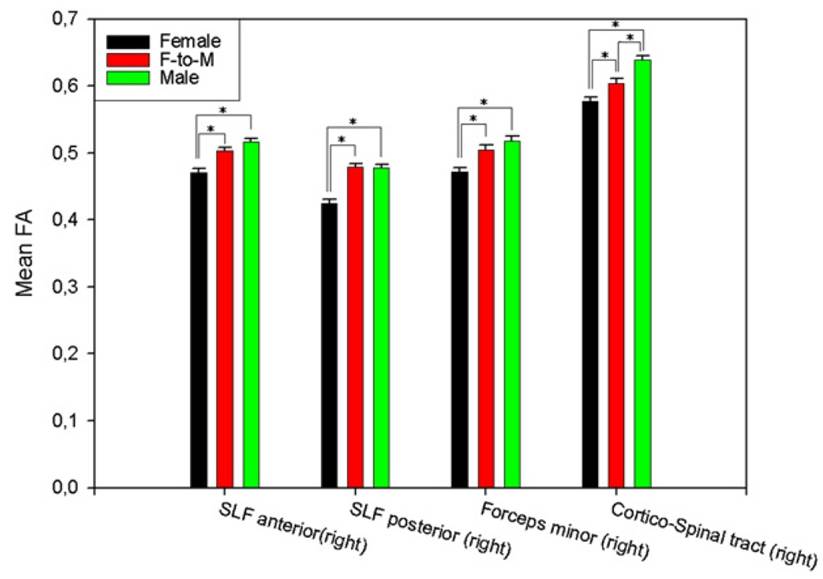
From Rametti (2011) – note where F-toM subjects lie, right between female and male subjects, and identical to males in one region.
- A positron emission tomography (PET) study showed that smelling androgens (male pheromones) caused transwomen to respond in the hypothalamus region of their brain in a manner similar to XX karyotype women. However, smelling estrogen-based pheromones also caused them to respond in the hypothalamus region in a manner similar to XY karyotype men. This combination of results suggests that transwomen occupy an “intermediate position with predominantly female features” in the way the hypothalamus reacted. (Berglund)
- An MRI study of 22 transwomen and 28 transmen examined the shape of the corpus callosum in the brain at a specific cross-sectional plane, and compared this shape with that observed in 211 XY karyotype males and 211 XX karyotype females. Their results demonstrated that not only could the sex of the patient be determined with 74% accuracy from the MRI picture, but the shapes of the brains in the transsexuals strongly reflected their gender, and not their biological sex. (Yokota)
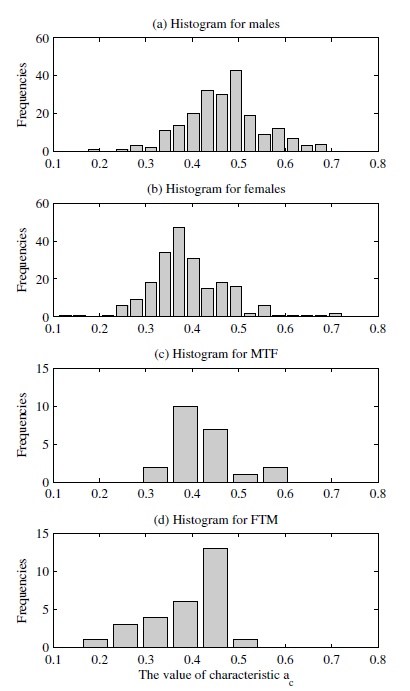
From Yokota – note the shape and skewing of the histograms – MTF subjects are closer to females than males, and FTM subjects are closer to males than females.
- A recent study examined cortical thickness in the brain between 29 XY karyotype males, 23 XX karyotype females, 24 transmen, and 18 transwomen. None of the transsexual subjects had received any hormone treatment prior to the study. Using an MRI, the researchers found that the transwomen had more cortical thickness than the XY males in three regions of the brain. The transmen showed evidence of masculinization of their grey matter. In all transsexuals studied, the key differences from their biological sex were found in the right hemisphere. (Zubiaurre)

- Testing of a chemical produced in our bodies called “brain-derived neurotropic factor” (BDNF) in 45 transwomen found that when they were compared with 66 XY karyotype male control subjects, the transwomen had significantly lower levels of BDNF. However, this could be a result of higher stress levels and higher emotional trauma levels in the transsexual sampling. It should also be noted that no women control subjects were compared in this study. (Fontanari)
- Genetic testing of 112 transwomen and 258 XY karyotype male control subjects found that the transwomen had significant differences in androgen receptor genes. The result of this difference could lead to less effective testosterone signaling, meaning that there would be significantly less “masculinization” of the brain in the womb. This would result in a brain which was much more feminized, leading to a female gender identity. (Hare)
- An admittedly small study of 9 post-operative transwomen showed their brain activation was similar to women when viewing pictures showing erotic male images. (Oh) However, this study doesn’t so much address the root cause of the transsexuality as it shows that their sexual attraction towards men led to the same brain reaction as seen in heterosexual women.
Evidence Which May Indicate or Imply Physical Differences in the Transgender Brain
A 2013 study from Taiwan compared transsexuals with control subjects using two different assessments. In the first comparison, 41 transwomen were compared against 38 control subjects in a behavioral study to see how they would respond to pornographic short films. The results showed that transwomen overwhelmingly saw themselves in the role of their mental gender while watching the films. The second study was objective rather than subjective, and used functional MRI to compare the brains of 23 transwomen who had not been treated with hormones with 23 age-matched control subjects. The result was a significant difference in brain activity, primarily in the dorsal and pregenual ACC regions of the brain, between the transwomen and the controls. These regions of the brain are typically associated with processing feelings of social exclusion and emotional conflicts, so this may not indicate a difference in the brain due to gender identity differences, but rather a difference due to the negative social results of gender identity differences. (Ku, 2013)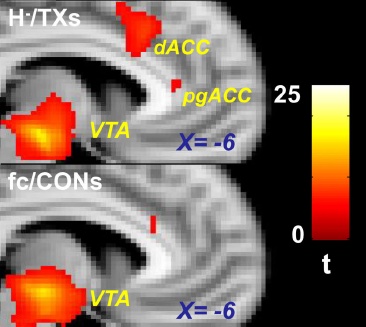
Evidence Against Physical Differences in the Transgender Brain
In opposition to these studies, however, there are some studies which have found no significant differences between the brains of transsexuals and the population at large.
- Early studies directly examining the corpus callosum in the brains of 20 transsexuals found no significant differences on a gross level between their brains and those of 40 control subjects. (Emory) However, The MRI technology which was employed was relatively new at the time of the study (1991).
- A study of four sex-sensitive mental processes (rotation of an object, visualization of objects, perception, and verbal skills) found no significant differences between transwomen and XY karyotype males. However, analysis of the results actually showed biological sex only influenced rotation and visualization, and previous results showing XY versus XX differences in perception and verbalization were not shown. This could point to a flaw in the study, as other studies have shown significant differences. (Haraldsen)
- Many studies have pointed to the difference between the length of the index finger and the ring finger being an indicator of androgen exposure before birth. In a “normal” XY karyotype male, the index finger is significantly shorter than the ring finger, which has led some to question whether transwomen with that same finger pattern have any significant physiological differences from XY males. However, as noted above gendering of the brain is not due to just simple androgen exposure, and studies have found the finger-length test to be poor, with a 60% overlap between XY men and XX women. (Gooren, 2006)
- A study of 30 transwomen and 31 transmen found only two transwomen possessed a detectable DNA defect. (Hengstschläger) This study has been criticized for being too small and for not looking deep enough into the genome to find potentially subtle differences in genetics. However, a sample size of 61 transsexuals is at least average, if not larger than average, and the study otherwise seems sound.
- Recently, there has been some focus on differentiating transsexual women who are attracted to men, versus those attracted to women. A criticism is that many of these brain studies do not account for these differences (e.g., Luders) and should do such, and some researchers claim that their studies of the brains of lesbian transwomen show no significant differences from male brains. (Savic) This has led to debate within the research community as to whether or not differentiation is even needed, with no clear resolution forthcoming. (e.g. Cantor, Italiano)
- Some researchers feel that the evidence is intriguing, but too subtle and difficult to study or replicate, and therefore not conclusive enough to say that transsexuality is a brain structure-focused intersex condition. (Meyer-Bahlburg)
Human beings are biological organisms before they are cultural ones. Culture matters, but it does not appear out of nowhere. It develops from brains shaped by biology, hormones, and fetal development long before a child can speak or understand social rules. Many people argue that gender is a social construct and that transgender people are simply making choices about how they want to behave socially, but this view overlooks the fact that our brains are biologically programmed to respond to social situations in sexed and gendered ways.
Transgender people generally know themselves to be a gender that differs from their assigned sex because their brains developed differently in the womb. This is not abstract or ideological. It is biological. Research shows that prenatal exposure to sex hormones influences not only physical development but also brain organization related to gender identity and gendered behavior. Studies on human neurodevelopment demonstrate that variations in prenatal androgen and estrogen exposure are associated with later differences in gender identity and related traits
[https://pubmed.ncbi.nlm.nih.gov/21438685/
].
The body and the brain do not develop at the same time during pregnancy. The genitals differentiate earlier. The brain differentiates later, under the influence of hormones such as testosterone and estrogen. When these hormonal signals differ from what the chromosomes would normally produce, the result can be a body that develops along one sex pathway and a brain that develops along another.
In this sense, transgender people can be understood as having an intersex condition of the brain. Unlike people born with mixed or atypical sex organs, transgender people usually have one typical set of sex organs. The difference lies in the brain. The brain is the organ responsible for identity, perception, and social behavior. In transgender people, that organ developed in alignment with a different sex than the rest of the body.
Evidence from studies on the effects of the medication diethylstilbestrol, or DES, provides further support for this model. DES is a synthetic estrogen that was prescribed to pregnant women for decades. Research has shown that XY individuals who were exposed to DES in utero have a significantly higher prevalence of transgender identity compared with unexposed males. This finding strongly suggests that exposure to estrogen during critical periods of fetal brain development can influence later gender identity
[https://pubmed.ncbi.nlm.nih.gov/38249107/
].
If exposure to synthetic oestrogen can have this effect, it follows that variations in natural prenatal oestrogen exposure could also shape gender identity development.
Some people argue that gender is purely learned behaviour. This assumes that social behaviour can be separated from biology. Nature does not work this way. Across the animal kingdom, social behaviours are deeply tied to physical sex and hormonal programming.
Male peacocks fan out their tail feathers to attract mates. They are not taught to do this. Female peacocks do not perform this behaviour. In many bird species, only males sing mating songs. The brain regions that control these songs differ by sex and develop under hormonal influence.
Male peacock spiders perform elaborate dances to court females. Female spiders do not. Male deer engage in ritualized combat during mating season. Female deer do not fight in this way. In lions, males show different patterns of aggression and territorial behaviour than females. These differences appear even when animals are raised in similar environments. Praying mantises offer another example. In some species, females may eat the heads of their mates during or after reproduction. This behaviour is tied to reproductive biology and energy demands. It is not learned or culturally transmitted.
One of the clearest examples of biology shaping social roles comes from clownfish. All clownfish are born male. In a social group, the largest fish becomes female. If the dominant female dies, the largest male undergoes hormonal changes that transform its body and behaviour. The fish becomes female. The trigger is social, but the mechanism is biological.
Zoological research shows that animals can display behaviours typically associated with the opposite sex, and these behaviours are often strongly influenced by hormones. In mammals, exposure to testosterone or other androgens during critical prenatal or early developmental periods can organize the brain in ways that increase male‑typical behaviours in genetic females and alter behavioural patterns later in life [https://pubmed.ncbi.nlm.nih.gov/15862182/
] and early androgen exposure can masculinize sexual behaviour in rodents [https://www.sciencedirect.com/…/abs/pii/0031938479901161
]. In teleost fishes such as zebrafish (Danio rerio), treatment with sex steroids like 11‑ketotestosterone or oestradiol can shift mating behaviours and reproductive activity, showing that adults can express behaviours more typical of the opposite sex depending on hormonal context [https://www.ncbi.nlm.nih.gov/pmc/articles/PMC4575480/
]. In the peacock blenny (Salaria pavo), smaller “sneaker” males naturally mimic female morphology and courtship behavior to gain reproductive access, and administration of 11‑ketotestosterone suppresses female‑like displays while promoting male traits [https://pubmed.ncbi.nlm.nih.gov/11799276/
]. These examples illustrate that sex‑typical behaviors are not fixed, but are shaped by hormonal influences across species and throughout development.
These are but a few examples of the countless gendered behaviors that are tied to brain biology in species all across the Animal Kingdom. They demonstrate that social roles and biology are not opposites. Social circumstances can activate biological pathways. Biology then shapes behaviour and identity.
Humans follow the same pattern. Babies are born with instinctive knowledge. A newborn does not need to be taught how to suckle when a nipple touches their mouth. This reflex is automatic. Infants also display a swimming or paddling reflex when placed in water. No one teaches them this behaviour. It is built into the nervous system.
Likewise, certain aspects of gender are programmed in the brain. People recognize their gender because of how their brains respond to social cues and roles. Prenatal hormone exposure plays a key role in shaping these responses.
Additional research supports this biological foundation. Studies show that prenatal hormone exposure influences human neurobehavioral development, including sex-typed behavior and gender-related traits
[https://pubmed.ncbi.nlm.nih.gov/34872968/
]. Genetic studies also show that variations in sex hormone signaling pathways are overrepresented in transgender individuals, further linking biology and gender identity
[https://academic.oup.com/jcem/article/104/2/390/5104458
].
Taken together, this evidence leads to a clear conclusion. Gender identity is not a preference or a decision about social behaviour. It emerges from brain development shaped by biology. Culture influences how gender is expressed, but biology shapes the underlying sense of self.
Transgender people are not rejecting nature. They are one of the many ways nature expresses human diversity. Those who claim God doesn’t make mistakes are assuming this is not part of God’s design, but making such a claim is like calling a solar eclipse an abomination. It’s rare. It’s not described in the book of Genesis where we are told God created male and female, and day and night. An eclipse  turns day into night, and could be called unnatural, just as transgender people turn, male into female or female into male, and are called unnatural. But transgender people, like solar eclipse, are beautiful. Thanks to science, we can understand these aspects of creation. To reject them is a rejection of science.
Summary
Taking the entire breadth of the findings uncovered by my research, it appears that there is more than sufficient evidence that transgender persons either have a serious hormonal-based birth defect, have been exposed to exogenous chemicals which have impacted their gender development in the womb, have a genetic karyotype which differs from the general population, or via some other process have a brain structure which is different than would be indicated by their chromosomes. While no single study presents proof beyond any shadow of a doubt or with metaphysical certainty, taken together they do present a preponderance of evidence such that one can say with confidence that transgender individuals have a congenital gene-based difference from cissexual individuals.
Endocrine-disrupting chemicals (EDCs) are defined by the US Environmental Protection Agency as a group of substances that “interfere with biosynthesis, secretion, transport, elimination and function of naturally existing hormones in the human body”. Exposure to endocrine disruptors during crucial developmental time windows increases an individual’s risk of developing a variety of diseases, including inborn errors, infertility, obesity and cancer
Una is a professional science researcher and part-time university professor. The reader is encouraged to perform their own follow-up and fact-checking with the references listed below. Unintentional bias may exist in this article, as the author is herself an intersex transsexual woman. No personal, commercial, or academic conflict of interest exists between the author and any authors or institutions cited as references.
References
Balen, Adam H., et al. “Polycystic ovaries are a common finding in untreated female to male transsexuals.” Clinical Endocrinology 38.3 (1993): 325-329.
Bao, Ai-Min and Swaab, Dick F. “Sexual differentiation of the human brain: Relation to gender identity, sexual orientation and neuropsychiatric disorders” Frontiers in Neuroendocrinology 32 (2011): 214–226.
Berglund, H. et al. “Male-to-Female Transsexuals Show Sex-Atypical Hypothalamus Activation When Smelling Odorous Steroids” Cerebral Cortex 18 (August, 2008): 1900—1908.
Cantor, James M. “New MRI Studies Support the Blanchard Typology of Male-to-Female Transsexualism” Arch Sex Behav 40 (2011): 863–864.
Coolidge, Frederick L., Linda L. Thede, and Susan E. Young. “The heritability of gender identity disorder in a child and adolescent twin sample.” Behavior Genetics 32.4 (2002): 251-257.
Dessens, Arianne B., et al. “Prenatal exposure to anticonvulsants and psychosexual development.” Archives of Sexual Behavior 28.1 (1999): 31-44.
Dorner, Gunter, et al. “Genetic and Epigenetic Effects on Sexual Brain Organization Mediated by Sex Hormones.” Neuroendocrinology Letters 22.6 (2001): 403-409.
Emory, Lee E., et al. “Anatomic variation of the corpus callosum in persons with gender dysphoria.” Archives of Sexual Behavior 20.4 (1991): 409-417.
Fontanari, Anna-Martha V. et al. “Serum concentrations of brain-derived neurotrophic factor in patients with gender identity disorder” Journal of Psychiatric Research (2013): 1-3 (advance copy).
Futterweit, Walter, Richard A. Weiss, and Richard M. Fagerstrom. “Endocrine evaluation of forty female-to-male transsexuals: Increased frequency of polycystic ovarian disease in female transsexualism.” Archives of Sexual Behavior 15.1 (1986): 69-78.
Gooren, Louis “The biology of human psychosexual differentiation” Hormones and Behavior 50 (2006): 589–601.
Green, Richard, and Eric B. Keverne. “The disparate maternal aunt–uncle ratio in male transsexuals: an explanation invoking genomic imprinting.” Journal of Theoretical Biology 202.1 (2000): 55-63.
Green, Richard. “Family cooccurrence of “gender dysphoria”: Ten sibling or parent–child pairs.” Archives of Sexual Behavior 29.5 (2000): 499-507.
Haraldsen, I. R. et al. “Sex-sensitive cognitive performance in untreated patients with early onset gender identity disorder” Psychoneuroendocrinology 28 (2003): 906–915.
Hare, Lauren et al. “Androgen Receptor Repeat Length Polymorphism Associated with Male-to-Female Transsexualism” Biol Psychiatry 65.1 (January 1, 2009): 93–96.
Hengstschläger, Markus, et al. “Sex chromosome aberrations and transsexualism.” Fertility and sterility 79.3 (2003): 639-640.
Hines, Melissa, Charles Brook, and Gerard S. Conway. “Androgen and psychosexual development: Core gender identity, sexual orientation, and recalled childhood gender role behavior in women and men with congenital adrenal hyperplasia (CAH).” Journal of Sex Research 41.1 (2004): 75-81.
Italiano, M. “Comment on Cantor” Arch Sex Behav 41 (2012):1079.
Khandelwal, Ashish et al. “A 47,XXY Female with Gender Identity Disorder” Arch Sex Behav 39 (2010):1021–1023.
Kruijver, Frank P. M. et al. “Male-to-Female Transsexuals Have Female Neuron Numbers in a Limbic Nucleus” The Journal of Clinical Endocrinology & Metabolism 85.5 (2000): 2034-2041.
Ku, Hsiao-Lun et al. “Brain Signature Characterizing the Body-Brain-Mind Axis of Transsexuals” PLOS ONE 8.7 (July, 2013).
Lentini, E. et al. “Sex Differences in the Human Brain and the Impact of Sex Chromosomes and Sex Hormones” Cerebral Cortex 23 (October, 2013): 2322-2336.
Luders, Eileen et al. “Regional gray matter variation in male-to-female transsexualism” Neuroimage 46.4 (July 15, 2009): 904–907.
Meyenburg, Bernd, and Volkmar Sigusch. “Kallmann’s Syndrome and Transsexualism.” Archives of Sexual Behavior 30.1 (2001): 75-81.
Meyer-Bahlburg, Heino FL. “Transsexualism (“Gender Identity Disorder”)–A CNS-Limited Form of Intersexuality?.” Hormonal and Genetic Basis of Sexual Differentiation Disorders and Hot Topics in Endocrinology: Proceedings of the 2nd World Conference. Springer New York, 2011.
Oh, Seok-Kyun et al. “Brain Activation in Response to Visually Evoked Sexual Arousal in Male-to-Female Transsexuals: 3.0 Tesla Functional Magnetic Resonance Imaging” Korean J Radiol 2012;13(3):257-264
Rametti, Giuseppina et al. “White matter microstructure in female to male transsexuals before cross-sex hormonal treatment. A diffusion tensor imaging study” Journal of Psychiatric Research 45 (2011): 199-204.
Rametti, Giuseppina et al. “Effects of androgenization on the white matter microstructure of female-to-male transsexuals. A diffusion tensor imaging study” Psychoneuroendocrinology 37 (2012): 1261—1269.
Sabalis, Robert F. et al. “The Three Sisters: Transsexual Male Siblings” Am J Psychiatry 131 (August 8, 1974): 907-909.
Sadeghi, Majid, and Ali Fakhrai. “Transsexualism in female monozygotic twins: A case report.” Australasian Psychiatry 34.5 (2000): 862-864.
Savic, Ivanka and Arver, Stefan. “Sex Dimorphism of the Brain in Male-to-Female Transsexuals” Cerebral Cortex 21 (November, 2011): 2525—2533.
Swaab, D.F. “Sexual differentiation of the human brain: relevance for gender identity, transsexualism and sexual orientation” Gynecol Endocrinol 19 (2004): 301–312.
Yokota, Y. et al. “Callosal Shapes at the Midsagittal Plane: MRI Differences of Normal Males, Normal Females, and GID” Proceedings of the 2005 IEEE Engineering in Medicine and Biology 27th Annual Conference Shanghai, China, September 1-4, 2005.
Zhou, Jiang-Ning, et al. “A Sex Difference in the Human Brain and its Relation to Transsexuality.” Nature 378.6552 (1995): 68-70.
Zubiaurre-Elorza, Leire et al. “Cortical Thickness in Untreated Transsexuals” Cerebral Cortex Advance Access, published August 31, 2012.
Zucker, Kenneth J., et al. “Psychosexual development of women with congenital adrenal hyperplasia.” Hormones and Behavior 30.4 (1996): 300-318.
NIH Public Access Author Manuscript – Reprod Toxicol. Author manuscript; available in PMC 2007 July 20.
Published in final edited form as: NIH-PA Author Manuscript NIH-PA Author Manuscript NIH-PA Author Manuscript – txflTextFlow3cdirFont0Reprod Toxicol. 2007 ; 23(3): 374–382.
Developmental Oestrogen Exposures Predispose to Prostate Carcinogenesis with Aging
Gail S. Prins1, Lynn Birch1, Wan-Yee Tang2, and Shuk-Mei Ho2
Chapter 9: What are the biochemical pathways that result in the Transgender Brain?
Una is a professional science researcher and part-time university professor. The reader is encouraged to perform their own follow-up and fact-checking with the references listed below. Unintentional bias may exist in this article, as the author is herself an intersex transsexual woman. No personal, commercial, or academic conflict of interest exists between the author and any authors or institutions cited as references
It’s clear that a significant segment of human society has difficulty accepting that transsexuality is a real medical condition which is part of our inherited genetics. The common tactic of the blatant transphobe is to dismiss transgender people as freaks, psychopaths, or even monsters deserving of involuntary institutionalism. A transphobe, a person who does not accept anyone can be transgender, and state that being transgender is just not “common sense”.
“Common sense” is a meaningless phrase loaded with contrived meaning, almost always uncommon and insensible, the manifestation of the dogma of the day, and a lifetime’s accumulation of prejudice. If a more scientific approach is adopted towards understanding why people are transgender, the accumulated knowledge and experience need to be considered.
So why not dispense with “common sense”, and look at the facts, addressing the following points in order:
- How the genitals and brain develop their respective gendering, and significant cases of brain and genital misalignment resulting from endogenous or exogenous chemicals.
- Clues given to us from hereditary studies.
- Karyotype aberrations from the normal XX and XY chromosomes.
- Several significant differences from the average population which have been found in the brains of transsexuals.
- Contrary research which indicates there may be either a limited or no difference between the brains of transsexuals and the general population.
It should be considered that : “Transsexual” is used somewhat synonymously with “transgender”. The word “transsexual” will be the default term, as it typically is used in scientific literature, unless there is a specific need for the broader umbrella term “transgender.” Also note, “transwomen” refers to male-to-female transsexuals, and “transmen” refers to female-to-male transsexuals.
Brain Development
Gender identity was once thought of as being entirely a social construct, with most of our gender formation occurring between the ages of 1-4. (Bao, Gooren 2006) In the 21st century, the general thought is that gender identity is programmed at birth, although social factors can potentially overwhelm this programming. One tragic example is the “John-Joan-John” case, where a boy who lost his penis at 8 months was surgically turned into a girl, including the administration of estrogens and receiving psychological counseling. Although raised a girl all her life, she had the unshakeable feeling that she was in fact a boy. She transitioned back to male at age 14, and attempted to live as a male, but eventually, due to financial instability and a failing marriage, committed suicide. (Bao)
It’s common to hear the phrase “all babies start out female, and it’s only later that they become male,” and this is at least partially true. In fact, the influence of testosterone on a foetus has been described as a defeminization process, changing a foetus which was essentially predestined to be female into male. (Gooren, 2006) Testosterone production and the conversion of some testosterone to dihydrotestosterone between weeks 6 and 12 of pregnancy is critical for the initial development of male features, such as the penis, prostate gland, and scrotum. (Bao) In the absence of these male hormones, female genitalia develop instead. Brain development, however, does not occur in earnest until the second half of the pregnancy term, after the genitals have been developed, and the continued presence of male hormones results in a brain which has subtle, but critical physical differences from the female brain. (Bao)
The fact that the brain and the genitals develop at different times in the womb mean that a misalignment between the genitals and brain may develop, leading to either an intersex condition, or a transgender individual.
Example 1:Women with complete androgen insensitivity syndrome (CAIS) develop bodies which are almost entirely female, and they tend to be sexually oriented towards men – despite having an XY karyotype. (Bao, Gooren 2006) Often, there is no indication the child is anything but female until surgery or an x-ray reveals the presence of undescended testes. (Gooren, 2006)
Example 2: Either a 5α-reductase-2 or a 17β-hydroxy-steroid dehydrogenase-3 deficiency will prevent the formation of testosterone into dihydrotestosterone, which will result in an XY karyotype baby girl with a large clitoris. However, when puberty arrives the girl will discover to her alarm that her clitoris grows significantly, her testes descend, and she will begin to take on masculine features. (Bao, Gooren 2006) Even though children with these birth defects are raised as girls, about 60% will become heterosexual males. (Bao) A Brazilian study found that of 25 5α-reductase-2 affected babies who were raised as girls, 13 changed their gender identity to male after puberty. (Gooren, 2006) Another study found that about 50% of 17β-hydroxy-steroid dehydrogenase-3 affected babies changed their gender identity back to male at puberty. (Gooren, 2006) What these results indicate to us is that testosterone likely more directly impacts the organization of the foetal brain than dihydrotestosterone. (Bao)
Example 3: Boys with an XY karyotype who are born with a cloacal exstrophy (where they are either partly or completely missing a penis) are typically changed surgically into “girls” just after birth, and are given female hormone therapy and counseling. However, about half of these new girls later determine that they are really boys, and change their social gender when they become teenagers or adults. (Bao, Gooren 2006)
Example 4: Girls with an XX karyotype born with congenital adrenal hyperplasia (CAH) (meaning they were exposed to high levels of testosterone in the womb) tend to develop male social tendencies and male personality features. (Hines, Zucker) They tend to be described by their parents as “tomboys”, with a high energy level. (Gooren, 2006) CAH girls are 100-300 times as likely to be transsexual, compared to the general female population, and 1 in 20 have serious gender identity problems. (Bao) One study found that 37% of CAH girls classified themselves as either lesbian or bisexual, a number far greater than the general population. (Gooren, 2006)
Example 5: Phenobarbital or diphantoin administered to pregnant women as anticonvulsants can increase the chance of giving birth to a transsexual child.(Bao, Dessens) The belief, not proven conclusively at this juncture, is that these chemicals disrupt the influence of testosterone on the brain in the womb. (Bao, Swaab) In other cases, it’s believed that prenatal exposure to oestrogens, progestins, and antiandrogenic chemicals could suppress endogenous testosterone production by interfering with the hypothalamic-pituitary-testicular axis. However, studies have focused largely on sexual preference as a result of this exposure, rather than gender identity, and in general these drugs were primarily only given to pregnant women between 1940-1970. (Gooren, 2006) There is some evidence that exposure to DDT could be responsible for increased polycystic ovary syndrome (PCOS) in women, increased idiopathic oligospermia (IO) in men, and increased transsexualism. Notably, transmen are found to often have PCOS, while transwomen often have IO. (Balen, Dorner) One study found transmen were 32.5% more likely to have endocrine dysfunction than XX karyotype women. (Futterweit)
Example 6: Kallmann’s Syndrome, a condition which occurs due to deficiency of gonadotropin-releasing hormone. The result can be an adult who has a loss of secondary sex characteristics. It is found much more frequently in genetic males than in genetic females, and male sufferers typically have what the medical literature describes as “eunuchoid growth,” with delayed or absent puberty, undeveloped infantile genitals, sparse body hair growth, a high-pitched voice, and other feminine features. Some of those with Kallmann’s Syndrome will become transsexual, although this is rare. (Meyenburg, 2001)
Even in these factual cases, questions remain about the connection between genetic and physical factors and gender identity. For example, why wouldn’t a preponderance of those with cloacal exstrophy feel they were boys? This likely attests either to the complexity of the physical processes involved, randomness in our development process, or the intense pressures social upbringing can exert upon both our gender and sexual attraction.
Other recent studies cast some question on what is more important in creating a feminized brain – the presence of two X chromosomes, or the presence of a Y chromosome and a sufficient level of testosterone. It’s a subtle argument, which essentially is trying to determine if hormones are the only differentiator between male and female brains, or whether there are other factors. One study which compared XX, XXY, and XY individuals came to the conclusion that having two X chromosomes is responsible for differences in the formation of the amount of grey matter in the cerebrum and precentral areas of the brain. However, the presence of testosterone appeared to be responsible for differences in the amygdala, parahippocampus, and occipital cortex. Thus, any condition which would reduce or interfere with the testosterone that the foetus was exposed to could result in an intersex or transgender brain. However, it is also possible that XXY individuals may have other compounding factors which can skew the data. (Lentini).
Heredity Studies
Transwomen who are sexually attracted to men have been found to be more likely to be the younger or youngest children in families with more brothers than sisters. (Bao) A study of 417 transwomen and 96 transmen found that transwomen had significantly more maternal aunts than uncles, while transmen showed no clear trends. Interestingly, this trend was strongest in lesbian transwomen, while an even stronger trend was seen for asexual transsexuals of both birth sexes, where they had more maternal uncles than aunts. (Green & Keverne) There is some speculation that this could be a result of a defect in the X chromosome from the mother, similar to fragile-X syndrome. Twin studies have shown a hereditary component for gender identity disorder (GID). (Swaab) One study of gender identity disorder in 314 twins found a heritable trait – and thus, implying strong genetic trait – as being 62% likely. (Coolidge) In some rare cases, two or more transsexuals have been born into a single family generation, (Green, Sabalis, Sadeghi) and in some cases transsexualism has been inherited from a transsexual parent. (Green)
Karyotype Aberrations
None of the cases above address profound karyotype aberrations, such as Klinefelter’s syndrome (47,XXY karyotype males, or 47,XXY/46,XY mosaics, or even the exceedingly rare 47,XXY/46,XX mosaicism), which can occur in 1 out of 1,000 male births. (Khandelwal) Other karyotype aberrations of note include 47,XYY males and 47,XXX females. In all of these cases the individual can develop gender identity disorder and become a transsexual (Khandelwal); indeed, this author personally knows individuals in this category who have become transsexuals.
Evidence for Physical Differences in the Transgender Brain
Despite the many profound genetic variations which can occur to create a transgender individual, most do not fall under any of the examples listed above. More subtle evidence must be examined, and the majority of studies searching for a physical cause for transgender individuals have found physiological and genetic differences which can be tested and measured. And most of these differences are found in our brains.
Before the results of brain studies are examined, there are some points of scientific fairness which need to be addressed. The first one is that all of the physical manifestations which are listed below are subtle effects. These will not be observed on an X-ray, nor even an MRI without specifically looking for them. If the differences in the brains of transsexuals were significant and profound, we wouldn’t be faced with having to continually justify our existence and alleged “motivations” in the first place. The second thing to note is that the uncertainty values of many of these studies are quite high, because there is significant variation in the brains of individuals from person to person. Finally, we need to recognize that because we are “rare and beautiful creatures,” and so many of us are closeted and unwilling to participate in studies, many of these studies have only examined a very small sample sizes of transsexuals.
Keeping all of that in mind, let us look at the evidence.
- XY karyotype men have about twice the volume and twice the number of neurons as XX karyotype women in two regions of the brain, called the BSTc and INAH3 regions. (Bao, Kruijver) An early study of cadaver brains found that transwomen have roughly the same numbers of neurons in these areas as XX women (Zhou), and this has been backed up by further non-invasive imaging studies. (Bao, Kruijver) A single transman who was tested was found to have an XY male number of neurons.(Bao, Kruijver) However, it should be noted that in the imaging study, the differences from person to person were somewhat wide-ranging, and the sample sizes were very small.
From Bao:
MRI data from 24 transwomen who had not started hormone treatment revealed that while their overall grey matter appeared similar to that of XY karyotype males, they possessed a significantly larger amount of grey matter in the right putamen. In fact, the grey matter structure of the transwomen was much closer to those seen in XX karyotype female subjects. In short, while the brains of the transwomen resembled XY male brains in terms of grey matter, in one specific region their brains appeared to be “feminized.” (Luders)
- A study of the white matter in the brains of 18 transmen, 24 XY karyotype males, and 19 XX karyotype females using diffusion tensor imaging (DTI) showed that the white matter structure of transmen was much closer to that of XY males than XX females. In fact, the white matter of their brain differed from the XY males only in a single region of the brain, whereas they differed from the XX women in three regions of the brain. None of the transmen had received hormone treatment at the time of the study. (Rametti, 2011) A follow-up study by the same researchers found that after the transmen had received hormone treatment, significant changes occurred in their brains, making them appear even more masculinized in certain regions which are associated with XY males. (Rametti, 2012)
From Rametti (2011):
A positron emission tomography (PET) study showed that smelling androgens (male pheromones) caused transwomen to respond in the hypothalamus region of their brain in a manner similar to XX karyotype women. However, smelling oestrogen-based pheromones also caused them to respond in the hypothalamus region in a manner similar to XY karyotype men. This combination of results suggests that transwomen occupy an “intermediate position with predominantly female features” in the way the hypothalamus reacted. (Berglund)
- An MRI study of 22 transwomen and 28 transmen examined the shape of the corpus callosum in the brain at a specific cross-sectional plane, and compared this shape with that observed in 211 XY karyotype males and 211 XX karyotype females. Their results demonstrated that not only could the sex of the patient be determined with 74% accuracy from the MRI picture, but the shapes of the brains in the transsexuals strongly reflected their gender, and not their biological sex. (Yokota)
From Yokota – MTF subjects are closer to females than males, and FTM subjects are closer to males than females.
- A recent study examined cortical thickness in the brain between 29 XY karyotype males, 23 XX karyotype females, 24 transmen, and 18 transwomen. None of the transsexual subjects had received any hormone treatment prior to the study. Using an MRI, the researchers found that the transwomen had more cortical thickness than the XY males in three regions of the brain. The transmen showed evidence of masculinization of their grey matter. In all transsexuals studied, the key differences from their biological sex were found in the right hemisphere. (Zubiaurre)
- Testing of a chemical produced in our bodies called “brain-derived neurotropic factor” (BDNF) in 45 transwomen found that when they were compared with 66 XY karyotype male control subjects, the transwomen had significantly lower levels of BDNF. However, this could be a result of higher stress levels and higher emotional trauma levels in the transsexual sampling. It should also be noted that no women control subjects were compared in this study. (Fontanari)
- Genetic testing of 112 transwomen and 258 XY karyotype male control subjects found that the transwomen had significant differences in androgen receptor genes. The result of this difference could lead to less effective testosterone signaling, meaning that there would be significantly less “masculinization” of the brain in the womb. This would result in a brain which was much more feminized, leading to a female gender identity. (Hare)
- An admittedly small study of 9 post-operative transwomen showed their brain activation was similar to women when viewing pictures showing erotic male images. (Oh) However, this study doesn’t so much address the root cause of the transsexuality as it shows that their sexual attraction towards men led to the same brain reaction as seen in heterosexual women.
Evidence Which May Indicate or Imply Physical Differences in the Transgender Brain
A 2013 study from Taiwan compared transsexuals with control subjects using two different assessments. In the first comparison, 41 transwomen were compared against 38 control subjects in a behavioural study to see how they would respond to pornographic short films. The results showed that transwomen overwhelmingly saw themselves in the role of their mental gender while watching the films. The second study was objective rather than subjective, and used functional MRI to compare the brains of 23 transwomen who had not been treated with hormones with 23 age-matched control subjects. The result was a significant difference in brain activity, primarily in the dorsal and pregenual ACC regions of the brain, between the transwomen and the controls. These regions of the brain are typically associated with processing feelings of social exclusion and emotional conflicts, so this may not indicate a difference in the brain due to gender identity differences, but rather a difference due to the negative social results of gender identity differences. (Ku, 2013)
Evidence Against Physical Differences in the Transgender Brain
Presenting a counter interpretation, however, there are some studies which have found no significant differences between the brains of transsexuals and the population at large.
- Early studies directly examining the corpus callosum in the brains of 20 transsexuals found no significant differences on a gross level between their brains and those of 40 control subjects. (Emory) However, The MRI technology which was employed was relatively new at the time of the study (1991).
- A study of four sex-sensitive mental processes (rotation of an object, visualization of objects, perception, and verbal skills) found no significant differences between transwomen and XY karyotype males. However, analysis of the results actually showed biological sex only influenced rotation and visualization, and previous results showing XY versus XX differences in perception and verbalization were not shown. This could point to a flaw in the study, as other studies have shown significant differences. (Haraldsen)
- Many studies have pointed to the difference between the length of the index finger and the ring finger being an indicator of androgen exposure before birth. In a “normal” XY karyotype male, the index finger is significantly shorter than the ring finger, which has led some to question whether transwomen with that same finger pattern have any significant physiological differences from XY males. However, as noted above gendering of the brain is not due to just simple androgen exposure, and studies have found the finger-length test to be poor, with a 60% overlap between XY men and XX women. (Gooren, 2006)
- A study of 30 transwomen and 31 transmen found only two transwomen possessed a detectable DNA defect. (Hengstschläger) This study has been criticized for being too small and for not looking deep enough into the genome to find potentially subtle differences in genetics. However, a sample size of 61 transsexuals is at least average, if not larger than average, and the study otherwise seems sound.
- Recently, there has been some focus on differentiating transsexual women who are attracted to men, versus those attracted to women. A criticism is that many of these brain studies do not account for these differences (e.g., Luders) and should do such, and some researchers claim that their studies of the brains of lesbian transwomen show no significant differences from male brains. (Savic) This has led to debate within the research community as to whether or not differentiation is even needed, with no clear resolution forthcoming. (e.g. Cantor, Italiano)
- Some researchers feel that the evidence is intriguing, but too subtle and difficult to study or replicate, and therefore not conclusive enough to say that transsexuality is a brain structure-focused intersex condition. (Meyer-Bahlburg)
Summary
Taking the entire breadth of the findings uncovered by research, it appears that there is more than sufficient evidence that transgender persons either have a serious hormonal-based birth defect, have been exposed to exogenous chemicals which have impacted their gender development in the womb, have a genetic karyotype which differs from the general population, or via some other process have a brain structure which is different than would be indicated by their chromosomes. While no single study presents proof beyond any shadow of a doubt or with metaphysical certainty, taken together they do present a preponderance of evidence such that one can say with confidence that transgender individuals have a congenital gene-based difference from cissexual individuals.
References
Balen, Adam H., et al. “Polycystic ovaries are a common finding in untreated female to male transsexuals.” Clinical Endocrinology 38.3 (1993): 325-329.
Bao, Ai-Min and Swaab, Dick F. “Sexual differentiation of the human brain: Relation to gender identity, sexual orientation and neuropsychiatric disorders” Frontiers in Neuroendocrinology 32 (2011): 214–226.
Berglund, H. et al. “Male-to-Female Transsexuals Show Sex-Atypical Hypothalamus Activation When Smelling Odorous Steroids” Cerebral Cortex 18 (August, 2008): 1900—1908.
Cantor, James M. “New MRI Studies Support the Blanchard Typology of Male-to-Female Transsexualism” Arch Sex Behav 40 (2011): 863–864.
Coolidge, Frederick L., Linda L. Thede, and Susan E. Young. “The heritability of gender identity disorder in a child and adolescent twin sample.” Behavior Genetics 32.4 (2002): 251-257.
Dessens, Arianne B., et al. “Prenatal exposure to anticonvulsants and psychosexual development.” Archives of Sexual Behavior 28.1 (1999): 31-44.
Dorner, Gunter, et al. “Genetic and Epigenetic Effects on Sexual Brain Organization Mediated by Sex Hormones.” Neuroendocrinology Letters 22.6 (2001): 403-409.
Emory, Lee E., et al. “Anatomic variation of the corpus callosum in persons with gender dysphoria.” Archives of Sexual Behavior 20.4 (1991): 409-417.
Fontanari, Anna-Martha V. et al. “Serum concentrations of brain-derived neurotrophic factor in patients with gender identity disorder” Journal of Psychiatric Research (2013): 1-3 (advance copy).
Futterweit, Walter, Richard A. Weiss, and Richard M. Fagerstrom. “Endocrine evaluation of forty female-to-male transsexuals: Increased frequency of polycystic ovarian disease in female transsexualism.” Archives of Sexual Behavior 15.1 (1986): 69-78.
Gooren, Louis “The biology of human psychosexual differentiation” Hormones and Behavior 50 (2006): 589–601.
Green, Richard, and Eric B. Keverne. “The disparate maternal aunt–uncle ratio in male transsexuals: an explanation invoking genomic imprinting.” Journal of Theoretical Biology 202.1 (2000): 55-63.
Green, Richard. “Family cooccurrence of “gender dysphoria”: Ten sibling or parent–child pairs.” Archives of Sexual Behavior 29.5 (2000): 499-507.
Haraldsen, I. R. et al. “Sex-sensitive cognitive performance in untreated patients with early onset gender identity disorder” Psychoneuroendocrinology 28 (2003): 906–915.
Hare, Lauren et al. “Androgen Receptor Repeat Length Polymorphism Associated with Male-to-Female Transsexualism” Biol Psychiatry 65.1 (January 1, 2009): 93–96.
Hengstschläger, Markus, et al. “Sex chromosome aberrations and transsexualism.” Fertility and sterility 79.3 (2003): 639-640.
Hines, Melissa, Charles Brook, and Gerard S. Conway. “Androgen and psychosexual development: Core gender identity, sexual orientation, and recalled childhood gender role behavior in women and men with congenital adrenal hyperplasia (CAH).” Journal of Sex Research 41.1 (2004): 75-81.
Italiano, M. “Comment on Cantor” Arch Sex Behav 41 (2012):1079.
Khandelwal, Ashish et al. “A 47,XXY Female with Gender Identity Disorder” Arch Sex Behav 39 (2010):1021–1023.
Kruijver, Frank P. M. et al. “Male-to-Female Transsexuals Have Female Neuron Numbers in a Limbic Nucleus” The Journal of Clinical Endocrinology & Metabolism 85.5 (2000): 2034-2041.
Ku, Hsiao-Lun et al. “Brain Signature Characterizing the Body-Brain-Mind Axis of Transsexuals” PLOS ONE 8.7 (July, 2013).
Lentini, E. et al. “Sex Differences in the Human Brain and the Impact of Sex Chromosomes and Sex Hormones” Cerebral Cortex 23 (October, 2013): 2322-2336.
Luders, Eileen et al. “Regional gray matter variation in male-to-female transsexualism” Neuroimage 46.4 (July 15, 2009): 904–907.
Meyenburg, Bernd, and Volkmar Sigusch. “Kallmann’s Syndrome and Transsexualism.” Archives of Sexual Behavior 30.1 (2001): 75-81.
Meyer-Bahlburg, Heino FL. “Transsexualism (“Gender Identity Disorder”)–A CNS-Limited Form of Intersexuality?.” Hormonal and Genetic Basis of Sexual Differentiation Disorders and Hot Topics in Endocrinology: Proceedings of the 2nd World Conference. Springer New York, 2011.
Oh, Seok-Kyun et al. “Brain Activation in Response to Visually Evoked Sexual Arousal in Male-to-Female Transsexuals: 3.0 Tesla Functional Magnetic Resonance Imaging” Korean J Radiol 2012;13(3):257-264
Rametti, Giuseppina et al. “White matter microstructure in female to male transsexuals before cross-sex hormonal treatment. A diffusion tensor imaging study” Journal of Psychiatric Research 45 (2011): 199-204.
Rametti, Giuseppina et al. “Effects of androgenization on the white matter microstructure of female-to-male transsexuals. A diffusion tensor imaging study” Psychoneuroendocrinology 37 (2012): 1261—1269.
Sabalis, Robert F. et al. “The Three Sisters: Transsexual Male Siblings” Am J Psychiatry 131 (August 8, 1974): 907-909.
Sadeghi, Majid, and Ali Fakhrai. “Transsexualism in female monozygotic twins: A case report.” Australasian Psychiatry 34.5 (2000): 862-864.
Savic, Ivanka and Arver, Stefan. “Sex Dimorphism of the Brain in Male-to-Female Transsexuals” Cerebral Cortex 21 (November, 2011): 2525—2533.
Swaab, D.F. “Sexual differentiation of the human brain: relevance for gender identity, transsexualism and sexual orientation” Gynecol Endocrinol 19 (2004): 301–312.
Yokota, Y. et al. “Callosal Shapes at the Midsagittal Plane: MRI Differences of Normal Males, Normal Females, and GID” Proceedings of the 2005 IEEE Engineering in Medicine and Biology 27th Annual Conference Shanghai, China, September 1-4, 2005.
Zhou, Jiang-Ning, et al. “A Sex Difference in the Human Brain and its Relation to Transsexuality.” Nature 378.6552 (1995): 68-70.
Zubiaurre-Elorza, Leire et al. “Cortical Thickness in Untreated Transsexuals” Cerebral Cortex Advance Access, published August 31, 2012.
Zucker, Kenneth J., et al. “Psychosexual development of women with congenital adrenal hyperplasia.” Hormones and Behavior 30.4 (1996): 300-318.
NIH Public Access Author Manuscript – Reprod Toxicol. Author manuscript; available in PMC 2007 July 20.
Published in final edited form as: NIH-PA Author Manuscript NIH-PA Author Manuscript NIH-PA Author Manuscript – txflTextFlow3cdirFont0Reprod Toxicol. 2007 ; 23(3): 374–382.
Genetic Link Between Gender Dysphoria and Sex Hormone Signalling. Foreman M et al. 2019 The Endocrine Society.
Gender identity—our sense of being male or female— develops early in life. By age 2 years, most children are able to identify their own gender, which is typically consistent with the sex they were at birth. Yet, a small percentage of people will report substantial clinical distress because their sex at birth does not reflect their gender identity. In extreme cases, patients will be given the diagnosis of gender dysphoria and may undergo medical treatments to better align their anatomy and physiology with their gender identity.
Many identity labels may be used among this group of people, with transgender being a broad, encompassing term for many subtypes. In this report, we focus on transgender women, or people whose sex was male at birth and who later transitioned to be female (historically referred to as male-to-female transsexual). Unlike other people who may be transgender, transgender women take steps to affirm their gender identity by social and/or physical transitioning from their birth sex to their experienced gender through cross-hormone treatment and surgery.
Early research into gender dysphoria focused on the belief that it was a psychological condition and suggested that dysfunctional family dynamics and traumatic childhood experiences may contribute to gender dysphoria. However, recent studies point toward a biological basis involving endocrine, neurobiological and genetic factors. For instance, an increased prevalence of gender dysphoria was observed among people who experienced atypical prenatal androgen exposure in utero, such as females with congenital adrenal hyperplasia. Neuroimaging studies revealed specific regions in the brains of transgender women that may be more similar to the brains of women serving as control subjects (than that of men serving as control subjects). Heritbility studies suggest a genetic component: 23% to 33% of monozygotic twin pairs are concordant for gender dysphoria.
Candidate gene association studies have begun to investigate whether functional variants in sex hormone signalling genes are associated with gender dysphoria. It is proposed that functional variants may alter sex hormone signalling, causing atypical sexual differentiation of the developing brains of those who will later experience gender dysphoria. Some associations have been identified, including an overrepresentation of long CAG repeats in the AR of transgender women and an overrepresentation of the CYP17 T/C SNP (22, 23), ERb CA repeat (24), and ERa Xbal A/G single nucleotide polymorphism (SNP) (25) in transgender men. Other studies found no associations. Most studies have been limited by small sample sizes and there is a need to reproduce findings in large, independent cohorts.
The hypothesis is that gender dysphoria in transgender women is associated with genetic variants in sex hormone signalling genes responsible for under masculinization and/or feminization of the brain. The aim of this study was to conduct a genetic association study of 12 sex signalling genes, including COMT, CYP11A1, HSD17B6, STS,andSULT2A1, which, may have not previously been studied in the context of gender dysphoria. The allele and genotype frequencies of variable polymorphic lengths of seven genes and SNPs of five genes in Caucasian(non-Latino)transgender women and compared these with Caucasian (non-Latino) male control subjects, was determined.
Genomic DNA was extracted from whole blood (30) or saliva (Oragene; DNA Genotek) samples. Androgen receptor (AR) exon 1 CAG repeat; oestrogen receptor a (ERa) promoter region TA repeat; oestrogen receptor b (ERb) intron 5 CA re peat; cytochrome P450 family 11 subfamily A member 1 (CYP11A1) promoter region TTTTTA repeat; aromatase (CYP19) intron 5 TTTA repeat; and progesterone receptor (PGR) CA repeat fragment lengths were amplified by PCR and sized by automated capillary electrophoresis.
Steroid 5-a reductase 2 (SRD5A2)30untranslated region (UTR) TA repeat was genotyped by PCR directly followed by gel electrophoresis (31). SNPs in catechol-O-methyltransferase (COMT) (exon 3 G/A SNP), cytochrome P450 17a-hydroxylase/17,20-lyase (CYP17) (50UTR T/C SNP), 17b hydroxysteroid dehydrogenase 6 (intron 1 T/C SNP), steroid sulfatase (STS) (intron 2 A/G SNP), and sulfotransferase (SULT2A1)(30UTR T/C SNP) were determined by agarose gel electrophoresis, after PCR and re striction enzyme digestion.
Oligonucleotide pairs, re striction enzymes, and optimal annealing temperatures used are shown in Supplemental. Genotyping data were removed if the study subject was determined to be non white or, post genotyping, to have a disorder of sex development, or if a sample had a genotype failure rate greater than 20%.
This is the largest study to date of gender dysphoria conducted; 12 genes were examined. Variants within COMT,CYP11A1,HSD17B6,STS,and SULT2A1 have not previously been studied in trans gender men or women. In addition, the study is the only one of three studies to identify an association between TA repeats in Era and gender dysphoria. The did not reproduce the in dependent associations between ERb and gender dysphoria in transgender women reported by Henningsson et al. or the association with long CAG repeats in AR, previously identified in a subset of the present cohort. However, ERb and AR were identified as over represented in transgender women when in combination with other genes, supporting their involvement in the development of gender dysphoria.
Associations were identified among genetic variants in ERa,SRD5A2,STS, and SULT2A1 and this cohort of transgender women. These genetic variants are suspected to be functional, which permits the examination of the predicted functional effects of the specific polymorphism overrepresented in transgender women. In ERa, for example, short TA repeats overrepresented in trans gender women are also associated with low bone mineral density in women.
It is speculated that oestrogen signalling is reduced (37). InSULT2A1, the heterozygous TC genotype is over represented in trans gender women. The minor, CalleleofSULT2A1 is associated with elevated sex hormone–binding globulin a glycoprotein that regulates circulatory sex steroid bioavailability and is present within fetal male blood during early gestation.
In summary, the results of the study of transgender women support the hypothesis that gender dysphoria has a polygenic basis, involving interactions among multiple genes and polymorphisms that may alter the sexual differentiation of the brain in utero, contributing to the development of gender dysphoria in transgender women. However, although discordance rates for gender dysphoria suggest that genetics plays a role, it is not the sole determinant of gender identity. Genome-wide association studies, and genome and methylome approaches, especially when coupled with neuroimaging or sex steroid measurements, should be undertaken to better understand how genetic variants contribute to gender dysphoria.
Transgender people continue to be subjected to high rates of gender-based discrimination when seeking medical care, employment, and education. Although people’s civil rights should not hinge on science to validate their individuality and lived experience, determining what biological factors contribute to gender dysphoria may influence public opinion and public policies related to the transgender community. More importantly, such knowledge can be used to improve diagnosis and treatment of transgender people (e.g., differentiating which children with gender dysphoria will persist into adulthood, vs which will remit). Therefore, there is a clinical need to investigate further the genetic and biological basis of gender dysphoria.
From: Biological sex classification with structural MRI data shows increased misclassification in transgender women. Flint C et al. 2020. Neuropsychopharmacology in Nature.
Being transgender describes the stable feeling of belonging to the opposite sex rather than the biological sex assigned at birth, while the term cisgender (CG) describes the feeling of coherence between biological sex and perceived gender.
Although there is an ongoing social and political debate regarding the terms and phrases used to describe gender, little is known about how a divergence between biological sex and perceived gender emerges. A popular view is that sexual brain differentiation and body development diverge in transgender individuals (TIs). Evidence for this comes from studies in female infants with congenital adrenal hyperplasia, who develop male playing behaviour. Due to prenatally circulating testosterone, the brain of such female infants is structurally organized as a male brain, while their body development is female.
Previous research provides extensive information on how brain structure differs as a function of biological sex. Briefly, localized sex differences show higher grey matter volume in CG-men, while the volume of limbic structures is particularly increased in CG-women. However, sexual differentiation seems less prominent in the brain compared with physical appearance. Hence, brains cannot easily be classified into dimorphic gender categories.
Few ROI-based approaches have studied how the brain structure of TIs differs from CG-individuals. Compared with CG men, transgender women (biological sex male, perceived gender female, TW) show structural alterations of areas associated with body perception. Brain structures that repeatedly showed alterations across multiple studies are the putamen and the insula. However, the alterations are highly heterogeneous in their direction and the reported studies only investigated individuals before cross-sex hormone treatment (CHT). Comparisons between TW-pre/post-CHT with CG-individuals again exhibited heterogeneous results. CHT in TW combines treatment with antiandrogens and oestradiol and is associated with region-specific structural alterations of the brain such as local volume and cortical thickness decreases. However, longitudinal studies are scarce.
In the present study, we developed an SVM using hyperparameter optimization resulting in an accurate classification of biological sex based on structural MRI images. The classifier, trained on a large training set of healthy CG-individuals, performed equally well in three independent validation samples of healthy CG-individuals, and CG-participants suffering from MDD. When applying the same classifier to structural MRI data of TW, the SVM shows a much lower TPR, resulting in significantly more misclassifications of the biological sex of TW (male) in favour of their perceived gender (female). Moreover, the descriptive statistics of classification probabilities regarding TW indicate a pattern of prediction uncertainty that is not observable in CG.
Hence, our results shed light on two important aspects in biological psychiatry of TIs: The impact of hormonal treatment on brain structure, the separation of psychological distress (i.e., depression), hormonal treatment, and trait characteristics of being a TI.
Our results replicate the finding that biological sex is increasingly misclassified in TIs, as previously described. This might encourage further investigations into the cause for increased misclassifications in TW. Most notably and in contrast to previous studies, we could rule out that our findings are biased by comorbid depression and antidepressant medication. Given that the results of the first validation sample of healthy CG-participants were replicated in a large clinical sample of CG-patients suffering from major depression, the classifier is reliable and robust to noise even from psychiatric disorders such as MDD and medication, which have been associated with structural brain changes.
In comparison to CG-men, TW-pre-CHT showed larger volumes of the putamen, while TW-post-CHT showed lower volumes of both insula and putamen. Thus, TW independent of treatment state show brain-structural alterations in our regions of interest in comparison to both, CG-men and-women.
Detailed analysis of TW-pre compared with-post-CHT revealed a less pronounced pattern of structural brain alterations in TW-post CHT compared with CG-women. Comparing TW-pre with TW-post CHT revealed lower volume of TW-post-CHT in both regions of interest, as well as the whole-brain analysis. This implies that CHT induces a further feminization of brain structure in TW. This result fits with previous longitudinal studies that have shown reductions of cortical thickness in TW-pre to post-CHT [26]. Structural and functional alterations of the insula have consistently been associated with TIs compared to CG-individuals. The insula is associated with body and self-perception. Behaviourally, TW perceive an incoherence between their biological sex and perceived gender that is accompanied by altered insula activity in response to bodily sensations.
Brain structural alterations of the putamen have been associated with TW across multiple studies and independent of treatment state. We examined the putamen volume across different treatment states. Our study reveals that TW-pre show a higher volume of the putamen compared with CG-men and CG-women, while TW-post show lower volume of the putamen compared with CG-men, but not to CG-women. However, it remains unknown how CHT influences these structural alterations of TW. Longitudinal examinations are required to reveal region-specific structural alterations to estimate the impact of CHT of brain structure.
Our combined univariate and multivariate approach revealed associations of CHT with lower accuracy in detecting the biological sex of TW. Our results show that the brain structure of TW aligns with neither their biological sex (male) nor their perceived gender (female). This implies that there is a biological basis for being transgender and thus, destigmatizes TIs. Further, this evidence can be used in psychoeducation during treatment of gender dysphoria. The diagnosis of gender dysphoria is new to DSM-5 to allow for treatment if TIs suffers from distress due to incoherence between perceived gender and biological sex. Our results could relieve distress in transgender patients in case of the experience of guilt or shame due to the discrepancy between biological sex and perceived gender.
In line with this idea, hormonal processes, brain-structural development, and the development of gender identity are intertwined. Intrauterine hormones drive the development of gender identity, rather than social learning processes. The male physical appearance is formed in the first trimester, due to effects of testosterone, and the female body develops due to the lack of androgens in this period. While the maturation of reproductive organs is more or less limited to the first trimester, brain development is continuing throughout pregnancy. Hormonal influences after the first trimester do not change the biological sex, but the experience of gender and thus might be responsible for the incoherence between biological and experienced sex. Since hormonal influences change gender perception as well as brain structure, CHT may lead to misclassifications in the TW-group after treatment. Our univariate data indeed show that CHT is associated with structural brain alterations comparing TW-pre and post CHT to CG-individuals. A previous study showed increased misclassification of biological sex even in untreated TW, which we could not statistically support due to the small sample size of our untreated group. Therefore, further studies should follow up on this effect, with higher sample sizes of untreated TW to increase power. An extension of the design with a second control group (women with hormonal treatment) should be used to clarify whether misclassification is an effect of treatment only, due to the combination of being transgender and CHT.
In conclusion, this study, we present a highly accurate biological sex classifier in CG-individuals that shows a significantly decreased accuracy in TIs after CHT. Our results underline that the brain structure of TIs is similar to both, the brain structure of their perceived gender and biological sex. This implies that brain structure of TW differs from both CG-men and-women. Based on our brain-structural data, we suggest a dimensional rather than binary gender construct which will contribute to the destigmatization of Tis.
From: Brain Sex in Transgender Women Is Shifted towards Gender Identity. Kurth F et al. 2022. Journal of Clinical Medicine.
Transgender people report discomfort with their birth sex and a strong identification with the opposite sex. Transgender women are assigned male at birth but identify as female; transgender men are assigned female at birth but identify as male. Worldwide, the reported prevalence of transgender identities is rising [1], but our scientific understanding of how gender identity develops is still limited. Social explanations pointing to psychosocial and environmental influences [2,3] are complemented by biological explanations that include genetic predispositions and hormonal exposures [4–9]. Some (or perhaps all) of the aforementioned variables may have contributed to neuroanatomical variations in transgender brains, as repeatedly observed in both post mortem and in vivo studies published over the past three decades.
The overarching question addressed in those recent studies is whether the brains of transgender people are concordant with their birth sex or their gender identity, which is usually based on a so-called “classification accuracy” (i.e., how well can a brain be classified as male or as female). Interestingly, some studies reported that the classification accuracy was reduced in transgender individuals, albeit not all studies observed this effect. The reasons for divergences in study outcomes may be due to including individuals at different points in their gender-affirming process, using univariate classifiers and/or applying binary classifiers contrary to the notion that a mere binary classification may be insufficient to capture interactions between biological sex and gender identity.
The observed shift away from a male-typical brain anatomy towards a female-typical one in people who identify as transgender women suggests a possible underlying neuroanatomical correlate for a female gender identity. That is, all transgender women included in this study were confirmed to be genetic males who had not undergone any gender-affirming hormone therapy. Thus, these transgender women have been subject to the influence of androgens and grown up (at least up until a certain age) in an environment that presumably treated them as males. The combination of male genes ,androgens ,and (to some degree) male upbringing should ordinarily be expected to result in a male-typical brain, making a female-typical brain anatomy extremely unlikely. Yet, the brain anatomy in the current sample of transgender women is shifted towards their gender identity
Brain Sex in Transgender Women Is Shifted towards Gender Identity
From: Transgender brains are more like their desired gender from an early age. J Bakker 2018. European Society of Endocrinology.
Brain structure and function in gender dysphoria The concept of gender identity is uniquely human. Hence we are left with the phenomenon of men and women suffering from Gender Dysphoria (GD) also known as transsexualism to study the origins of gender identity in humans. It has been hypothesized that atypical levels of sex steroids during a perinatal critical period of neuronal sexual differentiation may be involved in the development of GD.
In order to test this hypothesis, brain structure and function in individuals diagnosed with GD were investigated using magnetic resonance imaging (MRI). Since GD is often diagnosed in childhood and puberty has been proposed to be an additional organizational period in brain differentiation, both prepubertal children and adolescents with GD were included in the studies.
First, brain activation upon exposure to androstadienone was measured, a putative male chemo-signal which evokes sex differences in hypothalamic activation (women > men). It was found that hypothalamic responses of both adolescent girls and boys diagnosed with GD were more similar to their experienced gender than their birth sex, which supports the hypothesis of a sex-atypical brain differentiation in these individuals. At the structural level, both regional gray matter (GM) volumes and white matter (WM) microstructure were analyzed using diffusion tensor imaging. In cis gender girls, larger GM volumes were observed in the bilateral superior medial frontal and left pre/postcentral cortex, while cis-gender boys had more volume in the bilateral superior-posterior cerebellum and hypothalamus. Within these regions of interest representing sexually dimorphic brain structures, GM volumes of both GD groups deviated from the volumetric characteristics of their birth sex towards those of individuals sharing their gender identity.
Furthermore, it was found that intermediate patterns in WM microstructure in adolescent boys with GD, but only sex-typical ones in adolescent girls with GD. These results on brain structure are thus partially in line with a sex-atypical differentiation of the brain during early development in individuals with GD, but might also suggest that other mechanisms are involved. Indeed, using resting state MRI, it was observed that GD-specific functional connectivity in the visual network in adolescent girls with GD. The latter is in support of a more recent hypothesis on alterations in brain networks important for own body perception and self-referential processing in individuals with GD.
Brain activity and structure in transgender adolescents more closely resembles the typical activation patterns of their desired gender, according to findings to be presented in Barcelona, at the European Society of Endocrinology annual meeting, ECE 2018. These findings suggest that differences in brain function may occur early in development and that brain imaging may be a useful tool for earlier identification of transgenderism in young people.
Transgenderism is the experience, or identification with, a gender different to the assigned biological sex, whilst gender dysphoria (GD) is the distress experienced by transgender people, and may be present from a very young age. Although GD incidence is rare, gender identity is an essential part of psychological health, and if unaddressed can lead to serious psychological issues. Current strategies for addressing GD in younger people involve psychotherapy, or delaying puberty with hormones, so that decisions on transgender therapy can be made at an older age.
Genetics and hormones contribute to sex differences in brain development and function that lead to more male- or female-typical characteristics; however, these processes are not well established. Furthermore, little is known on how early in life, or to what extent, the gender-typical characteristics of transgender people become established. Earlier diagnosis or better understanding of transgenderism could help to improve quality of life for young transgender people, and help families to make more informed decisions on treatment.
In this study, Dr. Julie Bakker from the University of Liège, Belgium, and her colleagues from the Center of Expertise on Gender Dysphoria at the VU University Medical Center, the Netherlands, examined sex differences in the brain activation patterns of young transgender people. The study included both adolescent boys and girls with gender dysphoria and used magnetic resonance imaging (MRI) scans to assess brain activation patterns in response to a pheromone known to produce gender-specific activity.
The pattern of brain activation in both transgender adolescent boys and girls more closely resembled that of non-transgender boys and girls of their desired gender. In addition, GD adolescent girls showed a male-typical brain activation pattern during a visual/spatial memory exercise.
Finally, some brain structural changes were detected that were also more similar, but not identical, to those typical of the desired gender of GD boys and girls. Dr Bakker says, “Although more research is needed, we now have evidence that sexual differentiation of the brain differs in young people with GD, as they show functional brain characteristics that are typical of their desired gender.”
Dr Bakker’s research will now investigate the role of hormones during puberty on brain development and transgender differences, to help guide and improve future diagnosis and therapy for GD adolescents.
Dr Bakker comments, “We will then be better equipped to support these young people, instead of just sending them to a psychiatrist and hoping that their distress will disappear spontaneously.”
Symposium S30.3 Brain structure and function in gender dysphoria:
The concept of gender identity is uniquely human. The phenomenon of men and women suffering from Gender Dysphoria (GD) also known as transsexualism to study the origins of gender identity in humans. It has been hypothesized that atypical levels of sex steroids during a perinatal critical period of neuronal sexual differentiation may be involved in the development of GD. In order to test this hypothesis, brain structure and function in individuals diagnosed with GD using magnetic resonance imaging (MRI) were investigated.
Since GD is often diagnosed in childhood and puberty has been proposed to be an additional organizational period in brain differentiation, both prepubertal children and adolescents with GD in our studies were included. First, brain activation upon exposure to androstadienone, a putative male chemo-signal which evokes sex differences in hypothalamic activation (women > men were measured). Hypothalamic responses of both adolescent girls and boys diagnosed with GD were more similar to their experienced gender than their birth sex was found, which supports the hypothesis of a sex-atypical brain differentiation in these individuals.
At the structural level, both regional grey matter (GM) volumes and white matter (WM) microstructure using diffusion tensor imaging were analysed. In cis gender girls, larger GM volumes were observed in the bilateral superior medial frontal and left pre/postcentral cortex, while cis-gender boys had more volume in the bilateral superior-posterior cerebellum and hypothalamus. Within these regions of interest representing sexually dimorphic brain structures, GM volumes of both GD groups deviated from the volumetric characteristics of their birth sex towards those of individuals sharing their gender identity.
Furthermore, intermediate patterns in WM microstructure in adolescent boys with GD, but only sex-typical ones in adolescent girls with GDd was found. These results on brain structure are thus partially in line with a sex-atypical differentiation of the brain during early development in individuals with GD, but might also suggest that other mechanisms are involved. Indeed, using resting state MRI, GD-specific functional connectivity in the visual network in adolescent girls with GD was observed. The latter is in support of a more recent hypothesis on alterations in brain networks important for own body perception and self-referential processing in individuals with GD.
Transgender brains are more like their desired gender from an early age.
From: Biological sex classification with structural MRI data shows increased misclassification in transgender women. Flint C et al. 2020. Neuropsychopharmacology in Nature.
Transgender individuals (TIs) show brain-structural alterations that differ from their biological sex as well as their perceived gender. To substantiate evidence that the brain structure of TIs differs from male and female, a combined multivariate and univariate approach was used in the study.
Gray matter segments resulting from voxel-based morphometry preprocessing of N=1753 cisgender (CG) healthy participants were used to train (N=1402) and validate (20% holdout N=351) a support-vector machine classifying the biological sex. As a second validation, N =1104 patients with depression were classified. A third validation was performed using the matched CG sample of the transgender women (TW) application sample. Subsequently, the classifier was applied to N=26 TW. Finally, brain volumes of CG-men, women, and TW-pre/post treatment cross-sex hormone treatment (CHT) in a univariate analysis controlling for sexual orientation, age, and total brain volume was compared. The application of the biological sex classifier to the transgender sample resulted in a significantly lower true positive rate (TPR-male = 56.0%). The TPR did not differ between CG individuals with (TPR-male = 86.9%) and without depression (TPR-male =88.5%). The univariate analysis of the transgender application-sample revealed that TW-pre/post treatment show brain-structural differences from CG-women and CG-men in the putamen and insula, as well as the whole-brain analysis. Our results support the hypothesis that brain structure in TW differs from brain structure of their biological sex (male) as well as their perceived gender (female). This finding substantiates evidence that TIs show specific brain-structural alterations leading to a different pattern of brain structure than CG-individuals.
Being transgender describes the stable feeling of belonging to the opposite sex rather than the biological sex assigned at birth, while the term cisgender (CG) describes the feeling of coherence between biological sex and perceived gender. Although there is an ongoing social and political debate regarding the terms and phrases used to describe gender, little is known about how a divergence between biological sex and perceived gender emerges.
A popular view is that sexual brain differentiation and body development diverge in transgender individuals (TIs). Evidence for this comes from studies in female infants with congenital adrenal hyperplasia, who develop male playing behaviour. Due to prenatally circulating testosterone, the brain of such female infants is structurally organized as a male brain, while their body development is female. Previous research provides extensive information on how brain structure differs as a function of biological sex. Briefly, localized sex differences show higher grey matter volume in CG-men, while the volume of limbic structures is particularly increased in CG-women. However, sexual differentiation seems less prominent in the brain compared with physical appearance.
Hence, brains cannot easily be classified into dimorphic gender categories. Few ROI-based approaches have studied how the brain structure of TIs differs from CG-individuals. Compared with CG men, transgender women (biological sex male, perceived gender female, TW) show structural alterations of areas associated with body perception. Brain structures that repeatedly showed alterations across multiple studies are the putamen and the insula. However, the alterations are highly heterogeneous in their direction and the reported studies only investigated individuals before cross-sex hormone treatment (CHT).
Comparisons between TW-pre/post-CHT with CG-individuals again exhibited heterogeneous results. CHT in TW combines treatment with antiandrogens and oestradiol and is associated with region-specific structural alterations of the brain such as local volume and cortical thickness decreases. However, longitudinal studies are scarce and a recent large study did not find any differences between TW-pre and post-CHT. Next to univariate analyses, multivariate analyses offer new insights into the similarities and differences between CG and TIs. In contrast to univariate analysis, multivariate analysis does not focus on identifying mean differences between individuals rather than recognizing the discriminative patterns within the data applicable on an individual level. This may be utilized to subdivide data into broader categories, but also to identify cases that exhibit unusual patterns and cannot be categorized easily. This approach is particularly interesting for TI, since they perceive a disparity between their gender and their biological sex.
Hence, one could assume that they represent cases that exhibit unusual data patterns, e.g., hormone levels, personality traits or brain function, and structure. Recent studies also show a variety of brain-structural differences between TIs and CG-individuals. Thus, a univariate approach might not be suitable to clarify how TIs and CG individuals differ from each other structurally. Another methodological motivation for choosing multivariate techniques is that samples of TIs are usually small. Using a multivariate approach trained and validated on larges samples of CG-individuals and applied to TIs allows more valid conclusions about brain-structural differences between TIs and CG-individuals. Multivariate analyses have already been used to investigate whether TIs can be separated from CG-individuals by their brain volumetric patterns. Both studies show decreased accuracy in biological sex classification in TIs compared with CG individuals. However, it has been recently criticized that classifiers trained with small sample sizes often lead to high accuracies, but low external validity.
Hence, in contrast to previous studies, a biological sex classifier with large samples of CG-participants without any psychiatric comorbidities was trained and validated. Wethen applied the classifier to a smaller sample of TW. To ensure that observed misclassification is not caused or biased by psychiatric comorbidity, a second validation of the classifier in an additional large validation-sample with patients with Major Depressive Disorder (MDD) was [performed. A third validation was performed in a matched CG sample of the TW application-sample, whose data were recorded at the same time and in the same scanner. Thus, an extensively greater generalizability is expected and therefore real-life applicability is enhanced. The hypotheses for the multivariate analysis are:
(1) The classifier trained on healthy CG-participants shows significantly worse performance when applied to a sample of TW
(2) The classifier trained on healthy CG-participants performs equally well in a validation-sample of CG-patients suffering from major depression Following our multivariate approach, we investigated local structural brain alterations in the putamen and the insula. Since TW differ in brain structure from both CG-men and-women, with TW exhibiting lower volume in the putamen and insula than CG men, but lower volume than CG-women, we hypothesize that
(3) CG-women show lower volume in comparison to CG-men/
(4) TW-pre and post-CHT show increased volume in comparison to CG-women
(5) TW-pre and post-CHT show lower volume in comparison to CG-men Since we expect CHT to be associated with a further feminization of brain structure and hence reduced volume, we hypothesize that
(6) TW-pre-CHT show higher volume in comparison to TW-post CHT.
Associations of CHT with lower accuracy in detecting the biological sex of TW. Our results show that the brain structure of TW aligns with neither their biological sex (male) nor their perceived gender (female). This implies that there is a biological basis for being transgender and thus, destigmatizes TIs. Further, this evidence can be used in psychoeducation during treatment of gender dysphoria.
The diagnosis of gender dysphoria is new to DSM-5 to allow for treatment if TIs suffers from distress due to incoherence between perceived gender and biological sex. Our results could relieve distress in transgender patients in case of the experience of guilt or shame due to the discrepancy between biological sex and perceived gender. In line with this idea, hormonal processes, brain-structural development, and the development of gender identity are intertwined/ Intrauterine hormones drive the development of gender identity, rather than social learning processes.
The male physical appearance is formed in the first trimester, due to effects of testosterone, and the female body develops due to the lack of androgens in this period. While the maturation of reproductive organs is more or less limited to the first trimester, brain development is continuing throughout pregnancy. Hormonal influences after the first trimester do not change the biological sex, but the experience of gender and thus might be responsible for the incoherence between biological and experienced sex.
Since hormonal influences change gender perception as well as brain structure, CHT may lead to misclassifications in the TW-group after treatment. The univariate data indeed show that CHT is associated with structural brain alterations comparing TW-pre and post CHT to CG-individuals. A previous study showed increased misclassification of biological sex even in untreated TW, that could not statistically support due to the small sample size of the untreated group (N=8). Therefore, further studies should follow up on this effect, with higher sample sizes of untreated TW to increase power. An extension of the design with a second control group (women with hormonal treatment) should be used to clarify whether misclassification is an effect of treatment only, due to the combination of being transgender and CHT.
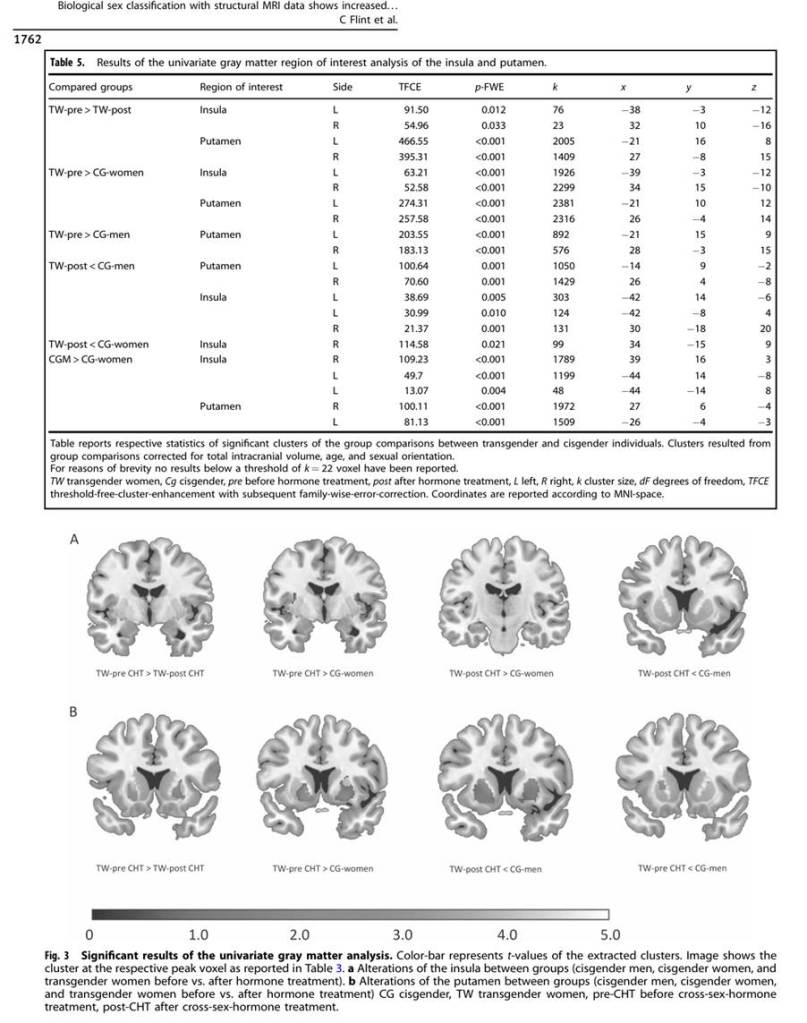
In this study, a highly accurate biological sex classifier in CG-individuals that shows a significantly decreased accuracy in TIs after CHT was presented. The results underline that the brain structure of TIs is similar to both, the brain structure of their perceived gender and biological sex. This implies that brain structure of TW differs from both CG-men and-women. Based on the brain-structural data, a dimensional rather than binary gender construct which will contribute to the destigmatization of Tis is suggested.
The transsexual brain – A review of findings on the neural basis of transsexualism. Smith E, Junger J, Derntl B, Habel U. 2015. Neuroscience & Biobehavioral Reviews.
The term transsexualism describes the condition when a person identifies with a gender that differs from the at birth assigned sex. Although the terms gender and sex are often used interchangeably in common speech, their distinction in the context of research is meaningful. Sex refers to the biological and physiological properties of a person, whereas the term gender refers to one’s psychological identification as a male or female and the assigned social role and lays emphasis on social and cultural imprinting processes. As a result of this incongruence of psychological gender and biological sex, transsexuals often try to resemble the preferred sex, for example by binding of breasts in the case of a female-to-male transsexual or permanent hair removal in the case of a male-to-female transsexual.
Many transsexuals undergo hormone replacement therapy (HRT) and sex-reassignment surgery (SRS). Given the strong cross-gender identification in combination with the strict binary gender system of most cultures and general low social acceptance, many transsexual individuals suffer from severe psychological distress. The rate of psychiatric disorders appears to be higher in these individuals compared to the general population, with affective and anxiety disorders being the most frequent. Even so, transsexualism is not necessarily associated with psychiatric problems and it is assumed that these mainly occur as a result of experienced psychosocial distress. Only recently, data from Finnish adolescents cast doubt on this assumption, as the onset of gender dysphoria was frequently preceded by severe psychopathology. Considering this observation, the issue needs further investigation.
Transsexual individuals who suffer from their condition can be diagnosed with gender dysphoria (GD) or gender identity disorder (GID). In the 10th revision of the International Statistical Classification of Diseases and Related Health Problems (World Health Organization, 2014) transsexualism is subsumed under the category of gender identity disorders (along with dual-role transvestism, gender identity disorder of childhood, other and unspecified gender identity disorders) and coded as F64.0. According to the ICD-10, transsexualism is characterised as: A desire to live and be accepted as a member of the opposite sex, usually accompanied by a sense of discomfort with, or inappropriateness of, one’s anatomic sex, and a wish to have surgery and hormonal treatment to make one’s body as congruent as possible with one’s preferred sex.
Transsexualism can occur in the context of a physical intersex condition, that is the ambiguity of the genital and gonadal apparatus and/or the chromosomes. Yet it is not clear, whether the co-occurrence is accidental or causally determined. Note that this article does not consider transsexualism with a concurrent congenital intersex condition. The DSM-IV states that GID shall not be diagnosed in these cases, the DSM-5 now requires the rater to specify if the diagnosis of GD is accompanied by a disorder of sex development (American Psychiatric and Association, 2000). If so, both diagnoses are coded. Research has put its focus on biological models of transsexualism. There are no overt biological anomalies, such as sex chromosome aberrations, that are associated with transsexualism. Yet, there are studies suggesting that the development of transsexualism is related to biological mechanisms, such as genetic factors and prenatal exposure to sex hormones, rather than environmental factors like parenting practices. During pregnancy, the foetal brain develops into a male brain under the influence of the androgen testosterone, and into a female brain in the absence of this hormone. The sexual differentiation of the brain however, occurs much later in development than that of the genitals. These two processes could be influenced independently, which is postulated to result in transsexualism if they develop in opposing directions. Thus, transsexualism is believed to result from a discrepancy between sexual brain and genital differentiation caused by genetic or hormonal deviations.
A genetically determined aberrant hormonal status could result from an anomalous prenatal exposure to sex hormones, i.e. caused by an altered sensitivity or function of sex hormone receptors or synthesis of sex steroids. A rough indicator for prenatal testosterone exposure is the digit ratio, or 2D:4D ratio, which describes the ratio of index finger and ring finger length. This measure correlates with prenatal androgen exposure, with lower 2D:4D ratio indicating higher prenatal androgen exposure. The 2D:4D ratio is a sexually dimorphic measure: relative to the length of the ring finger, a long index finger is considered a “more feminine” hand, a short index finger a “more masculine” hand (Zheng and Cohn, 2011). The digit ratio also has been studied in transsexuals, yielding a higher digit ratio in MtF transsexuals than in control males, similar to control females. By contrast, the digit ratio of FtM transsexuals was found to be in the range of control females. The findings support the assumption of prenatal testosterone exposure as etiological factor of transsexualism, at least for MtF transsexualism. Data from girls with congenital adrenal hyperplasia (CAH), a metabolic disease characterised by a deficient production of sex steroids, indicate that prenatal androgenisation is indeed related to masculinisation of the child’s later behaviour. Even so, no association with later gender confusion or dysphoria was found. Hence, gender identity does not seem to be absolutely determined by prenatal androgen exposure.
Brain morphometry
There is widespread evidence for differences between the sexes in brain morphometry. Differences exist both in total brain volume, as well as in several sex-dimorphic structures. It is a well established finding, that the absolute brain volume is larger in men than in women , even after correcting for body size. Woman, however, have a higher proportion of grey matter, men a higher proportion of white matter.
EEG studies
Several electroencephalography (EEG) studies have been conducted in transsexuals, all pointing more or less towards altered EEG patterns in transsexuals. A couple of early studies from the mid and late 1960s report atypical EEG patterns in transsexual individuals.
Findings from task-based functional neuroimaging studies
Meanwhile, there are also several functional neuroimaging studies comparing brain activation patterns of transsexuals and controls during task performance. Berglund et al. (2008) measured cerebral activation patterns of (nonhomosexual) MtF transsexual individuals with positron emission tomography (PET) while smelling odorous steroids (AND, 4,16-androstadien-3-one, a metabolite of testosterone and EST, estra-1,3,5(10),16-tetraen-3-ol, a derivate of oestradiol).
Structural and functional connectivity
To gain insight into the (transsexual) brain, not only knowledge about structural and functional properties of brain regions should be acquired, but also how these are structurally and functionally interconnected. Structural connectivity is constituted by anatomical connections such as synapses and fibre tracts and is frequently assessed through diffusion MRI.
Brain morphometry
As many transsexuals eventually decide for hormone therapy and sex reassignment surgery, the question arises in what way this acts upon the brain’s structure and function. During prenatal development, during puberty and even in young adulthood, sex hormones exert an organisational influence on the brain’s morphology.
The available data from structural and functional neuroimaging-studies promote the view of transsexualism as a condition that has biological underpinnings. The research in this field is ongoing at least since the early 1990s – yet, the phenomenon is far from being studied sufficiently. Many of the results are inconsistent or still need to be replicated and the sample sizes are often extremely small.
Brain Sex in Transgender Women Is Shifted towards Gender Identity. Kurth F, Gaser C, Sanchez F, Luders E. 2022. Journal of Clinical Medicine.
Transgender people report discomfort with their birth sex and a strong identification with the opposite sex. Transgender women are assigned male at birth but identify as female; transgender men are assigned female at birth but identify as male. Worldwide, the reported prevalence of transgender identities is rising, but the scientific understanding of how gender identity develops is still limited. Social explanations pointing to psychosocial and environmental influences are complemented by biological explanations that include genetic predispositions and hormonal exposures. Some (or perhaps all) of the aforementioned variables may have contributed to neuroanatomical variations in transgender brains, as repeatedly observed in both post mortem and in vivo studies published over the past three decades.
The overarching question addressed in those recent studies is whether the brains of transgender people are concordant with their birth sex or their gender identity, which is usually based on a so-called “classification accuracy” (i.e., how well can a brain be classified as male or as female). Interestingly, some studies reported that the classification accuracy was reduced in transgender individuals, albeit not all studies observed this effect. The reasons for divergences in study outcomes may be due to including individuals at different points in their gender-affirming process, using univariate classifiers and/or applying binary classifiers contrary to the notion that a mere binary classification may be insufficient to capture interactions between biological sex and gender identity.
Twenty-four transgender women (biological sex: male; perceived gender: female) were recruited through local community organizations and through professionals who offer services to the transgender community. To be included in this study, participants needed to self-identify as transgender women, report no history of hormone therapy, and declare the intention of undergoing oestrogen replacement therapy. Moreover, participants were confirmed to be genetic males as defined by the presence of the SRY gene in their genome.
All participants provided informed consent, and ethics approval was granted by the Institutional Review Board of the University of California, Los Angeles (UCLA; protocol 041106703, 27 April 2007) and by the University of Auckland (UOA; protocol 022375, 30 November 2021).
All brain images were acquired on the same 1.5 Tesla MRI system (Siemens Sonata, Erlangen, Germany) using a T1-weighted sequence (MPRAGE) with the following parameters: TR = 1900 ms; TE = 4.38 ms; flip angle = 15◦; 160 contiguous 1 mm sagittal slices; FOV=256mm×256mm;matrixsize=256×256,voxelsize=1.0 × 1.0 × 1.0mm3. Brain images were processed using SPM8 (http://www.fil.ion.ucl.ac.uk/spm) and the VBM8 toolbox (http://dbm.neuro.uni-jena.de/vbm.html), as previously described [34,54–56]. In short, all brain images were tissue-classified into grey matter, white matter, and cerebrospinal fluid, and the resulting grey and white matter partitions were spatially normalized to MNI space using 12-parameter affine transformations. Finally, the normalized tissue segments were smoothed using an 8 mm FWHM kernel and resampled at 4 mm voxel size. These images constituted the input for the Brain Sex estimation.
The classifier performed at 90.2% accuracy (AUC = 0.97) when assessed in the training sample and at 88.3% accuracy (AUC = 0.97) when assessed in our 48 cisgender brains. These measures indicate a suitable classification performance and a reliable distinction between the sexes based on brain anatomy. The estimated Brain Sex index was significantly different between the three groups (F(2,69) = 40.07, p < 0.001), with a mean of 1.00 ± 0.41 in cisgender men andof0.00 ± 0.41incisgenderwomen. The Brain Sex of transgender women was estimated as 0.75 ± 0.39, thus hovering between cisgender men and cisgender women, albeit closer to cisgender men (see also Figure 1). The follow-up post hoc tests revealed that transgender women were significantly more female than cisgender men (Cohen’s d = 0.64, t(46) = 2.20, p = 0.016), but significantly less female than cisgender women (Cohen’s d = 1.87, t(46) = 6.48, p < 0.001).
The observed shift away from a male-typical brain anatomy towards a female-typical one in people who identify as transgender women suggests a possible underlying neuroanatomical correlate for a female gender identity. That is, all transgender women included in this study were confirmed to be genetic males who had not undergone any gender-affirming hormone therapy. Thus, these transgender women have been subject to the influence of androgens and grownup (at least up until a certain age) in an environment that presumably treated them as males. The combination of male genes, androgens, and (to some degree) male upbringing should ordinarily be expected to result in a male-typical brain, making a female-typical brain anatomy extremely unlikely. Yet, the brain anatomy in the current sample of transgender women is shifted towards their gender identity.
Existing studies using multivariate classifiers aimed to assess whether the brains of transgender persons differ from their biological sex. For example, one study investigated transgender men and transgender women before and after cross-sex hormone therapy using a binary classifier. The authors reported a significantly reduced classification accuracy in transgender persons compared to cisgender persons prior to hormone therapy, and the classification accuracy was even further reduced after therapy. This result might be explained by a shift in brain anatomy towards the gender identity (i.e., away from the biological sex), as also observed in the present study.
Two other studies reported similar findings in transgender women but effects seemed to be driven by [36] or became significant only after [35] hormone therapy. Nevertheless, the sample sizes in those studies were extremely small (n = 8 and n = 11, respectively) and analyses were conducted using binary (rather than continuous) classifiers simply categorizing brains either as “male” or as “female”. Continuous classifiers (as applied in the current study) reflect a more nuanced classification by indicating where brains sit on the “male–female” spectrum but have not been used in transgender samples when analysing structural magnetic resonance imaging (MRI) data. Nevertheless, even though findings are not immediately comparable, all existing structural MRI classifier studies—as well as a recent resting-state functional MRI classifier study —seem to support the notion of a “shift” away from the biological sex towards the gender identity in transgender people. This shift has also been observed previously in some traditional region-of-interest studies focusing on single brain features and brain areas, such as the uncinate nucleus (INAH-3), the insula and pars triangularis, the area around the central sulcus, posterior cingulate, and occipital regions as well as the bed nucleus of the stria terminalis, just to name a few.
SUMMARY
It would appear the evidence is strong in supporting the notion that trans people have brains that are wired differently from their cis counterparts, in line either fully or in part with their gender identity as opposed to their birth sex, evidenced by MRI brain scans carried out independently of each other, coming up with roughly comparable results.
In Biology, we are dealing with natural variation, so it reasonable to expect variations in results. However, any experiment or test must be repeatable and for a trend to become established, roughly the same results should be obtained from similar tests.
If we accept that trans people’s brains are different, wired that way from conception and development in the womb, they are nonetheless still humans, and should be treated as such with rights and dignity to become the people they need to be. Trans people don’t ask to be that way, it is who they are, not a fad, fashion statement, phase to be gone through or an ideology. They exist in themselves and for themselves. This brings into focus ethics – Transethics, more in a later chapter.
Chapter 10.
The association between autism and variations in gender identity?
Background.
Over the past twenty years, the literature has highlighted the frequency of the association of transidentities and autism, proposing numerous theories to explain this observation, describing the characteristics of transidentities in people with autism, studying their psychiatric co-occurrences and recommending specialised care. A growing number of studies are emerging, including meta-analysis affirming higher prevalence of this co-occurrence.
Nonetheless, studies about the specifics of this co-occurrence in terms of clinical and social consequences and the particularities of specialised care are sparse. No systematic review exists to propose an inventory of the existing knowledge. So it is contested.
Is being both autistic and transgender an example of co-occurrence, indicating a link, or can these conditions occur at the same time, and yet with no link? Could it be that autistic people are more prepared to question and explore their gender identity due to the fact they either question or don’t recognise the societal norms?
A study at Princeton found DNA glitches can determine subtypes before or after a child is born, and autism subtypes differ in the timing of genetic switches, which guide distinct stages of development.
Aviya Litman, a PhD student at Princeton University and co-lead author, said: ‘These findings are powerful because the classes represent different clinical presentations and outcomes, and critically, we were able to connect them to distinct underlying biology.’ Researchers have determined that common gene variants account for only around 20 percent of ASD diagnoses, leaving the remaining 80 percent to a complex interplay of environmental factors, modifications to DNA that regulate gene expression, and gene-environment interactions that scientists still don’t fully understand. Being Transgender also has genetic origins, is there a genetic link?
From: The Autistic Trans Guide To Life. Purkis Y and Lawson W. 2027. Jessica Kingsley Publishers.
This empowering guide supports autistic trans and non-binary adults with practical tools, personal stories, and evidence-based advice to navigate life with pride and authenticity. Covering topics like self-advocacy, mental health, masking, and transitioning, it promotes self-acceptance and resilience. Written by two autistic trans activists, it offers honest, affirming insights into living as one’s true self.
Blending personal accounts with evidence-based insights and up-to-date information, and written from a perspective of empowerment and self-acceptance, the book promotes pride, strength and authenticity, covering topics including self-advocacy, mental health and camouflaging and masking as well as key moments in life such as coming out or transitioning socially and/or physically.
From: Transidentities and autism spectrum disorder: A systematic review. Bouzy J et al. [2023]. Psychiatry Research Science Direct.
Transidentity and autism frequently co-occur. Previous reviews have focused mainly on frequencies. A systematic review was conducted to condense all the studies and themes on this co-occurrence and to offer a global view. 5 main themes were identified (sex ratio, theories, sexual orientation, clinical and social consequences, and care implications) in addition to frequencies. Many theories have been proposed to explain the co-occurrence. One posits that social difficulties related to autism would lead to less identification with gender norms and less pressure to conform to these norms, allowing for greater gender diversity in people with autism.
Given their difficulties with social interactions and communication, the announcement of one’s transidentity to one’s social group is often discredited, increasing the risk of suffering and delayed care. Many reports reaffirm the importance of providing specialised care for transgender people with autism. Autism is not a contraindication for gender-affirming treatment. However, some cognitive specificities can affect the planning of care, and transgender people with autism are at high risk of discrimination and harassment.
Transidentities refer to all gender identities that do not conform to the gender assigned at birth. According to the Diagnostic and Statistical Manual of Mental Disorders, 5th version (DSM-5) (American Psychiatric Association, 2013), gender dysphoria (GD) comprises the notion of perceived suffering or impairment in the social field experienced by a transgender person. In the International Classification of Diseases, 11th version (ICD-11) (World Health Organisation, 2020), transidentities are referred to as “gender incongruence” and are no longer considered a mental disorder but a sexual health condition. Indeed, transidentities are no longer seen as a medical condition but as a singular construction of identity within human diversity.
Autism is a neurodevelopmental disorder characterised by difficulties with social interactions and verbal and nonverbal communication, restricted and stereotyped activities and interests, and sensory features. In the DSM-5 (American Psychiatric Association, 2013) and ICD-11 (World Health Organisation, 2020), autism is referred to as “autism spectrum disorder” (ASD), which is defined by persistent deficits in initiating and maintaining reciprocal social communication and social interactions and restricted and repetitive patterns of behaviours, interests and sensory activities that are atypical or excessive for the individual’s age and/or sociocultural environment.
Regarding the frequencies of autism in trans populations and of transidentity in people with autism, the results are quite heterogeneous but show an overrepresentation of this cooccurrence.
From: Associations between autism, gender dysphoria and gender incongruence: insights from the Swedish Gender Dysphoria Study (SKDS) Ozel F et al [2025] Psychiatry Research Science Direct.
High levels of autistic traits have been reported among TGD people across age groups, using a variety of ASD screening tools (Huisman et al., 2024; Kung, 2020; Lehmann et al., 2020; van der Miesen et al., 2018a; Vermaat et al., 2018; Warrier et al., 2020). Studies using self-reported diagnoses and information from health records and registers have also demonstrated increased rates of ASD among TGD people in comparison to general or cisgender populations (David et al., 2025; Heylens et al., 2018; Mahfouda et al., 2019; Strauss et al., 2021).
When investigating the potential connection between TGD identities and ASD, focusing on people experiencing gender dysphoria is particularly important, as the co-occurrence with ASD may pose certain challenges, including difficulties in obtaining a diagnosis and accessing gender-affirming treatments (Strang et al., 2023)
The results support the previously proposed co-occurrence of ASD and gender dysphoria in the literature. There is no consensus regarding the underlying mechanisms of the high co-occurrence of ASD and gender dysphoria. Different factors, including biological, psychological, and social, have been proposed to explain this co-occurrence (van der Miesen et al., 2016). Among the biological hypotheses, the extreme male brain (EMB) theory has been frequently cited in previous studies (Wattel et al., 2024). According to the EMB theory, females tend to have a greater inclination toward empathizing, while males are generally more inclined toward systemizing, and autistic people show more male patterns (Baron Cohen, 2002). Additionally, higher prenatal testosterone levels were proposed to lead to autistic traits and gender dysphoria (Auyeung et al., 2009; Jones et al., 2012).
Apart from biological hypotheses, the literature has discussed differences in gender development between autistic and neurotypical people, obsessions originating from autistic traits and rigid thinking among individuals with gender dysphoria, and mentalizing impairments among autistic people leading to symptoms of gender dysphoria (Wattel et al., 2024).
The present study demonstrates that the prevalence rates of ASD diagnoses and autistic traits are higher among people with gender dysphoria compared to cisgender people.
From: Autism Spectrum Disorder and Gender Dysphoria/Incongruence. A systematic Literature Review and Meta-Analysis. Kallitsounaki A and Williams D [2022} Journal of Autism and Developmental Disorders.
The suggested overlap between autism spectrum disorder (ASD) and gender dysphoria/incongruence (GD/GI) has been much disputed. This review showed a relationship between ASD traits and GD feelings in the general population and a high prevalence of GD/GI in ASD. Meta-analyses revealed that the pooled estimate of the prevalence of ASD diagnoses in GD/GI people was 11% (p < .001) and the overall effect size of the difference in ASD traits between GD/GI and control people was significant (g = 0.67, p < .001). Heterogeneity was high in both meta-analyses. The chances that there is not a link between ASD and GD/GI are negligible, yet the size of it needs further investigation.
From the studies reviewed it was estimated that the positive rates for ASD caseness in GD/GI people range from 1.2 to 68% (e.g., Akgül et al., 2018; Vermaat et al., 2018). The prediction intervals of the prevalence estimate were very wide, indicating that not all GD/GI people are affected by ASD to the same degree. Based on the characteristics of the literature pertaining to the prevalence of ASD diagnoses/ASD traits in GD/GI individuals, as discussed hereunder, wide prediction intervals were expected.
Furthermore, the findings reviewed indicated that GD/GI children have higher ASD traits than control children (e.g., Akgül et al., 2018; Skagerberg et al., 2015). Yet, mixed evidence emerged about the difference in ASD traits between GD/GI adults and nonclinical/population-based control adults (e.g., Nobili et al., 2018; Stagg & Vincent, 2019; Warrier et al., 2020).
Taken together, results from the literature review and the meta-analyses indicate that the chances there is not a link between ASD and GD/GI are negligible, yet absolute conclusions about the size of the link cannot be drawn.
It is also important to note that the high co-occurrence between ASD and GD/GI is underrecognized among health care professionals (Murphy & Livesey, 2017). Evidence about a link between ASD and GD/GI might stimulate the development of appropriate trainings to raise their awareness (Strauss, et al., 2021), so that GD/GI people are screened for ASD and autistic people for gender related issues.
The findings of the current literature review and meta-analyses suggest that there is:
(a) a positive relationship between ASD traits and GD/GI feelings among people from the general population,
(b) an increased prevalence of GD/GI in the autistic population, and
(c) an increased prevalence of ASD diagnoses and ASD traits in the GD/GI population. Overall, these findings suggest the existence of a link between ASD and GD/GI that warrants the investigation of mechanisms that could explain that link and the intensification of clinical attention to autistic GD/GI individuals.
From: Gender Discomfort and Autism. Lawson W. [2023] Autism Research Institute.
Literature on the intersection of autism and GDC has increased substantially in the last seven years. Early studies revealed that autistic individuals report higher rates of gender diversity than the non-autistic population (Glidden et al., 2016; Van der Miesen et al., 2016; George & Stokes, 2017). Consequently, autistic individuals also experience lower identification and fewer positive feelings about assigned gender groups which can lead to GDC. This is especially true for those assigned female at birth (Cooper et al., 2018).
Research also suggests that this relationship is bidirectional, where the rate of autism in transgender individuals is between 6 – 26% compared to a 1.85% prevalence in the general population (Thrower et al., 2020; Maenner et al., 2020; Walsh et al., 2018). Although research on the co-occurrence of autism and GDC is widely available, much less is known about the underlying mechanisms of this association. Biological, psychological, and social explanations have been published.
Specific distresses experienced by autistic adults with GDC include social stigmas about gender- and neurodiversity, accessing gender affirming care, and managing the intersecting needs of autism and GDC – such as the tension between a need for undergoing physical gender changes versus the need for sameness and routine (Cooper et al., 2021). Autistic trans youth report distress from overwhelming negative feelings about gender incongruence, difficulty in accessing external support (e.g., gender-affirming care), and disparities in what needs they and their caretakers focus on (Cooper et al., 2022a). Some caretakers and clinicians working with young people worry that autism may impact one’s perception of gender and therefore focus on autism treatments instead of gender-based care.
It is critical to note that autistic children and youth are at higher risk of sexual victimization than the neurotypical population. Autistic individuals also experience a notably higher prevalence of mental health conditions than non-autistic individuals.
Despite the daily challenges faced by the autistic transgender community, their resilience shines through. Research indicates that transgender individuals with high self-esteem, assertiveness, and perceived social support from loved ones demonstrate greater resilience to psychiatric conditions than their counterparts (Hall et al., 2020). Further, a growing body of evidence reveals that trans autistic individuals experience significant reductions in poor mental health and suicidality when provided with gender affirming care. These improvements can be attributed to greater comfort within one’s body and the validation and hope that accompany acceptance and treatment.
Diagnosing GDC in autistic individuals, formal or otherwise, should be done carefully, taking into account the signs and outcomes related to autism and GDC. Autism traits like rigid thinking, sensory sensitivities, resistance to change, and social differences may compound GDC, making the diagnosis and treatment process more difficult.
Given our as-yet incomplete understanding of the co-occurrence of autism and GDC, treatment and care options must be developed based on the lived experiences of autistic individuals with GDC.
Because concepts of gender are very cultural, they can be difficult for autistic people to access, and many never assume the gender roles that society would have them accept. On a fundamental level, most autistic individuals experience and understand gender differently from, and often in contrast to, the wider population (Lawson & ARI, 2019).
Like autism, gender is experienced on a spectrum and is not confined to a binary or ternary lens. Without compassion, education, and understanding from broader society, autistic individuals experiencing GDC will continue to encounter discrimination and be underserved by the healthcare system. Compoundingly, if we do not actively listen to and adjust for the lived experiences of autistic people, humanity stands to lose an opportunity for deeper understanding and self-discovery. As we continue to build a society that recognizes the talents and strengths of autistic individuals, accepting gender fluidity is critical. With love, kindness, and acceptance, we can learn to understand gender the way autistic people do – as a characteristic of oneself that is not based upon outside forces trying to tell us what we are and how to act.
From: Autism and Gender Diversity. Dattaro L [2020] The Transmitter Neuroscience News and perspectives.
People who do not identify with the sex they were assigned at birth are three to six times as likely to be autistic as cisgender people are, according to the largest study yet to examine the connection. Gender-diverse people are also more likely to report autism traits and to suspect they have undiagnosed autism. Autistic people are more likely than neurotypical people to be gender diverse, several studies show, and gender-diverse people are more likely to have autism than are cisgender people.
Simon Baron-Cohen, professor of developmental psychopathology at the University of Cambridge and the new study’s lead investigator, led the collection of those data Gender-diverse people also report, on average, more traits associated with autism, such as sensory difficulties, pattern-recognition skills and lower rates of empathy — or accurately understanding and responding to another person’s emotional state. And they are five times as likely to suspect they have undiagnosed autism as cis people are, based on one dataset of 1,803 people whose survey included this question.
It also indicates a need for clinicians and educators to talk with autistic people about gender identity, and to be aware of potential mental health impacts that can result from ‘minority stress’ — or the difficulties associated with being part of a marginalized group. Being both autistic and gender diverse can intensify such stress . “Clinicians and practitioners in both fields — autism and gender identity — need to be aware of this association, and to factor it into how best to support the person’s mental health,” Baron-Cohen says. Nearly 70 percent of autistic gender-diverse adolescents say they need medical gender-related care, according to a small 2018 study, and 32 percent say their gender identity has been questioned because of their autism diagnosis . “It’s really, really distressing to read sometimes, where you have people who have very strong gender dysphoria and want to transition, and their therapist says, ‘Well, we need to first cure your autism before we transition,’ which is wrong on all levels,” This study demonstrates that both of these things can co-occur, and just because these things co-occur does not mean that one should be denied.” The findings also suggest that researchers should investigate how autism presents in gender-diverse people,
From: The Problem With Tethering Gender Dysphoria to Autism. Saleh N. [2025] Verywell Health.
Several hypotheses have been proposed to causally link autism to gender dysphoria, but there is no consensus regarding a clear link or a reason for a link. These hypotheses include:
- According to the extreme male brain theory, women are wired to think in more empathetic terms; whereas men are more systematic in their thinking. According to this hypothesis, high levels of testosterone (a male hormone) in the womb result in an extreme male brain or male pattern of thought, which leads to both autism and gender dysphoria.
- Difficulty with social interactions has also been used to explain the development of gender dysphoria in autistic children. For instance, an autistic boy who is bullied by other boys might come to dislike other boys and identify with girls.
- Autistic people have difficulty communicating with others. This trait may contribute to others missing social cues about assigned gender which might increase the chance of developing gender dysphoria. Other people don’t pick up on cues of a child’s assigned gender, then the child isn’t treated in a fashion concordant with this assigned sex and may be more likely to go on to develop gender dysphoria.
- Gender dysphoria could be a manifestation of autism, and autistic-like traits could drive gender dysphoria. For instance, a child with a male-assigned gender and autism may become preoccupied with female clothes, toys, and activities. In fact, this apparent gender dysphoria may not be gender dysphoria at all but rather obsessive-compulsive disorder (OCD).
- Autistic children can demonstrate rigidity with respect to gender differences. They may have a hard time reconciling the difference between their assigned and experienced or desired gender. This increase in distress could possibly exacerbate gender dysphoria and make it harder for them to manage these feelings.
- Confusion in the development of gender identity or an altered pattern of gender identity development might contribute to gender dysphoria in children who have ASD.
- Limitations with imagination and empathy, common in autistic people, may make it hard for autistic people to recognize that they belong to a certain gender group.
No consensus on medical treatment could be drawn. Consenting to treatment may be difficult for autistic adolescents experiencing gender dysphoria because children may have difficulty understanding the long-term risks and irreversible effects of certain gender interventions. The clinician should develop a specialized consenting plan with risks and benefits presented in a concrete, step-wise, and accessible manner. Puberty suppression using hormones is a good option for adolescents who consent because it’s reversible.
There’s still much to learn about the co-occurrence of gender dysphoria and autism. Although rarely spoken about, gender is viewed as essential, unchangeable, and binary by all members of society, including experts doing studies and giving treatments. It’s possible that the distress that a trans child feels may stem from the universal expectation that gender is binary. Researchers continue to seek evidence-based approaches to treat people with both autism and gender dysphoria.
From: Theories on the Link Between Autism Spectrum Conditions and Trans Gender Modality: a Systematic Review. Watte L, Walsh R and Krabbendam L [2022] Review Journal of Autism and Developmental Disorders.
While research on the prevalence of co-occurring autism spectrum conditions (ASC) and trans gender modality (TGM) is available, less is known about the underlying mechanism of this association. Insight is needed to improve treatment of trans autistic people. This review provides an overview of theories on the ASC-TGM link and the available evidence for/against them published between January 2016 and October 2020. A systematic search was performed in PubMed, PsycINFO, Web of Science, and Scopus. This resulted in 36 studies, in which 15 theories were identified. Results indicate all theories lack substantial empirical support. Unlikely and promising theories were identified. The most promising theories were those on resistance to social norms and weakened sex differences.
Resistance to Social Norms This theory proposes that TGM is more common amongst autistic people because they are less susceptible to societal prejudice/pressure than neurotypical people. In other words, this explanation entails that autistic people are free from normative influences when forming their gender identity, whereas neurotypical people are influenced by the gender binary norm. There were 18 mentions of this theory in the included papers. One study claimed evidence for, and no studies claimed evidence against the explanation. In an ASC population,
Weakened Sex Differences According to this explanation, a high prevalence of TGM in autistic people is due to weakened sex differences (i.e., autistic men being less masculine/more feminine and autistic women being less feminine/more masculine). Weakened sex differences were mentioned as an explanation four times, with two papers claiming support for it and no papers claiming evidence against it. Vermaat et al. ( 2018) found that trans AFABs had similar AQ scores to neurotypical males and that trans AMABs had similar AQ scores to neurotypical females.
There are some noteworthy observations when looking closer at the biological explanations for the ASC-TGM link. One such observation is that no empirical evidence was provided for or against three out of four biological explanations (birth weight, genetic factors, and prenatal hormones).. Based on the evidence (i.e., 4 claims for and 3 against), the EMB theory could possibly be considered an explanatory factor for the ASC TGM link in AFABs. However, it cannot be the sole explanatory factor as it does not account for the co-occurrence of ASC and TGM in AMABs. The EMB theory additionally does not explain why there would be a sharp division in the mechanisms behind TGM between autistic AMABs and autistic AFABs. Consequently, the EMB theory may be considered an unlikely explanation for the ASC-TGM link.
When looking at all theories, there are potentially contradictory and complementary explanations to be found. For instance, the theories on minority stress and resistance to social norms are seemingly contradictory: while the theory on minority stress suggests that autistic people are marginalized and affected by social ostracism, the theory on resistance to social norms suggests that autistic people do not conform to social norms. However, these theories are not necessarily mutually exclusive: the fact that a person does not internalize social norms as their own does not mean that they are insensitive to negative reactions of their surroundings. A more substantial contradiction may be found between the theories on rigidity and sexual orientation, and the theories on weakened sex differences and resistance to social norms. While the former theories imply that autistic people have inflexible ideas about gender, the latter theories imply autistic people are less constrained by the gender-binary norm.
From: Sex/Gender Differences and Autism: Setting the Scene for Future Research. Lai M et al. [2015] Journal of the American Academy of Chid and Adolescent psychiatry. Science Direct.
The relationship between sex/gender differences and autism has attracted a variety of research ranging from clinical and neurobiological to etiological, stimulated by the male bias in autism prevalence. Findings are complex and do not always relate to each other in a straightforward manner. Distinct but interlinked questions on the relationship between sex/gender differences and autism remain under addressed.
Recently, an increasing number of studies from different perspectives and methodologies have revisited how sex/gender differences are related to autism. Some have attempted to clarify how males and females with autism are similar or different in behavioural features via meta-analyses, multi-site large datasets, and by means of a male/female-balanced design. This has been extended to proteomics, anthropometrics, brain structure, and neural/somatic growth patterns. On the other hand, studies of population genetics and genomics have revisited the sex/gender-differential liability hypotheses using well-powered datasets and advanced technology. The use of adequately powered datasets and statistical design as well as multi-level approaches offer promising avenues for advancing our understanding.
However, findings from different studies are complex and do not always relate to each other in a straightforward manner. This is because there are several different (but interlinked) questions embedded in the broad theme of the relationships between sex/gender differences and autism.
Using multivariate methodology, serum proteomic and transcriptomic studies also suggest that in high-functioning adults, females are different, rather than more severe, compared to males with autism. Anthropometric and neuroimaging studies show that high-functioning adult males and females with autism have different directions of shifts from same-sex/gender controls on the masculine–feminine dimension, that females are masculinized, yet males are feminized.
In light of the well-replicated, critical role of de novo mutations, which play a more substantial role in simplex than in multiplex autism, it is interesting that paternal age (which is associated with increased risk for de novo mutation in the gametes) correlates with the odds of simplex to multiplex autism in females but not in males. Corresponding to the predictions from the multi-factorial multi-threshold etiological model (level 3) that females with autism have a greater etiological/genetic load (reflecting a female-protective effect), data from the SSC show a trend toward more gene-rich de novo copy number variations (CNVs) in females than in males with autism, particularly microduplications, and in functional hub genes. This is also true for mutations indexed by single nucleotide variants and complete gene knock-out (in samples beyond SSC). Furthermore, females with autism are more likely to have highly penetrant pathogenic CNVs and are overrepresented among individuals carrying exonic deletions overlapping fragile X syndrome protein targets. An increased rate of mutation in females is also found in other neurodevelopmental disorders
An obvious genetic mechanism explaining sex/gender-differential liability are sex chromosomal genes, including male-specific risks by Y-chromosome genes such as SRY (and its downstream effects, including hormonal), and/or female-specific protections from the increased X-chromosome gene dosage in females (from genes that escape inactivation). Associated epigenetic mechanisms related to X-chromosome genes likely further contribute, including skewed X-inactivation, parent-of-origin allelic imprinting, and hypothetically, heterochromatin sink that results in sex-differential protein-mediated epigenetic effects on autosomes. Sex chromosome genes (and associated epigenetic effects) may account for only a portion of the etiological mechanisms, as autism risk genes largely involve autosomes.
Research into specific mechanisms has shown initial evidence in genetics, epigenetics, and the prenatal environment. Genetic and environmental effects are closely entwined through epigenetic and other regulatory mechanisms. Brain gene expression studies show that, although sex-differentially expressed genes do not overlap with autism candidate genes or genes aberrantly expressed in autistic brains, gene ontology enrichment analysis indicates that male-biased transcriptional modules are also implicated by the autism candidate genes. This suggests that it is downstream pathways that converge to show potential linkage between epigenetic (and genomic) sex differences and autism etiologies rather than individual genes per se. Early prenatal development is a critical period where pronounced sex-differential gene expression and exon use occurs, and where genetic and epigenetic mechanisms relevant to autism are placing potent permanent neurodevelopmental effects. Studies need to go beyond comparing groups at genetic or environmental levels alone, to investigate how their interplay has a role in producing potentially multiple “hits” in the emergence of autism.
From: An X-linked long non-coding RNA, PTCHD1-AS, and the core features of autism. Scherer S et al. 2026. Nature
Scientists have discovered a gene that may be responsible for defining behaviors linked to autism.
Genetic factors also come into play, with about 100 genes and variations currently thought to be linked to autism spectrum disorder (ASD).
Now, researchers in Canada have pinpointed a gene on the X chromosome, a sex chromosome found in men and women, that may influence issues with social interaction and repetitive behaviours such as stimming.
They discovered that based on genetic data from nearly 10,000 people, dozens of deletions within the gene, dubbed PTCHD1-AS, were associated with an increased susceptibility of autism in males.
The experts believe this increased risk was specifically in men because men only have one X chromosome, while women have two.
Follow-up experiments in mice also showed male mice lacking the PTCHD1-AS gene showed changes in social behavior and repetitive actions.
The team believes the findings may pave the way to more targeted therapies to reduce the social and behavioural deficits found in autism.
‘PTCHD1-AS gives us a new entry point to study the biology of ASD, sharpening our understanding of how specific biological pathways relate to key autism traits,’ Dr Stephen Scherer, senior study author and Chief of Research at The Hospital for Sick Children (SickKids) in Toronto, said.
‘This is essential, because no new therapeutics in clinical trials are designed to modulate the main features of ASD.’
The study, published in the journal Nature, looked at genetic sequencing data from 9,349 people with autism and 8,332 without the condition. Using that data, they searched for deletions along the X chromosome affecting the PTCHD1-AS gene.
They found 27 males with autism who carried PTCHD1-AS deletions from 23 unrelated families.
Their analysis showed deletions involving PTCHD1-AS were associated with a 2.6-fold increased risk of having autism compared to the neurotypical controls.
About 82 percent of the autistic individuals in the study had social difficulties, communication issues and repetitive behaviours like rocking back and forth, which led the team to believe PTCHD1-AS was linked to these autistic traits.
Additionally, the researchers looked at mouse models with PTCHD1-AS deletions and found that they spent significantly more time self-grooming than controls, which is considered a repetitive behaviour. They also vocalized less and at a weaker intensity, signalling communication issues.
‘Our findings suggest there is a different biology involved with our PTCHD1-AS model compared to other ASD protein-coding models,’ Dr Lisa Bradley, first study author and research associate in The Centre for Applied Genomics at SickKids, said.
Based on mouse observations, the researchers found disrupting the PTCHD1-AS gene affected ‘synaptic plasticity,’ which is the brain’s ability to adapt and fine-tune signals in response to activity in the striatum, where repetitive behaviours are regulated.
‘When we examined gene and protein expression in this area, we saw changes in genes and proteins involved in regulating synaptic plasticity as well as myelination, the process that allows electrical signals to travel faster between neurons,’ Bradley said.
‘This gives us a molecular pattern we can use for future studies into the biological effect of this non-coding gene in the brain.’
The team also believes the gene reduces activity of protein kinase C in a brain circuit that connects the cortex to the striatum. Protein kinase C regulates synaptic plasticity, learning and memory.
‘Through a multi-disciplinary approach combining human genetics, mouse models, multi-omics and electrophysiology, we’ve connected a non-coding gene to measurable changes in brain function,’ Dr Graham Collingridge, senior investigator at Lunenfeld-Tanenbaum Research Institute, said.
‘Together, our research helps clarify how unique alterations in synaptic plasticity relate to the core features of autism.’
The team’s next steps involve looking more deeply at the pathways influenced by PTCHD1-AS to identify targets for future therapies.
‘Beyond significantly advancing our understanding of Autism as a human condition, the study shows how small changes in DNA can influence complex human behavior,’ Scherer said.
‘It’s amazing to me how much of our disposition is genetically “hardwired,” even in the traits that shape how we connect and interact.’
It is interesting this gene us found in the X chromosome in chromosome pair 23, the region of DNA that codes for sex differentiation. And supposing autism isn’t a disorder, but a genetic memory?
From: Environmental contaminants, endocrine disruption, and transgender: Can “born that way” in some cases be toxicologically real? Holladay SD. 2023. Human and Experimental Toxicology (SAGE).
Gender is viewed by many as strictly binary based on a collection of body traits typical of a female or male phenotype, presence of a genotype that includes at least one copy of a Y chromosome, or ability to produce either egg orspermcells. A growing non-binary view is that these descriptors, while compelling, may nonetheless fail to accurately capture an individual’s true gender. The position of the American Psychological Association (APA) agrees with this view and is that transgender people are a defendable and real part of the human population. The considerable diversity of transgender expression then argues against any unitary or simple explanations, however, prenatal hormone levels, genetic influences, and early and later life experiences have been suggested as playing roles in development of transgender identities. The present review considers existing and emerging toxicologic data that may also support an environmental chemical contribution to some transgender identities and suggest the possibility of a growing nonbinary brain gender continuum in the human population.
Humans have synthesized multiple millions of tons of toxic chemicals and then distributed these onto the surface of the land, for control of insects, weeds and other life forms. Classes of these chemicals have included persistent or ganochlorines, mercury- and arsenic-based compounds, organophosphates, carbamates, pyrethroids, and diverse others. Some of these agents have been in existence for well over 100 years, for instance, the organochlorine insecticide dichlorodiphenyltrichloroethane (DDT) was first synthesized in 1884.In addition to being nearly colourless and odourless, and highly effective for killing insects, DDT also proved to be an endocrine disrupting compound, meaning it can interfere with natural hormones when it enters animal bodies. A well-known consequence of spraying large quantities of DDT into the environment for insect control was wildlife reproductive disturbance, including thinning of the eggshells of bald eagles and other carrion- and fish-eating birds. Such eggshell thinning activity of DDT has been verified by studies in domestic birds including chickens and shown to be a consequence of disrupted prostaglandin synthesis in the uterus of the birds. (See Silent Spring by Rachel Carson)
A hypothesis was put forth in 1991, that widely dis tributed pesticides and related chemicals on the earth have the potential to subtly and broadly disrupt hormonal systems in wildlife. This hypothesis came to be known as the Endocrine-Disrupting Contaminants Hypothesis and has been proven valid by a significant body of scientific research. Observations in wildlife have included disruption of normal estrogenic, androgenic, brain neurochemical, thyroid, and other hormone activities by these environ mental chemicals. Such hormone-mimicking or inhibiting effects of pollutants have been documented in wildlife species that include land and sea mammals, fish, amphibians, reptiles, birds, and diverse invertebrates and have been found to include changes in sex differentiation before and after birth, intersex animals that show features of both sexes, sex reversal, altered sex ratios, skewed steroid production by gonads, altered penile density, reproductive impairment, altered thyroid function, behavioural changes, shifts in brain neuroendocrine hormones, changed brain synaptic density in steroid-sensitive nuclei, and other endocrine system-related changes.
Considerable research is now available to show that developmental chemical exposures can cause persistent if not permanent postnatal changes in multiple body systems including cardiovascular, immune, respiratory, renal, nervous (brain), reproductive, and endocrine, often with overlapping effects. Researchers who focused specifically on pollutant effects in the reproductive and closely linked brain and endocrine systems of wildlife have detected changes in reproductive behaviour, reproductive success, and sexual orientation. For example, developmental exposure to the widely distributed chlorinated herbicide atrazine has been found to feminize male gonads in amphibians, reptiles, fish and mammals.
It is well-recognized that post-pubertal human female and male bodies on average display sex hormone-driven differences that include average height and weight, percent body fat, pro portionate muscle and bone mass, pelvis width and roundness of pelvic inlet, extent and distribution of body hair, size and development of the larynx, and thickness and collagen content of skin. Early years in neuroscience research similarly identified differences in the brain portion of the human body between females and males, and viewed these as largely limited to hypothalamic-related gonadal hormone effects that underlie dimorphic sex behaviours. More recent neuroscience research has demonstrated microanatomic and neurochemical brain differences by sex that influence brain function at multiple and diverse levels. These differences include regional neurotransmitter levels and cortical volumes, cortical neuron and synaptic density, enzymatic pathways, regional complexity of dendritic arbors and density of dendritic spines, and locally synthesized neurohormones not regulated by gonadal hormones.
Roles of maternal- and fetal-derived sex steroid hormones in brain feminization or masculinization have long been recognized. During gestation of mammals, a timed testosterone surge initiates masculinization of the developing brain, while absence of such a surge begins the pathway to a female brain that continues into the prepubertal period. These hormones profoundly affect sexual function and differentiation of neural circuits that control female and male behaviour.
The past few generations of humans have seen a dramatic increase in environmental contaminants that possess hormone mimicking properties, which may suggest the possibility of subtle modulation of normal brain sex differentiation in some portion of the human population.
Of growing concern, many of these chemical contaminants that have achieved global environmental distribution have been found to possess endocrine modulating activity in animals and humans, and in humans have been linked to disrupted endocrine signaling, altered reproductive rhythms, reduced male fertility, neurologic damage, increased risk of autism.
Counsellors and therapists have identified societal and environmental contributions to sexual identities including transgender identity, which may occur over varying numbers of years after the birth of a person. Among these for some transgender individuals are adverse childhood events including the experiencing of childhood sexual abuse from siblings or adult family or non-family members.
Pre-birth epigenetic modifications of DNA have been related to foetal androgen signalling patterns regulating brain sex development. Specifically, these authors showed decreased androgen sensitivity in human XX foetuses and increased androgen sensitivity in XY foetuses as a consequence of epigenetic modifications. Such foetal androgen signalling strongly influences brain sex development, which led the authors to hypothesize that inappropriate epigenetic modifications can masculinize the brains of human females during foetal development, and feminize the brains of developing males. Brain development can be changed through additional pathways that may be subject to modulation by environ mental chemicals. The microglia are an immune cell type located throughout the brain and spinal cord, that regionally account for 5-15% of brain cells. During development, these cells play critical roles in synaptic organization, or “wiring” of the brain. This brain organization is different by sex (female vs. male) in steroid-sensitive regions that are responsible for sociosexual and mood-related behaviours, suggesting potential for vulnerability to endocrine disruption.
Clearly, transgender humans long predate modern endocrine disrupting environmental chemicals and have throughout history been a portion of the human population. In a world that has gained ubiquitous contamination with endocrine disrupting chemicals, an environmental component to some human phenotypic males (humans born with male genitalia and other typical male physical traits) who are also genotypically male (possess XY chromosomes), but whose brains strongly assure them they are female (transgender) may be supported by the chemical and animal data reviewed in this report. The same is of course true for some transgender individuals who phenotypically and genotypically present as female, but whose brains tell them they are male.
Regarding transgender, the available literature supports the possibility that non-genetic but DNA-carried, environmentally induced epi genetic modifications, in some individuals, may influence adulthood gender identities. Based on this growing database, the possibility should not be dismissed that some humans can be born with brain microanatomic and neurochemical architecture that underlies identifying as the sex trans to their body phenotype and genotype. The recognizing of scientific support for this possibility may be of value to humans who very strongly perceive their gender identity to be a hard-wired reality present since time of birth (i.e., “born that way”), rather than a choice made by them. The position of gender binary (only 2 genders, female or male) is then strongly supported by human macroscopic anatomic phenotypes and the typical XX or XY genomes (these being the factors most commonly used to deny the reality of transgender people). However, data surveyed in this review also lend support to the possibility of some level of a nonbinary brain gender continuum in the human population due to ubiquitous endocrine modulating environmental chemicals. A relevant question then becomes, when designating individuals as female or male, which basis may be more appropriate; body phenotype and genotype, or brain microanatomy and neurochemistry?
From: Gene linked to sex differences in autism. Thien A. Nguyen and Katherine Roche. 2020. National Institute of Health.
Researchers found that a small cluster of mutations in the NLGN4X gene, which has been linked to autism spectrum disorder, may explain the sex differences tied to the gene. Although NLGN4X is only involved in a small number of cases, the study helps boost our understanding of the causes of this disorder.
Autism spectrum disorder (ASD) is a developmental disorder that affects communication and behaviour. Experts estimate that 1 in 54 children has ASD. The disorder occurs in every racial and ethnic group, and across all socioeconomic levels. However, boys are significantly more likely to develop ASD than girls. A main biological difference between boys and girls is the sex chromosomes. Every cell in our body has two sex chromosomes. Females have two X chromosomes, and males have one X and one Y. Previous studies have linked mutations in a gene called NLGN4 to autism. NLGNs are important for establishing and maintaining synapses, the places where communication signals are sent between brain cells called neurons. Although the gene on the X chromosome (NLGN4X) is 97% identical to that on the Y (NLGN4Y), most of the mutations found thus far have been in NLGN4X
A team of researchers led by Drs. Thien A. Nguyen and Katherine Roche at NIH’s National Institute of Neurological Disorders and Stroke (NINDS) explored whether differences between NLGN4 on the X and Y chromosome might play a role in some of the observed sex bias in ASD. They analysed the genes’ activity and the proteins’ function in rat and human cells in the lab. The study was funded by NINDS and NIH’s National Institute of Mental Health (NIMH). Results were published on April 2, 2020, in Neuron. The researchers found that the NLGN4Y protein is less able to move to the surface of cells compared with NLGN4X, making it less able to form working synapses. Neurons with only NLGN4Y showed deficits in synaptic signaling. The researchers found that these differences in protein localization and function were due to a single amino acid on NLGN4Y. A cluster of mutations in the region surrounding that amino acid in NLGN4X have been linked to people with ASD and intellectual disability.
Neurons with these mutations showed similar deficits to those seen in neurons making NLGN4Y. Further, changing the amino acid on NLGN4Y to match that of normal NLGN4X restored the protein’s function in cells. In females, when a gene on one chromosome has a mutation, the same gene on the other chromosome can often compensate. However, in males, when there’s not a functionally equivalent gene on the Y chromosome, mutations on the X chromosome can cause disease. This study’s findings suggest that when there’s a harmful mutation in NLGN4X, NLGN4Y isn’t able to take over because the protein doesn’t function the same way. This may help explain why males tend to have a greater incidence of NLGN4X-associated ASD than females. “We really need to look at NLGN4X and NLGN4Y more carefully,” Thien says. “Mutations in NLGN4X can lead to widespread and potentially very severe effects in brain function, and the role of NLGNY is still unclear.
Shared Biological Pathways
The overlap is rarely a coincidence of a single mutation acting independently; rather, it stems from deeply connected developmental systems, in chromosome pair 23, the X and Y:
- Androgen Pathways: Both DSD and autism are linked to differences in how androgens (like testosterone) are synthesized or received during foetal development. Sex Differences in Autism Spectrum Disorder: a Review – PubMed
Neurodevelopmental disorders disproportionately affect males. The mechanisms underlying male vulnerability or female protection are not known and remain understudied. Determining the processes involved is crucial to understanding the etiology and advancing treatment of neurodevelopmental disorders. Findings and theories that contribute to male preponderance of neurodevelopmental disorders, with a focus on autism, are reviewed.
Recent work on the biological basis of the male preponderance of autism and other neurodevelopmental disorders includes discussion of a higher genetic burden in females and sex-specific gene mutations or epigenetic changes that differentially confer risk to males or protection to females. Other mechanisms discussed are sex chromosome and sex hormone involvement. Specifically, foetal testosterone is involved in many aspects of development and may interact with neurotransmitter, neuropeptide, or immune pathways to contribute to male vulnerability. Finally, the possibilities of female underdiagnosis and a multi-hit hypothesis are discussed. This review highlights current theories of male bias in developmental disorders. Topics include environmental, genetic, and epigenetic mechanisms; theories of sex chromosomes, hormones, neuroendocrine, and immune function; underdiagnosis of females; and a multi-hit hypothesis.
Autism spectrum disorder (ASD) comprises a set of neurodevelopmental disorders that affect 1 in 68 children. ASD is defined by the early developmental onset of persistent, usually lifelong symptoms, primarily social communication deficits, and a pattern of restricted and repetitive behaviours. Heritability estimates of ASD have ranged from 0.5–0.9%. Eight hundred eighty one genes have been implicated in autism, at least one from every chromosome, however the majority of cases of autism are due to unknown genetic etiology. A few prenatal or perinatal environmental contributors have been identified, but mechanisms of environmental factors are also largely unknown.
Various studies have attributed the male preponderance of ASD to sex-specific single nucleotide polymorphisms (SNPs), single-nucleotide variants (SNVs), microdeletions, copy number variants (CNVs) and proteins. However, as has been common in studies of the highly heterogeneous ASD, these findings have not been consistently replicated. A fairly new idea is that risk genes–rather than themselves being sex-specific–may interact with sex-specific pathways, possibly those associated with hormones or immune function.
Female Protective Effect (FPE) theory attempts to explain the differences in preponderance and severity of ASD between males and females. The FPE includes the Greater Variability Model, which states that males exhibit greater genetic variability, allowing for an increased incidence but decreased severity of ASD. The FPE also incorporates the liability-threshold model, which states that females who meet diagnostic threshold for ASD will carry a higher mutational load than males, and that relatives of females with ASD are more likely to be affected than relatives of males with ASD.
Another theory put forth to explain sex differences in the prevalence of ASD is the idea that males are more susceptible to ASD. This concept is not necessarily exclusive of a FPE, and may be explained by a proposed increase in genetic variability amongst males, as mentioned earlier, or other biological factors that confer vulnerability to males in particular. Studies of gene networks found a sex-specific pattern of expression in a typically developing population, and the genes over-represented in male versus female brains were those often associated with ASD, including genes involved in cytoskeletal and extracellular matrix proteins, immune response, and chromatin. It is possible, therefore, that perturbations in genes that are typically expressed at higher levels in males would have a bigger impact on male brain development.
The developmental origin of the many behavioural and anatomical differences between males and females is in the sex chromosomes. In addition to a maternally inherited X chromosome, there is a paternally inherited sex chromosome complement: a Y in the case of males, and an X in the case of females. To correct for gene dosage, whereas females have twice as many X chromosomes as males, one of the X chromosomes in each cell is silenced, known as X-inactivation. However, some genes (~10–15%) escape X-inactivation (escape genes). This earliest source of differences between males and females is discussed below as a possible mechanism for male bias in ND.
Secondary to sex chromosomes is the other main factor that differentiates males and females: sex hormones, primarily testosterone and oestradiol. These steroids are produced by the gonads and have important developmental effects, particularly during two critical periods. First, an organizational period during development in utero results in the body and brain being permanently formed into male or female anatomy. In the case of males, the Y chromosome contains the SRY gene, which encodes the testis-determining factor. The testis-determining factor is a DNA-binding protein that upregulates transcription factors to initiate the formation of testes, which then produce testosterone. This foetal testosterone is responsible for masculinization, whereas the process of feminization mainly requires the absence of hormones. The second critical period is the activational, and it comprises the sex hormone surge during puberty: the cyclical levels of oestradiol and progesterone in females until menopause (menstrual or oestrous cycle) and the steady surge of testosterone in males until senescence. Sex hormones at that time have more transient effects. As ND, by definition, manifest early, and are male-biased, foetal testosterone is a strong candidate for male bias in ASD.
Sex chromosomes (XX=female; XY=male) determine which gonads will form and which sex hormones (mainly testosterone, oestradiol, and progesterone) they will produce. Fetal testosterone is important for permanent masculinization of the male brain and body during the organizational period (late gestation/birth, in rodents). This is the proposed period for vulnerability to ND.
Testosterone in utero is critical for the development of many observed sex differences, from physical appearance to brain region size, neurotransmitter and receptor levels, neurogenesis, cell death, migration, differentiation, immune function, neuropeptide signalling, and many other factors, some of which will be addressed here. Many of the genes associated with autism encode proteins involved in synapse formation or maintenance, cell adhesion, and scaffolding. These molecules may be targets of hormones during the organizational period of development, resulting in the male preponderance observed in ND. These epigenetic mechanisms, along with chromatin modifications, and microRNA expression, are new areas of interest in the ASD field and may be influenced by sex hormones to contribute to susceptibility.
It has been proposed that possessing a Y chromosome, in the case of males, is a risk factor for neurodevelopmental disorders, and/or having a second X chromosome is protective in the case of females. There is some evidence for this in animal models with altered numbers of sex chromosomes, as well as from aneuploid individuals with increased risk for ASD (XYY, XXY, XXYY)
Foetal testosterone (fT) affects a number of downstream targets, as discussed earlier, and has been identified as a prime candidate for male-biased risk. Levels of fetal testosterone have been directly measured through amniocentesis. fT is also indirectly approximated by digit ratio (higher levels of fT are associated with lower second to fourth digit length ratio (2D:4D), although this is slightly controversial). Evidence for the effects of fT also come from studies of girls with congenital adrenal hyperplasia (CAH), children of women with polycystic ovarian syndrome (PCOS), and females with male co-twins, all of whom are exposed to higher than normal levels of fT. Correlation of increased fT in these populations with autistic trait scores and ASD diagnosis was demonstrated in many studies but not all.
A report from the Baron-Cohen group has directly compared fT levels of boys who later received a diagnosis of ASD or Asperger syndrome to typically developing controls. Individuals with ASD had higher amniotic levels of progesterone, 17α-hydroxy-progesterone, androstenedione, testosterone, and cortisol.
A number of studies in the past several years have implicated sex hormones, receptors, and related enzymes in ASD. Human studies are somewhat lacking, as manipulation of foetal hormone levels in humans is of course not possible, but one study looking at postmortem brains of a small group of adolescents demonstrated an interesting pattern of decreased oestrogen receptor beta (ERβ), aromatase (an enzyme that converts androgens to into oestrogens), and several ER coactivators in the frontal gyrus of individuals with ASD compared to controls (n=13 per group). Another group has demonstrated decreased aromatase levels in the frontal cortex of individuals diagnosed with ASD and a positive correlation between aromatase levels and the protein product of the ASD-associated gene RORA (retinoic acid-related orphan receptor-alpha).
The role of immune function is becoming more prominent in the ASD field, and immune function is modulated by sex hormones. ASD has been linked to a number of abnormalities in the immune system, including maternal infection, cytokine and chemokine activity, and many studies have demonstrated the effects of sex hormones on immune responses, including cytokine and microglia responses. In humans, a sex-specific biomarker signature of inflammatory molecules and cytokines identified in blood was significantly different between individuals with Asperger syndrome and controls. PET scans revealed an increase in microglia activation in males with ASD relative to control males. Subsequent studies should include larger group sizes as well as female subjects. Finally, evaluation of the ASD transcriptome revealed a number of genes associated with neuroimmune function.
An additional theory growing in popularity purports that the male preponderance of ASD is overstated because of underreporting or under-diagnosis of females with ASD. As mentioned previously, ASD females are more likely to present with comorbid intellectual disability, but they are also more likely to be comorbid for sensory issues, seizures, sleep disturbances, anxiety, and depression. Diagnosis with a co-occurring disorder can lead to under-diagnosis of ASD in females. Not only are fewer girls diagnosed with autism, but they are diagnosed later than males on average. The reason for this is contentious.
Differences in brain structure, connectivity, or function in ASD indicate that the sexes may manifest the disorder distinctively. There is evidence of this in MRI and fractional anisotropy studies in individuals with ASD. fMRI showed that males, but not females, with ASD had decreased activity in the posterior superior temporal sulcus in a social information processing task during fMRI.
A recently proposed theory, the three-hit hypothesis, combines some of the previously discussed ideas and states that interactions between sex, genes, and environment lead to the male bias in ASD. Many studies indicate that two hits may be sufficient to confer ASD vulnerability, including some combination of a number of possible environmental factors; chromosomal or gonadal/hormonal sex; and/or genetic and epigenetic alterations. The combinations of factors potentially resulting in an autism spectrum phenotype under this model are abundant.
Many factors or combinations of factors may lead to sex differences in ASD or ND, and so there is a need for increased research focus on the complex interactions among such factors. As previously mentioned, most studies with human subjects have not included females and have not considered sex as a variable, although several mentioned previously haThe striking sex bias in ASD and other neurodevelopmental disorders is an important phenomenon to examine in order to better understand the underlying biology of ASD and to work toward new and better treatment strategies. There have been many contradictory findings that complicate the question, perhaps due to a combination of the heterogeneity of ASD and the prevalence of under-powered studies. It seems likely that parts of many of the hypotheses and models discussed here interact to confer greater risk to males. In addition, different biological subtypes of ASD almost certainly exist, with different combinations of underlying biological factors involved.ve found sex differences in populations of people with ASD.
- Gene Regulatory Networks: Many genes involved in brain synapse formation and neurogenesis (such as \(NLGN4X\)) are located on the X chromosome, which plays a major role in both sexual differentiation and neural wiring. Gene linked to sex differences in autism | National Institutes of Health (NIH)
Researchers found that a small cluster of mutations in the NLGN4X gene, which has been linked to autism spectrum disorder, may explain the sex differences tied to the gene. Although the NLGN4X gene is only involved in a small number of cases, the study helps boost understanding of the causes of this disorder.
Autism spectrum disorder (ASD) is a developmental disorder that affects communication and behaviour. Experts estimate that 1 in 54 children has ASD. The disorder occurs in every racial and ethnic group, and across all socioeconomic levels. However, boys are significantly more likely to develop ASD than girls.
A main biological difference between boys and girls is the sex chromosomes. Every cell in our body has two sex chromosomes. Females have two X chromosomes, and males have one X and one Y. Previous studies have linked mutations in a gene called NLGN4 to autism. NLGNs are important for establishing and maintaining synapses, the places where communication signals are sent between brain cells called neurons. Although the gene on the X chromosome (NLGN4X) is 97% identical to that on the Y (NLGN4Y), most of the mutations found thus far have been in NLGN4X.
A team of researchers led by Drs. Thien A. Nguyen and Katherine Roche at NIH’s National Institute of Neurological Disorders and Stroke (NINDS) explored whether differences between NLGN4 on the X and Y chromosome might play a role in some of the observed sex bias in ASD. They analysed the genes’ activity and the proteins’ function in rat and human cells in the lab. The study was funded by NINDS and NIH’s National Institute of Mental Health (NIMH). Results were published on April 2, 2020, in Neuron.
The researchers found that the NLGN4Y protein is less able to move to the surface of cells compared with NLGN4X, making it less able to form working synapses. Neurons with only NLGN4Y showed deficits in synaptic signalling.
The researchers found that these differences in protein localization and function were due to a single amino acid on NLGN4Y. A cluster of mutations in the region surrounding that amino acid in NLGN4X have been linked to people with ASD and intellectual disability. Neurons with these mutations showed similar deficits to those seen in neurons making NLGN4Y. Further, changing the amino acid on NLGN4Y to match that of normal NLGN4X restored the protein’s function in cells.
In females, when a gene on one chromosome has a mutation, the same gene on the other chromosome can often compensate. However, in males, when there’s not a functionally equivalent gene on the Y chromosome, mutations on the X chromosome can cause disease. This study’s findings suggest that when there’s a harmful mutation in NLGN4X, NLGN4Y isn’t able to take over because the protein doesn’t function the same way. This may help explain why males tend to have a greater incidence of NLGN4X-associated ASD than females.
“We really need to look at NLGN4X and NLGN4Y more carefully,” Thien says. “Mutations in NLGN4X can lead to widespread and potentially very severe effects in brain function, and the role of NLGNY is still unclear.”
Is there a genetic link between autism and gender dysphoria?
- Genetic Factors: Emerging research—such as studies mapping genetic variations and single nucleotide polymorphisms (SNPs)—suggests potential genetic intersections. However, researchers emphasize that more investigation is needed to firmly establish a direct genetic cause.
- Prenatal Hormones: Some theories propose that atypical exposure to androgens (hormones that influence male characteristics) during fetal development may influence both neurodevelopment and gender identity.
- Shared Neurological Traits: Both populations often display a reduced adherence to rigid social norms and increased neurodiversity. Autistic individuals may also process gender and social constructs differently than neurotypical individuals, making them less likely to feel constrained by assigned societal gender roles.
- Independent Identities: Experts stress that correlation does not mean causation. Autism does not “cause” gender dysphoria, and they are distinct conditions.
Autistic and transgender/gender diverse people’s experiences of health and healthcare Green, K.*, Weir, E.*, Wright, L.*, Allison, C., & Baron-Cohen, S 2025 Molecular Autism;
Researchers at the Autism Research Centre at Cambridge University found that Autistic transgender/gender diverse individuals also report experiencing lower quality healthcare than both autistic and non-autistic people whose gender identity matches their sex assigned at birth (cisgender).
The findings have important implications for the healthcare and support of autistic transgender/gender diverse (TGD) individuals. This is the first large-scale study on the experiences of autistic TGD people and the results are published today in Molecular Autism.
Previous research suggests that both autistic people and TGD people separately have poorer healthcare experiences and are more likely to be diagnosed with physical and mental health conditions than other people. In addition, a 2020 study of over 640,000 people, carried out by the Autism Research Centre in Cambridge, found that TGD people are more likely to be autistic and have higher levels of autistic traits than other people. Several other studies now confirm this finding and show that autistic people are more likely to experience gender dysphoria than others. Despite these findings, there are no studies that consider risks of mental health conditions, physical health conditions, and healthcare quality among autistic TGD people.
In the largest study to date on this topic, the team at the Autism Research Centre used an anonymous, self-report survey to compare the experiences of 174 autistic TGD individuals, 1,094 autistic cisgender individuals, and 1,295 non-autistic cisgender individuals.
The survey assessed rates of mental health conditions and physical health conditions, as well as the quality of 51 different aspects of healthcare experiences. The healthcare experiences questions were wide-ranging and included questions about communication, anxiety, access and advocacy, system-level issues, and sensory experiences among others. They addressed several very basic aspects of healthcare, including asking participants to endorse statements such as ‘If I need to go to see a healthcare professional, I am able to get there’, ‘I am able to describe how bad my pain feels’, and ‘I usually understand what my healthcare professional means when they discuss my health’.
Both autistic TGD and autistic cisgender adults reported significantly poorer healthcare experiences across 50 out of 51 items compared with non-autistic cisgender people, confirming that autistic people appear to have poorer quality healthcare than non-autistic cisgender individuals, regardless of their own gender identity.
Compared to non-autistic cisgender individuals, autistic TGD people were three to 11 times more likely to report anxiety, shutdowns, and meltdowns related to common healthcare experiences.
For every 10 cisgender non-autistic adults who endorsed the following statements, on average, only two autistic cisgender adults and only one autistic TGD adult stated that they: (i) understood what their healthcare professional meant when discussing their health; (ii) knew what was expected of them when seeing a healthcare professional; or (iii) were able to describe how bad their pain felt.
Autistic TGD people and autistic cisgender people were more likely to report both long-term physical and mental health conditions that were formally diagnosed, suspected, or that had been recommended for assessment by clinicians. For every 10 non-autistic cisgender people who had at least one diagnosed physical health condition, there were 15 autistic cisgender people and 23 autistic TGD people. For every 10 non-autistic cisgender people who reported at least one diagnosed mental health condition, there were 50 autistic cisgender people and 109 autistic TGD people who reported the same.
Alarmingly, it is now well-established that autistic people and TGD people are each at a much higher risk of suicide and suicide-related behaviours than other people. In 2023, the Department of Health and Social Care specifically recognized autistic people as a priority group in their Suicide prevention strategy for England: 2023 to 2028. The new study found that, compared to people who are non-autistic and cisgender, autistic cisgender individuals were 4.6 times more likely and autistic TGD people were 5.8 times more likely to report self-harm.
Dr Elizabeth Weir, a postdoctoral scientist at the Autism Research Centre, and one of the lead researchers of the study, said: “These findings add to the growing body of evidence that many autistic people experience unacceptably poor mental health and are at a very high risk of suicide-related behaviours. We need to consider how other aspects of identity, including gender, influence these risks.”
These results emphasise the importance of considering intersectionality in clinical settings, including health risks for individuals who hold multiple minoritised identities. The researchers say clinicians should be aware of these risks and the unique barriers to healthcare that autistic TGD people may experience. The findings also underscore that people who are autistic and transgender/gender diverse experience particularly high rates of mental health conditions and risks of self-harm.
Professor Sir Simon Baron-Cohen, Director of the Autism Research Centre and a member of the team, said: “We need to consider how to adapt healthcare systems and individual care to meet the needs of autistic transgender/gender diverse people. Policymakers, clinicians, and researchers should work collaboratively with autistic people to improve existing systems and reduce barriers to healthcare.”
Living With Asperger’s Syndrome
I look at the world, and it seems remote, I don’t fit in, I don’t fit in anywhere, it seems I live in a parallel world, and I can’t find a way through. I feel like a don’t belong, isolated, I am different, but that is not to say I am better or worse than anyone, and that something is wrong, but I don’t know what. It is like being in a parallel universe, seeing this one yet not being able to cross over. It can be likened to seeing a party yet not being invited, and then thinking “do I want to go anyway?”
I used to chew my knuckles as a youngster. Why didn’t my parents pick up the signs, see something was not right, and get me help? They left me to struggle. Over the years I learned acquired characteristics in an attempt to fit in, and “wear the mask”
So, who is the real me? I look in the mirror and what do I see? I see a reflection that is simply not me, a similar experience to that of Gender Dysphoria.
In a pack of Tarot cards is one with the symbol the Tower Struck Down. This symbolises destruction and rebirth. A process that a late diagnosed Asperger Syndrome affected person, along with gender dysphoria must go through.
I only found out by a chance look at my medical record. No one has ever told me and it has been a long, painful and lonely path to come to terms with how I interact with the world, and I have had to learn and adapt. Nowadays Aspies can get special help and therapy. When I was a lot younger that “therapy” was the strap or the cane, as I would never “act normal”. I am not a freak, mad, an idiot, or lacking in humour. I just needed my hand held by a guardian angel and nobody ever did that. I always knew I was different but not quite how, it is like being in a glass bowl and you can’t break out. (Me).
Asperger Syndrome is an Autism Spectrum Disorder (or Pervasive Developmental Disorder) characterized by significant difficulties in social interaction along with restricted and repetitive patterns of behaviours and interests. Those with Asperger Syndrome, or AS, may exhibit a lack of empathy for their peers, clumsiness, and atypical use of language, though none of these symptoms are required for a diagnosis.
The disorder has much in common with High-Functioning Autism, and it has been suggested recently that AS be removed and Autism Spectrum Disorders be rated on a severity scale. Individuals with AS typically lack the linguistic and cognitive difficulties commonly associated with Autism.
Like Autism and other Developmental Disorders, Asperger Syndrome begins in childhood. Unlike other disorders, many with AS are high functioning enough that they don’t receive the diagnosis until well into adulthood. When the disorder was first identified by Dr. Hans Asperger, he believed that it only affected males. The disorder does affect males at a higher rate than females. Estimates for the male to female ratio range from 10:1 to 3:1, the actual ratio may be lower since the disorder may present itself quite differently in males and females.
The cause of the disorder is unknown; however research supports a possible genetic link. Recently there has been a shift in attitude towards treatment, with many pushing the idea that it is not a disability or disorder, simply a difference.
The lack of empathy prevalent in the disorder makes interpersonal relationships difficult for most with Asperger Syndrome. Many individuals also have additional problems such as an inability to hold eye contact, awkwardness with posture, and a lack of facial expression. They are often unable to read the subtleties of body language and facial expressions necessary to interact normally. This can often lead to others seeing them as uncaring or selfish. Those with AS are usually shocked and upset when told their actions were inappropriate or hurtful.
While those with Autism are typically withdrawn, a person with AS are not afraid to approach others. This can often be quite awkward and off-putting for others as those with AS may engage in long-winded speeches about a favourite topic instead of discussions. Those with Aspergers tend to misunderstand or not recognize the reactions and feelings of those they are with. Some mistake this social awkwardness as a disregarding of feelings which means making friends can be quite difficult for those with AS. Sadly after a number of failed social encounters and attempts at friendship, the childhood desire for companionship can become numbed.
Individuals with AS can often discuss the intricacies of social norms in almost scientific detail without the ability to put that knowledge into action. Quite often their attempts to “act normal” can cause additional problems when others misinterpret their intentions.
Another major feature of AS that can cause problems in relationships is the restriction or repetition of behaviour. They may create strict routines and follow them without regard for others, or focus so intently on a particular item or task that they ignore their friends and family members.
Other features of AS such as talking too much, or too loudly, or rapidly changing subjects can also result in social problems. They may also tend to take things too literally, leading to unexpected responses and sometimes hurt feelings.
Is Asperger’s Syndrome a disability or a different ability? While both have some truth to them Asperger’s Syndrome, for those who are diagnosed in adulthood doesn’t have to be a negative disabling isolating reality. Understanding your differences more and accepting them will enable you to succeed.
Ability is defined in Webster’s New World Dictionary, Third College Edition, as “being able,” “power to do,” “skill or talent,” “capacity or tendency.” Disability is defined in Webster’s New World Dictionary, Third College Edition, as (among other things) “something that restricts; limitation, disadvantage.”
However, what one thinks of as restricting or limiting or a disadvantage may for another be made to be the “power to do,” a “skill or talent,” a matter of a different “capacity or tendency.” In other words, what is literally defined as a disability can in fact be turned into many different kinds of abilities by those with Asperger’s Syndrome (AS).
Notwithstanding that there are arenas in which AS is a challenge and I’ll admit can even feel like a disability I think what’s most relevant here is how one thinks about this. If you focus on the negative then AS will be mostly about being a disability. If you focus on the positive AS will speak volumes to the joy of difference that even if difficult at times is as much, if not more, about difference than it is about being disabled.
It’s all a matter of perspective. We all need to learn, more and more, each and every day, to be more open to one another as citizens of this world that we share. We need to embrace differences.
All-too-often we categorize and pathologize differences because what is not “like” us is not always understood and therefore tends to be threatening when we let it be.
Each and every person wants, needs, and seeks to be understood and validated for who he/she is. Sameness has somehow become this cherished thing that more often than not leads to acceptance and inclusion. Differences have become threatening, unwanted, and unaccepted and continue all-too-often to lead to rejection, judgment, and exclusion.
In so far as Asperger’s is not understood by many, yes, there is a component of it being a disability there. The differences that adults with Asperger’s present, particularly in relating and the area of socializing and to some degree just communicating, is to varying individual degrees a disability. How much of a disability this really remains in one’s life, is also individual and depends upon many factors other than just having AS. It depends upon willingness to accept difference, to think outside of the Neuro-Typical (NT)-box, and whether or not one focuses on the downside or the upside.
For those who have Asperger’s, it offers them wonderful opportunities to take in all kinds of information of special interest, to remember most things very well, to think way outside the box and to be quite unique in many ways. The very high intelligence that is seen in most with AS is testament to a largely untapped gold mine of resources, talents and strengths.
Each Aspie adult, when being challenged and struggling in some areas of socializing, communicating, relating or what have you must remember that with the deficits and challenges come also the gifts and blessings.
If you have AS and/or if you have someone in your life you love and/or care about who has AS, you will be so surprised what joy can be found in all of the differences when you focus on the gifts and the blessings. Everyone has different abilities. Everyone has weaknesses and challenges in life. Everyone has strengths. Adults with Asperger’s Syndrome, while different in some ways, aren’t entirely different.
What the question really boils down to when asking if AS is a disability or more about a different ability is whether or not you think there is only one way to communicate, to socialize, to relate or to desire to relate to the world. It depends upon your perspective and whether or not you are open-minded enough to those who live outside of this box.
Living with Asperger’s Syndrome, and mainly living outside of the neuro-typical (NT) box myself, I have to say that while there have been times I’ve allowed myself to be described as disabled or less able that was when I compared myself to others in a black and white way.
When I accept that I am different in certain areas of life and relating than most and don’t judge that as good or bad I find a lot of peace and joy inside of myself for just being who I am and how I am. There is an inherent freedom in AS that I am learning to celebrate more and more. While there is some pain and frustration at times I’m sure this is the case in the average ebb and flow of anyone’s life, AS or not. Each of us has unique ability that although at times applied differently, when accepted, understood and valued can mean the difference between a life in pursuit of ability or a life lost to alienation, isolation and the desolation of having been branded disabled and having believed it to the degree that one does not seek to spread his or her individually unique wings and fly in the unfolding wind of their most intense interest and wildest dreams.
I am still very much grappling to accept that I have Asperger’s Syndrome. I mean, I know this, now, yes. But, I still keep sort of denying it, in a sense, hoping it will somehow go away. Hoping that if I work hard enough, for long enough, that I would break through this void of not feeling for others and the void of not being able to emotionally understand socialization and the pleasures that I’m told others derive from it. And, I get that now. I really do. It hurts inside as it bounces off all that I don’t emotionally understand. It leaves me feeling like damaged goods. Though I think I intellectually know better than to think of myself as damaged goods, it’s very difficult to not when I am now so aware of such an incredible separation between myself and others. This separation is not due to my choosing or to anything that I can change. That’s somewhat of a relief but also somewhat of a grief-causing frustration too.
I really never cared to address this before. I really never had any explanation for this before. Now I do. For better or for worse, now I do.
I now know loneliness in both worlds. Am I getting anywhere?
The answer, as most things in my Asperger experience are, has to be an ambivalent and conflicting yes and no. Yes I am getting somewhere. No I’m not really getting anywhere? I had made an intellectual choice to change certain aspects of my presentation, rather than an emotional response. I read a lot of psychology books, especially Jung and eastern philosophy, and that started to give me insights.
I learned a lot about what others need/want/expect from me in order to feel more closely connected to me – this is how I got somewhere. However, I did not learn to feel anything else emotionally from my side of what the “connections” “should” be (as I understand it intellectually from what I was told and re-told”) In this sense I didn’t get anywhere at all.
I continue to try to understand what I just experienced. I continue to try to figure out why I can’t “get it”. Why each time they felt closer to me I would not feel closer to them.
While I noticed a difference in the behaviour of others toward me at one point when I was somehow living up to what they wanted me to do (act like) or be I never quite understood what that difference really meant, emotionally. There was no pleasure in it for me. I only know pleasure in my own world. Pleasure in nature. Pleasure in other aspects of life. I do not know pleasure from shared emotional connection to anyone. It feels scary to admit this because I now know that it can easily hurt other people’s feelings. The feelings that they have that I don’t understand very well. While I might be different emotionally, wired differently emotionally this does not mean that I, in any way, want to hurt anyone else.
I have always felt I am behind a wall or trapped in a bubble, and desperately want and need to escape. Ironically others spend a lifetime building a wall around them. The question at this juncture is, what now? Where does what I now know and understand actually leave me?
Adults with Asperger Syndrome can have a variety of symptoms, some of the more common characteristics include:
- Average or above-average intelligence
- Difficulty with high-level language skills (reasoning, problem solving, being too literal)
- Lack of empathy, although many with As are extremely empathetic, but may not know how to express that.
- Inability to see another person’s point of view
- Problems engaging in “small talk”
- Lack of emotional control, particularly with anger, depression, and anxiety
- Strict adherence to routines which can lead to anxiety when something unexpected happens
- Extreme focus on a particular interest or hobby
Asperger syndrome is part of a group of conditions where people experience difficulties with communication and social skills, and which can lead to isolation and emotional problems. Because there is a wide range of severity and symptoms, the conditions are collectively known as autistic spectrum disorders. Symptoms vary from so mild that the person can function as well as anyone else around them, to so severe that they are completely unable to take part in normal society.
People with Asperger Syndrome are usually more mildly affected than those with autism. In fact, many people with milder symptoms are never diagnosed at all, and some argue that Asperger syndrome is simply a variation of normal rather than a medical condition or disorder.
Even so, many people with Asperger syndrome (or their family) find it causes particular problems getting on with daily life and this can result in isolation, confusion and other difficulties, all of which could be defined as ‘disease’.
Although a person with Asperger syndrome may be able to speak fluently, sometimes there are difficulties judging or understanding the reactions of those they are talking to. Common problems include:
- Failing to notice the body language of others.
- Appearing insensitive to the feelings or views of the listener.
- Continually talking, unaware of the listener’s interest.
- Appearing over-precise in what they say.
- Taking comments literally (for example, misunderstanding jokes, metaphors, sarcasm or colloquialisms).
Children with Asperger syndrome are often of average or above intelligence, and may be particularly good at learning facts and figures. However, they may also find creative play or thinking in the abstract very difficult, but that is not to say they lack imagination. I loved making up and telling stories!
This means they may be particularly good at topics such as maths, science or history, but struggle with subjects such as philosophy, religious education or creative arts.
There’s no specific treatment or ‘cure’. Instead, the aim is to help the individual learn to manage in a world that thinks or functions slightly differently than they do. An early diagnosis is important as this will help the individual and those affected understand and appreciate the syndrome and how it can influence their relationship with the world around them, and find the right support.
Because the syndrome varies, some children manage (or in fact do very well) in mainstream schools, especially if extra support is available. However, even when children cope well academically, they may have problems socialising and are likely to experience teasing or bullying.
More severely affected children need the specialist help provided by schools for children with learning disabilities.
Drugs may sometimes be used for symptoms often associated with Asperger syndrome such as obsessional behaviour or depression. Many other things can be helpful including:
- Behavioural therapy.
- Appropriate specialist education.
- Social skills training.
As they get older, children with Asperger syndrome may become aware they are different from others. This can lead to a sense of isolation or depression, especially if they have trouble building a circle of friends. Helping them develop some insight into the condition is an important step towards adjusting to, or at least coping with, the way the rest of the world works. Some people with Asperger syndrome do very well, especially in an environment or job where they can use their particular talents.
Every person in the world will have a few of these signs. It is when a person has a lot of them, and also when the intensity of the symptoms is more extreme than in the average person, that there may be cause for concern. Each person who has Asperger Syndrome is also an individual, and may not have exactly the same profile of characteristics as another. Every possible symptom of Asperger Syndrome is not listed here. Where there is a deficiency, in other aspects there is an over compensation.
As soon as we meet a person we make judgements about them. From their facial expression, tone of voice and body language we can usually tell whether they are happy, angry or sad and respond accordingly. People with Asperger syndrome can find it harder to read the signals that most of us take for granted. This means they find it more difficult to communicate and interact with others which can lead to high levels of anxiety and confusion.
Asperger syndrome is a form autism, which is a lifelong disability that affects how a person makes sense of the world, processes information and relates to other people. Autism is often described as a ‘spectrum disorder’ because the condition affects people in many different ways and to varying degrees.
Asperger syndrome is mostly a ‘hidden disability’. This means that you can’t tell that someone has the condition from their outward appearance. People with the condition have difficulties in three main areas. They are:
- social communication
- social interaction
- social imagination
They are often referred to as ‘the triad of impairments’
While there are similarities with autism, people with Asperger syndrome have fewer problems with speaking and are often of average, or above average, intelligence. They do not usually have the accompanying learning disabilities associated with autism, but they may have specific learning difficulties. These may include dyslexia and dyspraxia or other conditions such as attention deficit hyperactivity disorder (ADHD) and epilepsy.
With the right support and encouragement, people with Asperger syndrome can lead full and independent lives The characteristics of Asperger syndrome vary from one person to another but are generally divided into three main groups.
Understanding conversation is like trying to understand a foreign language.
People with Asperger syndrome sometimes find it difficult to express themselves emotionally and socially. For example, they may:
- have difficulty understanding gestures, facial expressions or tone of voice
- have difficulty knowing when to start or end a conversation and choosing topics to talk about
- use complex words and phrases but may not fully understand what they mean
- be very literal in what they say and can have difficulty understanding jokes, metaphor and sarcasm. For example, a person with Asperger syndrome may be confused by the phrase ‘That’s cool’ when people use it to say something is good.
In order to help a person with Asperger syndrome understand you, be clear and concise
I have difficulty picking up social cues, and difficulty in knowing what to do when I get things wrong. Many people with Asperger syndrome want to be sociable but have difficulty with initiating and sustaining social relationships, which can make them very anxious. People with the condition may:
- struggle to make and maintain friendships
- not understand the unwritten ‘social rules’ that most of us pick up without thinking. For example, they may stand too close to another person, or start an inappropriate topic of conversation
- find other people unpredictable and confusing
- become withdrawn and seem uninterested in other people, appearing almost aloof
- behave in what may seem an inappropriate manner.
I have trouble working out what other people know. I have more difficulty guessing what other people are thinking.
People with Asperger syndrome can be imaginative in the conventional use of the word. For example, many are accomplished writers, artists and musicians. But people with Asperger syndrome can have difficulty with social imagination. This can include:
- imagining alternative outcomes to situations and finding it hard to predict what will happen next
- understanding or interpreting other peoples thoughts, feelings or actions. The subtle messages that are put across by facial expression and body language are often missed
- having a limited range of imaginative activities, which can be pursued rigidly and repetitively, eg lining up toys or collecting and organising things related to his or her interest.
- Some children with Asperger syndrome may find it difficult to play ‘let’s pretend’ games or prefer subjects rooted in logic and systems, such as mathematics, music and science.
The characteristics of Asperger syndrome vary from one person to another but people with the condition may also have:
- love of routines
- special interests
- sensory difficulties.
- Hand, eye, body co-ordination.
- Self harm.
- Difficulty in accepting compliments, but takes pride in good work.
- Propensity to be bullied.
- Gender Dysphoria
If I get anxious I get in a tizz. I have a timetable; it helps me to see what I have to do next, otherwise I get confused. To try and make the world less confusing, people with Asperger syndrome may have rules and rituals (ways of doing things) which they insist upon. Young children, for example, may insist on always walking the same way to school. In class, they may get upset if there is a sudden change to the timetable. People with Asperger syndrome often prefer to order their day to a set pattern. For example, if they work set hours, an unexpected delay to their journey to or from work can make them anxious or upset.
I used to be able to recite the distances of all the planets from the sun to a baffled classmate in the playground when I was five. I also used to be able to recite and recall dinosaur names. Since then I have had many obsessions, no doubt of which I love to talk about at length, and bore for England. People with Asperger syndrome may develop an intense, sometimes obsessive, interest in a hobby or collecting. Sometimes these interests are lifelong; in other cases, one interest is replaced by an unconnected interest. For example, a person with Asperger syndrome may focus on learning all there is to know about trains or computers. Some are exceptionally knowledgeable in their chosen field of interest. With encouragement, interests and skills can be developed so that people with Asperger syndrome can study or work in their favourite subjects.
I have a problem with touch when I don’t know what’s coming – like jostling in queues and people accidentally brushing into me. Light touch seems to be worse for me than a firm touch. People with Asperger syndrome may have sensory difficulties. These can occur in one or all of the senses (sight, sound, smell, touch, or taste). The degree of difficulty varies from one individual to another. Most commonly, an individual’s senses are either intensified (over-sensitive – me) or underdeveloped (under-sensitive). For example, bright lights, loud noises, overpowering smells, particular food textures and the feeling of certain materials can be a cause of anxiety and pain for people with Asperger syndrome. I have a difficulty with crowds, I just cannot focus on any one conversation, and the many conversations going on I find disorientating.
People with sensory sensitivity may also find it harder to use their body awareness system. This system tells us where our bodies are, so for those with reduced body awareness, it can be harder to navigate rooms avoiding obstructions, stand at an appropriate distance from other people and carry out ‘fine motor’ tasks such as tying shoelaces. Some people with Asperger syndrome may rock or spin to help with balance and posture or to help them deal with stress.
There are over half a million people in the UK with an autism spectrum disorder – that’s around 1 in 100. People with Asperger syndrome come from all nationalities, cultures, social backgrounds and religions. However, the condition appears to be more common in males than females; the reason for this is unknown. That is about the size of a city the population
The exact cause of Asperger syndrome is still being investigated. However, research suggests that a combination of factors – genetic and environmental – may account for changes in brain development. Asperger syndrome is not caused by a person’s upbringing, their social circumstances and is not the fault of the individual with the condition.
There is currently no cure and no specific treatment for Asperger syndrome. Children with Asperger syndrome become adults with Asperger syndrome. However, as our understanding of the condition improves and services continue to develop, people with Asperger syndrome have more opportunity than ever of reaching their full potential. There are many approaches, therapies and interventions, which can improve an individual’s quality of life. These may include communication-based interventions, behavioural therapy and dietary changes.
Because Asperger syndrome varies widely from person to person, making a diagnosis can be difficult. It is often diagnosed later in children than autism and sometimes difficulties may not be recognised and diagnosed until adulthood. The typical route for getting a diagnosis is to visit a GP. He or she can refer an individual to other health professionals who can make a formal diagnosis. Most frequently they will be psychiatrists or clinical psychologists and, in the case of children, paediatricians.
AS may simply be the ability to process information in a different way.
At a very early age I knew I was somehow different from the others. An unexplainable difference in behaviour, idiosyncrasies and just having bags more energy than other toddlers. Couple that with numerous trips to different psychiatrists asking why I had frequent tantrums and crying fits, and was very antisocial with other schoolkids. Something was mostly definitely wrong with me. My parents were unnerved by it. It was not so much that I had a problem with myself but, rather, a question mark tattooed on my forehead. I was lost in a limbo of myself. And so it went on for a number of years.
I would wander around by myself telling stories and inhabiting my own world, incredibly detailed full of make believe and fantasy.
Then an epiphany. Later in life I read about the symptoms of an autism-related condition called Asperger’s syndrome – and suddenly I understood, although as I said earlier, I still grapple with it. It affects about one in 300 people (mostly but not exclusively male) in the UK, according to the NHS. Some of the traits include difficulty in maintaining eye contact, unusual patterns of speech in conversation, an inability to interact with other people and often failing to read body language. There’s no “cure”, but training to cope with the outside world is required. Finally, I had some clarity on just why I felt as though I lived in a bubble throughout my adolescence. Now it made sense why I needed the extra learning support, being often taken out of lessons and into one-on-one tutoring.
Then there’s the small matter of rules of engagement with the opposite sex. Confidence is a stumbling block that for many, including myself, is an obstacle that is often too difficult to jump over. This isn’t to say that we’re completely incapable of being intimately involved or being in relationships. Though admittedly, it’s more difficult for us than most. Our social interaction skills aren’t perhaps as strong as anyone else’s, though that’s not to say that we’re cripplingly uncaring, po-faced or even indifferent, but to put it simply, it’s the thought of intimacy and sharing that intimidates. In contrast, as far as love goes, many of those diagnosed can go on to have happy and sustainable relationships.
There has been talk among researchers that Asperger’s syndrome, in terms medical approaches, can perhaps be seen as a different cognitive style rather than as a disability – much in the same way that homosexuality was once regarded as an illness but then demedicalised. Personally I’m a little dubious. Homosexuality is widely accepted tacitly and people are much more accepting of it than Asperger’s, because they have so little experience or knowledge of the latter.
Employers and educators could also go a long way in acknowledging Asperger’s. I sued to get into trouble at school owing to my looking as though I’d rather be elsewhere than at my desk. On the flipside, we are perhaps not as able as others at reading body language or certain facial expressions.
But this isn’t to say we should be spoken to in a condescending or pitying manner. Maybe we ought to develop a thicker skin if we are to swim gracefully in the workplace rather than sink without the support we need. That’s easier said than done for us, though: criticism, however constructive, is often taken to heart. Much more awareness is needed by everyone. We’re not asking for pity, just understanding and acknowledgment.
For all the talk of Asperger’s being an albatross hanging around our necks, it’s not all bad. Why do I say that? Because of our tendency to care passionately, even obsessively, about the things we love dearly. Not wanting to be bound by the rules of society, we may be seen as unique and original.
We can use our talents in an environment where we often achieve, if not excel, in certain fields. Music is my passion/obsession/vice. I find solace in progressive rock, jazz fusion and folk music, and, if anything, it confirms that people with Asperger’s can prosper. And then some.
As far back as I can remember, I have had intricate thoughts and ideas which have made me unique. As a young child in early primary school, I used to spend most of my time just doing my own thing and not really making much sense to people. My ever intriguing thoughts and ideas were locked up in my head and I couldn’t communicate them to others.
Not everyone will understand everything in this book straight away but if something doesn’t make sense at first then it might make more sense if you skip it and come back to it later.
There are many unwritten rules which most people instinctively know and take for granted. When people disobey these unwritten rules, sometimes they get away with it, but usually they who break informal rules are made to suffer informal punishments. These punishments may include being laughed at, being treated as a less important person or being isolated.
The most difficult thing about being autistic (or having Asperger syndrome) is that so many people expect you to know these rules and live by them, as they do, even though no-one has told you what these rules are. There is no doubt that this is extremely unfair, but unfortunately most people don’t see it this way because they don’t understand the problem.
If you, yourself, are having trouble accepting that you are autistic (or have Asperger syndrome), you could be making things even more difficult for yourself. Accepting such a thing will not only help you to get the most out of this book but may also allow you to forgive yourself for things you might be doing wrong and take away some of the pain which can only be holding you back.
Usually, there is an unwritten rule against talking about unwritten rules in public, but it is normally all right to talk about them with parents, teachers, counsellors or friends when they are on their own.
With many of these rules, you are likely to want them explained to you. Unfortunately, not all of them can be explained without moving away from what is important to the aims of this book. Also, many people are able follow the rules in this book perfectly but are not even consciously aware of them. If you are so busy questioning these rules that you cannot put them into practice, you might not be getting the best from this book. However, there is no harm in spending some of your time questioning them. Some unwritten rules, I have been unable to include, either because they are too vague and depend too much on the situation, or because I may not yet have discovered them myself. The problem with the game of life is that every situation is slightly different. Some things might be suitable in some situations but not in others.
Autistic people tend to remember detail, non-autistic people tend to remember plot. Plot closely accompanies the detective work which enables most people to learn the unwritten rules of society. Sometimes, certain people might give you advice and criticisms which you find slightly patronizing, pedantic or unimportant. This might often cause you to want to rebel, but you could in fact be rebelling against the very things which are to be most helpful to you.
What else does Asperger’s do? You know that person who doesn’t laugh and everyone else does in the room, but then like 3-5 minutes later they laugh out loud, and people are like “what’s so funny?” “Oh, I just got the joke.” Now, some people aren’t good at getting jokes, so their brain might take a few minutes to process it. A person with Asperger’s will most likely not get a very clever joke, or one that isn’t direct. Even if they get the joke, they might not even laugh. This is not because we are depressed, but because generally people with Asperger’s have a unique trigger that sets off their humor alarm. Me personally, I love satire(as do a lot of people with Asperger’s) and random things, and just things that seems so insane.
It is sad that society doesn’t really understand this disorder. And even more sad that Autism is general isn’t understood (yes. Asperger’s is on the Autism Spectrum Disorder – ASD) by society. Our society, in my opinion, is one of “If you don’t get it, f*** you!” In other words, if you aren’t “normal”(quick note on “normal”: There isn’t anything such as “normal.” “Normal” is a word created by society that is conformed to those who act similar. Basically, anyone without any problems that are not noticeable. News flash, everyone has problems, and no one is “normal” because everyone is unique. To say there is a “normal standard” is, quite possibly, insane), then you are inferior to others. Our society would rather just say “You are making it up and using it as an excuse” rather than trying to research or read up on the conditions.
No, I’m not saying that you should let anyone get away with saying whatever they want because they said “I have Asperger’s” and they shouldn’t say “It’s ok, I have Asperger’s.” What most people who are trying to say when they say “I have Asperger’s” is simply that- to tell you they have it. If the person they are speaking to has no clue what that is, they’ll just get angry and yell at the person with Asperger’s, saying something like “boo hoo” or “everyone has problems, learn to deal with them.” Yes, we all do have problems, but this one is not an easy one to deal with (especially in my scenario where depression and anxiety are added into the mix, so not only is a social disorder I’m dealing with, but also chemical imbalances in my brain which might further alter the thing said by someone in my brain.)
The next time you decide to automatically assume someone is making up something, take time to get to know that person, and understand what they might be dealing with or coming from.
I just think I look at the world through different eyes, and feel very alone.
References.
How Gender Dysphoria Manifests: Biochemical Dysphoria :: That’s Gender Dysphoria, FYI
The Link Between Autism and Gender Diversity | Psychology Today United Kingdom
How Gender Dysphoria Manifests: Biochemical Dysphoria :: That’s Gender Dysphoria, FYI
(Notable) ***Autism Spectrum Disorder and Gender Dysphoria/Incongruence. A systematic Literature Review and Meta-Analysis | Journal of Autism and Developmental Disorders
(Notable) *** Gender Discomfort and Autism – Autism Research Institute.pdf
Sexuality and Gender Issues in Individuals with Autism Spectrum Disorder – ScienceDirect
(Notable) ***The Problem With Tethering Gender Dysphoria and Autism
(Notable) ***Transidentities and autism spectrum disorder: A systematic review – ScienceDirect
Gender Dysphoria and Autism Spectrum Disorder: A Systematic Review of the Literature – ScienceDirect
(Notable) *** Sex/Gender Differences and Autism: Setting the Scene for Future Research – ScienceDirect
An X-linked long non-coding RNA, PTCHD1-AS, and the core features of autism
Gene linked to sex differences in autism
Chapter 11.
Studies of personal narratives in the evolution of self-discovery about gender identity?
From: Coming Into Identity: How Gender Minorities Experience Identity Formation. Nordmarken S. [2023] Gender and Society. Sage Journals.
Previous studies have found that trans people claim to have consistent gender identities over their lifetimes. As a result, scholars know little about processes through which individuals come to identify differently from their gender assignment. In this article, I analyze how gender minorities in the United States come to identify with new labels, theorizing gender-identity formation as a social process. Despite pressure to present oneself as “trans enough” and despite many individuals’ claims to “always have been” the ways they are, most research participants’ stories illustrate a process of gender-identity change—what I term coming into identity. Coming into identity is the process whereby individuals come to understand themselves in new ways despite living in epistemological systems and constructed realities where such ways of understanding oneself are not widely acknowledged. I find that participants’ coming-into-identity experiences involved self-reflection in relation to
(1) exposure to new gender conceptualizations and models,
(2) gender experimentation,
(3) difficult experiences, and/or
(4) conversations with others.
The idea that identity is an innate essence is dominant in mainstream culture and prominent LGBTQ+ narratives. I term this idea the innate-essence identity model. This idea operates in the “coming out of the closet” metaphor, which presupposes that a person has always had the stigmatized identity they are disclosing. The metaphor does not address how one came to identify in such a way, despite the social construction of sexual and gender categories and the social process of learning about them. The most common example is the “born in the wrong body” metaphor—what gender-minority communities call the “wrong body narrative.” Conceptualizations of trans identity that adhere to binary, “wrong body” thinking reflect transnormativity, a form of gender normativity. Trans people often hold themselves and each other accountable to transnormative standards. To be considered “trans enough,” gender minorities attempt to conform to the transnormative narrative.
Despite being raised in the gender associated with their assigned sex, most participants recalled memories of childhood gender difference. More than two-fifths of participants claimed consistent feelings over time about their gendered selves. These patterns suggest that the innate-essence identity model persists, but the fact that a minority of participants claimed consistent feelings over time means that gender identity, for most, has changed. Importantly, most participants discussed the circumstances under which they came into their gender identities. Regardless of whether they experienced childhood gender difference, almost all participants described a process of self-reflection whereby they gained an enhanced understanding of their gendered selves. Most also described one or more of four experiences, which co-occurred with and/or led to their self-reflection:
(1) exposure to gender minorities and/or information about them,
(2) gender experimentation,
(3) an emotionally difficult period or event, and
(4) conversations with others.
These patterns suggest that the expansive gender-identity discourse’s dissemination facilitated coming-into-identity experiences. The data also enhance our understanding of the expansive gender-identity discourse. In addition, coming-into-identity stories’ pervasiveness suggests that a distinct coming-into-identity narrative operates alongside the “wrong body” narrative. In the following pages, I present participants’ experiences of coming into identity and the persistence and change I have observed in the innate-essence identity model, as represented in participants’ self-stories.
The innate-essence identity model structures the cisnormative epistemological environment in which gender minorities must attempt to attain social legitimacy. Because this environment privileges cisgender identities and assumes that sex equals gender, gender minorities constantly face the threat of a challenge to their identity, with potentially devastating consequences. Cisnormative perspectives, casting gender minorities as unnatural, deceitful, and dangerous, justify marginalization and violence against them. Medical and legal gatekeepers have established their authority to discredit nontransnormative narratives and withhold care and services. In this context, claiming “sameness” to social norms is a strategy for navigating social life and pursuing civil rights and medical care. Gender minorities’ innate identity claims can be understood as a deployment of dominant discourse and master story-patterns about gender and the self—cisnormative discursive and narrative structures—as resources to obtain legitimacy in a cisnormative society.
The innate-essence identity model structures the cisnormative epistemological environment in which gender minorities must attempt to attain social legitimacy. Because this environment privileges cisgender identities and assumes that sex equals gender, gender minorities constantly face the threat of a challenge to their identity, with potentially devastating consequences.
However, some individuals challenge the dominant gender discourse. Gender minorities in the 1990s began to contest the innate-essence identity model through political critique and by creating new, alternative ideas about gender and themselves, resisting both cisnormativity and transnormativity. They conceptualized gender without a binary structure and consisting of many varied and fluid identities not tied to biology. Using primarily print media to circulate their ideas, these intellectual rebels pushed toward a new discourse that problematized existing gender conceptions and expanded possibilities for new gender conceptualizations, experiences, and identities to come into being
Midlife reckoning experiences also led to identity realizations. A traumatic event prompted self-reflection in half of participants who experienced midlife reckoning. With or without trauma, midlife reckoning involved realizing that an unsatisfactory aspect of one’s life was about gender. Decisions to initiate gender changes typically were made with a desire for happiness and an awareness that time was limited, which spurred the decision.
Unlike the idea of coming out, the idea of coming into identity does not presuppose innate identities; instead, it challenges the innate-essence identity model. Coming into identity is a process of gender-identity change whereby individuals come to understand themselves in new ways, despite living in epistemological systems and constructed realities where such ways of understanding oneself are, for the most part, not acknowledged or understood, but are erased.
This article shows how, despite innate identity notions’ persistence, most gender minorities experience an identity change process. Coming into identity via self-reflection, exposure to ideas and models, gender experimentation, difficult experiences, and/or conversations transcends both cisnormative gender enforcement and a transnormative narrative. Rather, identity is a process that involves understanding oneself in social and epistemic context, through interaction with others. The data also demonstrate that coming into identity is a racialized process.
From: Creating gender: A thematic analysis of genderqueer narratives. Bradford N et al. [2020]. International Journal of Transgenderism.
Participants described “genderqueer” as a sufficiently broad category to capture their diverse experiences, and descriptions of genderqueer identities were heterogeneous, directly contradicting binary understandings of gender identity. A thematic analysis of interview transcripts resulted in three themes: intrapsychic experience, descriptions of master narratives about gender identity, and the co-construction of identities.
Participants described navigating a series of master and alternative narratives, such that all transgender people transgress a cisnormative master narrative, but genderqueer people further transgress normative understandings of a medicalized, binary transgender identity. The experience of co-creating identities was the process by which participants actively navigated constraints of the master narrative experience. Participants described the integral role of language in crafting new narratives to legitimize genderqueer experiences, as well as the subsequent intragroup conflict resulting from conflicting relationships to narratives in the transgender community. This study highlights genderqueer identities as a source of strength and positivity, and the importance of expanding beyond the hegemonic gender binary within research and clinical practice.
From: Non-Binary Gender Identities – The Language of Becoming. Cordoba S. [2022]. Routledge.
Non-Binary Gender Identities examines how non-binary people discover, adopt, and negotiate language in a variety of social settings, both offline and online. It considers how language, in the form of gender-neutral pronouns, names, and labels, is a central aspect of identity for many and has been the subject of much debate in recent years.
Cordoba captures the psychological, social, and linguistic experiences of non-binary people by illustrating the multiple, complex, and evolving ways in which non-binary people use language to express their gender identities, bodies, authenticity, and navigate social interactions – especially those where their identities are not affirmed. These findings shed light on the gender and linguistic becomings of non-binary people, a pioneering theoretical framework developed in the book, which reflects the dynamic realities of language, subjectivities, and the materiality of the body. Informed by these findings, the text offers recommendations for policy makers and practitioners, designed to facilitate gender-related communication and decrease language-related distress on non-binary people, as well as the general population.
This important book advances our understanding of non-binary gender identities by employing innovative methodologies – including corpus-based research and network visualisation – furthering and developing theory, and yielding original insights. It is essential reading for students and academics in social psychology and gender studies, as well as anyone interested in furthering their understanding of non-binary gender identities.
Gender and sex are different constructs within psychological re search and are unreservedly more complex than the common conception. Gender has typically been understood as “a social and psychological construct used to describe one aspect of how we experience ourselves in a world where the category ‘gender’ is made to matter” whereas sex is typically “based on the presence of external genitalia”. Thus, one is abstract and socially constructed (gender) while the other one is physical and biological (sex). Within psychology, Stoller (1968) has been credited with distinguishing between sex and gender identity, arguing that the former is a product of nature while the latter one is a product of nurture. As such, Stroller introduced the term “gender identity,” which illustrated that “sex and gender are not inevitably bound … each may go in its quite independent way” and that one’s sense of gender identity may be different than one’s biology. Kessler and McKenna (1978), however, made the case that, while sex and gender are independent constructs, they relate to one another as mind, society, language, and body are indeed all interrelated. While sex and gender typically correlate, both constructs are multidimensional and bimodal rather than linear and binary. Historically, sex has been understood as the biological components that make up maleness and femaleness, typically differentiated in terms of chromosomes, gonads, hormones, internal reproductive systems, external genitals and, according to some research, brain.
The sex someone is assigned at birth based on their visible sex characteristics (i.e., having a penis or a vagina, and sometimes intersex) may not always “align” with their gender identity throughout their life, as is the case with trans people. Trans (the abbreviated form of the word transgender) is often used as an umbrella term for people who do not identity as the gender they were assigned at birth.
While the focus of this book is on non-binary gender identities and the numerous and heterogenous ways in which gender can be experienced and articulated, it is important to illustrate some of the ways in which “sex” is also as diverse. The endosexist perspective of sex stipulates– and prioritises – sex as an immutable binary system. However, intersex people demonstrate that sex is far from binary. Intersex refers to a wide range of biological sex variations that include chromosomes, hormones, primary or secondary sex characteristics, among others. According to Fausto-Sterling, some of the most common intersex conditions include, but are not limited to:
• Congenital Adrenal Hyperplasia: A genetically inherited malfunction which affects the production of steroids. It can cause masculinisation of genitalia in XX children.
• Androgen Insensitivity Syndrome: A genetically inherited malfunction which affects the reception of testosterone. XY children with this condition are typically born with highly feminised genitalia and develop a feminine body shape during puberty.
• Gonadal Dysgenesis: An umbrella term for a variety of conditions where gonads do not develop customarily, typically affecting XY people.
• Klinefelter Syndrome: A form of gonadal dysgenesis wherein males have an extra X chromosome (XXY). Adults are typically infertile and may develop breasts.
• Turner Syndrome: Another form of gonadal dysgenesis wherein females lack a second X chromosome (XO). As a result, children develop neither secondary sex characteristics nor ovaries.
Intersex people and their sexed bodies do not entirely fit the constructed binary notions of the body. For example, a male-identified intersex person might have a uterus and not a penis. While it is estimated that 1–2% of the population is intersex, these conditions might not be detected until later in life (when people try to become pregnant, for instance) or might not be detected at all.
TRANSGENDER STORIES
I found these accounts from various online sources. Names have been changed, or omitted, to preserve the anonymity of the authors to protect their identities. Nevertheless these are in the public domain, these are lived experiences and need to be told.

As a trans woman, I deeply know the toll that living a lie takes on one’s mental health and overall quality of life.
Yesterday was a milestone for me. I finally came out as transgender to an old friend and it was, more than anything, a relieving experience as it was the first time for me to talk about my feelings as transgender and sharing my experiences openly face to face to someone that has known me all my life. Although it didn’t go exactly as expected, it was an incredible experience to talk to someone and listen his opinion with no judgment at all. He is my friend and also a psychologist. We remembered when I had sessions with him when I was a teenager but I didn’t open to him at that time because I was afraid. He was not surprised when I told him I consider myself transgender and willing to transition and shared with me his opinion from his professional point of view.
He thinks my desires are mainly the result of a whole life finding in crossdressing a shelter, an escape from a reality in which I am exposed to too much stress and pressure, even some sort of violence (when I was a child) that caused me to try to find a way to be someone else because being myself was meaning to suffer. For him it is like dressing and expressing myself as female gives me so much temporary satisfaction and relief that I want it to be more and more but my feelings are been driven like it happens when some activity becomes an addiction. Well, I don’t fully agree with him but respect his point of view and care about what he says anyway. It was not what I believe and wanted to listen but I try my best to be a good listener and pay attention to different perspectives as it helps expanding my thoughts and awareness about my identity and also reassuring my beliefs.
We will meet again next week and for sure will go deeper than this first time. There was more than we talked about but I am summarizing to share with you as this post is becoming too long. I feel extremely happy for what I did! A new door is opened and I have stepped in… I am so excited about it!
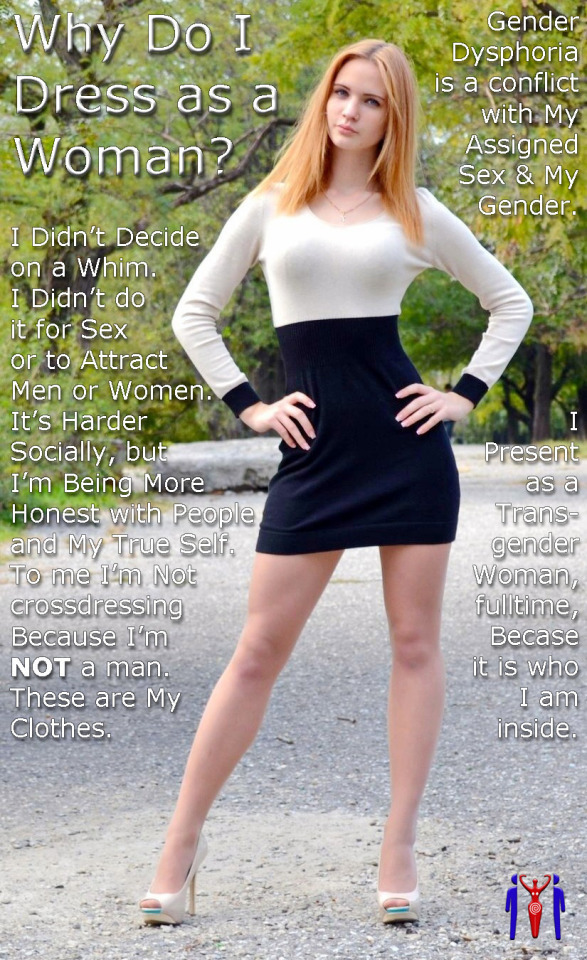
I know to some this is just a pretty picture with a lot of words on top, but this is very real for many people. Be kind, be supportive and if you can’t do either just walk away. We all have a right to life, liberty and the pursuit of freedom to be ourselves.
I felt like a part of me was always hidden, even as I tried to fit into people’s expectations as best I could. I was still the jigsaw piece that didn’t quite fit.
When I finally accepted who I was and made the decision to transition, there was an immediate improvement in my self-esteem, confidence, and mental state. And the growth I’ve experienced after transitioning is nothing short of life-affirming. But my initial transition wasn’t easy, and there were a lot of pitfalls and traps along the way. The best way to make the process easier is by talking to a wide variety of trans people, and learning from their successes and failures.

“Imagine going through life every day and having so many of your interactions involve somebody trying to give you a hug and stepping on your foot while doing it,” Prince, a 31-year-old trans woman in Alexandria, Virginia, said. “And then when you ask them to step off your foot, no matter how polite you are about it, they respond with, ‘Oh, excuse me, I was just trying to give you a hug.'”
Many transgender people, who identify with a gender different than the one assigned to them at birth, feel misunderstood by the general public. As a minority group that makes up less than 1 percent of the US population, they can often feel detached from the rest of the world. And the world, in turn, constantly pushes its prejudices against trans people — by treating them as “others” or identifying them by the wrong gender.
Trans communities are made up of people with stories and experiences to tell — some greatly shaped by their gender identity, some not.

I was about 6 years old when I picked up that I’m trans. You know how kids describe what they want to be when they grow up, like a firefighter? When I was 6 years old, I said I wanted to be a woman when I grew up. Similarly, to have people at that age grow up and realize they’re not going to grow up to be a firefighter or that it takes a lot of work to be a firefighter, that’s how I identified with being trans.
I realized something was wrong when I was 3 years old. I’ve always seen myself as female. I tried to come out to family numerous times over the years when I was younger. I couldn’t really tell them, so they took me to therapists. The therapists would say they understood and just tell my parents I’m depressed, put me on all these medications, and ignore the fact that I’m trans.
It was more than depression. It was more about having to fake who I was for so long. But once I started transitioning in 2012, I haven’t had any depression of any kind.
The first recollection I have that something was amiss was when I was 7 or 8 years old. I had a dream where I was on board the Enterprise from Star Trek. There was this transporter accident, and I switched bodies with this girl from my second-grade class. Instead of freaking out, I was like, “Oh. Hey, this feels kind of nice. I like this.”
I had a lot of vague inklings like that until I started transitioning.
If I knew this was a legitimate thing — that I wasn’t crazy — I would have transitioned much sooner. I definitely had that period where I wasn’t sure if these feelings were right to have. I wasn’t sure if these feelings were a result of something psychologically wrong with me, or some sort of sexual fetish. I had to realize it wasn’t a problem.
There were varying points in time when I knew something was different about me. I didn’t put all the pieces together in a way that I was ready to declare to anyone until after law school, when I was 22.
I remember when I was 15, being online and presenting myself as a girl in internet relay chat. I also remember around that time watching TV shows that I knew were coded for girls, and hiding it because I knew that wasn’t what I was supposed to be doing. At a younger age, I remember playing with Barbies and also hiding it. I remember knowing that my clothes didn’t feel right to me, even as a little kid.
But I wasn’t able to tell anyone I was trans. The first time I said anything, I said to the Lambda Legal group in the University of Virginia that I’m the “other one” — meaning the other gender. The first time I told anyone I’m trans was my therapist more than a year ago.

I knew from a very young age that there was something different about me. I didn’t have a name for it. As a child of the ’50s and ’60s, I came from a conservative, blue-collar family with a Catholic background. It was a different era than right now. So I never acted on it.
By the time I was 20, I had graduated from high school and joined the military. It was probably during that decade in the ’70s that I realized what I identified with.
By that time, it was a bit stressful for me. Being in the military, that was one of the things I would be discharged for. That helped me deeply suppress it.
I was married. I had two beautiful, wonderful kids and three grandchildren. I worried about my kids and my spouse if I came out in the military, because I would be without a job.
I went through my three-plus-decade career. I deployed twice, in Europe and the Middle East. But as I neared retirement, I became less comfortable with coming home.
Throughout my career, there would be occasional interludes in which I would be my authentic self. I would do that for a very short period of my time. Then the fear would creep in, and I would purge everything and try to get it out of my mind.

When I was 8 or 9 years old, I started to have this feeling that something was different about me, but I didn’t know what it was. One time, my dad and I were in hardware store. I had shaggy hair back then. An older guy bumped into me and said, “Oh, I’m sorry, little girl.” My dad went off on this guy. “No! He’s a boy!” What’s funny is I look back at that and remember I wasn’t offended. I was a little confused, but I didn’t think much of it. So there were little hints even back then.
When I went to college, that was the beginning of the internet taking off. I would voraciously consume all the information I could possibly get about transgender people and the process of transitioning. But I was incredibly adept at making up reasons I couldn’t be trans. “You can’t be trans because you like girls,” I would tell myself. “You can’t be trans because you like sports.”
As I got older, I went through a process in which I started doing things in part because they were the things that “normal men” do and these things would quiet my feelings. I got engaged, I got married, I had children.
But throughout this entire time, I was absolutely a miserable human being. I was deeply, deeply unhappy. It led to other problems in my life. I had a period in which I was absolutely lost in internet porn. It’s not something that’s fun to talk about, but it’s one of the ways my feelings presented themselves. That led to problems in my marriage, and I was unfaithful in my marriage. All of these things came from this problem of having this hole really deep within myself that I didn’t know how to fill.
Looking back, I had a lot of gender dysphoria starting at a young age — probably 5 or 7, I’d say. I wasn’t open about it for a long time. Going through primary and secondary school, I was completely closed off even to my family.
It wasn’t until shortly after high school when a suicide attempt brought a lot of that to the surface. I was kind of forced to deal with a whole lot more about myself than I usually had. I kind of came out to myself about being transgender.

Ever since I was very young I knew something was different. I enjoyed girlie things such as playing with dolls and my sisters practicing make up on me. I felt awkward somehow. Up until 10 or 11 years ago I suffered from major depression and it was at that point that I finally started to understand my true identity, and the depression disappeared. I now understand I was suffering from gender dysphoria.
When I was old enough to start work I took on a number of male dominated roles including: fireman, military police officer, police officer finally settling into a role as counsellor working with various groups including young offenders. During that time I married, divorced and married again and had five children. I emigrated to Canada with my wife and started a life there.
Throughout all of this time I knew I was gender variant, but my true identity was a complete and total secret. Then, about eight years ago, I became ill and I made the decision to come out. For the next four years I came under relentless attack from all sorts of people, including my own children. I even had my home taken away four times in one year.
I eventually left Canada after being disowned by literally my whole family. I lost my whole life and left after 18 years with nothing but a small blue suitcase. I arrived in the UK two years ago as Vicky-Marie and I haven’t looked back.
Transitioning for me was not a choice, I had to do it it was a necessity. Immediately I became a patient of Dr Webberley and began HRT. In 2017 I became a patient of the London GIC. I have now been discharged by the GIC, I have met my surgeon and will have confirmation surgery within six months.
I have undergone facial electrolysis and have applied for funding for breast augmentation. The process of transitioning brings many realisations. One of which is that I had no idea how to be a man.
The careers I chose all came with a ready made male identity, I was doing what I thought a man does, basically winging it. I also realised I wasn’t a straight man but a gay woman, and I realised I always felt uncomfortable and body conscious as a man.
I have been and still am subjected to abuse discrimination and harassment including five incidents of hate crime from neighbours. Nevertheless I am the most content I have ever been and, for the most part, I am happy especially with my amazing fiancé to share this journey with. I feel completely comfortable authentic and natural and liberated living my life as the true woman that I have always been.
I cannot imagine ever wearing the smallest item of male clothing or presenting any way as male. I can hardly even recall living as a man all those years. It’s as if my old self is someone I knew about but have never met. I am in the process of ridding myself of what I call my male infection and learning, as all young girls do, how to be a woman.
I’m almost complete and once I have completed transition and I will simply be a woman and no longer a trans woman. I look forward to what’s left of my life being who I always should have been, being the wife of the love of my life, rescuing rehabilitating and then releasing sick and injured wild birds.
I have also been involved in trans support work. I have featured in Soldier magazine, national/ county papers/ radio and several education sessions for Department Of Work and Pensions, the Samaritans and the IOW Business Women group. I was also on the main stage at the first ever IOW Pride.
My hope is that through this work I can help promote understanding and education and to dispel the assumptions and myths held by so many about trans men and women. When you decide to transition you focus almost entirely on being who you were supposed to be, my advice is not to forget that that person was always there, you just need to give them a voice.

I was born in 1952, when food rationing was still in existence. I lived with my parents, together with my older sister in an old, cold, four-roomed cottage, deep in the English countryside. We did not have a car, bathroom, or even an inside toilet, so bath time was on a Friday night by the living room fire in a long tin bath. Going to the loo meant a trip down the garden to a galvanised iron shed in which there was a toilet seat secured to a wooden frame with a metal bucket underneath which my father would regularly empty into holes dug into the surrounding farmland. My father was a land worker, my mother a part-time cleaner for the local gentry (posh people). Without question, we were poor.

One of my first memories, probably at the age of four or five, was asking my mother for a dancing skirt and she kindly obliged with one of my sister’s old skirts. It was a typical fifties cotton flared skirt, primrose yellow with blue and white flowers. Being seven years younger than my sister, it was way too big, so my mum would secure it around my waist with a safety pin. It was far too long as well, but this added to the twirling sensation and fun that I had dancing to fifties songs on the wireless (radio). By the age of seven, my dad had built an extension to our home. We now had a bathroom, and I no longer had to share a bedroom with my parents.

My sister got promoted to the newly built bedroom, and finally, I got my own room. This was very convenient for me because the room had some very loose and broken floorboards, meaning I had a hiding place for all the clothes I had started to steal from her. At night I would remove her clothes from under the floorboards, trying them on, fantasising that I was going to grow into a beautiful young woman.

At the age of ten, I remember being carried from the netball court by my school’s headmistress after being accidentally kneed in the stomach while jumping for the ball. I wanted to play in the netball team but could not – because I was a ‘boy’.

I was fortunate that my parents understood my gender issues from early on. Most parents in those days would have tried to beat it out of their kids or sought conversion therapy, which was very common in those days.
At secondary school, many of my friends were girls, and my friend, Ann, suggested I become a hairstylist on leaving school. It was an idea that worked for me. With my parent’s agreement, I made an application to the local Technical College, and both my mum and dad came with me for the initial interview. In the waiting room was a very pretty tall girl accompanied by her mother. She too was waiting for an interview as a student hairdresser. I smiled, and she blushed profusely. We were engaged within two years and married two years later, I was twenty, and Linda was just nineteen.
After my hairdresser training, I went on to work for several big companies ending my time in the beauty industry, working for a global brand. For me, my hairdressing and make-up skills have been of particular use throughout my life.
Linda (Lin), my wife, knew from early on that I was trans. We had loads of fun, often going out shopping as sisters as I could ‘pass’ reasonably easily. We built a very successful retail business together, which very conveniently provided flats above the shops we rented. This allowed me to dress femme pretty much whenever I wanted. Lin later extended the use of the flats and they became a safe haven, where men from across the area would come and secretly crossdress, away from the scrutiny of their families. Some wanted to be schoolgirls and brides, but for most, it was a case of wearing a dress, having a coffee, or for the very brave, going out for a shopping experience.
Our marriage lasted 27 years before we parted, with Lin very suddenly deciding that she was fed up with one trans partner leaving our kids and me for a new trans partner. Immediately after Lin and I split up, my trans strengths came to the fore. I did a pretty good job, becoming both mum and dad, looking after my sons and my daughter, who was aged just seven when Lin left.
Around one year later, I met Jen, and we fell instantly in love. We were engaged within a few weeks, and Jen with her two daughters, moved in with us, making us a family of seven. Jen and I married as soon as my divorce was finalised, and we are still very much in love.
Jen is a wonderful woman. When we met, she had utterly lost faith in ‘normal men’. Her previous marriage, like mine, ended in an unhappy divorce, which is always sad. Jen was a bit surprised when I came out to her, but you marry a person, not a gender and after all, having a partner who can fix cars, cut hair, and do all the sewing is pretty useful!
We do everything together from going for long walks (we cover about twenty miles a week) to sharing dresses and going shopping. I often feel sorry for a woman on a shopping spree with a cis man. Sat outside the changing rooms they often resemble a row of newly convicted prisoners, about to suffer a root canal filling!
Over the years, I have learned that life can be very unkind. Our first grandson died very suddenly; he was just 26 days old, and our third grandson is autistic. Eight years ago, Jen suffered ovarian cancer, and five years ago she was diagnosed with pancreatic cancer. Miraculously she has survived – I was with her every step of the way.
In 2010 Jen and I agreed I should go onto hormones. Because of a very concerning prostate issue. I was already on mild testosterone blockers, and I wanted to be at peace with my true gender. I was 58 at the time and was becoming increasingly aware that life was passing me by and that, while almost everyone knew me as male, in reality, both Jen and I knew my female side dominated me. I was not quite in the depths of despair, but Jen knew I had been very patient in sorting out my gender dysphoria issues and had always looked after our family first. Coming out to my excellent female GP was not easy. Still, she instantly confirmed she would prescribe me oestrogen subject “to passing the necessary psychiatric tests” which I subsequently passed after visiting a private psychiatrist.

While I was exceedingly lucky in being able to handle my dysphoria for most of my life, most trans people simply cannot. In my case, I was able to tell myself I was ‘special’ and that being able to be a man or a woman was a gift. But eventually, even this mindset became eroded.
Being trans can become all-consuming, an ever-pressing obsession with becoming your true self which eventually explodes to the surface. For me though, hormones were not enough – I knew I had to have surgery to fulfil my final destiny.

I can only beg parents, that if their young (school-aged) son or daughter declares they have gender issues, to take it seriously. Be kind and accept what they are saying is valid. In my experience, the crunch ages are often at around seven and then just before or after puberty. If only I had been born fifty years later and had the opportunity to puberty blockers – but that was not to be.

My fight for surgery lasted several years, but with the help of GenderGP I got there in the end and had surgery on the 2nd of July 2019.

I became acutely aware that transphobia was becoming an issue in the UK and that cis people needed to be told the truth – that we just seek acceptance and peace.
In reality, I wanted to live a “normal life” not build a website. I have a passion for singing and wanted to join a choir, but Coronavirus has put paid to that dream, at least for the time being.I describe myself as a student trans activist as I struggle with social media although I understand SEO.
I also hope that I can inspire younger trans people that while it can take many years before achieving the life they deserve the fight is worth it in the end. Peace can be achieved by just “hanging on in there” and remembering they are “special”. I would be a liar if I said I do not have regrets though.
I regret missing out on childhood and not being a girl, not having a childbearing body… and not being a mum. I feel I have been cheated of the life I should have had; but life is never fair, and we all have to accept that.
On the outside, I am delighted with how I look, and that makes me feel good. I have had to fight very hard to achieve what I have achieved with hundreds of hours of electrolysis, laser treatments, voice therapy and of course, pain. But all the pain (both physical and mental) and all the effort has most certainly been worthwhile.
I am very grateful for all the support I have had from my health professionals, family, friends & work colleagues…to them I can only say a huge “thank you” for accepting me as I am.

I am 49. Recently my third marriage was on the brink of total collapse with conflict so destructive, stress and anxiety off the scale For the past 4 years I had been feeling angry and alone and previous behaviour of self harming and suicidal thoughts were once again surfacing in my mind.
Outwardly I had everything and had no reason to be feeling like this but things were just not right and getting worse. Following 30 years of very serious drug and alcohol abuse and many years of counselling for those problems, I realise now that I had spent 30 years numbing my feelings and hiding from everything, especially how I felt. After 500 days of being drug free, every day was becoming absolutely crazy! Immense rage, loneliness, confusion, stress, panic attacks, terrible fights with my partner.
Everything was spiralling out of control so in an attempt to save our relationship we sought marriage guidance counselling. After just two, two hour sessions it became clear how dysfunctional the relationship had become and that it was damaging both of us to the point that the counsellor suggested we consider parting. This was a wake up call as we truly felt that we loved each other but just couldn’t understand why things were so badly wrong.
What followed over the next few days was at first incredible but straight away felt right and bits of a 35 year old puzzle came together so easily that i cannot believe the years of denial I put myself through. My inability to behave like a man throughout my life has been excruciatingly painful. I always felt so out of place around men and so comfortable and at ease around women. After the second session of our marriage guidance counselling, sat on the sofa that night something came out of my mouth that i had no idea was in my head and i had no idea that I was about to say it.
I asked my wife to help me find a skirt and in a moment everything in my world shifted and clicked into place. The next day we went shopping for women’s clothes and had the best weekend together for many years. We talked and talked and feelings came pouring our of me. Things long buried surfaced and little bits of a puzzle finally began to make sense to me. Its not all been easy and at the beginning I was constantly questioning whether this was real or not but with understanding and self acceptance came such a feeling of relief and ” rightness” that I know this is real.
I have been living as a female since this happened in June ( months ) and have never been so happy and at ease with myself in my entire life! The next time we attended marriage guidance I arrived wearing a dress !! she said im not at all surprised !and she commented on how relaxed and happy I looked. Once I realised what had been wrong all of my life I began counselling and researching transition. I realised I could become my real self.

Unfortunately I began to find major obstacles in my path. I am English but moved to France 8 years ago. Assistance for transgender people in France seems to be seriously lacking and even finding information was a huge struggle. I was getting more and more anxious and when eventually I found the team in France that is responsible for looking after Transgender people, I was horrified to be told that the earliest initial appointment would be in 3 years time !! I felt so depressed. After so many years of unhappiness and not knowing what was wrong with me, to finally understand and realise that something could be done to help me, to then be told I would have to wait 3 years was crucifying. I knew I couldn’t wait 3 years so I began to look for alternatives. I felt pretty desperate and even considered moving countries !
I found Dr Webberley’s service whilst searching the internet for help. I made contact, explained my situation and found all the help I needed. I can’t begin to explain the utter relief I felt. Accessing and using the service couldn’t be easier. Even though I am in another country I can access Dr Webberley and Katie quickly and efficiently and any questions or worries I have are addressed straight away. I feel very supported and it is not a problem at all that I live in a different country.
I began gender therapy with Avril, and after looking at a detailed history and blood test results Dr Webberley prescribed hormones for me . I have now been on Hormones for 10 weeks and wow what a difference. The unhappy, frustrated, angry, dysfunctional person seems to have gone. Its like the fog has lifted and I am seeing and thinking so much more clearly.
I am really feeling like I am becoming the woman I should have always been. For the very first time in my life I am liking myself. After years of self hatred I like what I see when I look in the mirror and more importantly perhaps I am liking the person that I am. My wife was initially shocked, although she was aware of my troubled past and had said before that she felt something was ” not right”. She had never imagined that her body building, tattooed husband was actually a woman.
Although there are challenges, she is adjusting to having a woman as a partner, and although she fell in love with me as a man she loves the person I am first and sees gender as secondary to that. She tells me that she prefers “Happy Sasha” to the unhappy man that I was. Truthfully I think if I had tried to stay living as the Man she thought I was our relationship and possible me couldn’t have survived. Now although the path is different and sometimes difficult we both feel that the future is going to be good.

It’s not a choice. When I was 3-4, I thought I was going to grow up to be a girl. In first grade, I told a pregnant teacher, I was going to have a baby when I got older. She told me I can’t be a girl because I was a boy. I told her I will be a girl. At 11-12, I first heard about Christine Jorgensen and thought I can become a woman. Life happens and I’m still a man, who’s had a great life and family. I will become the woman I was always meant to be. One day it will be accepted that peoples bodies don’t always match their minds. Transitioning will be okay and we won’t have the fear of losing friends and family. 7 months on GAHT

Hi, I’m a 59 yr old transgender woman (also late discovery intersex) and I believe it highly likely prenatal DES was in large part responsible. I was assigned male at birth but from a young age suffered gender dysphoria and had small male genitalia.
I also had low fertility discovered during IVF. When I started on HRT topical oestrogen in 2011 I gained a sense of peace – a feeling like coming home after being away for a long time. I was also on testosterone blockers from 2012 to 2016 until I had my gender affirmation surgery. I’m still on HRT today – just the topical estrogen the same as may be prescribed to any menopausal woman.
I would have loved to transition genders in my youth but there was no support in the 1970s. I recall in secret trying to castrate my pre-pubescent self with rubber bands around my testicles to stave off my puberty (in order to transition) but it got too painful after a time and I had to cut the rubber bands off. Like many transgender folk of my generation my journey took the long way round and included marriage and three decades of trying to pray it away after getting born again at 17.
I had much internalised transphobia from being bullied in my youth. In 2014 I underwent facial feminisation surgery and breast augmentation to undo some of the impact of decades of unwanted masculinisation.
Transitioned life has been good for me the past decade. I learnt and performed some burlesque and then at 50 I attended my first ballet class and fell in love with it.

Imagine a boy who is curious about this nagging feeling in the pit of his stomach. He’s a man who can’t seem to explain why he’s so attracted to how girls act, talk, move, dress, etc. It’s different than an attraction to females. He’s so intimately attracted to their “ways” that he’s jealous. He wants that in his life, in his body, in his days and in his ways. He’s questioning if he should have been born “as a girl”, if he has some fetish, if he’s submissive, if he’s interested in a cross-dressing hobby, or maybe that he sees himself as someone who can be both a boy and be feminine. He’s struggling to identify his heart and thoughts.
They’re there. He’s not forcing them. And they’re growing and beginning to consume him. He’s wondering if this gut-feeling has something to do with his sexual desires. Is he gay? Is he bi? Is he something else or does it really matter? He feels alone because he’s not sure if he can talk to anybody, even a counsellor. So, he spends a great deal of time reading, fantasizing, meditating about it. He even debates himself, feels guilt, feels embarrassment, and maybe hates himself. But then he sees the joy of it, the acceptance of being girly, the tenderness and peace that envelopes him as he begins to lean more into what he is discovering as his most natural way of being. But he will find himself, and be the person he needs to be, and will get there, if only he has an angel to guide him, and watch over him.
Chapter 12
Transethics.
Transgender Rights Are Human Rights.
The inspiration came from Caroline Cossey who was “The Bond Girl” in “For Your Eyes Only”, a cryptic title if ever there was one. If she wasn’t outed I don’t think anyone would have known, it nearly wrecked her career. She did work as a model, but I think kept a lower profile, but take her case to be recognised as a woman to the European Court and was successful, but oh what a surprise, the then British Government appealed and won. The road to recognition has again been a struggle.
At the time Gender Dysphoria and the whole Transgender scenario was not well known and understood even less in wider society. But I came across two trans females who would become role models: April Ashley and Caroline Cossey. I found their stories inspirational, and was the start of the realisation I was not alone, I was not weird, and if they could make the transition, then maybe I could?
April Ashley and Caroline Cossey. I found their stories inspirational, and was the start of the realisation I was not alone, I was not weird, and if they could make the transition, then maybe I could?
April Ashley
April Ashley had an incredible trajectory: from working-class Liverpool to the Lancashire psychiatric hospital where she was tied to a bed and treated with male hormones and electric shock therapy; to Paris; London high society; a brutal divorce trial; tabloid annihilation; exile in Hay-on-Wye; and, finally, as these only-in-Britain fairy-tales go, to Buckingham Palace to collect her MBE.
From the Parisian transvestite nightclub Le Carrousel, where Ashley finally met her kith and kin. It was a friend at the club who recommended she go to Casablanca to meet the pioneering surgeon Georges Burou. She ended up being his ninth patient. Waking up after the surgery, she felt the most “extraordinary happiness”. She returned to London and became Vogue’s favourite underwear model, having the best six months of her life while she lived in stealth. Until, in 1961, a so-called friend sold her story to the Sunday Post for a fiver.
Her divorce trial was indeed brutal. Two senior gynaecologists were appointed to examine her body, reporting back that she had an “artificial vagina”. In a powerful scene, Lord Justice Ormrod’s bigoted 1970 verdict is read out as the camera pans over each contributor’s face. He ruled that Ashley was “at all times a male”, and there could be no marriage between two men – a precedent that lasted 30 years.
There is no doubt that April had astounding bravery and courage. She grew up George Jamieson in a strict Roman Catholic family, one of six children. “A very tough area”, she recalled decades later in her cut-glass accent. Her siblings “were all terribly ashamed” of what they saw as their “terribly feminine” brother. Her mother beat her mercilessly. “She couldn’t stand me because I was an embarrassment,” she says with perfect poise. Every night Ashley ended her prayers with a plea to God to “let me wake up a girl in the morning”.
Of course she didn’t describe herself as transgender at the time. “There was an enormous battle going on inside me,” is how she put it. “I was growing up to be one thing and yet I was supposed to be another.” Her close friend Tony Singleton gets choked up talking about her legacy as a trans pioneer, which he feels is yet another misfire. “She’s not a trans woman,” he insists. “What she really believed and wanted to become was a woman” The fact that she was a woman is precisely why she is a trans trailblazer and, we have not come so far. The same question that preoccupied the trial more than half a century ago – namely, what constitutes a real woman – is still being debated daily in this country.
Her strength, humour and sheer guts of a woman dragged over the coals for daring to become herself is an inspiration. As is her grace and articulacy when answering the relentless barrage of nasty, thoughtless, fetishising questions through the decades. Archive footage of her is marvellous and telling. “Are you still an object of curiosity in England?” a male interviewer cheerfully asks her. Cue laughter from the audience. “Oh, I think so,” Ashley replies with impeccable timing. “Why do you think they’re all staring so intently?”
She was born George Jamieson in Sefton Liverpool in 1935. She was outed as a transgender woman by The Sunday People newspaper in 1961and is one of the earliest British people known to have had sex reassignment surgery.
Ashley joined the Merchant Navy in 1951 at the age of 16. Bit like me joining the Royal navy! Following a suicide attempt, she was given dishonourable discharge,and a second attempt resulted in Ashley being sent to Ormskirk District General Hospital psychiatric unit at age 17. In her book The First Lady, Ashley tells the story of the rape she endured before transitioning. A roommate raped her, and she was severely injured.
After leaving the hospital, Ashley moved to London. Having started cross-dressing, she moved to Paris in the late 1950s, began using the name Toni April, and joined the entertainer Coccinelle in the cast of the drag cabaret at the Caroussel Theatre. At the age of 25, having saved £3,000, Ashley had a seven-hour-long sex reassignment surgery on 12 May 1960, performed in Casablanca, Morocco, by Georges Burou. All her hair fell out, and she endured significant pain, but the operation was successful.
After returning to Britain, she began using the name April Ashley and became a successful fashion model, appearing in British Vogue, for which she was photographed by David Bailey, and winning a small role in the 1962 film The Road to Hong Kong, which starred Bing Crosby and Bob Hope.
A friend sold her story to the media in 1961 and The Sunday People outed Ashley as a trans woman. She became a centre of attention and some scandal and her film credit was dropped
After a heart attack in London, Ashley retired for some years to the Welsh border town of Hay-on-Wye. In her book April Ashley’s Odyssey she stated that Amanda Lear was assigned male at birth and that they had worked together at Le Carousel where Lear had used the drag name Peki d’Oslo.[4] Ashley had once been great friends with Learbut according to Ashley’s book The First Lady they had had a major falling out and had not spoken for years.
In the 1980s Ashley married Jeffrey West on the cruise ship RMS Queen Mary in Long Beach, California, US. They parted but remained friends. In the early 1990s, she worked for Greenpeace before taking a job in an art gallery
She talked about her life at St George’s Hall, Liverpool as part of the city’s Homotopia Festival on 15 November 2008 and on 18 February 2009 at the Southbank Centre.
Ashley latterly lived in Fulham, southwest London. She died at home on 27 December 2021, at the age of 86.
Caroline Cossey.
Caroline was born 31 August 1954. She is a British model who often worked under the name Tula, which she also used for two memoirs. She appeared in the 1981 James Bond film “For Your Eyes Only”. Following her appearance in the film, she was outed as transgender by British tabloid “News of the World”. I remember that incident, and feeling very sorry for her, yet those around me mocked and ridiculed, which to be honest I found upsetting, but dared not show my feelings. In 1991, she became the first trans woman to pose for “Playboy”. Since then, Caroline fought for her right to legally marry and be legally recognised as a woman.
Caroline was born in Brooke, Norfolk. In her early years, she was distinctly feminine in appearance due to XXXY syndrome. In her autobiography “My Story”, she describes an unhappy childhood, where she suffered confusing feelings and bullying by peers due to her femininity. Sounds not unfamiliar. Caroline’s closest companion was her sister, Pam, with whom she played dress-up in their mother’s clothes. She left formal schooling when she was fifteen and found work in a clothing store and then as a butcher’s apprentice. At sixteen, she moved to London and worked at a variety of low-wage jobs.
Caroline started transitioning while working as an usherette in London’s West End, and by 17, was receiving hormone therapy (HRT), by then working full-time in a female gender role as a showgirl. Her feminisation journey continued with breast augmentation surgery, then went on to work as a showgirl in Paris and as a topless dancer in Rome to save up for sex reassignment surgery (SRS). She had her final surgery on 31 December 1974 at Charing Cross Hospital, after years of hormonal treatment and counselling, along with legally changing her name.
At last, she began an active social life as a woman, concealing her transition. Asked about her dating life, Cossey replied, “I’m afraid I went a little wild” She worked as a model under the name “Tula”. She appeared in top magazines such as “Australian Vogue” and “Harper’s Bazaar”. She also worked extensively as a glamour model, and where I first became aware of her, modelling motorcycle riding gear! Ironically she was a Page Three Girl for the British tabloid “The Sun”.
In 1978, Tula won a part on the game show “3-2-1”. A tabloid journalist then contacted her, revealing he had discovered she was transgender, and planned to write about it. Other journalists researched her past, attempting to interview her family members. Cossey dropped out of the show, convincing the producers to release her from her contract. After this incident, Tula maintained a lower profile, accepting only smaller assignments.
Tula was cast as an extra in the 1981 James Bond film “For Your Eyes Only”. Shortly after the film’s release, the tabloid News of the World came out with a front-page headline that read “James Bond Girl Was a Boy.” By her own accounts, Tula was so upset she contemplated suicide. However, she continued her modelling career. Tula responded by releasing “I Am a Woman,” her first autobiography, written to take back control of her own narrative, she wrote:
“There, I thought, went all my hopes of leading a normal life. I was hounded by journalists everywhere I went, and their lack of understanding – the kinds of ignorant questions they asked – made me determined to tell my side of the story.”
In a later interview with “Cosmopolitan”, she said that she’d attempted suicide after the traumatic incident.
“I woke up in my bathroom in vomit. I just felt ashamed and embarrassed. And then at a certain point, I just got sick of being ashamed of something I’d never had any control over, which was my assigned gender.”
Tula became engaged to Count Glauco Lasinio, an Italian advertising executive, who was the first man to date her knowing of her past. He encouraged her to petition for changes in the British law concerning transsexuals. The engagement sadly ended, but her legal efforts continued for seven years, eventually reaching the European Court of Human Rights.
After breaking up with Lasinio, Tula met Elias Fattal, a businessman, who was unaware of her history until he proposed marriage on St Valentine’s Day 1988. When she told him, rather than rejecting her, he merely asked if she would convert to Judaism. She agreed, and they were married on 21 May 1989, weeks after the European Court of Human Rights decided legally to recognise Tula as a woman. They returned from their honeymoon to find that yet again the “News of the World” had published a story on their wedding. “Sex Change Page Three Girl Weds”,
As a result of this story, he broke up with her immediately after they returned from their honeymoon, as his parents were not aware she was trans. She also received death threats and the brakes on her car were sabotaged. She turned to writing again in order to cope, publishing her second book, “My Story”, in 1990, and returned to modelling, saying that she “wanted to make a statement”, giving details of her transition and her unsuccessful battle with the European Court. In an interview with Joan Rivers she told about the impact of the tabloid’s behaviour saying:
“We decided not to tell (his parents that I was transgender). We went for our honeymoon to Acapulco and we thought we’d tell them two years down the line. We came back and it was front page in one of the tabloids. He was summoned home by his mother, two days later I got a phone call from his brother saying you need a lawyer.
“I never saw my husband again and didn’t have a leg to stand on in terms of a settlement. The marriage was annulled. Being exposed by the press, being dumped by my husband, those are the issues I’m trying to address. My birth certificate can’t be amended, which means I’m legally a male and I can’t get married. I break the law every day because I use women’s bathrooms. In the end, I guess he just couldn’t stand up to his family. The sad thing is, I think he still does love me. You can’t just stop loving somebody in five minutes.”
She went on to explain that wasn’t the case in the US and Canada at the time, and that if she lived in America she would have more rights than she did in the UK, including the right to marry. Joan described the prejudice as “horrendous”.
Asked where she saw herself in 10 years time, she replied: “I’d like to have what I had when I was with my husband – totally happy, to have peace of mind and also to know the 30,000+ people I’m fighting for in England – to know how that’s turned out… they get sacked and have a bad time because people don’t understand what we’re all about.”
On 27 September 1990, the European Court overturned its decision on a British government appeal. Tula returned to modelling, which she had given up four years earlier. It took more than 10 years, but finally, in 2005, the Gender Recognition Act did come into force, allowing people to change their legal gender.
In a recent interview, she told “Cosmopolitan”: “Times have changed so much that it’s amazing. I knew over the years when I’d see shows with gay characters that one day there would be more visibility for trans people.”
This princess did live happily ever after. In 1992, Caroline Cossey married a Canadian man named David Finch, they’re still married and live near Atlanta, Georgia. The Canadian press reported their wedding oh-so-sensitively as “A ’90s odd couple: Montreal man to marry transsexual.”

Due to the paranoid, reactionary, ignorant, intolerant bigots I have not transitioned. I fear the rejection ridicule, prejudice, hostility and downright violence the trans community seems to face. I have nothing but respect for the courage shown by those that have transitioned.
Imagine if it was the other way around, and everyone on the planet was Trans except for a small group of men and women who were constantly being demonised and vilified for being a little bit different from the “norm” and for living a non-Trans life. And what if this Cis minority had to prove who they were and needed a certificate to enter a Trans only space; or were beaten, laughed at and called weird, perverted and worse; or had to go for conversion therapy to change their Cis thoughts and Cis identify to Trans?
Just think. What if it was the other way around? What would it be like for a government to hate you and treat you as a political football for votes. Would you think that was fair and just? And if you wouldn’t like it, would you. So why should Trans people. We are all human, and we should treat others how we would want to be treated ourselves.
It’s clear that a significant segment of human society has difficulty accepting that transsexuality is a real medical condition which is part of our inherited genetics. The common tactic of the blatant transphobe is to dismiss us as freaks, psychopaths, or even monsters deserving of involuntary institutionalism. The casual transphobe, or crafty one, will instead often use phrasing:
“Hey, I don’t care if someone thinks they’re Napoleon. What. Ever. But don’t expect me to salute them or call them Emperor. That would make me as crazy as they are. This is just common sense, people.”
Sadly, as seen in any political debate, “common sense” is a meaningless phrase loaded with contrived meaning, almost always uncommon and insensible. “We want common sense measures to keep dangerous weapons off our streets!” versus “Giving people the ability to defend themselves against criminals is just common sense!” With so much “common sense” out there, it’s amazing that anything ever goes wrong!
It’s common to hear the phrase “all babies start out female, and it’s only later that they become male,” and this is at least partially true. In fact, the influence of testosterone on a foetus has been described as a defeminization process, changing a foetus which was essentially predestined to be female into male. Testosterone production and the conversion of some testosterone to dihydrotestosterone between weeks 6 and 12 of pregnancy is critical for the initial development of male features, such as the penis, prostate gland, and scrotum. (Bao) In the absence of these male hormones, female genitalia develop instead. Brain development, however, does not occur in earnest until the second half of the pregnancy term, after the genitals have been developed, and the continued presence of male hormones results in a brain which has subtle, but critical physical differences from the female brain.
The fact that the brain and the genitals develop at different times in the womb mean that a misalignment between the genitals and brain may develop, leading to either an intersex condition, or a transgender individual.
Endocrine-disrupting chemicals (EDCs) are defined by the US Environmental Protection Agency as a group of substances that “interfere with biosynthesis, secretion, transport, elimination and function of naturally existing hormones in the human body”. Exposure to endocrine disruptors during crucial developmental time windows increases an individual’s risk of developing a variety of diseases, including inborn errors, infertility, obesity and cancer.
The belief, is that these chemicals disrupt the influence of testosterone on the brain in the womb. In other cases, it’s believed that prenatal exposure to estrogens, progestins, and antiandrogenic chemicals could suppress endogenous testosterone production by interfering with the hypothalamic-pituitary-testicular axis. So how is it ethical to influence natural development by synthetic means?
The science suggests there is more than sufficient evidence that transgender persons either have a serious hormonal-based birth defect, have been exposed to exogenous chemicals which have impacted their gender development in the womb, have a genetic karyotype which differs from the general population, or via some other process have a brain structure which is different than would be indicated by their chromosomes. While no single study presents proof beyond any shadow of a doubt or with metaphysical certainty, taken together they do present a preponderance of evidence such that one can say with confidence that transgender individuals have a congenital gene-based difference from cissexual individuals.
During my student days, ethics was covered in many of the modules, as you might appreciate. I want to get this out of my system
Ethics refers to the concepts of right and wrong conduct, and is basically a branch of philosophy dealing with the issue of morality. Moreover, ethics consist of the rules of behaviour. It certainly defines how a person should behave in specific situations.
Ethical comes from the Greek ethos “moral character” and describes a person or behaviour as right in the moral sense – truthful, fair, and honest. Sometimes the word is used for people who follow the moral standards of their profession.
In everyday life there are a set of principles that can be applied:
- Make Things Better. …
- Treat Others Fairly. …
- Consider the Consequences of Your Actions. …
- Respect the Rights of Others. …
- Act with Integrity.
Gender dysphoria is more than feelings and emotions. Hope, fear, joy, sadness, elation, desperation are all emotions, but gender dysphoria goes beyond those. It is a deep awareness that something is very wrong, and that the mind is trapped in the body of the wrong gender. There is a need to become the person that was meant to be.
Gender is not the same as sex, though the two terms are often used interchangeably, even in technical or scholarly literature, creating a great deal of confusion. Gender is generally considered to be cultural, and sex, biological (though contemporary theories posit sex as a cultural category as well). The words “man” and “woman” refer to gender. No one is born a woman or a man—rather, as the saying goes, “one becomes one” through a complex process of socialization. Gender is the social organization of different kinds of bodies into different categories of people.
Some people say that trans people are just confused about their gender, especially when they are young. But if regular boys and girls and cis men and women know from an early age what gender they are, then the same must be true of transgender people. All this being confused is just bigotry by another name.
The UN Charter of Human Rights without doubt applies to Trans people. Peace, dignity and equality on a healthy planet.
Human rights are rights inherent to all human beings, regardless of race, sex, nationality, ethnicity, language, religion, or any other status. Human rights include the right to life and liberty, freedom from slavery and torture, freedom of opinion and expression, the right to work and education, and many more. Everyone is entitled to these rights, without discrimination.
The foundations of this body of law are the Charter of the United Nations and the Universal Declaration of Human Rights, adopted by the General Assembly in 1945 and 1948, respectively. Since then, the United Nations has gradually expanded human rights law to encompass specific standards for women, children, persons with disabilities, minorities and other vulnerable groups, who now possess rights that protect them from discrimination that had long been common in many societies.
The International Covenant on Economic, Social and Cultural Rights entered into force in 1976. The human rights that the Covenant seeks to promote and protect include:
- the right to work in just and favourable conditions;
- the right to social protection, to an adequate standard of living and to the highest attainable standards of physical and mental well-being;
- the right to education and the enjoyment of benefits of cultural freedom and scientific progress.
It also deals with such rights as freedom of movement; equality before the law; the right to a fair trial and presumption of innocence; freedom of thought, conscience and religion; freedom of opinion and expression; peaceful assembly; freedom of association; participation in public affairs and elections; and protection of minority rights. It prohibits arbitrary deprivation of life; torture, cruel or degrading treatment or punishment; slavery and forced labour; arbitrary arrest or detention; arbitrary interference with privacy; war propaganda; discrimination; and advocacy of racial or religious hatred.
The rights of the child go a little further. These include the right to life, survival and development. Protection from violence, abuse or neglect. An education that enables children to fulfil their potential.
From the Institute of arts and ideas:
Earlier this year we put the question “How can philosophy help us understand transgender experiences?” to a range of thinkers. You can find some of the answers received below. When theorising about transgender experiences, questions of subjectivity and objectivity, of power, ideology, and authority, frequently get raised. Perhaps the greatest disputes have surrounded the relation between transgender identity and the legal consequences of feeling like one belongs to a different gender than assigned at birth. Just how much the tools of philosophy and theory can help express diverse experiences of being alive?
Philosophy can ask: what is a transgender identity? More generally, it can ask what “identity”is, and interrogate the central role that the notion now plays in contemporary politics. On one interpretation, one’s identity is wholly subjective: it’s whatever you believe you are, right now, where your beliefs guarantee success – if you now believe that you are such-and-such, then being such-and-such is your identity, and there’s no way you can be wrong about that. Sometimes we hear that identities include, not just being trans or not, but also having a sexual orientation: being gay, or heterosexual, or bisexual.
But if, for instance, “subjectively believing you are heterosexual” is equivalent to “actually being heterosexual”, then this presumably means you are automatically heterosexual as long as you feel that term applies to you. And this looks wrong. Aren’t there independent, non-subjective conditions to be fulfilled, to count as being a heterosexual? You have to be genuinely attracted to the opposite sex, for one. Lots of people believe they’re straight but aren’t. Self-deception is possible. So possession of a heterosexual identity, in an interesting sense, seems to require more than just subjective belief. If that’s right, then we should think harder about making a transgender identity only a matter of what one subjectively feels is true about oneself right now. (Kathleen Stock, Professor of Philosophy, University of Sussex)
Philosophy can change the way we understand both the social imposition of gender identity, because gender is nothing more and nothing less than a social construction based on sex stereotypes. By thinking philosophically about what it means to be a woman, or a man, we can differentiate between biological sex, and the rules imposed upon women and girls, in order to render us socially, sexually, socially and politically insubordinate to men.
Being a woman, or man for that matter, is not an abstract, philosophical concept though. Under patriarchy, our position is rooted in material reality. But women are not subordinated by our biology, but rather by the meaning imposed on our biology under patriarchy. It is patriarchy that decided women are defined by our biology, and not women ourselves. Part of our oppression is being denied reproductive rights. Any female is required to live under male dominance and adhere to gender rules of femininity – in other words – subordination. If being a woman in this society was merely a philosophical idea, we could rid the world of male dominance quickly and easily. (Julie Bindel)
One thing philosophers are good at is digging down into the details of a claim, working out whether it’s coherent and consistent, and clarifying what’s really being said so that people who are arguing about it can avoid talking past each other. One claim being advanced by a small segment of the population at present is that everyone has a gender identity. This claim does several things. First, it displaces alternative understandings of gender, e.g. gender as harmful stereotypes, shifting focus from how someone is treated by others in the world to how a person feels about themself. Second, it imposes a form of self-understanding on a large number of people.
People who do not experience dissonance in living as men or women are told they are ‘cisgender’, that they identify with their manhood or womanhood. This claim is unfalsifiable: there’s no way to tell the difference between a person who has a gender identity that isn’t dissonant for them, and a person who doesn’t have a gender identity. Many feminists inspired by the second-wave insist that they are in the latter category. Philosophers can help us understand what a gender identity might be, and whether it’s a fitting characteristic to replace sex in law. (Holly Lawford-Smith is a political philosopher at the University of Melbourne)
By emphasizing trans people’s knowledge and lived experiences, trans philosophy runs at odds with much of mainstream professional philosophy, in which trans people are seen as politically biased or self-deluded as opposed to the unsituated, unbiased, disengaged philosopher. What many philosophers do not acknowledge, however, is that the distant, critical, non-trans writer has actually been the historical norm when it comes to practitioners of trans scholarship. There’s nothing novel about them at all.
Just as trans philosophy was becoming transformed into a conversation with trans people, we are seeing a resurgence of philosophical claims to the right to treat trans people as objects of study and curiosity. Mainstream philosophy (ever late to the party) suddenly demands work on trans issues, but the impact of tenuous trans employment and the silencing of trans perspectives are deprioritized as issues of free and open academic inquiry. Even critiques of gender-critical philosophers continue to centre non-trans critics as the primary sources of trans philosophy, while ceaseless controversy makes affiliating with trans people as colleagues and potential employees risky for professional advancement.
The work that has been done to create spaces for trans philosophers continues to be fragile, and the material conditions of academic philosophy will likely not support it anytime soon. Nevertheless, however mired in conflict this work may be—indeed, because of how great the conflict is—the work to build trans spaces and promote trans perspectives in philosophy is more important than ever.
Kathleen Stock, a professor of philosophy at the University of Sussex, in Britain, brings another set of tricky question to the fore: If there are inherent differences in interests between cisgender women and trans women, why aren’t academics debating them?
Writing philosophy about being transgender is tricky. There are outstanding debates about which questions actually matter and who is best situated to philosophize about transgender identity, along with pitfalls to avoid — arguably facile comparisons among them.
Beyond the academic world, there’s a huge and impassioned discussion going on, around the apparent conflict between women-who-are-not-transwomen’s rights and interests, and transwomen’s rights and interests. And yet nearly all academic philosophers – including, surprisingly, feminist philosophers – are ignoring it.”
Stock’s occasion for writing is proposed changes to Britain’s Gender Recognition Act, which would make it easier for trans people to gain recognition for their identities through self-declaration. While many British feminists support the changes without hesitation, others — especially radical feminists — believe being born with a vagina is meaningfully different from being born without one. There are concerns about whether trans women might come to dominate women’s issues in politics, for example, likely unfounded.
The debate has, in some instances, led to clashes between protesters in Britain, but academics aren’t really talking about it. The claim is that part of the problem may be fear of being labelled transphobic for asserting that there are important differences between cisgender women and trans women — what is called the “gender-critical” position. (The “metaphysical” position, she says, is that there is no meaningful difference between cisgender women and trans women.) Yet another part of the problem is that academics may not want to add fuel to anti-trans bigotry.
Arguing for civil, academic debate on these different perspectives, but seeing the validity of these points should not depend on accepting the [gender-critical] position. It is perfectly possible to think the [gender-critical] position fundamentally flawed without acting like there is a bad smell in the room when anyone raises it, and that its proponent must be a moral degenerate.
Gender-critical feminists outside the academy are doing strong and interesting work on their own, and arguably don’t need help in any case, but it would be nice if the political climate allowed like-minded philosophers to contribute freely where they could.
Rachel Williams, an independent scholar of philosophy and a trans woman, said there are so many worthwhile questions beyond “What does it mean to be trans?” While it’s not a bad question, she said, it’s “telling when cis scholars jump right on that” because it’s “exotic” or “interesting,” trying to “psycho-analyse our identities and define who we are when we are quite capable of defining the boundaries of our own existence.”
“If your first entry into trans scholarship is ‘Are trans women, women?’ then you are probably doing it wrong,” Williams said. “Do more scholarship, ask deeper questions and, above all, listen to trans people when they tell you the dangers of pursuing that question — especially when your first entrance into trans studies comes through the so-called gender-critical perspective.” That perspective, while philosophically significant, “has a long and distorted ideological history which is often dangerous, bigoted and filled with hatred for trans women disguised as feminism,” she added.
The nature of transphobic violence against trans people, what transphobic violence against trans people shows about how gender works in general, and how transgender identity illuminates personhood itself. Overall, Williams said, “Trans lives are not just some academic puzzle. We live real lives, with real experiences and real problems.”
Living life as a trans man, woman or non-binary individual in a deeply transphobic society is likely to result in violence, prejudice and discrimination. A YouGov survey commissioned by Stonewall in 2018 found that two in five trans people have been subjected to a hate crime or incident because of their gender identity, more than a quarter of trans people in a relationship in the last year have faced domestic abuse from a partner, and one in four trans people have experienced homelessness. Trans people are far more likely to be victims of violence than perpetrators.
On 25th May 2019 the World Health Organization (WHO) announced an important change to its global manual of medical diagnoses: being transgender would no longer be classified as a mental disorder.
Coming 46 years after homosexuality was similarly declassified, this was recognition, a WHO expert said at the time, that being trans is “not actually a mental health condition”.
Three years later, at the time of writing, the “liberation” that this move supposedly promised trans people is yet to materialise. The WHO had removed “gender identity disorder” from the mental disorders chapter of its diagnostic manual and reframed us as “gender incongruent” in the sexual health chapter. At the time, human rights organisations hoped that this would push governments around the world to drop the requirement that trans people be medically diagnosed before being able to access gender-affirming healthcare and legal gender recognition.
But in dozens of countries – including nine in Europe and Asia, according to the most recent Trans Rights Europe Map – trans people must be sterilised to be legally recognised. In many more, including the UK, trans people who want the correct name and gender on their official documents, or access to gender-affirming healthcare, are forced to be medically diagnosed first with gender dysphoria. By medicalising the process of transition, governments – often going against the professional opinions of doctors – continue to pathologise trans people.
The paradox at the heart of this myth’s persistence is this: While being trans is not a sickness, the way society treats trans people often makes us sick. The lack of baby boomer generation LGBTQ+ people isn’t because it is more popular now. Many were murdered by their peers, died from government inaction during the AIDS crisis, committed suicide due to lack of social supports, or have had to live in the closet due to their peers’ cruelty.
And in countries where a gender dysphoria diagnosis is required for trans people to access gender-affirming healthcare, the myth becomes extra sticky. If trans people aren’t mentally ill, why do we need a psychologist’s report before we can have healthcare? Healthcare that, often, cis people can access without being made to jump through these pathologising hoops.
This myth that being trans is a mental illness also persists beyond the finer details of trans-related legislation and healthcare. We get called “mentally ill perverts“. The paradox at the heart of the myth that being trans is a mental illness is this: while being trans is not a sickness, the way society treats trans people often makes us sick.
Of course, society branding women as mentally ill is nothing new – doctors diagnosed women with “female hysteria” for centuries. And we shouldn’t shame people who live with mental illness, as many trans people do.
The diagnosis of gender dysphoria (which not all trans people experience) is not a mental illness – it is a term used to describe the clinically significant distress some people feel at the difference between their gender and the sex they were assigned at birth. That said, many trans people do have mental health issues.
Why? Discrimination, violence and stigma contribute to trans people having worse mental health outcomes than cis people. Trans people are nearly nine times more likely to attempt suicide in our lifetimes, four times more likely to experience depression, three times more likely to have an anxiety disorder, significantly more likely to use drugs or alcohol as coping mechanisms, and more likely to develop an eating disorder. Research this year found that non-binary people (who may or may not be trans) have the worst mental health of all genders. More than one in two non-binary people worldwide are clinically distressed or struggling.
Often, trans and non-binary people’s mental health can be improved by having better access to resources and support – just like it can for any other group. Housing security, employment that pays a liveable wage and accessible healthcare all hold the potential to improve someone’s mental health and wellbeing. In the UK, one in four trans people have experienced homelessness; a 2018 survey revealed that a third of UK employers won’t hire a person they know is trans; and trans people who want to medically transition will be left on an NHS waiting list for around five years before being given their first appointment at a gender clinic.
For trans people, research shows that gender-affirming healthcare – including counselling, hormones, surgeries, speech therapy and puberty blockers – has a positive impact on mental health.
This was reiterated by a study I read, forget where, which found that trans people who want and take hormones have better mental health than those who want them but can’t have them. The researchers also concluded that if trans teenagers who want to take hormones are given them, they grow up having fewer suicidal thoughts, fewer substance use issues and being less likely to experience a major mental health disorder in adulthood. For trans people, transition can bring happiness.
Many trans and non-binary people know this. Instead of being defined by experiencing gender dysphoria, trans writers and artists increasingly make work about gender euphoria: a powerful sensation of happiness. It can come through being gendered correctly by others, by changing our name or pronouns or hair or the way we dress, or from that magical first post-top surgery swim.
Making gender-affirming healthcare freely available to all who want it, trans or cis or anywhere in between, would go some way towards ending the myth that we are mentally ill. Improving trans people’s material conditions would help, too.
Perhaps in that future, where we get our T from Tesco and everyone is housed and fed, we will stop measuring transness by gender dysphoria and poor mental health. Perhaps in that future, trans people will be defined by our experiences of trans joy.
Then there is “woke” I liken it to woke up:
“The opposite of ignorant”. It is to have an open mind, curiosity and critical antennae. It is to understand that, though the world will never be perfectly fair to all, we all have a duty to strive to make it fairer, and stand by the many who are kept down and denied, generation after generation. (From Webster’s universal dictionary)
“woke” is defined as being “alert to injustice in society, especially racism”, which is a good thing. However, the right (and by that I mean the paranoid reactionary and intolerant who believe that anything that runs contrary to their narrow world view as a conspiracy) have appropriated the term as a pejorative
For Sam Leith, I read, of the adamantly right-wing Spectator: “[It] is to show curiosity about other people; to aspire to enlarge your range of sympathy. It is to take an interest in how the world may look from another perspective… the aspiration to be woke is in line with the basic project of the Enlightenment: to question received ideas and see if your assumptions are susceptible to disproof.
We all have an obligation to examine our own life stories and inherited prejudices. Both are too often airbrushed or Photoshopped out. I cannot claim to be woke if I don’t address, for example, the racisms and embedded sexism and homophobia and intolerance of the cultures I was born into. I learnt to interrogate what I was taught and to have respect for LGBT and disabled people here, in this country.”
Anti-wokery in the media has an audience because it’s full of comforting lies: pre-packaged opinions that can easily be picked up and use to soothe any sense that something might need to change.
But “woke,” in its earliest use in African-American Vernacular English, before it was co-opted as a slur, simply meant “becoming woken up or sensitised to issues of justice”. It meant refusing to be soothed by the comforting lies. What’s changed is that large chunks of the media and political class have started explicitly naming “becoming aware of issues of social justice” as a direct threat to their business model.
As such, it’s unsurprising that the mainstream “anti-woke” crowd would find themselves getting closer to the more extreme far right. If telling comforting lies in service of a politics that actively makes everything worse, then there needs to be even more outrageous excuses for why it’s not working.
It becomes more difficult to justify climate change denial when the UK breaks temperature records year-on-year, so there needs to be conspiracies to explain why the real world disagrees with that perspective. If “racism isn’t a problem anymore, so anyone complaining about it is just ‘race-baiting’,” an excuse to explain away real inequalities in wages and health outcomes, the far-right’s race science is there to help. As more people meet trans people and find out they’re actually not sex offending “men in women’s clothes” trying to invade toilets, there is solidarity in the far right-wing “anti-gender ideology” networks advocating to roll back feminism than in wider society.
Perhaps most importantly, at least as far as the professionally anti-woke are concerned, is the need to shut down any hint of culpability. If climate change really is a problem, then the people who made good money for decades saying it wasn’t have some questions to answer. If the UK’s economic woes weren’t caused by the evil EU, but by politicians closer to home, those who spent years hammering foreigners in defence of those politicians seem to bear some responsibility for the way politics has gone in recent years.
If your entire worldview, your entire sense of self, and the justification for your continued employment is that the left are simply out of touch scolds who are never right about anything, you are going to end up uncomfortably close to every other “anti-woke” reactionary group as you get increasingly desperate to explain away the problems you have been saying are just far-left radicalism for decades.
This process inexorably trends towards radicalisation. The uncomfortable result is that Andrew Tate’s politics, odious and extreme as they are, aren’t as far from something you can read every week in some sections of the UK press as people would have you believe.
Let’s recognise “anti-wokeness” as what it is: a smokescreen for reactionary, misogynistic, racist, homophobic views. Let’s stop pretending that the people who spout this stuff are speaking for some kind of mythical “authentic” man on the street because it makes you feel better about agreeing with them. Let’s accept that the comfort of a small bunch of media commentators isn’t more important than fixing the problems we’ve made for ourselves, be they the climate crisis, racism, homophobia, transphobia, or industrial-scale misogyny.
Woke it would appear is a word that can now mean anything the user wants it to mean, ultimately advocating ideas that others don’t agree with, almost overwhelmingly the paranoid, reactionary, ignorant bigots. It is the connotations as to what “anti-woke” means.
The Pantheist attitude towards other humans is one of the deepest respect. Humans are not just equal participants in the unfolding of the universe. Every individual consciousness is an equal focus of awareness of the cosmos and nature. Whatever a person’s abilities or disabilities, in this central respect, all are equal.
It should be recognised that all humans are equal participants in and observers of the reality that is revered. They should be treated as ends in themselves, and not simply as a means to an end, and their suffering should be alleviated where possible.
Their legitimate goals in life should be observed and respected, and these goals do not have to be drawn up in a list from scratch. These have been summarised in the body of the international treaty of human rights, probably the greatest ethical achievement so far. These include civil rights such as the freedom of speech, opinion, religion, assembly and association, and freedom from torture and arbitrary detention. They also include political rights such as the right to democracy, economic and social rights, such as the right to work, orientation, health care and freedom form hunger.
“LGBTQ” is now a commonplace term that joins lesbian, gay, bisexual, queer, and transgender people under the same acronym. If you are part of a company or group that says it’s LGBTQ-inclusive, remember that transgender people face unique challenges, and that being LGBTQ-inclusive means truly understanding the needs of the trans community and implementing policies address that them.
Despite the tremendous challenges that come with living in a culture that does not treat transgender people equally, transgender people have made and are making significant contributions to society.
An understanding and demonstration of basic human decency is no bad thing. Us trans folk do not want to change the world or convert people. Far from it, we want to be left alone in peace to lead the lives we need to lead. If the paranoid, reactionary, intolerant bigots, whose prejudices are fuelled by certain sections of the media and politics, and who believe that anything outside of their narrow world view is a conspiracy theory, can’t deal with it, then tough, we are not asking for your acceptance or agreement, leave us alone!
And so the debate rages on between politicians, media pundits, journalists, media celebrities, those who would exploit for their own ends, and men and beards, and none of them actually bother to talk to trans people to gather first hand experience.
You can hate us, shun us, beat us and kill us, but in a 100 years we will still be here, because trans people have always been here
The path of medical diagnosis of “trans” led from an unquestioned pathologization – an evaluation as pathological – in the middle of the 20th century to the view more or less accepted in professional circles today that trans identity is a norm variety and has nothing to do with mental health or illness.
From her own experience, Annette Güldenring, specialist in psychiatry and psychotherapy, describes this situation as a life on the margins of society, in a legal no-man’s land, since trans people in the 50s and 60s of the last century the way into a bourgeois position was usually impossible. Also, medical aids such as hormone treatments and surgery were only available to a few trans people during this time, and very few professionals in psychiatry and psychology were willing and competent to work with trans people. The result was a life in hiding, in constant fear of being discovered and victims of massive exclusion and violence.
The rejection of trans experiences and trans forms of life has its cause above all in the idea of binary genders – an idea that strongly shapes the thinking in society and to which it is almost relentlessly adhered to.
From a young age, “They” told you that you are a boy even though inside you feel like a girl. “They” told you to never speak about it, it is too dangerous because society is not kind to people who are different and do not fit the mold. “They” said to hide her, and to be ashamed of her. This is how to kill a transgendered child. God created them this way for a reason, yes he created their genitals but he also created their minds. If you argue only their genitals are valid and that their mind isn’t, I guess you are saying God made a mistake when he created them. So maybe your argument is really with God!
The tension and suffering resulting from the discrepancy between a person’s gender identity and their biological body leads many trans people to seek physical assimilation to the desired gender. The diagnosis is now called “gender dysphoria”. This signals that it is not the identity that is pathological, but that there is a discomfort (“dysphoria”) with one’s own gender in the case of opposite-sex identification. This is at least a step towards to depathologisation, even if this goal has not yet been fully achieved. This carries the risk of serious psychosocial impairments.
The diagnosis of “transsexualism” as “the desire to live and be recognized as a member of the opposite sex. This is usually accompanied by discomfort or the feeling of not belonging to one’s own anatomical sex. There is a desire for surgical and hormonal treatment in order to adapt one’s own body to the preferred sex as much as possible”. By assigning “transsexualism” to “gender identity disorders”, this form of identity is pathologized.
The depathologisation and the formulation of new treatment and counselling guidelines are only the first steps in the right direction. In order for trans people to be freed from the untenable situation of extreme heteronomy, the following changes should be necessary.
- Trans identity should be considered by professionals in the various disciplines as a norm that has nothing to do with mental health or illness.
- The professionals with whom trans people deal during their transition (endocrinology, plastic surgery, psychiatry, psychology, social work, jurisprudence, etc.) should make their expertise available to trans people so that they can make their own decisions about the transition steps they want.
- The determination of the goals and the approach to the transition should lie solely with the trans people themselves.
- The consequence of this should be that there are no more assessments or other professional opinions (e.g. for hormonal and surgical interventions or for the change of first name and civil status) and no other demands (e.g. “everyday test” or obligation to undergo accompanying psychotherapy).
- Every trans person should be given the recommendation and the opportunity to be psychotherapeutically and socially accompanied, but should not be obliged to do so. The nature and scope of such an offer are to be determined by the trans*person himself.
- The public should be informed about trans people without prejudice.
- Society as a whole should rise to the challenge that trans people pose to them by questioning the dichotomous notions of binary genders and perceiving the diversity of identity concepts and ways of life as an enrichment.
Is this possible and achievable?
I imagine saying publicly:
“You see before you a woman, and I hope an attractive one at that”
“But when I die and they bury me, and should an archaeologist dig my remains up in a few thousand years, assuming humans are still around….”
“….they would find the skeleton of a male!”
“But bones don’t tell the whole story, nowhere near it, you need to see the whole person before you can tell what their story is. The skeleton will not show what I looked like and how I lived. You are scientist, you will know there needs to be supporting evidence and verification before such an assertion can be made. You see I am transgender, a trans female, I was born a boy. Let me explain…..”
“The skeleton is like a motorcycle frame. From that you can find the frame number and tell what make and model it is. But on its own you can’t tell what the colour f the bike was, whether it was standard or modified, or whether the engine was standard or tuned”
“Jung, you all know him, put forward the idea of anima and animus, there is the male psyche and female psyche in all of us”
“For the biologists, and I know there are a few here, you will know the genome, genotype, whatever, the blueprint that has all the information to make a human, is arranged in forty-six chromosomes, arranged in twenty-three chromosome pairs”
“Twenty-two of these pairs are identical between males and females, we are more alike than you think! It in the twenty third pair which provides the sex differences, female have an XX pair, and males an XY pair. The sequences that define male characteristics are on the Y chromosome, in a DNA protein complex called the S R Y (Sex Region development Y)”
“We all begin life in the womb as females, interesting huh? To become a male the S R Y complex has to switched on to do its job”
“But things can happen to disrupt that. It can become detached, get lost in translation, or inhibited by endocrine disrupters.”
“One such disruptor is Diethylstilbesterol DES for short. This is a synthetic form of oestrogen, given to pregnant mothers during the forties and seventies to prevent miscarriages. It had unfortunate side effects in both male and female offspring, elevated risk of certain cancers, autoimmune disease, deformed genitalia, and gender dysphoria, the hell of feeling you are trapped in the wrong body. My mother took DES when she was pregnant with me”
“Hormones work on a lock and key process, to activate the regulatory proteins, and DES mimics and inhibits. It can also cross the blood brain barrier in the developing foetus and rewire the hypothalamus, hippocampus and pituitary”
“Consider also Anti Mullerian hormone. When the male foetus does not produce enough anti-Müllerian hormone, the Müllerian ducts do not disappear and this leads to persistent Müllerian duct syndrome. Patients with this syndrome will have a male appearance but they usually have undescended testes (cryptorchidism) and low or absent sperm count due to abnormal development of the Wollfian duct. This can be associated with malformation of the vas deferens and epididymis. This condition is rare, but not uncommon with DES exposure.”
“DES is also known as the invisible thalidomide, and gender bending drug”
“So having an SRY gene makes you “genetically male” but is this “biological sex”? Sometimes that SRY gene / protein pops off the Y chromosome and over to an X chromosome. Surprise! So you now have an X with an SRY and a Y without an SRY, so what does that mean?”
“A Y with no SRY means physically you are female, chromosomally you are male, XY, and genetically you are female, no SRY. An X with an SRY means physically you are male, chromosomally female, XX, and genetically male SRY, as you have acquired the SRY strand.”
“And in the process of replication in cells in the foetus, there are occasions when an additional X chromosome is formed. This is XXY, also known as Klinefelter Syndrome. So are you a female, XX, or a male XY, or genuinely both? It is a spectrum disorder, and the extent of the effect relies on how many cells carry the extra X chromosome. Interestingly it is estimated this happens to 1 in 2,000 and maybe as many as 1 in 500, as many go undiagnosed, or just keep quiet.”
“But biological sex is simple! So there must be another answer….Sex related genes ultimately turn on hormones in specific areas of the body, and reception of these hormones by cells throughout the body. Is this the root of biological sex?”
“Consider also that males produce oestrogen, and females produce testosterone, and this balance can be disrupted”
“Even just a few years ago it was not safe for me to come out as trans, the pace of change has been amazing. Unfortunately, there now appears to be a backlash against that progress in the last year with hate from the media against trans increasing disturbingly in the last six months. This increasing transphobia is accelerating and is causing acute anxiety in my daily life. We are constantly questioned on our existence, treated hostilely and ridiculed in the name of debate. We are constantly exposed to hate and criticism in media and daily life as the public respond to the media’s attitudes. I’m sick of being described as a mentally ill freak.”
“Coming out as transgender is the hardest thing I’ve ever done, and having to explain it over and over again to medical professionals that were supposed to be helping me, almost made me end my life. There needs to be better support for us. I have lost those who were close to me, and it hurts, really hurts.”
“It is actually very simple. If we had no bigotry, hatred, homophobia, prejudice, racism, sexism and transphobia; and if we started embracing compassion, diversity, equality, freedom, love, truth, and understanding, the world would be a better place….for everyone. No-one is born with hatred in their hearts, they learn that from others. Every new baby is born with love, nurture it and it will grow stronger”
“So there you have it, this is me. I did not choose this, it chose me, we as trans people are not out to convert people or take over the world, we just want the right to be. I had years of hell of being locked into a body that was not meant to be. When I transitioned, I found a happiness, peace, contentment and confidence to go on and achieve what I have, and you see, trans people can contribute and hopefully make a difference for the good”
“I was born a boy, I will die a woman.”
Being trans is only 1% of who a trans person is The rest is filled with love, family and friends (hopefully) hopes, dreams, hobbies, jobs, careers, and all the other things that make things worth living. Trouble is, there are some people that just can’t see beyond that 1%, and that is a sad reality.
I think that it should be a good time for many of us, and allies in particular, to practice again the dying art of minding our own business when it comes to the identities and lives of other people.
You see someone from one of your classes in a public place with a different gender presentation/expression than they typically have? Mind your own business.
You discover that one of your coworkers is in a same gender relationship, but they aren’t out at work? Not your place to share that information in the workplace.
You overhear students in your classroom using a different name and different pronouns for one student than you are used to using? If you live in a state hostile to trans rights, pretend that you don’t know anything about this and report nothing.
You suspect that an acquaintance of yours might be gay, but they deny it when asked directly? Leave them the fuck alone.
One of your friends refuses to publicly label their sexuality? Good for them, you aren’t entitled to that information anyway.
Your sibling comes out to you as questioning, but isn’t comfortable sharing that with your parents yet? Keep your mouth shut.
Don’t out people; coming out is a personal choice not a moral obligation. Don’t demand personal information about other people’s sexuality or sex lives. You aren’t entitled to information about anyone’s gender identity, assigned gender at birth, or transition.
Bring back privacy, allow people to have control over the information that is shared about them publicly; it might save their job, their housing, their parental rights and their child’s safety, or even save lives.
I am a transgender, a woman, a human being. I am not confused, a fetish or a threat.
Much is made of where a trans person, especially female can use the bathroom, and potential for an assault. Think in terms of means, motive and opportunity. Means: If a person is undergoing the process of transitioning, or has undergone sex reassignment surgery, they are physically not capable of a sexual assault. HRT sterilises the male gonads, an erection cannot be obtained, and if transitioned, the male gonads are removed. Motive: A trans female wants to be accepted by women and accepted as one. Why attack the er people they want to be accepted by, it makes no sense. Opportunity: it seems the female of the species goes to the loo as a pack animal, so there would always be a witness.
Following the recommendations of the UK Equalities and Human Rights Commission (EHRC) as a result of the ruling of the UK Supreme Court on biological sex, both trans and cis people have to use facilities according to their birth sex, and not gender. So a trans female should use male facilities, and trans male should use female ones. There are two problems with this:
- The risk of crimes against trans females.
- A trans male would need to sue female facilities. A trans man is likely to wear chest binders, or have had breast removal surgery, and also be taking HRT (testosterone) to masculinise them, for example a deeper vice and facial hair. So in every respect they will pass as a male. So what is to stop a cis male entering female only spaces and claiming they are a trans man, and committing the offences the gender critical group fear?
Why would a predatory male go to all that trouble? It seems from a matter of record they hide in trusted professions. They can be found in the clergy, social work, youth organisations, teaching, mini cabs, showbiz, even the police; a 1,000 or so officers are facing prosecution and that is just in the metropolitan police. I bet none of them have drag queen on their charge sheets…..
Getting tired of people, politicians and the press telling me who I am and who I should be based on their own beliefs, faith and prejudices. I am not a debate. I am not an issue. And I am certainly not a political football or against the will of some invisible super being. I am me. A person. You may not agree with how I live my life, nor I yours, but I do expect the same respect from you, that you demand from me.
A thought. If the alignment of DNA and genes is determined in the foetus, before a human is born, and this determines sex and gender, then if that human turns out to be trans, then surely this is the result of a natural process, genetic variation. That is pure science. But if we believe in ”Creationism” then there is a grand design at work, and therefore that genetic alignment is part of the plan. Either way, if you are trans, that is the way you are meant to be.
Imagine if it was the other way around, and everyone on the planet was Trans except for a small group of men and women who were constantly being demonised and vilified for being a little bit different from the “norm” and for living a non-Trans life. And what if this Cis minority had to prove who they were and needed a certificate to enter a Trans only space; or were beaten, laughed at and called weird, perverted and worse; or had to go for conversion therapy to change their Cis thoughts and Cis identify to Trans?
Just think. What if it was the other way around? What would it be like for a government to hate you and treat you as a political football for votes. Would you think that was fair and just? And if you wouldn’t like it, would you. So why should Trans people. We are all human, and we should treat others how we would want to be treated ourselves.
The Pantheist attitude towards other humans is one of the deepest respect. Humans are not just equal participants in the unfolding of the universe. Every individual consciousness is an equal focus of awareness of the cosmos and nature. Whatever a person’s abilities or disabilities, in this central respect, all are equal.
It should be recognised that all humans are equal participants in and observers of the reality that is revered. They should be treated as ends in themselves, and not simply as a means to an end, and their suffering should be alleviated where possible.
Their legitimate goals in life should be observed and respected, and these goals do not have to be drawn up in a list from scratch. These have been summarised in the body of the international treaty of human rights, probably the greatest ethical achievement so far. These include civil rights such as the freedom of speech, opinion, religion, assembly and association, and freedom from torture and arbitrary detention. They also include political rights such as the right to democracy, economic and social rights, such as the right to work, orientation, health care and freedom form hunger.
“LGBTQ” is now a commonplace term that joins lesbian, gay, bisexual, queer, and transgender people under the same acronym. If you are part of a company or group that says it’s LGBTQ-inclusive, remember that transgender people face unique challenges, and that being LGBTQ-inclusive means truly understanding the needs of the trans community and implementing policies address that them.
Despite the tremendous challenges that come with living in a culture that does not treat transgender people equally, transgender people have made and are making significant contributions to society.
An understanding and demonstration of basic human decency is no bad thing. Us trans folk do not want to change the world or convert people. Far from it, we want to be left alone in peace to lead the lives we need to lead. If the paranoid, reactionary, intolerant bigots, whose prejudices are fuelled by certain sections of the media and politics, and who believe that anything outside of their narrow world view is a conspiracy theory, can’t deal with it, then tough, we are not asking for your acceptance or agreement, leave us alone!
And so the debate rages on between politicians, media pundits, journalists, media celebrities, those who would exploit for their own ends, and men and beards, and none of them actually bother to talk to trans people to gather first hand experience.
You can hate us, shun us, beat us and kill us, but in a 100 years we will still be here, because trans people have always been here
The path of medical diagnosis of “trans” led from an unquestioned pathologization – an evaluation as pathological – in the middle of the 20th century to the view more or less accepted in professional circles today that trans identity is a norm variety and has nothing to do with mental health or illness.
From her own experience, Annette Güldenring, specialist in psychiatry and psychotherapy, describes this situation as a life on the margins of society, in a legal no-man’s land, since trans people in the 50s and 60s of the last century the way into a bourgeois position was usually impossible. Also, medical aids such as hormone treatments and surgery were only available to a few trans people during this time, and very few professionals in psychiatry and psychology were willing and competent to work with trans people. The result was a life in hiding, in constant fear of being discovered and victims of massive exclusion and violence.
The rejection of trans experiences and trans forms of life has its cause above all in the idea of binary genders – an idea that strongly shapes the thinking in society and to which it is almost relentlessly adhered to.
From a young age, “They” told you that you are a boy even though inside you feel like a girl. “They” told you to never speak about it, it is too dangerous because society is not kind to people who are different and do not fit the mold. “They” said to hide her, and to be ashamed of her. This is how to kill a transgendered child. God created them this way for a reason, yes he created their genitals but he also created their minds. If you argue only their genitals are valid and that their mind isn’t, I guess you are saying God made a mistake when he created them. So maybe your argument is really with God!
The tension and suffering resulting from the discrepancy between a person’s gender identity and their biological body leads many trans people to seek physical assimilation to the desired gender. The diagnosis is now called “gender dysphoria”. This signals that it is not the identity that is pathological, but that there is a discomfort (“dysphoria”) with one’s own gender in the case of opposite-sex identification. This is at least a step towards to depathologisation, even if this goal has not yet been fully achieved. This carries the risk of serious psychosocial impairments.
The diagnosis of “transsexualism” as “the desire to live and be recognized as a member of the opposite sex. This is usually accompanied by discomfort or the feeling of not belonging to one’s own anatomical sex. There is a desire for surgical and hormonal treatment in order to adapt one’s own body to the preferred sex as much as possible”. By assigning “transsexualism” to “gender identity disorders”, this form of identity is pathologized.
The depathologisation and the formulation of new treatment and counselling guidelines are only the first steps in the right direction. In order for trans people to be freed from the untenable situation of extreme heteronomy, the following changes should be necessary.
- Trans identity should be considered by professionals in the various disciplines as a norm that has nothing to do with mental health or illness.
- The professionals with whom trans people deal during their transition (endocrinology, plastic surgery, psychiatry, psychology, social work, jurisprudence, etc.) should make their expertise available to trans people so that they can make their own decisions about the transition steps they want.
- The determination of the goals and the approach to the transition should lie solely with the trans people themselves.
- The consequence of this should be that there are no more assessments or other professional opinions (e.g. for hormonal and surgical interventions or for the change of first name and civil status) and no other demands (e.g. “everyday test” or obligation to undergo accompanying psychotherapy).
- Every trans person should be given the recommendation and the opportunity to be psychotherapeutically and socially accompanied, but should not be obliged to do so. The nature and scope of such an offer are to be determined by the trans*person himself.
- The public should be informed about trans people without prejudice.
- Society as a whole should rise to the challenge that trans people pose to them by questioning the dichotomous notions of binary genders and perceiving the diversity of identity concepts and ways of life as an enrichment.
Is this possible and achievable?
1Department of Urology, University of Illinois at Chicago, 820 South Wood St, MC 955, Chicago, IL 60612
2Department of Environmental Health, University of Cincinnati, 3223 Eden Avenue, Cincinnati, OH 45267-0056
Abstract
Prostate morphogenesis occurs in utero in humans and during the perinatal period in rodents. While largely driven by androgens, there is compelling evidence for a permanent influence of estrogens on prostatic development. If estrogenic exposures are abnormally high during the critical developmental period, permanent alterations in prostate morphology and function are observed, a process referred to as developmental estrogenization. Using the neonatal rodent as an animal model, it has been shown that early exposure to high doses of estradiol results in an increased incidence of prostatic lesions with aging which include hyperplasia, inflammatory cell infiltration and prostatic intraepithelial neoplasia or PIN, believed to be the precursor lesion for prostatic adenocarcinoma. The present review summarizes research performed in our laboratory to characterize developmental estrogenization and identify the molecular pathways involved in mediating this response.
Furthermore, recent studies performed with low-dose estradiol exposures during development as well as exposures to environmentally relevant doses of the endocrine disruptor bisphenol A show increased susceptibility to PIN lesions with aging following additional adult exposure to estradiol. Gene methylation analysis revealed a potential epigenetic basis for the estrogen imprinting of the prostate gland. Taken together, our results suggest that a full range of estrogenic exposures during the postnatal critical period – from environmentally relevant bisphenol A exposure to low-dose and pharmacologic oestradiol exposures – results in an increased incidence and susceptibility to neoplastic transformation of the prostate gland in the aging male which may provide a fetal basis for this adult disease.
Is diethylstilbestrol induced low functioning of HOXA10 gene a factor common to endometriosis and prostate cancer?
This study confirms that HOXA10 gene is predominantly expressed in prostate epithelial cells and its levels are reduced in tumors at the Castrate Resistant Prostate Cancer stage. HOXA10 suppresses prostate cancer cell proliferation, colony formation and xenograft growth independent to androgens. Whole transcriptome profiling assays revealed that HOXA10 regulates lipid metabolism and AR signaling. We demonstrate that HOXA10 can form a protein complex with Androgen Receptors, preventing Androgen Receptors from being recruited to the FASN gene promoter and thereby inhibiting FASN gene transcription. These findings indicate that reduced HOXA10 expression may contribute to CRPC progression by enhancing AR-mediated lipogenesis …..
EXPRESSION PROFILE OF HOX GENES WITHIN THE PROSTATE DURING DEVELOPMENT
Billy C Wang, Asheena L Keith, Charmaine U Pira, Kerby C Oberg
First published: 01 April 2007
Abstract
Hox transcription factors are believed to regulate body and organ-specific patterning during development. However, abnormal Hox expression post-development has been demonstrated in a number of human tumors. For example, HOXC8, quiescent in the normal adult prostate, is up-regulated with malignancy and appears to impair androgen regulation. Interestingly, the expression profile of Hox genes, such as Hoxc8,
have not been comprehensively described during prostate development. The role of these transcription factors may be critical not only for development, but also may be markers of tumor progression or targets for therapy.
In an effort to identify Hox genes important for development and potentially tumorigenesis, we isolated mouse prostates at various stages of development (0, 2, 6, 13, 24 wks post delivery (pd)). Prostate RNA was harvested, cDNA generated and semi quantitative PCR performed. Whole prostates were also formalin fixed and processed for in situ hybridization.
We found several Hox genes up-regulated during prostate development, peaking around 6 wks pd (puberty). Paralog 10 appears to be a marker for prostate as the expression of Hoxa10 and Hoxc10 is strong and persists throughout development and adulthood. Interestingly, several genes are transiently up regulated during puberty, but absent in adults including Hoxa3, Hoxb4, & Hoxc8-9.
These data may provide insight into prostate development as well as tumorigenesis.
And this study relates to endometrial cancer –
http://cancerres.aacrjournals.org/content/canres/66/2/889.full.pdf
Deregulation of the HOXA10 Homeobox Gene in Endometrial Carcinoma: Role in Epithelial-Mesenchymal Transition
Foetal programming and environmental exposures:implications for prenatal care and preterm birth
This article refers to Liang Ma (Washington University School of Medicine) who described his research into the mechanism of action of diethylstilbestrol (DES), a synthetic estrogen that was widely used as an antimiscarriage drug between 1940 and 1970 but was later shown to induce reproductive tract malformations and other defects.38 Ma’s data show that DES represses key developmental genes such as Hoxa10, inhibits cell death, reduces cell proliferation in the uterine epithelium, induces accumulation of lipid droplets, and promotes upregulation of the glucose pathway. Ma predicts that the metabolic defects caused by DES exposure could also be present in other estrogen-responsive tissues, such as fatty tissue, and thus may contribute to obesity later in life.
HoxA10 Protein Regulates Transcription of Gene Encoding Fibroblast Growth Factor 2 ( FGF2 ) in Myeloid Cells
Xenoestrogen exposure Imprints expression of genes [Hoxa10] Required for normaluterine development
Caroline C Smith And Hugh S Taylor [[[from volume 21 January 2007 the FASEB Journal by Smith and Taylor at page 245]]]]
[[[https://faseb.onlinelibrary.wiley.com/doi/pdfdirect/10.1096/fj.06-6635com]]]
Department of epidemiology and public health Department of Obstetrics Gynecology and reproductive sciences And Department of molecular cellular and developmental biology Yale University New Haven CT USA
The developing reproductive tract is sensitive to endocrine perturbation. Bisphenol a [ BPA ] A xenoestrogen, Is a common component of food storage plastics and dental composites. We tested the ability of BPA to alter expression of Hoxa10, a gene necessary for uterine development. A dose response increase in Hoxa10 MRNA expression was demonstrated in Ishikawa cells treated with 0.1 NM to 25MU MBPA. To determine whether in utero BPA exposure resulted in a lasting alteration of uterine Hoxa10 expression, mice were treated with 0.5 to 5.0 milligrams per kilogram BPA on gestational days 9 to 16. A dose responsive increase was seen in stromal cell Hoxa10 expression in 2 and 6 week old mice exposed in utero. The mechanism of BPA action, the HOXA10 estrogen response element [ERE] and autoregulatory element [ ARE ] were tested for BPA responsiveness. BPA drove luciferase expression From Hoxa10 ARE and ERE reporter constructs. Hoxa10 ERE mediated induction was blocked by ER Antagonist ICI While HOXA10 ARE induction was blocked by either ICI or Hoxa10 antisense. BPA affects HOXA10 expression through the Hoxa10 ERE and indirectly through the ARE. BPA initially alters Hoxa10 expression through the ERE, however, the response is imprinted and uncoupled from estrogen stimulation in the adult. Several xenoestrogens alter HOX gene expression, indicating that HOX genes are a common target of endocrine disruption. In utero exposure to a xenoestrogen produces reproductive tract alterations by imprinting essential developmental regulatory genes – Smith CC Taylor HS xenoestrogen exposure imprints expression of genes
Humans are widely exposed to bisphenol a BPA A common component of plastics used to contain food products and in dental composite resins. BPA is a purported endocrine disruptor First recognized as such when it leached from polycarbonate laboratory flasks and confounded an estrogenicity essay. Reproductive tract development is altered in some rodent models by treatment with BPA.
In humans exposure to BPA has also been associated with pregnancy loss 8. The potential hazards that may stem from exposure to this NO estrogen and its mechanism of action Have not been fully characterized.
In utero exposure to relatively high levels of BPA results in multiple developmental defects in rodents. BPA treatment in utero Reduces the number of days between vaginal opening and thirst estrus as well as the rate of postnatal growth in males and females [9, 10] In utero exposure to BPA also results in altered patterns of Estrus cyclicity. [11 ] After in utero exposure, the vagina demonstrates long term deleterious effects reminiscent of those induced by DES [14, 15 ]. Additionally, BPA treatment in Nutero affects the mouse mammary gland, where it alters the rate of ductal migration to the stroma And significantly increases the number of ducks, terminal ducts terminal and buds and alveola end buds [ 12, 13 ]. Early onset of puberty, changes in hormone production, and histological changes in the vagina and mammary glands indicate that in utero exposure to BPA has multiple functionally significant developmental consequences in the female reproductive tract.
Euturo exposure appears to have an effect on the uterus that persists in the adult. Low dose gestational exposure results in decreased volley increased proliferation, as well as increased estrogen receptor alpha and progesterone receptor expression In the adult murine uterine endometrium [17 ]
Similarly adult exposure to BPA results in reproductive alterations. Functional effects are seen in exposed female mice; BPA exposure results in a reduction in pregnancy rate and litter size, as well as an increase in embryo resorption [18 to 21 ]. In humans, exposure to BPA has been associated with recurrent miscarriage [8 ]. Paradoxically, lower bpa serum levels are associated with complex endometrial hyperplasia in women [22 ]. Despite the human and animal data associating [page] BPA with anomalous reproductive tract development, cancer, and pregnancy loss, the mechanism of action is not understood.
Previously, it has been demonstrated the two endocrine disruptors alter HOX gene expression in the female reproductive tract [25 to 26 ]. HOX genes are highly conserved developmental regulators that govern the segmental differentiation of the anterior posterior body axis [27 ]. Hox genes direct the development of the fallopian tube, uterus, cervix, and upper vagina, all of which derive from the undifferentiated paramesonephric duct. [28 ]. Hoxa 9, Hoxa10, Hoxa 11, and Hoxa 13 Are expressed in the developing oviducts, uterus uterine cervix, upper vagina, respectively [28]. HOXA10 mouse / Hoxa10 human in particular is the target of endocrine disruption by diethylstilbestrol [DES ] both in mice and in human reproductive tract cell lines [24 to 26 ]. Unlike estradiol, DES induces alteration of Hoxa10 expression in vitro and causes posterior shifts in Hox gene expression after in utero exposure [24 ]. The molecular mechanism by which DES exerts this effect Involves the HOXA10 estrogen response element [ERE] {25.29]. Similarly,
neonatal exposure to another endocrine disruptor, methoxychlor, permanently reduces uterine Hoxa10 expression [ 23 ].
It is hypothesized that the purported endocrine disruptor BPA would impact the expression of Hoxa10, a gene required for normal development of the uterus. Because of the necessary role of HOXA10 in uterine development and adult function, abberant expression of this gene may underlie Bpa mediated endocrine disruption. Are widely exposed to estrogenic endocrine disrupting chemicals; Disturbances in the normal endocrine regulation of Hox genes may be a common mechanism of estrogenic endocrine disruption. Further, we identify a potential mechanism of persistently altered gene expression after xenoestrogen exposure.
Materials and methods I have not included these in this note
Results
Treatment with BPA alters Hoxa10 in Vitro
Semi quantitative RT-PCR was performed to screen the effect of endocrine disruptor treatment on Hoxa10 gene expression of human Ishikawa’s cells. [omitted]
H Exposure to BPA in utero leads to persistently increased Hoxa10 expression
To determine whether in utero BPA treatment would produce alteration in Hoxa10 expression that persists in the adult, we dosed timed pregnant female mice with BPA and examined their female pups. The pregnant mice were injected with one of five concentrations of BPA on days 9 to 16 of gestation; at either 2 or 6 weeks after birth, female pups were euthanized and reproductive tracts were resected, fixed, and paraffin embedded. As shown in figure 3 immunohistochemistry was performed on sections of the reproductive tracts from female offspring. The control igG treated slides showed no nuclear staining. The uteri obtained from vehicle treated controls revealed the expected basal expression of Hoxa10 protein. Attempts to dose pregnant females with BPA at 50 milligrams per kilogram resulted in one still birth followed by death And one death without parturition. Treatment with 200 milligrams per kilogram resulted in death of all pregnant females.
Stromal Hoxa10 expression was detected. A 5, 7, and 10 fold increase in Hoxa10 protein expression was seen in the .5 1 and 5 milligrams per kilogram BPA treated mice respectively, compared with vehicle treated controls as determined by H score at the two week time point. At six weeks a five, nine, and 12 fold increase was seen in the .5 1 and 5 milligram per kilogram BPA treated mice. The results were statistically significant; p less than 0.01 Compared with controls in the 1 and 5mg per kilogram treated groups at two weeks, and the 0.51 and 5 milligram per kilogram groups at six weeks using ANOVA on ranks. After in utero treatment, no gross anomalies of the reproductive tract were observed in any of the female offspring. No positional shifts were noted in the spatial expression of Hoxa10 in the uterus or other female reproductive tract tissues Examined by IIIC [overduct, cervix, vagina: data not shown ]. Additionally, no anatomic defects were observed in non reproductive tissues known to be developmentally regulated by Hoxa10, including the spine and limbs.
Reproductive success has been previously reported and was not evaluated here.
Three mice from the 5mg per kilogram treated group and three controls underwent ovariectomy at 6 weeks. Two weeks after ovariectomy examined in the same fashion as described above. Those mice exposed to BPA in utero continued to display higher levels of uterine oxygen expression than controls. HOXA10 expression was tenfold higher In the BPA treated mice then controls. The increased Hoxa10 expression persisted despite absence of estrogen stimulation. Hoxa10 expression was imprinted by BPA.
BPA action is mediated through the Hoxa10 ERE and ARE
Hoxa10 is regulated by an ERE and an auto regulatory element ARE [24, 58 ]. To determine whether the BPA driven increase Hoxa10 expression was mediated through the Hoxa10 ERE, transient transfection and Luciferase reporter gene essays were performed. Briefly, Ishikawa cells were transfected with the PGL 3 Hoxa10 ERE, or control plasmid, Treated with varying concentrations of BPA, estradiol E-2, or do you went control, And luciferase activity was measured in cell lysates. As shown in figure 4 treatment with E-2 resulted in a dose responsive increase in luciferase activity. Activity was detected At 10-12M E2 treatment With AKD 50 of 10-10 m. treatment with BPA resulted in an induction of luciferase activity compared with controls. BPA induced reporter expression was first detected at 10 -8 M with AKD 50 of 10-6m. Excess ICI [10-6 M ] inhibited luciferase induction in response in to either E-2 or BPA.
Once activated through the ERE, we hypothesized that Hoxa10 expression would activate the ARE and maintain the increased expression. To determine Whether the BPA driven increased Hoxa10 expression was further mediated through the HOXA10 ARE transient transaction and luciferase reporter gene essays were performed. Briefly, Ishikawa cells were transfected with the PGL 3 slash Hoxa10 ARE, control plasmid with or without ICI or HOXA10 antisense, and treated with varying concentrations of BPA or diluent control. Luciferase activity was measured in cell lysates. As shown in figure 5, treatment with BPA resulted in an induction of luciferase activity compared with controls. BPA induced reporter expression was first detected at 10 to the minus 8 M. ICI Blocked the ability of ICI to induce reporter expression. Hoxa10 antisense treatment similarly inhibited Luciferase induction from the ARE in response to BPA, indicating an indirect response; BPA mediated ARE activation through increased Hoxa10, ICI blocked Hoxa10 induction by BPA, while Hoxa10 AS blocks Hoxa10 expression and therefore HOXA10 activation of the ARE. Our model of Hoxa10 Endocrine disruption is shown in figure 6. Hoxa10 expression is initially attained through the ERE and subsequently maintained by an auto regulatory loop involving the ARE.
Discussion
Endocrine disruption continues to be a significant health concern. The paradigm was established based on the untoward effects seen in women exposed in utero to the non steroidal estrogen DES. DES, given to women to prevent miscarriages, instead caused disruption of reproductive tract development. Many of the daughters of women given DES during pregnancy were found to have reproductive tract
anomalies, and some of these women developed vaginal adenocarcinoma [30]. DES mediated endocrine disruption during gestation results in developmental anomalies that persist into adulthood. More recently, endocrine disruption by multiple agents has been documented in humans, laboratory animals, and diverse species of wildlife [40, 41 ].
BPA is a major component of polycarbonate plastics and a demonstrated xenoestrogen. BPA containing plastics are used extensively in packaging of food products and are also found in the material used for dental composite fillings and sealants, which has resulted in numerous opportunities for human exposure to a synthetic oestrogen.
In vitro treatment with BPA resulted in elevated levels of Hoxa10 gene expression. BPA concentrations used to treat uterine cell culture included the average levels detected in the serum of non pregnant women [2.0 NG per ML 8.8 NM, women in early pregnancy [one .5 NG per ML 6.6 NM] Women in late pregnancy [one .4 NG per ML 6.1 NM] And fetal serum [2.2 ng per ML 9 .6 NM ] [42]. Higher concentrations are reported in human amniotic fluid [up to 8.3 NG per ML, 36NM] [43, 44]. Based on the relative bioavailability demonstrated in rats, the lowest BPA doses administered here to pregnant mice would have been expected to achieve average serum levels over 24 hours that are comparable with those reported after human exposure [45 to 47, 53 ]. Further, human serum BPA levels vary widely, Indicating potential for an increase in response with greater than average human exposure.
Altered Hoxa10 expression in women is seen in association with a number of common medical conditions. Diminished Hoxa10 expression has been reported in polycystic ovary syndrome [PCOS], endometriosis, hydrocell pinks, and improper implantation [32, 54 to 57 ]. Elevated Hoxa10 expression is seen in ectopic pregnancy [55] . Hoxa10 expression is tightly regulated, and optimal reproductive success likely depends on appropriate levels of the Hoxa10 gene product. The alterations in Hoxa10 by BPA reported here have the potential to influence reproductive potential.
In this study, in vivo administration of BPA to pregnant mice increased Hoxa10 expression in the uterine Stromal cells of female pups exposed in utero. Dysfunction of the reproductive system attributable to the abnormal expression of Hoxa10 has been well documented in rodents. Hoxa10 is necessary for normal decidualization and pregnancy. Increased oxygen expression results in altered endometrial pinopods and microvilli As well as increased letter size [49, 50 closed bracket. Hoxa10 (-/-) Mice are infertile due to a defect in uterine decidualization leading to failure of embryo implantation. (48,51). BPA exposure has similarly been associated with uteroin decentralization defects and embryo resorption, in mice [52 closed bracket. The similar phenotype shared among mice exposed to BPA and those with altered expression of Hoxa10 suggest that decidualization defects may be mediated by the altered HOXA10 expression after BPA exposure. Either decreased or persistently elevated Hoxa10 expression can impair endometrial function.
HOX genes Have a necessary role in the development of the mouse and human reproductive tract and maybe a common target of endocrine disruption. DES and methoxy core abnormally regulate the expression of those HOX genes that direct differentiation of the uterus
From the parameternephric duct [24, 25,. DES exposure in mice decreases HOXA10 expression In its normal domain and shifts its expression posteriorly along the reproductive axis. Similarly, methoxychlor reduces uterine hoxa10 expression. Multiple xenoestrogens, including BPA, may potentially act as endocrine disruptors By altering expression of this gene. Interestingly, While DES or methoxy claw exposure decreases Hoxa10 expression, here BPA treatment increased it. The final mechanism of action in vivo differs between these estrogenic substances despite all three activating reporter expression by the Hocks at 10 ERE. In vivo this effect is compound dependent leading to either activation or inhibition gene expression. Differential co-activator or co-repressor recruitment likely underlies this differential regulatory function. The net activities of xenoestrogens are more complex than predicted based on in vitro reporter assays and likely depend On cellular and developmental context.
The effect of BPA on Hoxa10 expression persisted long after in utero exposure and in the absence of oestrogen stimulation. This suggests the existence of an imprinting mechanism that maintains expression at alters altered levels, even in the absence of ligand. Several tissues and the expression of multiple genes are permanently altered by transient in utero exposure to DES. DES and BPA appear to share the ability to imprint developmental genes in utero. Endocrine disruptors may change a critical set point in the regulation of gene expression. BPA likely alters Hoxa10 expression by inappropriate activation of the ERE at a time when it is normally silent. This activation may result in epigenetic modifications of autoregulatory loops, which then become fixed at distinct set points and subsequently determine gene expression throughout life. This model is demonstrated in figure 6; Hoxa10 is initially regulated by estrogens or xenoestrogens. This initial activation initiates auto regulation, however the mechanism by which the level of expression driven from this loop is ultimately set Is not yet characterized; However, it does not appear to involve methylation of Hoxa genes [61]. Changes in transcription of a gene have been shown to alter the rate of its epigenetic modification [62 ]. Imprinting of HOXA10 by BPA is likely mediated indirectly through the premature activation of the auto regulatory element, which then inappropriately remains persistently active. Inappropriate activation in the wrong developmental context likely exposes the element to proteins that have the ability to alter the set point. Multiple developmental genes that are autoregulated or involve complex regulatory loops may be similarly imprinted. Endocrine disruptors alter a critical set point that is later uncoupled from ERE activation.
Exposure to BPA is nearly universal due to its widespread use in plastics. Functional consequences of BPA exposure have been Documented in both animals and humans [63 ]. A change in Hoxa10 gene expression provides one mechanistic explanation to explain the effects of environmental xenoestrogen exposures. We have previously demonstrated that both DES and methoxychlor also alter hoxa10 expression [23 to 25 ]. Imprinting of HOX gene expression By xenoestrogens may be a common mechanism contributing to endocrine disruption.
Neuroendocrine Foundations of Gendered Behavior: Evidence From Comparative Biology
Kaylee A. Thompson, MA, Medical Writer, Memphis, TN, USA
Chapter 13
DES My Story.
My mother told me on many occasions she took a drug to prevent miscarriages. There was only one in use for such during the 1950’s.
I am pretty typical of a DES son, in that I have a microphallus, hypospadias – my uterine tract exits at the side instead of the centre, and I have epididymal cysts and hydroceles, plus cryptorchidism. My mother did tell me, on many occasions, that when I was very young, I had operations to correct deformities.
I have asthma, hypertension, type 2 diabetes, psoriasis, and psoriatic arthritis. There are a range of psychological conditions associated with DES. My medical record shows I have anxiety, depression and Asperger Syndrome, yet I can never remember being assessed for these, they are all associated with DES exposure, an Endocrine Disruptor, as DES disrupts the endocrine system: the immune system and hormonal balance. My mother told me before I even went to school, I had trouble settling down, so I was taken to a child psychiatrist, but was never told the outcome, but needed to be stimulated. My understanding is DES is a Teratogen, a substance that can interfere with normal foetal development, and is cited as a factor in developing ASD.
I had to find out about my psychological conditions by sneaking a look at my medical record during one of the many routine medical check-ups. At one review I asked a consultant as to why I had all these linked conditions. did tell me I had a defective set of genes, a genetic disorder, but would not elaborate.
I struggle in social situations, I struggle with emotions, I have emotional meltdowns, and I can’t read people’s faces, I can’t tell whether they are happy, sad or annoyed. I struggle with crowds, I can’t focus on any one conversation, it is like a cacophony. My senses are all over the place. I am obsessive about things I like. In relationships I try to hard with no doubt annoys people or not hard enough, so people think I am aloof and indifferent. I have found these out through bitter experience. I am not that well co-ordinated, cack handed as I was frequently called. But it made me become more curious about the word, and all its injustices But I don’t get sarcasm, and I don’t really know what normal is.
I don’t really understand other peoples’ feelings or perspectives. I have hypersensitivity to lights, sounds and textures. I have awkward social interactions, and difficulty talking with others. I am not really able to interpret nonverbal behaviours in others.
I remember as a young person I was thin and tall, and had a ”girlie” figure, and was teased mercilessly. I can remember feeling very anxious and would bite my knuckles. Why didn’t my parents pick up the signs, see something was not right, and get me help? They left me to struggle.
(Part of the feeling of not being right is that I wanted to be a girl, I wanted to be with them, dress like a girl, play games with them. It was, and is, uncomfortable being a male, and there are plenty of things about my body I don’t like. I would, and still do, imagine I am a woman, being a woman. I feel I am trapped in the wrong body. I was born a boy, but I want to be a girl. It is horrid, and depressing, it seems I can never be the real me. Gender dysphoria. My mother also said on many occasions I should have been a little girl. She never elaborated. I wonder how much she knew but never said.)
I would ask my parents what were the operations that were carried out on me when I was very young, down below. The response I revived was not to ask awkward questions. My parents were great believers in aversion therapy, called the cane.
It has been, and still is a puzzle, and taken a very long time to piece it together. Being a graduate biologist has been helpful in understanding the biochemical pathways. So there are what I call clues and cues as to who and what I am. Much later In life, when being assessed by a consultant for orthopaedic issues, I asked as to why I seemed to have so many autoimmune conditions. The response was that I had a set of genes that were defective, I had a genetic disorder, which was the subject of research. When pressed al he would say is that the research is on-going.
I have asked to see my childhood medical record, but was told it had been lost and never transferred. At a review with the practice nurse for hypertension I did sneak a peak at my medical record and under the entry ”psychological” it listed Asperger Syndrome. I can’t recall being assessed for that, as the only psychiatrist I have ever visited was as above, when I was very young.
Shortly before he died my father told me that I had been done a terrible wrong, a grave misjustice and been treated very badly, and was very sorry. He was in a very poor condition, so I didn’t want to press further, but he added “everything” So, all I can conclude is that when I was very young, something did go badly wrong, and yet no-one has ever bothered to explain exactly what. I can only piece the puzzle together, maybe I should have pressed harder.
And pressed harder I did. I recently underwent investigation for testicular cancer. Thankfully turned out negative, but at the examination, for what was thought to be Hydroceles and epididymal cysts, the consultant observed I had received operations there. The GP had confirmed what I had already managed to work out. These were for Hypospadias and Cryptorchidism. The consultant confirmed that. He also remarked there is considerable scar tissue on the scan, and the operations carried out were not very good. My testes were small, not fully descended, and this meant my testosterone and fertility is low, and if testosterone is low, oestrogen levels are higher. Interestingly DES is associated with being Carcinogenic.
I did question what could cause this. He did say that the causes were due to a chromosome disorder and hormone imbalance. These either occurs naturally or could be induced by chemical exposure. DES is associated with Aneuploidy, where sections of, or whole chromosomes can be duplicated or omitted. The view taken by both that these genitalia conditions along with microphallus, the inflammatory arthritis and type II diabetes, indicate Klinefelter Syndrome, XXY, a spectrum condition.
It would have been common for the operation on an infant to be carried out, with the aim of aligning with male of female gender. Some people are assigned male or female at birth but are born with traits including sexual anatomy, reproductive organs, and/or chromosome patterns that may not fit the typical definition of male or female. These traits may be known as variations or differences of sex development (DSD) or intersex. With KS, the birth incidence is about 1 in 600.
It would have been normal then not to have told the child, and to normalise behaviour to the assigned birth gender. It didn’t work, I worked out something wasn’t right and be curious. We were denied a choice as to how we could develop our lives, through no fault of our own. Others who felt they knew better made that choice for us. If I had known 45 years or so ago what I know now, most likely I would have different life choices.
From: Could the Feminization of the Male Brain in Utero by Xenoestrogens Contribute to Female Transgender Identity? Marie—Odile Soyer – Gobillard, Laura Gaspari—Sultan and Charles Sultan. 2026. Neuropediatrics – A Significant and Evolving Clinical and Scientific Frontier [Working Title]
Feminization of the brain during foetal life:
A complex mechanism Sex steroids (androgens, oestrogens) are key factors in the sexual differentiation of the brain. They play a role in neuron proliferation and migration, neuronal differentiation, and synaptic plasticity. Moreover, thyroid hormones are essential for neurogenesis, neuronal migration, neuron and glial cell differentiation, myelination, and oligodendrocyte maturation. Therefore, any alterations in thyroid function will affect this essential neurodevelopmental process. In addition, chemicals with estrogenic or antiandrogenic activity could activate or repress the gonadotropic axis and affect reproductive functions. Lastly, during foetal life, androgens are involved in the structure and function of brain centres that play an important role in the establishment of male sexual identity. Therefore, it is legitimate to hypothesize that antiandrogenic compounds might alter gender identity development in boys.
The causal mechanisms (anatomical, genetic, biological, and/or environmental) of transgender development have not been identified yet. As a multifactorial etiology is suspected, it is difficult to detect all the implicated factors. Moreover, many different environmental factors might exert an influence, further complicating this area of research.
In males, gender identity and sexual orientation are mainly driven by genetic, epigenetic, hormonal, and anatomical characteristics. According to the organizational theory, brain masculinization in male foetuses corresponds to neural changes induced by foetal testosterone. In the hypothalamus, sexual differentiation is characterized by structural and functional features, including the number of neurons and the volume of the bed nucleus of the stria terminalis Animal and human studies have shown that foetal androgens are implicated in the development Of sexually dimorphic neurobehaviors, in the male sexual differentiation Of the brain (reproductive function and behaviour) , and also in gender identity and sexual orientation in childhood and adulthood Therefore, prenatal exposure to compounds that alter androgen production or activity may affect male gender identity and sexual orientation.
Moreover, studies in animals indicate that androgens induce male behaviour by modulating gene expression in the brain. Some years ago, Foreman et al. hypothesized that gender incongruence in transgender women could be associated with genetic variants in the AR gene responsible for brain under masculinization. These authors identified several allele combinations that are over- represented in transgender women. According to this group, gender incongruence may have an oligogenic component Similarly, Hare et al. found a significant association between female transgender individuals and longer AR repeat length polymorphism. This polymorphism has been associated with reduced AR transcriptional activity, which is responsible for IOW androgen cellular activity and, consequently, under-masculinization during life.
Markers of androgen foetal exposure have been investigated, such as the length of the index finger (21)) to the ring finger (4D) ratio (2D/4D). This ratio has been used to indirectly evaluate the level of androgen activity, with inconsistent results. The measurement of anogenital distance, another marker Of foetal masculinization, is no longer used in clinical practice because Of divergent results.
Isolated GnRH Deficiency (IGD) is characterized by IOW or absent androgen production after the first trimester Of pregnancy, but normal external genitalia. Therefore, these children are identified as boys at birth. Shirazyet al. used IGD as a clinical model to elucidate the role of Iow foetal testosterone production in human sexual differentiation. They found that this condition predicts higher recalled childhood gender nonconformity in adult men. They concluded that androgen action is critical for the development of typical male play and role behaviour.
The role of foetal androgens in male sexual behaviour is also supported by the phenotype of individuals with complete androgen insensitivity syndrome (CALS) , which is caused by the absence of androgen receptor-mediated androgen action in the target cells. Despite the male karyotype and high foetal testosterone production, the external genitalia are female. The feminine behaviour of patients with CAIS is caused by the absence of androgen effects on the brain, leading to their social upbringing as females.
Chapter 14
Summary and Conclusions.
Are there essential differences between the male and female brain? The theory could be expanded so that the female brain is predominantly hard-wired for empathy, and that the male brain is predominantly hard-wired for understanding and building systems. According to Simon Baron-Cohen (Autism Research Centre, University of Cambridge 2003) this is the empathising-systemising (E-S) theory.
Empathy is the drive to identify another person’s emotions and thoughts, and to respond to these with an appropriate emotion. The empathiser intuitively figures out how people are feeling, and how to treat people with care and sensitivity. Systemising analyses and explores a system, to extract underlying rules that govern the behaviour of a system; and the drive to construct systems. The systemiser intuitively figures out how things work, or what the underlying rules are controlling a system. Systems can be as varied as a pond, a vehicle, a computer, a maths equation, or even an army unit. They all operate on inputs and deliver outputs, using rules.
According to this theory, a person (whether male or female) has a particular “brain type”. There are three common brain types: for some individuals, empathising is stronger than systemising. This is called the female brain, or a brain of type E. For other individuals, systemising is stronger than empathising. This is called the male brain, or a brain of type S. Yet other individuals are equally strong in their systemising and empathising. This is called the “balanced brain”, or a brain of type B.
A key feature of this theory is that your sex cannot tell you which type of brain you have. Not all men have the male brain, and not all women have the female brain. The central claim of this new theory is only that on average, more males than females have a brain of type S, and more females than males have a brain of type E.
We can take the definition of the brain as the coordinating centre for sensation, intellectual and nervous activity. However, the definition of mind is the element of a person that enables them to be aware of the world and their experiences, to think, and to feel; the faculty of consciousness and thought. All intellectual and psychological phenomena of an organism, encompassing motivational, affective, behavioural, perceptual, and cognitive systems; that is, the organized totality of an organism’s mental and psychic processes and the structural and functional cognitive components on which they depend. Can both brain and mind be male or female, or maybe make and female.
This reflects on the Jungian view of anima and animus, we all have female and male elements and it depends where an individual is in the spectrum. Or as DES does endow both Asperger Syndrome and Gender Dysphoria on individuals, perhaps these individuals have a unique world view.
There is growing support amongst the science community to suggest there is a link between Asperger Syndrome and Gender Dysphoria. The National Library of Medicine has published a paper ( Gender Dysphoria and Autism Spectrum Disorder: A Systematic Review of the Literature that supports There is a growing clinical recognition that a significant proportion of patients with gender dysphoria have concurrent autism spectrum disorder (ASD). The literature investigating ASD in children and adolescents with gender dysphoria showed a higher prevalence rate of ASD compared with the general population. There is a limited amount of research in adults. Only one study showed that adults attending services for gender dysphoria had increased ASD scores. Another study showed a larger proportion of adults with atypical gender identity and ASD.
Individuals on the Autism spectrum tend to be less influenced by or responsive to societal expectations or constraints. In many ways this individuality and “marching to a different drummer” leads to greater challenges fitting in socially and in the workplace; in other ways this out of the box thinking and behaviour leads those on the spectrum to become some of our greatest thinkers, innovators and creators. This natural inclination to be oneself and not follow the crowd or societal norms, seems to correlate with a higher than average incidence of individuals on the spectrum having greater variance and flexibility in the areas of sexual orientation and gender identity and expression.
Many on the Autism spectrum do not subscribe to the prevailing binary definitions. (To whom one is attracted) While many with Asperger/Autism firmly identify as heterosexual others firmly identify as gay, lesbian or bisexual. Still others may be more flexible regarding whom they are attracted to; being sexually attracted to an individual for who they are as a person regardless of the other person’s biological gender, gender identity or gender expression. Other Asperger/Autistics may identify as Asexual or Aromantic in higher numbers than in the general population.
This gender, assigned at birth, is determined by external genitalia and for the vast majority aligns with gender identity and expression. This is called being cisgender. Gender Identity: Those with Asperger/Autism may be less susceptible to buying into the prevailing binary gender identities and instead more readily identify or know that they are non-binary or transgender. [knowledge that one is the opposite of the gender assigned at birth – Male to Female (MtF), Female to Male, (FtM)] Less constrained by the strong societal messages and more inclined to be oneself, individuals with Asperger/Autism may more readily identify as Transgender than their non-autistic counterparts who may be more susceptible to strong societal messages about remaining their gender assigned at birth. (Gender expressed by an individual’s outward appearance and perceived by others) For many on the Asperger/Autism spectrum outward presentation of gender may have more to do with sensory issues than identification with accepted expressions of masculinity or femininity.
A Paper published by Science Direct (Autism and transgender identity: Implications for depression and anxiety; January 2020) concluded Autistic traits are over-represented in transgender populations, and gender variance is high in autistic individuals. Furthermore, some evidence suggests that the autism/transgender overlap is limited to individuals sex assigned female. Few studies, however, have investigated the impact of this overlap on mental health. This study therefore sought to investigate whether the autism/transgender overlap confers an increased risk of depression or anxiety. An online study of 727 individuals revealed a substantial overlap between transgender identity and autism, with increased autistic traits found in trans men compared to trans women. Depression and anxiety were highest in autistic-trans individuals, but no super additive effect was observed.
But when I die and they bury me, and should an archaeologist dig my remains up in a few thousand years, assuming humans are still around, they would find the skeleton of a male, but with some parts of it female.
But bones don’t tell the whole story, nowhere near it, you need to see the whole person before you can tell what their story is. The skeleton will not show what I looked like and how I lived. Scientists will know there needs to be supporting evidence and verification before such an assertion can be made.
The skeleton is like a motorcycle frame. From that you can find the frame number and tell what make and model it is. But on its own you can’t tell what the colour of the bike was, whether it was standard or modified, or whether the engine was standard or tuned.
Jung put forward the idea of anima and animus, there is the male psyche and female psyche in all of us.
For the biologists will know the genome, genotype, karyotype, phenotype, the blueprint that has all the information to make a human, is arranged in forty-six chromosomes, arranged in twenty-three chromosome pairs.
Twenty-two of these pairs are identical between males and females, we are more alike than you think! It in the twenty third pair which provides the sex differences, female have an XX pair, and males an XY pair. The sequences that define male characteristics are on the Y chromosome, in a DNA protein complex called the S R Y.
We all begin life in the womb as females, or more accurately undifferentiated. To become a male the S R Y complex has to switched on to do its job.
But things can happen to disrupt that. It can become detached, get lost in translation, go over to the X chromosome, subject to variation in the random recombination of DNA, or inhibited by endocrine disrupters.
One such disruptor is Diethylstilbesterol DES for short. This is a synthetic form of oestrogen, given to pregnant mothers during the forties and seventies to prevent miscarriages. It had unfortunate side effects in both male and female offspring, elevated risk of certain cancers, autoimmune disease, deformed genitalia, and gender dysphoria.
Hormones work on a lock and key process, to activate the regulatory proteins, and DES mimics and inhibits. It can also cross the blood brain barrier in the developing foetus and rewire the hypothalamus, hippocampus and pituitary.
Consider also Anti Mullerian hormone. When the male foetus does not produce enough anti-Müllerian hormone, the Müllerian ducts do not disappear and this leads to persistent Müllerian duct syndrome. Patients with this syndrome will have a male appearance but they usually have undescended testes (cryptorchidism) and low or absent sperm count due to abnormal development of the Wollfian duct. This can be associated with malformation of the vas deferens and epididymis. This condition is rare, but not uncommon with DES exposure.
DES is also known as the invisible thalidomide, and gender bending drug.
Biological Sex:
Sex, assigned at birth, is determined by external genitalia and for the vast majority aligns with gender identity and expression. In essence the only difference between males and females is that males have the SRY gene located on the Y chromosome SRY is short for sex region development. For most people the sex assigned concurs with their gender identity, their sense f self, how they see themselves, and how they see their place in the world. However there is a small percentage where the sex assigned at birth differs from their gender identity, this is called gender dysphoria. Sex and gender are binary for 99.9% of the human population, except for that small percentage where it isn’t. It is a bit like saying all cats are either black or white, except for the tabby ones.
Having an SRY gene makes you “genetically male” but is this “biological sex”? Sometimes that SRY gene / protein pops off the Y chromosome and moves over to an X chromosome. Surprise! So you now have an X with an SRY and a Y without an SRY, so what does that mean?
A Y with no SRY means physically you are female, chromosomally you are male, XY, and genetically you are female, no SRY. An X with an SRY means physically you are male, chromosomally female, XX, and genetically male SRY, as you have acquired the SRY strand.
Chromosomes can get mixed up to a process called Aneuploidy. Parts of a chromosome, or the whole chromosome can be duplicated or omitted. This is a natural process or the consequence of being exposed to endocrine disrupting chemicals. So the combinations of XXY, XXXY, XYY, XX and XY, XY {no SRY} and XO occur, and these are at the heart of intersex conditions, where features from both male and female sexes can be found in the anatomy.
But biological sex is simple! So there must be another answer….Sex related genes ultimately turn on hormones in specific areas of the body, and reception of these hormones by cells throughout the body. Is this the root of biological sex? Consider also that males produce oestrogen, and females produce testosterone, and this balance can be disrupted.
- The human genome / genotype (the blueprint that describes how to make a human) is contained within 46 chromosomes arranged in 23 chromosome pairs.
- The pairs are identical in males and females, except in air 23, where females have an XX pair and males have an XY pair.
- All human foetuses start off as females, or more accurately undifferentiated.
- There is a specific gene sequence / protein complex on the Y chromosome, called SRY, that must be switched on to develop male characteristics. NO SRY THE DEFAULT IS FEMALE.
- The SRY complex can get lost in translation and transcription, either due to copying errors or by endocrine disrupters.
- Endocrine disrupters can interfere with hormone production.
- This results in the Y chromosome having no SRY complex.
- The consequences are the foetus and subsequent human can be genetically male, chromosomally female, hormonally male / female.
- Endocrine disrupters can influence the development of areas of the brain that characterise gender, the hypothalamus, hippocampus and pituitary.
- The result is gender can be fluid and not binary.
- Gender is determined by genetics, chromosomes and hormones in the womb, and as such individuals are born the way they are, and not making lifestyle choices, following a fad or fashion, or an ideology.
- The possibilities are intriguing……….
From a UK perspective.
My own personal circumstances concerning transgender is that I was seen by a consultant urologist for suspected testicular cancer in October 2023. He confirmed that given the extensive scar tissue I have, I had been operated on when I was very young for Hypospadias, Cryptorchidism, and along with gonadotropism, a selectin of autoimmune conditions was all symptomatic of an intersex condition XXY. This condition occurs naturally or can be triggered by exposure to a drug given to my mother during pregnancy to prevent miscarriages.
I asked as to whether I could be referred to a GID, and the answer was no. I have had other negative experiences concerning gatekeeping.
So a question is does DES act as an environmental trigger for people who are genetically disposed to develop such conditions?
Before any transition can happen, it is important to understand the UK legal position. The legal status is clear, but there is now uncertainty as to the process of transition, and this has important bearing on health care.
Transgender people have legal protection under the Equalities Act of 2010. The Equality Act 2010 says that you must not be discriminated against because of gender reassignment. In the Equality Act, gender reassignment means proposing to undergo, undergoing or having undergone a process to reassign your sex. The Gender Recognition Act 2004: Allows legal gender changes but currently excludes under-18s.
Intersex conditions are not recognised when it comes sex assignment at birth in the UK, male or female. In contrast some European countries do recognise intersex; Germany, Austria, Iceland, Malta and Belgium.
In the UK, the previous Conservative government under Theresa May was going to change the law to allow gender self-determination. That was dropped following change in PM, although Tersa May des campaign on this and many human rights issues. Scotland was going to go down a similar route but was prevented for doing so by the Westminster government. The current Labour government pledged t reintroduce the legislation during its election campaign, but not unsurprisingly since elected it has dropped that pledge, no doubt guided by that international renowned Nobel prize winning Biologist JK Rowling……
National Health Service guidelines require individuals to be at least 18 for gender-affirming surgery. Private providers may offer top surgery (mastectomy) to 16- and 17-year-olds with appropriate medical assessment. Genital surgeries are typically only available to adults (18+). Until the Cass report people under 18 could be prescribed puberty blockers, they needed a diagnosis of gender dysphoria, and even so they were seldom prescribed. There is now a ban pending a review based on a drug trial. At the current time it is not known what this trail will be and who will take part.
Puberty blockers have been a contentious issue in the UK due to legal cases challenging their use in trans youth care. The Bell v Tavistock (2020) ruling initially restricted access to puberty blockers for under-16s, arguing they could not properly consent. Following the Cass Review, puberty blockers were then banned in the UK. Despite legal clarifications, access remains highly restricted on the NHS, leaving many young trans people seeking private options or experiencing significant delays.
The NHS guidelines for adults are as follows:
Adults who think they may have gender dysphoria should be referred to a gender dysphoria clinic (GDC). There are currently six clinics covering all of England, a population of abut 55 million. Scotland and Northern Ireland are better served by clinics, but all report a wating time of up to six years for a first appointment.
GDCs have a multidisciplinary team of healthcare professionals, who offer ongoing assessments, treatments, support and advice, including:
- psychological support, such as counselling
- cross-sex hormone therapy
- speech and language therapy (voice therapy) to help you sound more typical of your gender identity
For some people, support and advice from the clinic are all they need to feel comfortable with their gender identity. Others will need more extensive treatment.
Hormone therapy for adults
The aim of hormone therapy is to make you more comfortable with yourself, both in terms of physical appearance and how you feel. The hormones usually need to be taken for the rest of your life, even if you have gender surgery. It’s important to remember that hormone therapy is only one of the treatments for gender dysphoria. Others include voice therapy and psychological support. The decision to have hormone therapy will be taken after a discussion between you and your clinic team.
In general, people wanting masculinisation usually take testosterone and people after feminisation usually take oestrogen. Both usually have the additional effect of suppressing the release of “unwanted” hormones from the testes or ovaries. Whatever hormone therapy is used, it can take several months for hormone therapy to be effective, which can be frustrating.
It’s also important to remember what it cannot change, such as your height or how wide or narrow your shoulders are. The effectiveness of hormone therapy is also limited by factors unique to the individual (such as genetic factors) that cannot be overcome simply by adjusting the dose.
Risks of hormone therapy
There is some uncertainty about the risks of long-term cross-sex hormone treatment. The clinic will discuss these with you and the importance of regular monitoring blood tests with your GP.
The most common risks or side effects include:
- blood clots
- gallstones
- weight gain
- acne
- dyslipidaemia (abnormal levels of fat in the blood)
- elevated liver enzymes
- polycythaemia (high concentration of red blood cells)
- hair loss or balding (androgenic alopecia)
There are other risks if you’re taking hormones bought over the internet or from unregulated sources. It’s strongly recommended you avoid these. Long-term cross-sex hormone treatment may also lead, eventually, to infertility, even if treatment is stopped. The GP can help you with advice about gamete storage. This is the harvesting and storing of eggs or sperm for your future use. Gamete storage is sometimes available on the NHS. It cannot be provided by the gender dysphoria clinic.
Surgery for adults
Some people may decide to have surgery to permanently alter body parts associated with their biological sex. Based on the recommendations of doctors at the gender dysphoria clinic, you will be referred to a surgeon outside the clinic who is an expert in this type of surgery.
In addition to you having socially transitioned to your preferred gender identity for at least a year before a referral is made for gender surgery, it is also advisable to:
- not smoke
- lose weight if you are overweight (BMI of 25 or over)
- have taken cross-sex hormones for some surgical procedures
It’s also important that any long-term conditions, such as diabetes or high blood pressure, are well controlled.
Surgery for trans men
Common chest procedures for trans men (trans-masculine people) include:
- removal of both breasts (bilateral mastectomy) and associated chest reconstruction
- nipple repositioning
- dermal implant and tattoo
Gender surgery for trans men includes:
- construction of a penis (phalloplasty or metoidioplasty)
- construction of a scrotum (scrotoplasty) and testicular implants
- a penile implant
Removal of the womb (hysterectomy) and the ovaries and fallopian tubes (salpingo-oophorectomy) may also be considered.
Surgery for trans women
Gender surgery for trans women includes:
- removal of the testes (orchidectomy)
- removal of the penis (penectomy)
- construction of a vagina (vaginoplasty)
- construction of a vulva (vulvoplasty)
- construction of a clitoris (clitoroplasty)
Breast implants for trans women (trans-feminine people) are not routinely available on the NHS. Facial feminisation surgery and hair transplants are not routinely available on the NHS.
As with all surgical procedures there can be complications. Your surgeon should discuss the risks and limitations of surgery with you before you consent to the procedure.
Life after transition
Whether you’ve had hormone therapy alone or combined with surgery, the aim is that you no longer have gender dysphoria and feel at ease with your identity.
Your health needs are the same as anyone else’s with a few exceptions:
- you’ll need lifelong monitoring of your hormone levels by your GP
- you’ll still need contraception if you are sexually active and have not yet had any gender surgery
- you’ll need to let your optician and dentist know if you’re on hormone therapy as this may affect your treatment
- you may not be called for screening tests as you’ve changed your name on medical records – ask your GP to notify you for cervical and breast screening if you’re a trans man with a cervix or breast tissue
- trans-feminine people with breast tissue (and registered with a GP as female) are routinely invited for breast screening from the ages of 50 up to 71
NHS guidelines for gender dysphoria
NHS England has published what are known as service specifications that describe how clinical and medical care is offered to people with gender dysphoria:
Interim service specification for specialist gender incongruence services for children and young people
Non-surgical interventions for adults
Surgical interventions for adults

